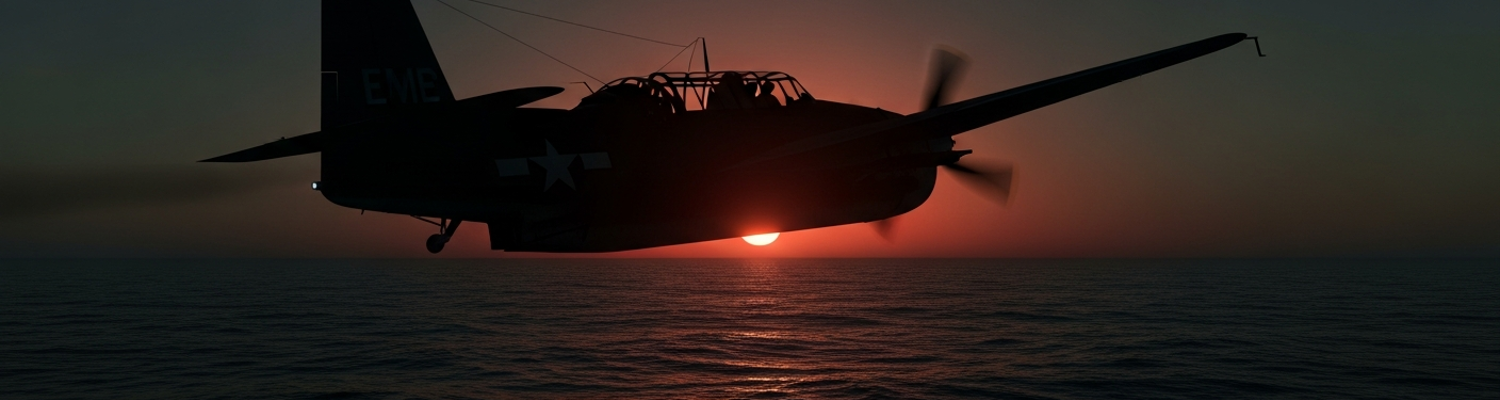

Torpedo Bomber ASW Patrol Peril
The Douglas TBD Devastator was a known liability. Its replacement, the Grumman TBF Avenger, was a rugged, capable aircraft designed for one purpose: carrying the heavy, often dysfunctional Bliss-Leavitt Mark 13 torpedo. Early in the war, these machines, built for attacking surface fleets, were pressed into the grim task of anti-submarine warfare (ASW). The 2,000-pound torpedo was often swapped for depth charges.
The three-man crew, pilot, turret gunner, and radioman-bombardier, flew extended patrols over featureless ocean.
Operational logs show the Avenger was not a purpose-built sub-hunter. It was a compromise. A heavy carrier-based aircraft forced into a role demanding patience and precision its designers had not prioritized. The TBD, already a deathtrap in fleet actions, was an even greater liability in the slow, low-level search patterns required for ASW, a fact underscored by its near-total withdrawal from service after the Battle of Midway.
Finding the enemy was the primary challenge. The main tool for detecting a submerged submarine from the air was the human eye. Crews scanned the water for hours, searching for the faint feather of a periscope wake, a dark shape beneath the waves, or the tell-tale rainbow sheen of an oil slick. Sun glare, cloud shadows, and the texture of the sea surface created a constant stream of false positives. A shadow that caused a crewman’s heart to pound might be a whale or a patch of seaweed.
The technology meant to augment the eyeball was primitive. Early airborne Magnetic Anomaly Detectors (MAD), such as the AN/ASQ-1, were developed to sense the distortion in the Earth’s magnetic field caused by a submarine’s large metal hull. These systems had an extremely short detection range, often no more than a few hundred feet. To register a contact, the Avenger had to fly dangerously low, sometimes less than 200 feet above the water, directly over the submarine. This made the aircraft vulnerable and gave the crew only seconds to react. A MAD-equipped plane was a flying metal detector, sweeping a tiny path across a boundless ocean.
Even with a confirmed contact, the fight was far from over. Ambiguous intelligence and delayed communications turned a difficult task into a nearly impossible one. Patrol sectors were often assigned based on radio intercepts or sighting reports that were hours, or even days, old. A submarine could be anywhere within a large search grid. A crew might receive a garbled radio update about a possible contact, forcing a decision: deviate from their meticulously planned search pattern to investigate a vague report, or hold course and risk letting the enemy escape? These decisions were made in the noisy, vibrating confines of the aircraft, with fuel gauges providing a constant, unforgiving countdown. The Allied victory in the Atlantic owed a great deal to the successful integration of intelligence, particularly ULTRA codebreakers who could provide timely information on U-boat locations. In the sprawling Pacific theater, such cohesion was often a luxury. A torpedo bomber crew returning to their carrier with their depth charges still racked, having spent eight hours seeing nothing but water, was a common and demoralizing event.
Submarine Threat Miscalculation Impact
Allied anti-submarine warfare planners operated under a core assumption. This doctrine, drilled into pilots and aircrew of carrier-based hunter-killer groups, stated that a targeted Japanese submarine would invariably crash-dive to escape. This expectation was based on early-war encounters and a fundamental understanding of submarine vulnerability on the surface. Archival evidence shows a significant, uncommunicated shift in Imperial Japanese Navy tactics beginning in 1943. As Allied air power grew more dominant, certain Japanese submarine commanders concluded that diving merely turned their vessel into a blind, slow-moving target for depth charges. They began augmenting their boats with additional deck-mounted Type 96 25mm anti-aircraft guns.
The choice was made to remain surfaced and fight.
This tactical evolution was not effectively disseminated to the Avenger crews. They continued to fly missions with the expectation that their target would seek refuge beneath the waves, setting the stage for sudden, violent, and often one-sided confrontations. Post-action reports from escort carrier hunter-killer groups detail the consequences of this intelligence failure. An Avenger crew from a unit like Composite Squadron 68 (VC-68), operating from the deck of the USS Anzio, endured hours of mind-numbing monotony. Upon making a MAD contact or a visual sighting, training dictated a specific, methodical approach: a low-level pass to confirm the target and drop depth charges on the swirl left by the submerging vessel.
For crews encountering a surfaced I-boat whose commander had chosen to fight, this carefully rehearsed procedure became a death trap. Instead of a clear run on a disappearing target, the Avenger would fly directly into the teeth of concentrated, close-range anti-aircraft fire. The Type 96 autocannon was lethal at the sub-1,000-meter ranges typical of these attacks. Tracers from multiple gun positions would suddenly reach up, shredding control surfaces and shattering canopies. The Avenger, a heavy and not particularly agile aircraft, was a substantial target in a low, slow attack run. For the crew, the transition from hunter to hunted was instantaneous and absolute, a direct result of tactical intelligence that was dangerously out of date.
This doctrinal blind spot inflicted a profound psychological wound. The terror was not just of combat, but of its complete and shocking unpredictability. An ASW patrol was an exercise in supreme patience, a state of being abruptly shattered by the violent reality of a submarine fighting back. The pilot, focused on lining up his attack, would be confronted with a wall of flak from a target that was supposed to be fleeing. His turret gunner, equipped with a single .50-caliber machine gun, was tasked with suppressing multiple 25mm cannons that were often protected by gun shields. Perhaps most terrifying was the experience of the radioman-bombardier, situated in the ventral position below the bomb bay. He often had no forward or side view of the engagement, experiencing the attack as a series of percussive shocks and the sickening sound of rounds tearing through the fuselage around him. Surviving such an encounter, nursing a crippled aircraft hundreds of miles back to a tiny carrier deck with wounded crewmates, erased any sense of routine. Every subsequent patrol was overlaid with the knowledge that the enemy might not follow the script.
Pacific Rescue Coordination Failures
For a downed aviator or a torpedoed sailor, survival depended on being found. In the Pacific theater, this was a matter of chance, degraded by systemic communication failures. A man in a life raft was a microscopic speck in a fluid battlespace covering over 60 million square miles. Rescue assets, primarily PBY Catalina flying boats and designated lifeguard submarines, relied on a last known position. That position could be rendered useless within minutes by ocean currents, wind, and navigational errors made under combat stress.
Standard-issue survival gear was rudimentary. Sea dye markers created a fleeting patch of color, quickly dispersed by waves. Signal mirrors were useless without direct sunlight and a searching aircraft in the immediate vicinity. The hand-cranked SCR-578 Gibson Girl radio required a survivor to be physically capable of turning the crank and hoisting a long wire antenna via a kite or balloon, a near-impossible task for an injured man. Its 500 kHz signal had a theoretical range of over 200 miles, but this depended on conditions rarely met at sea.
Fleet action records reveal a pattern of communication breakdowns that directly doomed survivors. The Battle of the Philippine Sea in June 1944 provides a stark case study. Following Admiral Marc Mitscher’s decision to launch a strike at extreme range, over 200 U.S. aircraft were dispatched late in the day. As they returned in darkness with fuel tanks running dry, mass ditchings and crash landings became inevitable. Mitscher ordered the fleet to illuminate the carriers to guide the pilots home. While this act saved many, the ensuing rescue operation was chaotic. Reports from multiple aircraft reporting men in the water, often with conflicting or inaccurate coordinates, flooded the radio nets. A pilot’s reported position, based on dead reckoning after a dogfight and a long flight, could be off by dozens of miles. Lifeguard submarines, prepositioned along flight paths, were overwhelmed with conflicting data. PBY crews, dispatched to search large grids based on this faulty information, spent hours scanning empty water while men drifted out of the search area. The sinking of the USS Indianapolis a year later, though not an aircrew incident, stands as the ultimate example of coordination failure. Due to a series of procedural misunderstandings and a failure to report the ship as overdue, no search was initiated for nearly four days.
The delay between a survivable incident and a successful rescue was often a death sentence. A U.S. Navy Bureau of Medicine and Surgery handbook from 1943 makes clear the medical realities. Injuries that would be manageable on land, such as flesh wounds or simple fractures, became lethal in the water. Without prompt medical attention, a wound contaminated by seawater would lead to rampant infection. The most pressing threats were dehydration and exposure. Survivors in rubber rafts, exposed to the relentless sun and saltwater spray, quickly succumbed. The body, deprived of fresh water, would begin to fail, leading to delirium and kidney failure. A man might survive being shot down without a scratch, only to die of thirst three days later. For every two men lost to combat in some parts of the Pacific theater, five were lost to disease and the elements, a ratio that speaks to the hostility of the environment.
Incomplete Hydrographic Data Complications
Pre-war naval intelligence assessments reveal a fundamental environmental threat that complicated the Pacific campaign: the charts were dangerously incomplete. Before the war, detailed hydrographic surveys were a low priority, confined to major commercial ports. Vast expanses of the ocean, including strategically critical areas like the approaches to the Hawaiian Islands and the island chains of the Central Pacific, were represented on naval charts by blank spaces, sometimes marked with the notation 'unsurveyed'. In some sectors, the only available charts were based on 19th-century British Admiralty surveys. The U.S. Coast and Geodetic Survey (USC&GS), the primary agency for this work, was a small organization with a limited budget. The sea floor of the Pacific was, for all practical purposes, an unknown territory.
For naval commanders, these blank spaces on a chart represented areas of absolute risk. They were forced to channel their fleets through predictable, well-surveyed deep-water routes. This restriction of movement was a significant tactical handicap. A carrier task force commander, needing to approach an objective from an unexpected direction, would be gambling a billion-dollar fleet and thousands of lives against the possibility of an unmapped seamount or reef. Archival evidence shows that even in supposedly well-known areas, the danger was present. A 1914 survey of the waters around Hawaii noted numerous uncharted offshore dangers and irregular, rocky bottoms close to shore. This lack of reliable data effectively funneled naval traffic into lanes that could be more easily patrolled by enemy submarines, turning a geographic problem into a tactical vulnerability. A command decision could be tactically brilliant but geologically catastrophic.
The problem of bad data was magnified exponentially during rescue operations. Unrestricted submarine warfare meant a constant stream of sinkings and a need for effective search-and-rescue. The success of any search for survivors depended entirely on two factors: an accurate last known position and a correct prediction of drift. The latter required precise knowledge of local ocean currents, a key component of hydrographic data that was almost entirely absent from wartime charts. Charts might show a broad, seasonal current, but they lacked the granular detail of localized eddies, wind-driven surface currents, or coastal counter-currents. A rescue operation for sailors from a torpedoed ship, or for the crew of a ditched aircraft, would establish a search grid based on the best available information. An unknown current running at just one knot could pull life rafts and men in the water more than twenty-four nautical miles away from the search area in a single day. A PBY Catalina flying a search pattern based on the chart could be searching an area that the survivors had already vacated hours before. This turned the difficult task of spotting a life raft into a near impossibility, a direct consequence of the failure to map the dynamic properties of the water itself.
The Visceral Experience of Doctrinal Failure
The sensory overload inside an Avenger during an attack run was total. The deep, vibrating roar of the 1,900-horsepower Wright R-2600 Twin Cyclone engine shook the airframe. During the attack, this sound was joined by the high-pitched whine of the hydraulics and the sharp chatter of the turret gunner’s .50-caliber machine gun. For the pilot, the visual field was a compression of green water and the intersecting lines of 25mm tracer fire from the submarine’s deck. He fought the controls of an aircraft pilots described as flying like a truck, a stable but unresponsive machine in a situation demanding agility.
The turret gunner, facing backward, experienced the attack as a receding wake and the spectacle of tracers overtaking his aircraft.
The worst position was that of the radioman-bombardier in the ventral tunnel. Confined in a cramped space that smelled of engine oil, cordite, and transmission fluid, he had almost no view of the fight. His reality was auditory and kinetic. The engine roar, frantic intercom reports, and the percussive thumps of enemy shells tearing through the thin aluminum skin around him.
This experience was a direct result of cascading failures. The abysmal performance of early Mark 13 aerial torpedoes demanded a dangerously low and slow attack profile, often below 130 miles per hour, to ensure a successful drop. This procedure, a doctrinal necessity born of technological shortcomings, flew the Avenger directly into the most effective engagement envelope of the Japanese Type 96 25mm cannon. This was a weapon intelligence had failed to report was being used in a new, aggressive surface-defense role. For the three-man crew, this was not a tactical calculation but a visceral, life-or-death contradiction. They were ordered to fly a heavy, un-agile aircraft into a kill box defined by the enemy’s weapon capabilities and their own faulty equipment.
Aircrew memoirs and psychiatric reports from the Pacific theater (NARA Record Group 52) show that this unpredictability was a key driver of what was then termed combat fatigue. A crew returning from a mission where they were ambushed by a surfaced I-boat was fundamentally changed. The eight hours of monotonous searching over empty ocean on the next patrol were no longer boring. They were filled with a tense, hyper-vigilant dread. The men in the back of the aircraft, the gunner and radioman, experienced a unique helplessness. They could only watch as parts of their own aircraft were shredded and streamed past, with no way of knowing if the silent pilot, isolated behind his armor plate, was still alive or slumped over the controls. This feeling of being a passenger in a catastrophe, waiting for a pull-out that might never come, was an experience that repeated in the minds of survivors. The physical separation of the crew compounded the issue. The pilot was alone, the gunner and radioman were together but cut off from the cockpit. After-action reports describe aircraft returning with gun turrets mangled by direct hits and crewmen killed inside, a direct consequence of a plan that treated a fighting submarine like a passive, submerging target.