
This was an arsenal directed at a 25-mile stretch of hostile territory in early 1969. The material expression of American military doctrine was overwhelming. 750-pound general-purpose bombs. M42 dual 40mm self-propelled anti-aircraft guns repurposed for ground fire. 105mm high-explosive artillery rounds delivered from hastily constructed firebases. 2.75-inch rockets fired from helicopter gunships. White phosphorus and napalm. This concentration of industrial firepower assembled in the I Corps Tactical Zone of South Vietnam had a single purpose.
A close review of operational logs (NARA Record Group 127) indicates the primary objective was the disruption of a massive logistical buildup by the People’s Army of Vietnam (PAVN). The operation, codenamed Dewey Canyon, was set to run from January 22 through March 18, 1969. It tasked the 9th Marine Regiment with a sweep of the NVA-dominated A Shau and Song Đa Krông Valleys. Intelligence reports showed a significant increase in enemy activity centered on a logistical hub designated Base Area 611, a node of the Ho Chi Minh Trail that straddled the Laotian border. Reconnaissance had observed extensive road work and truck traffic, sometimes up to 1,000 vehicles a day, moving supplies east toward South Vietnam’s coastal cities. The American command structure authorized a three-phase operation for the 9th Marines: first, to leapfrog into the region and establish a network of mutually supporting fire support bases; second, to conduct intensive patrols to locate enemy forces; and third, to attack south and dismember the supply lines. The stated intent was not to engage a major PAVN force, but to dismantle the system that supplied it.
The entire plan hinged on a formidable engineering problem. For the 9th Marine Regiment’s infantry battalions to push into the objective zone, they first had to cross the Da Krong River. This task fell to the regiment’s attached combat engineers. Their mission was fundamental to the entire operation: enable the movement of heavy assets across the water barrier so the infantry could advance. This meant fording a river under the constant threat of ambush, in terrain completely hostile to heavy machinery. Archival evidence shows that Marine combat engineer battalions in Vietnam were equipped for exactly these types of missions, responsible for road clearance, bridge construction, and mine-sweeping, often while providing their own perimeter security. The plan for Dewey Canyon required the engineers to facilitate the movement of M48 tanks, M109 self-propelled howitzers, and M54 supply trucks deep into an area previously considered a PAVN sanctuary. The physical work involved clearing approach roads, stabilizing the riverbanks, and potentially constructing floating bridges or reinforcing fords, all while exposed to sniper fire and pre-sighted mortars. Every piece of equipment, from bulldozers to pontoons, became a target in a valley where the enemy held the high ground.
American doctrine, reliant on mobility and concentrated firepower, collided with the unforgiving specifics of jungle warfare. The A Shau Valley actively worked to negate every one of those advantages. It was a region of extreme verticality, with mountains rising to 6,000 feet, covered in double- and triple-canopy jungle that hid enemy movement from the air. Constant fog and monsoon rains turned the ground into a morass of mud, making vehicle movement nearly impossible and exhausting foot patrols. For the enlisted engineer, this meant fighting the terrain as much as the enemy. Equipment failed in the suffocating humidity, and the jungle rot that festered on a Marine’s skin also corroded his tools. While American planners focused on destroying a logistical network, the PAVN had turned the environment into a weapon, creating an elaborate defensive system of concealed bunkers, tunnels, and booby-trapped trails. The mission to impose conventional order on the chaotic jungle, starting with a bridge across a river, was an almost perfect microcosm of the entire conflict. NVA fortifications were not just trenches but multi-level tunnel complexes, complete with hospitals and command posts, dug deep into the mountainsides.
The mechanical backbone of command and control for Marine units in the A Shau Valley was the AN/PRC-25 radio transceiver. In theory, this 23.5-pound box of solid-state circuitry was a lifeline, connecting squads to platoons and platoons to the regimental headquarters of the 9th Marines. It provided voice communication across 920 channels and, under ideal conditions, had a range of three to five miles. The A Shau Valley was the physical antithesis of ideal conditions. Engineers, often operating in small, isolated detachments to clear roads or establish bridgeheads, discovered this almost immediately. Archival records and after-action reports detail a catastrophic failure of these communication links. The valley’s signature triple-canopy jungle, where as little as two percent of sunlight reached the ground, was saturated with a humidity that hovered above 90 percent. This moisture was crippling, infiltrating the radio’s handset and corroding its delicate internal components. Worse, the valley itself is a 25-mile-long corridor flanked by mountains soaring up to 6,000 feet, creating a maze of radio shadows. Line-of-sight FM signals from the PRC-25’s standard AT-892 three-foot whip antenna simply slammed into the terrain, rendering them useless. Even with the taller AT-271A 10-foot antenna, which extended range, the dense vegetation and constant fog absorbed and degraded transmissions, making contact with firebases or command posts just a few kilometers away an exercise in futility.
For an engineer detachment tasked with building a bridge or clearing a minefield, this electronic silence was a tactical disaster. Being cut off from the 9th Marine Regiment’s command post, established at Fire Support Base Cunningham, meant losing the ability to coordinate for artillery support from the 12th Marines. It severed their connection to air support and, most critically, to medevac helicopters. A small team of engineers working with heavy equipment became a vulnerable, self-contained island in a valley occupied by an estimated 20,000 PAVN troops. A close review of operational logs from Operation Dewey Canyon reveals that engineer units were often the most exposed. Their work, by its nature loud, stationary, and conducted in predictable locations like river crossings, made them magnets for ambushes and pre-sighted mortar attacks. Without reliable communications, a firefight could not be escalated. There was no calling in suppressive fire, no adjusting artillery, and no efficient way to guide helicopters to a landing zone that might be obscured by the dense jungle canopy. The loss of a single engineer to a booby trap or sniper fire became a crisis that the unit had to handle entirely on its own, from providing immediate medical care to organizing its own perimeter defense against a potential follow-on attack.
This isolation forced a reversion to more primitive methods. Lacking directives from a headquarters they could not reach, engineer non-commissioned officers on the ground had to make command-level decisions. A doctrinal reliance on centrally coordinated fire and movement gave way to brutal pragmatism. Tactical choices were made based on what a sergeant could see with his own eyes. A planned floating bridge might be abandoned in favor of reinforcing a natural ford that offered better fields of fire for self-defense. Road-clearing operations, intended to follow a specific route dictated by operational maps, were rerouted on the spot to avoid terrain deemed too likely to conceal an ambush. Archival evidence shows that Marine engineers became adept at this kind of improvisation, using their C4 explosives not just for demolition but to blast emergency landing zones out of the jungle. They learned to identify and disable North Vietnamese mines that used fishing line and string instead of metal parts, making them invisible to detectors. Lacking the ability to call for support, they provided their own, turning their bulldozers and heavy equipment into makeshift barricades and fighting positions. They organized their own security patrols, relying on immediate observation rather than coordinated intelligence that was failing to reach them.
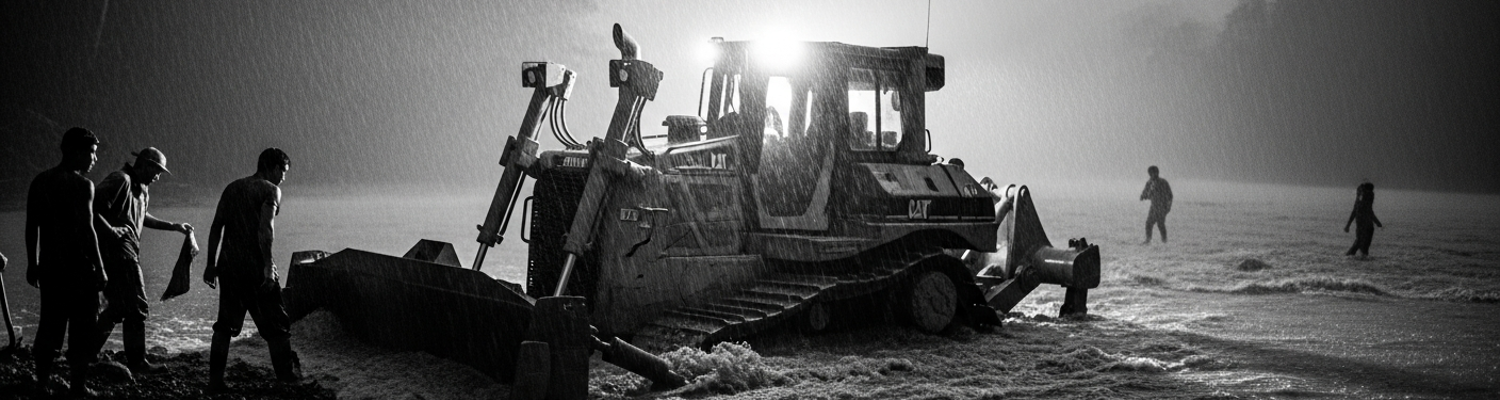
A close review of engineering after-action reports for Operation Dewey Canyon reveals the near-impossibility of constructing standard bridges across the region’s water obstacles. The initial plan for the 9th Marine Regiment’s push south required fording the Da Krong River, a task that proved monumentally difficult. Standard issue M4T6 floating bridge systems, designed for more predictable conditions, were completely inadequate. The river’s current, swollen by monsoon rains, was too swift for engineers to safely anchor pontoon sections. The riverbanks themselves were not solid ground but a treacherous slurry of mud and rock, offering no stable purchase for abutments. The Caterpillar D7E bulldozers, essential for grading approach roads and clearing sites, frequently bogged down in the muck, their engine noise broadcasting the Marines’ location to PAVN artillery observers on the high ground. Every attempt to establish a bridgehead was met with accurate, pre-sighted 82mm mortar and 122mm rocket fire from enemy positions hidden in the surrounding jungle-covered mountains. This turned the bridge construction sites into designated kill zones, forcing a tactical retreat to reliance on natural fords, which were often just as hazardous and created bottlenecks that became magnets for ambushes.
The triple-canopy jungle of the A Shau and Đa Krông Valleys was a physical barrier that exhausted men and negated technological advantages. For the individual Marine engineer, movement itself was a form of combat. Visibility on the valley floor was often reduced to less than ten feet, a perpetual twilight that disoriented patrols and concealed enemy bunkers, spider holes, and booby traps. Movement was not measured in miles per hour, but in agonizingly slow meters. A single platoon could take an entire day to advance a few hundred yards through the tangle of “wait-a-minute” vines, bamboo thickets as dense as walls, and steep, muddy slopes hidden beneath layers of rotting vegetation. The constant rain and suffocating humidity turned the ground into a viscous mud that could pull boots off a Marine’s feet and caked onto uniforms and equipment, adding pounds of useless weight. This environment directly attacked the troops, causing immersion foot, infections, and heat exhaustion while providing perfect cover for the enemy. Archival logs detail numerous instances of squads becoming lost just a short distance from their firebases, swallowed by a uniform and featureless green hell.
This environmental hostility systematically dismantled operational timelines and safety protocols. An engineering task projected to take a few hours, such as clearing a path for tanks or blasting a new landing zone, could stretch into a multi-day ordeal. This extended exposure in a fixed location was a tactical vulnerability. Operational records from the 9th Marines show a constant drain of personnel, not from large-scale battles, but from the steady attrition of sniper fire and ambushes that targeted the slow-moving and loud engineer units. The PAVN had seeded the entire operational area with an array of booby traps, from simple punji stakes to non-metallic “toe-popper” mines that were invisible to detectors and could only be found by painstakingly probing the ground with a bayonet. Safety was further degraded by equipment failure; the pervasive moisture and grit caused bulldozer hydraulics to fail, winch cables to snap, and weapon mechanisms to jam. A D7E bulldozer sliding off a rain-slicked trail on a 45-degree slope was as lethal as an enemy mortar round, and the persistent cloud cover often made helicopter medical evacuation impossible, meaning even a survivable injury could become fatal for an isolated engineer squad.
The fog of war in the A Shau Valley was a physical, soaking wet, and blindingly opaque presence. A review of combat records from Operation Dewey Canyon and similar actions in I Corps reveals a persistent pattern of fratricide incidents, often born from the collision of extreme environmental conditions and the friction of tactical movement. One such event, representative of the dangers faced by engineers, unfolded near a temporary river crossing deep in territory controlled by the People’s Army of Vietnam. An engineer detachment, likely from a company of the 11th Engineer Battalion supporting the 9th Marine Regiment, was tasked with improving a natural ford. Their work was loud and stationary, involving the use of chainsaws to clear fallen trees and the grinding protest of a D7E bulldozer attempting to grade the muddy banks. This noise, while essential to their mission, served as a beacon in the jungle, audible for miles and erasing any element of surprise or security.
This sound drew the attention of a lost Marine infantry patrol. The patrol, a squad from one of the 9th Marines’ battalions, had been maneuvering through the jungle for hours, completely cut off from command. Their AN/PRC-25 radio was useless, its signal swallowed by the combination of triple-canopy jungle and the steep, mountainous terrain that created impenetrable radio shadows. Disoriented by the featureless green landscape and the constant, disorienting fog, they were proceeding on nerve and compass readings alone. When the sound of the bulldozer reached them, their training took over. In their tactical situation, unexpected mechanical noise in a PAVN-dominated area meant one thing: an enemy engineering effort or a supply convoy. They advanced with caution, weapons ready, M16 safeties clicking to semi-automatic. Through the dense foliage and swirling mist, visibility was reduced to less than 20 feet. They saw only indistinct shapes moving near the riverbank, silhouettes that, in the absence of clear identification, were processed as hostile targets.
The first shots were a tragic mistake. A series of single, aimed rounds from the infantry squad who believed they were initiating a well-executed ambush. For the engineers at the river, who were already on edge from the constant threat of sniper and mortar attacks, the crack of incoming rifle fire signaled the very assault they had dreaded. They dropped their tools, grabbed their own M16s, and scrambled for the minimal cover afforded by their heavy equipment. The firefight escalated instantly. The engineers returned fire, their shots directed at muzzle flashes they could barely see in the gloom. The chaotic noise of a multi-sided engagement erupted, with the distinct sounds of M16s and an M60 machine gun from the infantry patrol being answered by the engineers’ own defensive fire. In the confusing acoustics of the valley, there was no way to distinguish the sound of a friendly weapon from an enemy one. The deadly exchange continued for several minutes, a furious, close-range battle between two American units, each convinced they were fighting the North Vietnamese. The incident only ceased when a lull in the firing allowed panicked shouts to be heard and finally understood, the American accents cutting through the deadly confusion. The immediate aftermath was a scene of shock and horror, with Marine casualties inflicted by Marine hands. After-action reports on such events were often terse, but they underscore a brutal lesson of the valley: the environment itself was an active antagonist that created the conditions for such disasters.
In the A Shau and Đa Krông Valleys, doctrine died and was replaced by instinct. The triple-canopy jungle negated nearly every technological advantage held by the 9th Marine Regiment, reducing warfare to its most primitive form: what a man could see, hear, and feel in his immediate surroundings. A close review of after-action reports from Operation Dewey Canyon shows that with visibility often reduced to less than ten feet by terrain and constant fog, survival became a matter of visual acuity at the most granular level. Air reconnaissance was useless, so the individual Marine engineer became the primary sensor. He learned to read the jungle not as a green wall, but as a complex tapestry of threats. His eyes, scanning constantly, were not looking for uniformed soldiers but for a vine that was tied just so, a patch of ground that looked too smooth, or a bamboo frond that was bent at an unnatural angle. This was the signature of a booby trap, often non-metallic “toe-popper” mines or punji stake pits designed to maim rather than kill, which were far more common than direct contact with the enemy. The eye became a tool for detecting minute, man-made alterations to the natural environment, a skill set developed out of sheer necessity when a single misstep could end a Marine’s war.
Sound was a weapon, a tool, and a constant torment. The geography of the valley created a disorienting acoustic environment where sound echoed and distorted. An enlisted man’s life depended on his ability to interpret this chaos. He had to learn the acoustic difference between the deeper, slower report of a PAVN AK-47 and the higher-pitched, faster crack of a friendly M16. This distinction was not academic; firing an enemy weapon could draw friendly fire, while misidentifying the sound of an approaching enemy attack could be fatal. A review of personal accounts highlights the importance of listening for the almost imperceptible thump of a distant 82mm mortar leaving its tube, a sound that offered a few precious seconds to dive for cover before the rounds impacted. The jungle itself was a source of constant noise, a background hum that could mask the approach of an enemy patrol. Survival demanded an almost superhuman focus, learning to filter out the natural sounds of the jungle to isolate the one that meant danger: the snap of a twig that was too deliberate, the rustle of foliage that was out of rhythm with the wind, or the metallic scrape of equipment.
A review of after-action reports from the 11th Engineer Battalion shows that textbook solutions were the first casualty of contact with the A Shau Valley. Standard-issue M4T6 floating bridge systems, designed for orderly crossings with stable banks, proved wholly ineffective against the rain-swollen currents and muddy collapses of the Da Krong riverbanks. The plan, conceived in a rear area, dissolved on contact with the physical ground. The heavy aluminum pontoon sections were difficult to handle and anchor in the swift water, and every attempt to secure the near and far banks with Caterpillar D7E bulldozers was a gamble. The 160-horsepower diesel engines advertised the engineers’ position for miles, drawing immediate and accurate mortar fire from People’s Army of Vietnam spotters on the high ground. These construction sites became pre-designated kill zones.
This forced an on-the-spot evolution of tactics. Non-commissioned officers, cut off from any coherent command by the terrain-blocked radios, made the decisions. A planned multi-span floating bridge was abandoned for the reinforcement of a barely-passable natural ford that offered slightly better cover from enemy fire. The mission was no longer about building a bridge; it was about getting a single tank across a river without being annihilated. Archival evidence shows engineers using their equipment in ways the designers never intended. The two-and-a-half-ton blade of a Rome Plow, designed for jungle clearing, was angled into the mud as a massive piece of mobile cover. Bulldozers were used to build up huge earthen berms around their own hasty defensive positions each night, creating small fortresses in the middle of hostile territory. Explosives intended for demolition were repurposed to blast emergency landing zones out of the jungle for casualty evacuation, an act of creation born from destruction.
The engineers were caught between two distinct, hostile fronts. In front of them were the PAVN forces, who had turned the valley into a fortress. Their tactics included initiating contact at such close range that Marine air and artillery support could not be used without risking friendly fire. But the second front was the environment itself. The jungle was an active enemy that attacked men and machines relentlessly. Monsoon rains turned work sites into mud pits that could swallow a D7 bulldozer, while the extreme humidity and grit caused hydraulic systems to fail and weapons to jam. An engineer detachment could find itself simultaneously suppressed by sniper fire while trying to winch a critical piece of equipment from a ravine it had slid into. This constant, dual threat forced a reliance on non-doctrinal solutions. Lacking reliable mine detectors for non-metallic PAVN traps, engineers learned to probe the ground ahead of their machines with bayonets and long poles, a nerve-shreddingly slow process. When a bulldozer was disabled by a mine, it was not simply abandoned. After-action logs detail mechanics being brought forward under fire to perform field repairs, patching hydraulic lines and armor plates while a perimeter was held against PAVN assaults. These mechanics kept the machines running well past their intended operational limits. Every task, from clearing a path to recovering a damaged vehicle, became a complex combat operation where the engineers provided their own security, made their own tactical decisions, and depended entirely on the Marine in the mud next to them.
The experiences of engineers in the A Shau Valley had a direct, lasting impact on Marine Corps doctrine. The repeated failure of rigid, top-down plans in the face of chaotic ground conditions highlighted the absolute necessity of decentralized command. The war in Vietnam, and intense operations like Dewey Canyon, demonstrated that small unit leaders, the corporals and sergeants on the ground, were often in the best position to make tactical decisions. This experience was a major factor in the post-Vietnam shift towards a philosophy of maneuver warfare, which emphasizes speed, opportunism, and initiative at the lowest possible level. The concept of the “strategic corporal,” a leader empowered to make decisions with operational consequences, has its roots in the lessons learned by isolated units like the engineer detachments in the A Shau. The Marine Corps took the difficult experiences of its enlisted personnel and institutionalized them, recognizing that the ability to adapt and improvise under fire was not a flaw in the plan, but a battlefield capability. This led to the development and formalization of a combined-arms approach where ground, air, and logistics elements are tightly integrated, a direct evolution from the ad-hoc solutions engineers and infantry had to invent to survive.