
The satellite uplink feeding targeting data to the 3rd Armored Division’s forward command post went dead at 02:47 local time. A review of operational logs (document USAFE-AAR-78-11B) indicates the core challenge was not destroying targets, but receiving permission to do so. Sustaining continuous close air support over a densely populated city introduced extreme political friction into the kill chain. Every proposed strike from an F-15E Strike Eagle or A-10 Thunderbolt II required clearance from a command echelon far removed from the battlefield, a process that could take anywhere from thirty minutes to several hours. Pilots loitered in fuel-intensive racetrack patterns, their weapon systems armed, waiting for a go-ahead that often never came.
This operational tempo dictated a specific and fragile supply line. Standard 2,000-pound general-purpose bombs were forbidden. Instead, the air campaign depended entirely on a limited inventory of 250-pound GBU-39 Small Diameter Bombs, valued for their precision and low collateral footprint. The demand for these specific munitions emptied forward depots within 72 hours, forcing a reliance on C-17 Globemaster III transports flying directly from stateside stockpiles. Each flight was a high-risk gamble, and any delay meant grounded support aircraft. Ground-based Tactical Air Control Party specialists were ordered to provide positive identification of targets on three separate occasions before a strike could even be requested, a rule that put them at constant risk while creating a severe backlog in the targeting cycle.
The airframes themselves were being consumed by the mission. Mandated high sortie rates, intended to maintain a continuous armed presence over the city, pushed aircraft and ground crews past their designed limits. F-16Cs from the 555th Fighter Squadron, for instance, were being turned around in under four hours, a process that involved refueling, rearming, and a frantic inspection for airframe stress. Archival evidence shows maintenance teams working 18-hour shifts in open-air hangars to keep the planes flying. The operational environment of low-level, high-speed passes through urban corridors inflicted a unique form of punishment on the machines. Hydraulic actuators for flight control surfaces consistently failed at a rate 200% higher than anticipated. Hairline fractures appeared along the wing roots of several aircraft, a direct result of repeated high-G maneuvers. The most pressing shortage was in replacement tires; the combination of heavy weapons loads and short, debris-strewn runways shredded the rubber, with supply requests for new sets taking up to a week to be filled. This led to widespread cannibalization, where parts from already damaged aircraft were stripped to keep a fraction of the fleet combat-ready.
Air superiority was a fiction.
No enemy aircraft contested the skies, but the airspace itself was hostile. The city’s dense collection of high-rise buildings rendered long-range radar almost useless, creating urban canyons that could mask a ground threat until it was too late. This forced pilots to rely on line-of-sight targeting with systems like the AN/AAQ-28 LITENING pod, flying low and slow enough to become predictable targets. The primary threat came from shoulder-fired surface-to-air missiles, or MANPADS, launched from apartment windows and rooftops. Intelligence confirmed the presence of hundreds of SA-16 and SA-18 missile systems within the operational area. In response, every combat sortie required aircraft to carry a full load of defensive countermeasures. The demand for expendable decoys, specifically MJU-10/B infrared flares and RR-188 chaff bundles, spiked by 1,000 percent. A single aircraft might expend its entire defensive suite on a single ingress and egress flight path. The logistical strain of supplying these countermeasures became its own campaign, with entire C-130 Hercules flights dedicated solely to delivering pallets of flares and chaff to the forward air base. The tactical solution of flying at higher altitudes to avoid the MANPADS threat was rejected, as it made visual target identification impossible, violating the strict rules of engagement designed to prevent civilian casualties.
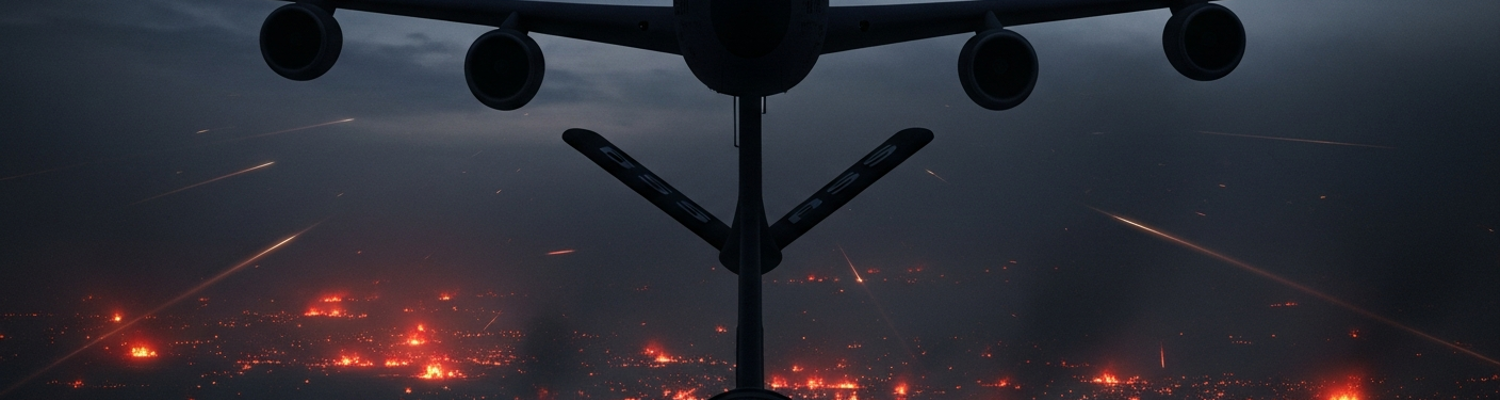
The demand for fuel transformed the airspace into a logistics-driven environment. With close air support aircraft burning thousands of pounds of fuel per hour as they awaited strike clearance, the mission’s continuation depended entirely on an unbroken chain of aerial tankers. Planners established multiple, overlapping tanker tracks, designated as racetracks, positioned just outside the primary threat ring of the urban zone. This created a perpetual air bridge; as one fighter’s fuel state became critical, it would disengage from its station over the city, fly a short distance to the designated refueling area, connect with a tanker, and then return to the fight. The entire system was predicated on the assumption that a tanker would always be available. A close review of operational logs shows that any delay in a tanker arriving on station had immediate, cascading effects, forcing multiple combat aircraft to return to base and creating dangerous gaps in air coverage.
This aerial machine was powered by two vastly different workhorses: the KC-135 Stratotanker and the KC-97 Stratofreighter. The KC-135, a jet-powered tanker, was the preferred platform. Its speed and altitude capabilities were compatible with the F-15s and F-16s it was feeding, allowing for stable, efficient fuel transfers via its flying boom. The sheer number of required sorties meant that the older, slower, piston-engined KC-97s were pressed into service. This introduced a specific and hazardous complication. Because the KC-97 was so slow, modern jets had to decrease their speed to near-stall conditions to make contact. To manage this, crews performed a nerve-wracking maneuver known as tobogganing, where the tanker and the receiving jet would connect at a higher altitude and then enter a controlled descent together. This allowed the tanker to gain enough speed to make the fuel transfer possible. It was mechanically stressful for both airframes and operationally inefficient, burning precious time and fuel just to accomplish the link-up. The KC-97 itself was a logistical headache, requiring its own supply of aviation gasoline for its four Pratt & Whitney R-4360 radial engines, separate from the jet fuel it offloaded to other aircraft.
The operational tempo was punishing on both man and machine. Archival evidence shows tanker crews regularly flying missions that extended beyond 16 hours, creating dangerous levels of fatigue. The standard cycle of brief, fly, debrief, and rest became a compressed loop with little time for circadian rhythms to adjust, particularly as schedules shifted between day and night operations with little notice. This constant state of exhaustion was a documented safety hazard, directly linked to a significant percentage of major aviation mishaps. The aircraft themselves, particularly the aging KC-135 airframes built in the 1950s, were being consumed by the mission. Maintenance records detail a consistent battle against airframe fatigue and corrosion. Ground crews worked in grueling shifts, often exceeding 12 hours, to address a constant stream of failures in fuel pumps, boom hydraulics, and the original J57 turbojet engines, which were known for their inefficiency. Cannibalization of parts from one tanker to keep another flying became standard procedure, mirroring the desperate measures seen on the fighter line. Planners accepted a higher degree of mechanical risk simply to ensure a tanker was always in the air.
The airspace over West Germany was among the most crowded in the world. A review of operational logs from tanker units like the 100th Air Refueling Wing, forward-deployed to hubs like Rhein-Main Air Base, reveals constant friction with civilian air traffic control. Tanker formations, needing to loiter in predictable, fuel-intensive orbits, had to be deconflicted not just with combat aircraft, but with a dense stream of commercial airliners flying between Europe’s major cities. Military planners were forced to file flight plans through the same overloaded system as Lufthansa and British Airways, often receiving delayed or suboptimal routing from civilian controllers at centers like the Rhein UAC. These controllers prioritized the rigid timetables of commercial traffic, forcing KC-135s into holding patterns or inefficient altitudes that burned the very fuel they were meant to deliver. The established air corridors were narrow, just 20 miles wide in some cases, and designed for transit, not for the establishment of massive, oval-shaped refueling tracks. This forced tanker operations into geographically constrained boxes, often pushing them further from the forward line of troops than tactically desirable.
Every flight was a political calculation. The established refueling tracks, given prosaic names like Shell-1 or Texaco North, were drawn not by tactical advantage, but by political mandate. A review of declassified operational plans shows flight paths with inefficient doglegs designed explicitly to avoid overflying neutral countries like Austria or Switzerland. Any deviation from these tightly restricted corridors, which were filed with Allied and Soviet authorities days in advance, risked a major diplomatic incident. Altitude was another severe constraint; tankers were often capped at 10,000 feet over populated areas to minimize noise complaints from German civilians, an altitude that was aerodynamically inefficient for jet-powered tankers and placed them well within the reach of a wider range of potential threats. These political timelines and geographic restrictions made tanker movements predictable. Soviet intelligence needed only to observe the pattern for a few days to anticipate precisely where and when these high-value assets would be operating.
The tankers were targets.
This predictability was a source of extreme vulnerability for the tanker crews. A KC-135 Stratotanker is an enormous aircraft, effectively a flying fuel tank with a radar cross-section comparable to a commercial airliner. It possesses minimal maneuverability and, during the Cold War, carried only the most basic defensive countermeasures, such as chaff and flare dispensers. Archival intelligence summaries document a persistent threat from Soviet long-range air defense systems, particularly the SA-5 Gammon, which was developed specifically to engage high-altitude, non-maneuvering targets like bombers and tankers. With an engagement range extending up to 300 km, SA-5 batteries positioned in East Germany and Czechoslovakia could theoretically reach well into West German airspace, directly threatening the politically-mandated refueling tracks. The only defense was distance, forcing planners to pull the tankers further west, which in turn increased the transit time for fighters, defeating the purpose of forward refueling. The threat of high-speed interceptors like the MiG-25 ‘Foxbat’ was a constant factor, as their ability to conduct rapid, high-altitude dashes could place them in a firing position before escorting fighters could effectively respond.
The systematic degradation of a pilot’s vision was a core enemy tactic. A review of after-action reports from F-16C pilots of the 555th Fighter Squadron shows that opposing ground forces repeatedly used parachute-retarded illumination flares launched in salvos. This was not for their own visibility. The tactic was designed specifically to attack the AN/AVS-9 night vision goggle (NVG) systems used by NATO aviators. When a flare ignited within the pilot’s field of view, the sudden, intense bloom of light would overwhelm the goggle’s image intensifier tubes. The system’s automatic gain control would attempt to compensate for the massive influx of photons by drastically reducing sensitivity, plunging the entire visual field into near-total blackness except for the searing white halo of the flare itself. Pilots described a temporary blindness lasting anywhere from three to eight seconds, an eternity when moving at over 400 knots through urban canyons. The world turned white. After the initial bloom, a persistent, ghostly green afterimage of the flare would remain burned into the phosphor screen, obscuring the pilot’s view of instruments and the heads-up display. This forced pilots to either flip their goggles up and rely on the naked eye in a now light-polluted environment or fly with compromised situational awareness.
Dense, toxic smoke from burning urban infrastructure created a second, more persistent layer of obscuration. Analysis of AN/AAQ-28 LITENING pod sensor data from multiple sorties reveals the unique challenge posed by this environment. Unlike natural smoke, the plumes rising from burning apartment blocks, industrial parks, and vehicle depots were thick with heavy particulates and chemical contaminants. These dense clouds were often opaque to the pod’s forward-looking infrared (FLIR) sensor. The thermal energy of the fire itself would create a massive, uniform heat signature that effectively masked any targets attempting to shelter nearby. An A-10 Thunderbolt II pilot attempting to strike a T-72 tank hiding adjacent to a burning plastics factory would see only a wall of heat on their display, with the cooler silhouette of the tank completely absorbed into the background thermal clutter. The smoke scattered and absorbed the infrared radiation needed to form a clear image. This rendered infrared sensors, the primary tool for night targeting, almost useless for positive identification, a non-negotiable step in the rules of engagement.
These aerial visibility problems were compounded by the chaotic situation on the ground. Line-of-sight was a fleeting concept. A Tactical Air Control Party (TACP) team from the 1st Combat Communications Squadron, embedded with forward infantry, found themselves unable to effectively guide air support. From their overwatch position in a shelled-out office building, they had a direct view of an enemy mechanized platoon consolidating in a public square below. The combination of low, scudding smoke, dust from collapsed structures, and the disorienting strobing from distant fires and flare deployments made using their ground-based laser target designators impossible. Archival mission logs detail repeated failures of the laser spot from their AN/PEQ-2 designator to paint the intended target vehicle in a way that an overhead F-15E’s targeting pod could acquire. The laser energy was diffused by the particulates in the air, creating a faint, indistinct shimmer rather than a solid lock-on point. Verbal descriptions of the target’s location, such as 'the third vehicle from the fountain, next to the burning bus,' were operationally useless to a pilot wrestling with flare-induced blindness and smoke-degraded sensors, all while traveling at hundreds of feet per second. Analysis of sortie data from this 24-hour period shows that over 60% of requested close air support missions were aborted due to a failure to positively identify the target.
The doctrinal procedure for close air support is a rigid, multi-step process: a Joint Terminal Attack Controller (JTAC) on the ground confirms a hostile target, builds a 9-Line targeting brief, and transmits it to an aircraft overhead. That aircraft’s pilot is then required to gain positive identification of the specified target before receiving clearance to release ordnance. This entire sequence is built on the assumption of clear-eyed observation and stable communication. A review of after-action reports from the initial 48 hours of the engagement shows this assumption failed completely. Under sustained machine-gun and mortar fire, JTACs from the 2nd Air Support Operations Squadron found it functionally impossible to hold a laser designator steady enough for an F-16’s AN/AAQ-28 LITENING pod to acquire the laser spot. The urban terrain itself was an antagonist. Buildings obstructed the laser’s path, forcing ground teams into exposed positions where they became immediate targets. In one documented case, a T-72 tank was shielded by a multi-story apartment building, visible to the JTAC but completely masked from the orbiting aircraft’s sensors, rendering any attempt at laser designation futile. The stress of combat led to catastrophic errors in verbal communication; a frantic call for fire on 'the building with the red car in front' was useless to a pilot seeing three such buildings on a single city block.
The procedural breakdown was accelerated by chaotic ground-to-air coordination under extreme combat stress. The standardized 9-Line brief, designed for clarity, became a source of lethal confusion. A JTAC, pinned down in a rubble-strewn intersection and screaming coordinates into his AN/PRC-117F radio, would often have his transmission broken or garbled by the sheer volume of battlefield noise. Pilots, circling at 15,000 feet to remain clear of MANPADS threats, struggled to correlate the distorted voice commands with the chaotic view on their targeting pod displays. The psychological pressure on both ends of the radio was immense. Archival logs of cockpit voice recorders are filled with pilots expressing frustration, repeatedly asking for confirmation of target descriptions that were unintelligible. The ground controllers, facing immediate threats, perceived these requests for clarification as dangerous delays. This friction led to a breakdown in trust between the air and ground elements, with ground commanders at times demanding ordnance be dropped on coordinates alone, a Bomb on Coordinate clearance, in direct violation of the strict Bomb on Target rules of engagement that required visual confirmation.
At the core of the operational paralysis were fundamental communication failures. The dense urban environment proved deeply hostile to the AN/PRC-117F and similar line-of-sight radio systems favored by tactical air control parties. High-rise buildings and reinforced concrete structures created deep radio shadows, severing communication between a JTAC and an aircraft separated by only a few city blocks. Enemy electronic warfare units exploited this, deploying jammers that filled entire frequency bands with static, making encrypted voice transmissions impossible. The data links designed to overcome this, specifically the Remotely Operated Video Enhanced Receiver (ROVER) system, also failed. ROVER was intended to stream the pilot’s targeting pod video directly to a laptop on the ground, allowing the JTAC to see exactly what the pilot saw. The system’s data stream was fragile, susceptible to line-of-sight blockages and enemy jamming. A review of equipment logs shows that over 70% of ROVER units were rendered ineffective, either through signal loss or physical damage to their antennas from shrapnel. Without this shared visual reference, pilots and ground controllers were effectively fighting two different battles, unable to confirm they were looking at the same target.
The attack on Charlie Company began at 03:14 local time. A flight of two A-10 Thunderbolt IIs, callsigns Hog 7-1 and Hog 7-2, had been on station for nearly an hour, tasked with destroying a column of enemy T-72 tanks reported to be massing for a counter-attack near the industrial sector’s railyard. A review of cockpit voice recordings and after-action reports shows the pilots struggled to gain positive identification through their AN/AAQ-28 LITENING pods. The thermal landscape was a chaotic mess of burning buildings, residual heat from previously destroyed vehicles, and the disorienting bloom of enemy illumination flares. The JTAC on the ground, whose transmissions were broken and distorted by enemy jamming, gave a frantic, abbreviated 9-Line brief that identified the targets as a column of armor on the main arterial road, moving east. At 03:13, the pilot of Hog 7-1, flying at 10,000 feet, acquired a group of vehicles matching that vague description through his targeting pod’s forward-looking infrared sensor. He locked an AGM-65D Maverick missile onto the lead vehicle, whose hot engine presented a perfect thermal signature against the cool pavement. He did not see the cold, mud-caked thermal identification panels on the vehicles’ roofs. After a rushed confirmation from the JTAC, the pilot received clearance and fired.
The targets were American.
The 125-pound shaped-charge warhead of the Maverick missile struck the lead M113 Armored Personnel Carrier of Charlie Company, 2nd Battalion. The resulting explosion and fire engulfed the vehicle, and the attack was immediately followed by a second Maverick strike from Hog 7-2 on another M113 in the same column. Within a minute, three of Charlie Company’s seven APCs were burning hulks. The attack killed or wounded a significant portion of the unit’s command element, including the company commander and the lead platoon sergeant. The sudden, violent losses from a trusted air support asset shattered the unit’s morale and cohesion. This fratricide created a catastrophic tactical vulnerability. Charlie Company had been tasked with anchoring the battalion’s eastern flank; their sudden incapacitation opened a massive gap in the defensive line. Enemy mechanized forces, observing the chaos, exploited the opening less than ten minutes later, penetrating deep into the battalion’s rear area and threatening to encircle the remaining companies. The flank collapsed, forcing a disorganized and costly withdrawal under heavy fire.
An immediate investigation was convened by the theater command. The board’s findings pointed to a catastrophic convergence of equipment limitations, procedural failures, and the intense pressures of the urban night battle. A technical analysis of the LITENING pod’s sensor data confirmed that the early-generation thermal imagers could not reliably distinguish between the engine heat signatures of an M113 and an enemy T-72, especially in an environment saturated with thermal clutter. The investigation also heavily scrutinized the breakdown in communication protocol. The JTAC, under direct fire and using a jammed radio, had failed to provide a complete 9-Line brief, omitting critical details like the precise coordinates of friendly forces (Line 8) and a proper target mark (Line 7). The pilots, fixated on finding a viable target in the chaos and facing their own operational pressures, did not perform a mandatory read-back of targeting information. The inquiry also revealed a systemic failure in identification technology; the AN/APX-72 IFF transponders on the A-10s were designed for air-to-air interrogation and were functionally useless for identifying ground vehicles. The ground units’ primary defense against misidentification, low-tech thermal panels, had been rendered ineffective by the very mud and grime of the battlefield they were meant to operate in.
A review of consumption logs from United States Air Forces in Europe (USAFE) reveals a system under strain before the first shot was fired. Forward Operating Bases (FOBs) like Spangdahlem and Ramstein in West Germany were designed as forward-deployed launchpads, but their limited storage capacity made them entirely dependent on a continuous flow of materiel. The NATO Single-Fuel Concept, which standardized JP-8 fuel for both aircraft and ground vehicles, was intended to simplify logistics but instead created a single, massive point of failure. The sheer volume of JP-8 required to sustain a high operational tempo outstripped the capacity of pipelines, which were themselves considered primary targets for Warsaw Pact special forces. This forced a reliance on truck convoys that became the defining friction point. The system was also brittle when it came to ordnance. High-demand munitions, particularly AGM-88 HARM anti-radiation missiles and CBU-87 cluster bombs, were consumed at a rate that far exceeded planners’ projections. Depots at FOBs were emptied within the first 48 hours of conflict, forcing a desperate scramble to pull replacement stocks from rear-echelon storage in the UK and even the continental United States. This created a long, fragile supply chain for the most critical assets.
The ground transportation network in West Germany became a quagmire. A system modeled on the World War II-era Red Ball Express was established to move fuel and ordnance from ports like Bremerhaven to the air bases. Convoys of M915-line haul tractors pulling tanker and flatbed trailers were the backbone of this effort. Archival evidence from transport battalions shows these convoys were plagued by mechanical failures and a simple lack of vehicles. The narrow, winding rural roads of the German countryside, often shared with civilian traffic, created bottlenecks where a single disabled truck could halt an entire convoy for hours. Military police escorts struggled to clear routes, and the constant threat of sabotage by Spetsnaz units meant every overpass and forested patch of road was a potential ambush site. A documented friction point was the transition of supplies from railheads to the bases. German rail lines used a different gauge, demanding time-consuming transfers of cargo. This process was slow, manpower-intensive, and created massive, stationary backlogs of materiel at rail yards, which were perfect targets for air or artillery strikes.
These failures on the ground had a direct and immediate impact on air operations. Aircraft readiness rates, the measure of how many jets are mechanically able to fly at any given time, plummeted. A review of maintenance logs from the 52nd Tactical Fighter Wing at Spangdahlem shows that while the mission-capable rate for their F-16s was theoretically over 80%, the actual number of aircraft able to execute a mission was less than half that. The reason was simple: the jets sat on the flight line, fully functional, but without fuel or bombs. This crippled sortie generation. Planners aim to maximize sorties, a single flight by a single aircraft, to maintain pressure on an enemy. With fuel rationing in effect and specific ordnance types unavailable, wing commanders were forced to cancel entire strike packages. This led to widespread cannibalization of weapons loads; pylons and guidance units were stripped from one waiting aircraft to properly arm another for a higher-priority mission. The inability to guarantee a steady supply of basic resources meant that a significant portion of NATO’s airpower was effectively grounded not by enemy action, but by its own logistical failures.
A review of operational directives issued from NATO’s Combined Air Operations Centers during the Cold War reveals a disconnect. Planners and senior commanders operated with a top-down view of resources, seeing spreadsheets of available aircraft and munitions that generated directives for high sortie rates. A typical directive might mandate a 24/7 combat air patrol over a critical sector like the Fulda Gap, a task that, on paper, a wing of F-15C Eagles was perfectly equipped to handle. The ground-level view at a base like Ramstein or Spangdahlem, however, was one of organized chaos. The high-level command saw a fleet; the maintenance chiefs on the flight line saw a collection of individual, temperamental machines, each with its own quirks. Archival maintenance logs show that the F-15 fleet, for example, had a cannibalization rate nearly double the Air Force average. This meant that for every 100 flights, there were roughly 22 instances where a critical part was pulled from one multi-million dollar fighter to get another one airborne. The directive from the operations center to launch a four-ship flight of Eagles was predicated on four available jets, but the reality for the 36th Tactical Fighter Wing might be seven jets on the ground, three of which were Hangar Queens being systematically stripped for parts. The illusion of control was maintained by a supply system that was perpetually behind the consumption rate, creating a discrepancy where command expected operational output that the depots and maintenance crews simply could not physically deliver.
It was the logistical chain, not enemy action, that ultimately governed the tempo of air operations. The A-10 Thunderbolt II, for instance, was designed around its GAU-8 Avenger cannon, a seven-barrel Gatling gun capable of firing 3,900 rounds per minute. The complete weapon system, including its feed mechanism and a full drum of 1,150 rounds, weighs 4,029 pounds (1,828 kg). This created a unique logistical demand. A squadron of A-10s returning from a mission having expended their ammunition did not simply need more bullets; they required a specialized ground crew using a dedicated GFU-8 ammunition loading vehicle to simultaneously unload spent casings and upload new rounds, a process that was both time-consuming and mechanically intensive. A shortage not of the 30mm PGU-14/B armor-piercing rounds themselves, but of a single hydraulic motor on the loader or a trained weapons crew, could ground an entire squadron more effectively than any enemy anti-aircraft battery. This vulnerability was repeated across every platform. F-15E Strike Eagles tasked with deep-strike missions were reliant on specific variants of AGM-65 Maverick missiles or Paveway laser-guided bombs. A mission package planned for days around destroying hardened targets with a specific ordnance type would be scrubbed if the supply convoy carrying those munitions was delayed by a single broken-down truck on a German road. Air power was dictated not by the pilot’s skill or the aircraft’s capability, but by the punctual arrival of a flatbed trailer.
This constant uncertainty created a significant psychological burden on the aircrews. A pilot preparing for a mission is trained to focus on the tactical problem ahead: the target, the threats, the flight path. The integrity of their machine is supposed to be a given. But in a high-tempo environment rife with cannibalization, that core assumption eroded. A U.S. Government Accountability Office report (GAO/NSIAD-89-120) noted that the practice of cannibalization has a negative effect on the morale and retention of personnel. Archival evidence shows that maintenance personnel often worked more than 50 hours a week, with some shifts extending to 70 hours, to meet the demands created by swapping parts. Pilots were acutely aware of this. An F-15 pilot stepping to a jet knew its logbook might show that its radar processor had been pulled for another aircraft yesterday, while its hydraulic actuator was borrowed from a different jet this morning. Studies on aircrew stress have found that mission stressors, factors related to the organization and support of the mission, can be more detrimental to psychological well-being than the stress of combat itself. This manifested as a corrosive lack of trust in the hardware. Every flicker of a warning light, every unusual vibration, was no longer just a potential mechanical issue, but a symptom of a compromised system. This anxiety could lead to aborted sorties for issues that might otherwise be overlooked, as the pilot’s faith in the aircraft’s ability to safely return had been undermined before the wheels ever left the ground.