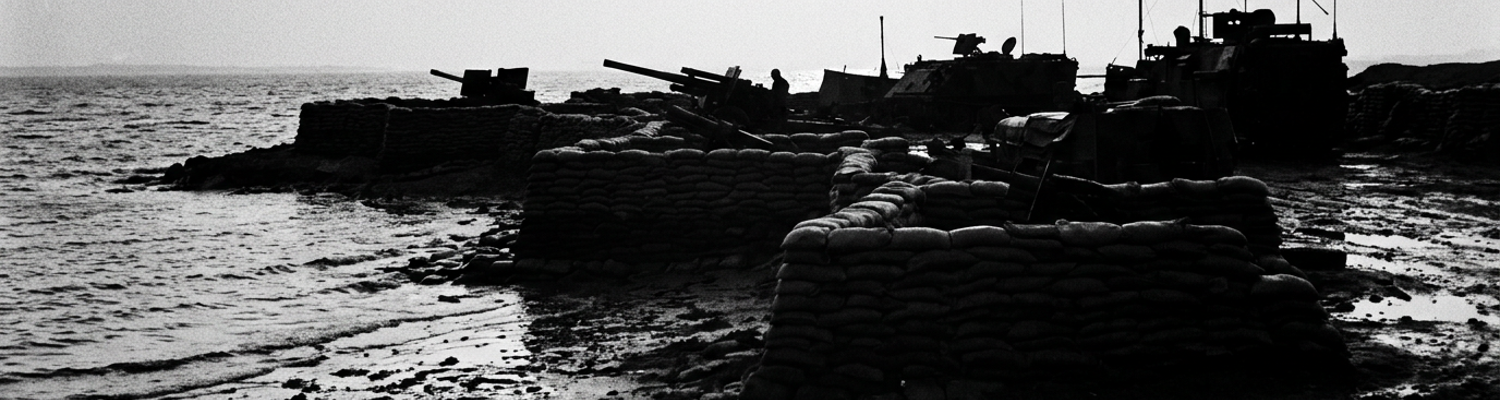

Forward Revetment Construction and Tidal Excavation
Between November 1950 and July 1953, United Nations air forces lost 1,041 aircraft over the Korean theater. Hundreds of downed aviators stranded in hostile territory faced rescue probabilities that decayed past eighty percent within three hours of ejection. Chodo Island sat barely ten miles off the communist-held Hwanghae Province shoreline at coordinates 38 degrees 32 minutes North by 124 degrees 46 minutes East. Establishing an advanced operating post this close to MiG Alley eliminated lengthy flight legs from southern bases like Taegu. The island offered zero level land on its steep interior ridges. Detachment 1 of the 3rd Air Rescue Group established operational staging revetments on exposed tidal flats along the eastern shoreline directly facing mainland coastal positions. Daily Yellow Sea tidal swings exceeded twenty-nine feet. This cycle repeatedly transformed the landing zones into impassable quagmires of gray clay. Thick coastal mud swallowed heavy equipment instantly. Flight mechanics and forward engineers anchored timber logs, crushed granite, and interlocking pierced steel planking onto the unstable sandbar before any aircraft could touch down.
Saltwater submerged the perimeter tie-down anchors twice every twenty-four hours.
Archival evidence shows that manual revetment excavation fell almost entirely to indigenous partisan fighters attached to United Nations Partisan Infantry Korea. Identified in military reports as Donkey units (NARA Record Group 338), these anti-communist North Korean guerrillas used hand shovels, rusted picks, and woven straw baskets to throw up protective earthen parapets across the tidal flats. Coastal artillery batteries concealed across the water at Cape Amgak targeted the revetment works systematically. Direct hits from 76mm and 85mm guns blasted through the soft earthworks. These strikes showered work parties with wet gravel and collapsed unreinforced trench walls before the mud could settle. Partisan excavation details shifted their shoveling to nocturnal low-tide windows to defeat mainland optical rangefinders. Guerrillas drove pine cribbing into the mud base and layered the exterior with heavy stones to construct blast walls. These barriers prevented shrapnel from slicing into parked aircraft while freezing winds baked the wet dirt into hard crusts.
Splintered steel fragments punctured four unshielded fuel drums along the tide line during the initial week of December.
A close review of operational logs indicates that flight commanders could not gather their rescue aircraft in a unified holding area without inviting catastrophic losses from mainland forward observers. Sikorsky H-5 and H-19 helicopters required constant dispersal across rudimentary beach revetments to avoid artillery strikes. Ground mechanics rolled four-ton H-19 Chickasaws over greasy metal matting by hand. They hid individual machines inside separated horseshoe-shaped mud enclosures spaced hundreds of yards apart on the sand. Thin magnesium skins and exposed rotor hubs made both helicopter models exceptionally vulnerable to tiny metallic flecks kicked up by near misses. Corrosive salt spray blowing off the waves deposited alkaline residue onto the Pratt and Whitney R-1340 and Wright R-1300 radial powerplants. This buildup gummed up control linkages and demanded continuous freshwater rinses hauled by hand from inland wells. Whenever mainland spotting rounds bracketed a specific sector, maintenance crews pushed the rotary aircraft out of the mud pens toward secondary alcoves cut directly into rocky sea bluffs.
Flight records from early 1952 list twenty-seven separate emergency relocations executed solely to shift parked airframes out of active artillery brackets.
Maritime Supply Vulnerabilities and Shallow Water Transport
Sustaining the forward garrison at Chodo Island required an ongoing contest between naval improvisation and raw physical geography. Archival evidence shows that Task Unit 95.1.2 operated through an uneven patchwork of deep-water amphibious assets and commandeered civilian vessels. Landing Ship Tanks, primarily shallow-draft vessels like LST-799 and LST-883, pushed north from the intermediate supply depots at Sasebo and Incheon carrying heavy cargo. Their forty-foot beam and loaded drafts exceeding eleven feet prevented direct approaches to the eastern mud flats. Navy handlers discharged hundreds of 55-gallon drums of 100/130-octane aviation fuel, crated Pratt and Whitney radial engine parts, and radio crystals onto unarmored, flat-bottomed wooden junk boats requisitioned from local Korean fishermen. These civilian watercraft lacked radio gear and relied on worn-out single-cylinder diesel engines that cracked cylinder heads after four or five passages across the open roadstead. West-coast sea chop threw ocean spray over open holds. This soaked dry provisions and short-circuited electrical harnesses bound for the 607th Aircraft Control and Warning Squadron. Beach parties spent twelve hours a day stripping salt crust from ignition harnesses. Sea spray repeatedly seeped through damaged canvas tarpaulins.
Two loaded junks foundered on submerged sandbars during a single December gale.
When examining the historical record of Task Force 95, extreme Yellow Sea tidal variations dictated every offloading attempt with punishing precision. Spring tides along the Hwanghae coastline receded at rates up to five vertical feet per hour. This created thirty-foot differences between high-water marks and the low-tide mud boundary. Shallow-draft LSTs and heavily burdened wooden lighters attempting to discharge freight on falling water routinely ran aground on the soft grey silt three hundred yards short of the island rock shelf. Heavy steel keels carved deep trenches into the muck. This trapped vessels on their sides for up to seven hours until the flood tide returned. Communist coastal artillery detachments positioned on the high ridgelines of Cape Amgak possessed direct optical range data covering these exposed shoals. Spotters directed continuous harassment fire with Soviet-supplied 76mm divisional guns and 85mm coastal batteries whenever a vessel sat stranded on the exposed mudbanks. Shifting winds prevented partisan smoke units from blinding mainland spotters. Naval crews hauled winch cables through thigh-deep mud as fragmentation shells detonated along the waterline.
Shrapnel punched thirty-two holes in the thin hull plates of an immobilized barge on 14 January 1952.
Adaptation under these conditions reflected a persistent belief that basic engineering could overcome geographic isolation. A close review of operational logs indicates that the physical survival of the base rested on stabilizing the saturated coastal soil against daily shelling and wave action. Revetment construction demanded thousands of board-feet of dense timber shoring to retain the shifting sand ramparts guarding the helicopter flight lines. Theater distribution priorities in Pusan routed heavy dimensional lumber exclusively to main-line defensive positions along the 38th parallel. Chodo received less than twenty percent of its requested ten-by-ten-inch treated pine timbers during the winter of 1951. Deprived of heavy retaining wood, Donkey guerrilla units constructed revetment bulkheads using thin local saplings, woven rice bags, and loose beach shale. Saturated sand exerted crushing hydraulic pressure on these unreinforced barriers. Outer revetment walls buckled and slid directly onto the dirt parking pads. Silt slumps buried maintenance tools, contaminated open rotor gearboxes, and punctured temporary fuel bladders. Ground mechanics regularly shoveled forty tons of wet sediment away from trapped landing gear before engineers could reinforce the compromised timber bulkheads with scavenged ammunition crates.
Eighth Army supply manifests from February 1952 confirm that three consecutive shipments of heavy pine timbers were canceled at Incheon to make room for 105mm artillery shells.
Aviation Fuel Drum Handling and Rotorcraft Maintenance
Archival evidence shows that every gallon of high-octane fuel consumed by Detachment 1 reached the aircraft solely through direct physical strain. Unarmored supply junks and LCMs grounded on the Yellow Sea mud shelves hundreds of yards offshore. Flight mechanics and Korean service troops rolled standard 55-gallon steel drums directly through the freezing intertidal silt. Each liquid-filled container weighed roughly four hundred and twenty pounds. Men sank past their calves into the anaerobic gray slime. They pushed the cylinders horizontally against receding tidal suction before high water returned to swallow the shoals. Salt deposits and grit caked the drum surfaces, threatening to compromise the rubber gaskets sealing the threaded steel bungs. Ground crews wiped the caps with rags soaked in clean solvent. They tested every drum using color-changing water-indicating paste on dipsticks before threading hand-cranked rotary wobble pumps into the access ports. Drawing contaminated fuel meant instant engine failure over communist waters. Handlers passed the volatile 100/130-octane gasoline through chamois-skin funnels to filter out suspended silt particles and ocean moisture before pouring it into H-5 Dragonfly tanks.
Five men required ninety minutes of sustained physical effort to roll a single drum up the low-tide incline.
When examining the historical record of rotary-wing operations along the Hwanghae coast, mechanical degradation occurred at rates far exceeding normal wear intervals. Rotor blade assemblies faced constant bombardment from windblown beach grit and saline sea fog driven across the revetments by forty-knot Siberian gusts. High tip speeds turned airborne quartz sand into an abrasive agent. This ground away protective paint coats on the Sikorsky main rotor blades within thirty operating hours. Bare metal along the leading edges pitted under the assault, disrupting the thin aerodynamic boundary layers needed to produce steady vertical lift. Magnesium alloy fuselage panels on the newer H-19 Chickasaws (serial number 51-3856) suffered severe galvanic corrosion wherever salt spray penetrated the seams around inspection doors and structural hardpoints. Swelling corrosion products jammed the pitch-change links, swashplate bearings, and rotor head flapping hinges. Survival of the aircraft depended on non-stop maintenance interventions. Flight technicians hauled five-gallon jerrycans of scarce inland well water down to the revetments to wash salt crust from the rotor heads twice daily. They hand-polished pitted aluminum blade skins with fine emery paper and applied fresh coats of zinc chromate primer under canvas tarps.
A single sandstorm pitted eight rotor blades beyond field-repair tolerances on 18 March 1952.
A close review of operational logs indicates that the mechanics sustained operational flight status by executing complete radial powerplant overhauls inside unroofed, hand-dug dirt pits. Chodo lacked steel hangars, heavy machine shops, or overhead gantry cranes capable of hoisting one-ton Pratt and Whitney R-1340 and Wright R-1300 engines out of the airframes. Detachment personnel adapted by positioning the nose of an H-19 directly above a revetment trench reinforced with scrap timbers. This allowed mechanics to stand beneath the forward-slanted powerplant bay. Ground crews erected crude three-legged wooden A-frames from scavenged telegraph poles. They ran rope-slung block-and-tackle gear to lower cracked crankcase housings and six-hundred-pound engine blocks directly into the soil depression. Wind constantly blew fine coastal dust across open rocker boxes. Mechanics draped greasy wool blankets over exposed internal gears while unbolting damaged cylinder barrels. Working in sub-zero winter temperatures, technicians discarded their heavy flight mittens to thread delicate exhaust valve retainers and calibrate valve clearances with feeler gauges using bare, numb fingers. Damaged cylinder jugs were unbolted individually, carried by hand to wooden workbenches braced against the revetment walls, and rebuilt with spare piston rings salvaged from downed aircraft before being winched back into place.
Maintenance crews completed three full engine swaps inside the open earthen trenches during the final week of April.
Distress Monitoring and Radio Network Operations
Archival evidence shows that radio operators from the 607th Aircraft Control and Warning Squadron monitored distress traffic from sandbagged bunkers perched along the highest ridge of the island. Operating within direct line of sight of the North Korean coast, technicians tracked downed pilot emergency transmitters across MiG Alley using SCR-399 mobile radio sets and AN/GRC-9 transmitters. The SCR-399, housed inside an uninsulated HO-17 wood-and-metal shelter, relied on a high-output BC-610 transmitter that generated up to four hundred watts across high-frequency bands. Specialists constantly adjusted BC-312 and BC-342 receiver dials to pull faint Morse code signals and intermittent voice Mayday calls through communist electronic jamming. Aviators bailed out between the Yalu and Chongchon rivers. Their battery-powered survival sets broadcast weak, line-of-sight distress pulses that barely cleared mainland ridgelines. Operators on Chodo triangulated these emergency transmissions, cross-referencing directional bearings with radar plots from the AN/TPS-1B search antenna to fix water crash sites before pilots succumbed to hypothermia. Portable AN/GRC-9 units functioned as secondary backup systems. These operated on low-power continuous wave frequencies to patch recovery vectors directly down to rescue amphibians idling off the coast.
Corrosive marine mist degraded signal strength before messages reached the rescue craft.
When examining the historical record of island signal detachments, tactical communication networks relied on temperamental PE-75 gasoline generators prone to salt fouling. These 2.5-kilowatt power units ran on single-cylinder Briggs and Stratton four-stroke engines that ingested moisture-laden air blowing off the Yellow Sea. Salt crystals formed thick crusts across carburetor intake throats, clogging delicate fuel jets and choking off the air-fuel mixture within three operating hours. Fine ocean brine penetrated unsealed magneto housings. This created conductive paths that shorted ignition points and killed spark delivery to the Champion spark plugs. Ground crews struggled to keep the generator output steady at 115 volts alternating current. Erratic engine revolutions per minute caused severe frequency drifts across the BC-610 transmitter stages. Voltage drops repeatedly tripped circuit breakers during active rescue sorties. This cut radio links precisely as pilots descended under parachutes into coastal waters. Power mechanics operated on continuous eight-hour shifts, scrubbing corroded copper windings with wire brushes and soaking gummed carburetor jets in scarce aviation fuel to restore erratic electrical current.
Technicians burned through forty replacement spark plugs every forty-eight hours.
A close review of operational logs indicates that chronic shortages of dry cell radio batteries degraded communications between forward beach revetments and island command. Forward lookouts guarding the Sikorsky H-5 and H-19 dispersal pens depended on portable SCR-300 and BC-1000 backpack transceivers powered by BA-70 or BA-270/U dry cell packs. Sub-zero winter temperatures along the Hwanghae coast caused the chemical electrolyte inside these zinc-carbon dry cells to freeze. This slashed operational battery life from twenty hours down to ninety minutes. Replacement batteries rarely arrived on schedule because incoming supply junks prioritized 100-octane aviation fuel and artillery rounds over small-arms signal stores. Beach lookouts frequently lost all radio contact with the radar operations bunker atop the 800-foot ridge. Coastal gun positions remained unaware of incoming communist night raids or low-flying YAK-9 fighters. Revetment crews attempted to revive dead dry cells by baking them on top of oil-drum space heaters or packing them inside their wool coats against their chests. Heat treatments failed to restore chemical voltage. Lookouts ran hand-cranked generators until bearings seized from abrasive beach sand.
Partisan runners carried hand-scrawled signal manifests between the tidal revetments and command bunkers when dead cells plunged the entire beach perimeter into silence.
Frost-Heaved Earthworks and Night Perimeter Security
Archival evidence shows that physical containment of the base required continuous manual excavation against rapid geotechnical failure. On the northern promontories of Chodo, soil temperatures fell past minus fifteen degrees Fahrenheit by late December 1951. This froze the top thirty inches of clay and marine sediment solid. Subsurface moisture gathered into thick ice lenses that expanded with tremendous mechanical pressure. This pushed earthworks upward in erratic frost heaves that cracked timber revetments and tore through burlap revetment sandbags. Midday sunlight raised temperatures just enough to melt the surface crust. The saturated earth liquefied into an uncontained slurry that slid straight into the communication trenches. Donkey 4 irregulars, operating under the 8240th Army Unit, spent daylight hours excavating these mud slumps with short-handled spades and bent steel sheeting. Guerrillas hauled shale plates and frozen sod on wooden A-frame backpacks from inland gullies to rebuild the parapets before nightfall. Without heavy dimensional lumber to build retaining cribs, the partisans wedged willow branches and scrap pierced steel planking into the trench floors. This kept firing steps from washing away under freezing meltwater.
Ground water expansion cracked forty yards of frontline timber breastworks along the northern bluff during the second week of January.
When examining the historical record of coastal skirmishes, survival depended on outward-facing trench perimeters positioned to detect silent amphibious landings. Communist detachments from the Korean People Army 23rd Brigade routinely launched shallow-draft wooden sampans from Cape Amgak under cover of zero-visibility sea fog. They sought to wipe out the radar shelters and helicopter pads. Partisan sentries manned individual rifle pits dug into the high-water berm. They covered the dead zones created by receding thirty-foot tides. These irregulars relied on captured Soviet PPSh-41 submachine guns and surplus M1 carbines. These weapon systems frequently jammed when sub-zero temperatures solidified standard lubricating oil. Sentries watched the mudbanks for hours without moving, waiting for blacked-out hulls to grind against the outer tidal bars. Tripwires strung across low-water approach lanes connected to Mark 2 trip flares and salvaged fragmentation grenades staked into the sand. Raiding parties breached the outer flats. Partisan lookouts directed 60mm mortar fire onto the exposed approaches while firing directly into the surf. They repelled communist boarding parties in zero-range night clashes across the freezing mud.
A single trip flare exposed two motorized junks eighty yards off the eastern sandbar on 18 January 1952.
A close review of operational logs indicates that exposure injuries degraded the standing sentry force far more severely than mainland artillery strikes. Eighth Army supply officers assigned low cargo priority to partisan units. This left Donkey 4 irregulars without insulated parkas, winter shoepacs, or dry wool socks. Indigenous sentries manned night watches wearing thin cotton jackets, summer canvas sneakers, and scavenged civilian trousers wrapped with straw cordage to block the Siberian wind. Standing in wet silt at twenty below zero caused rapid capillary collapse. This produced hundreds of severe cases of frostbite and trench foot across the defensive sectors. Sentry reaction times collapsed as fingers went numb on trigger guards and men lost sensation in their feet. Men occasionally froze to death in their rifle pits before relief details arrived. Partisan field surgeons working in unheated dirt shelters amputated blackened toes and dead foot tissue using straight utility knives and unsterilized bone saws. Defensive readiness dropped past thirty percent during peak cold snaps. Unit commanders shortened guard shifts to forty minutes to prevent lookouts from succumbing to hypothermia.
Medical manifests from early February recorded seventy-two severe tissue frostbite cases among the beach garrison within seventy-two hours.
Sortie Turnaround and Forward Base Refueling
Archival evidence shows that ground mechanics minimized helicopter exposure on the tidal landing mats by never cutting aircraft powerplants. An H-5 Dragonfly or H-19 Chickasaw returned from recovery runs north of the 38th parallel. The pilot kept the Pratt and Whitney R-1340 or Wright R-1300 radial engine turning over at flight idle. Shutting down invited starter motor burnouts and drained scarce 24-volt batteries. Service personnel conducted dangerous manual hot-refuelings while fifteen-foot rotor blades rotated six feet overhead. Handling teams ran across the pierced steel planking carrying portable rotary wobble pumps and grounding cables. Mechanics hammered brass grounding spikes into the salt mud. They clamped copper leads to the landing gear struts to dissipate electrostatic charges built up by whirling composite rotor blades. Technicians then dropped suction pipes directly into fifty-five-gallon drums of 100/130-octane gasoline. They turned hand cranks vigorously as forty-knot wash winds blasted freezing ocean spray and exhaust lead into their faces. Sub-zero temperatures thickened the fuel. This frequently sheared the internal bronze pump vanes and cracked stiff neoprene transfer hoses. Working with bare skin against chilled aluminum nozzles, two-man refueling teams pumped forty gallons within five minutes. This shortened target exposure on the open mud flats from thirty-five minutes to under seven.
Rotor downwash ripped four grounding clamps off aircraft landing struts during an emergency turnaround on 9 February.
When examining the historical record of recovery sorties, incoming casualties presented acute trauma that overwhelmed basic field aid. Downed Sabre pilots hauled from the Yellow Sea suffered severe hypothermia, third-degree burns from cockpit fires, and shattered lumbar vertebrae caused by explosive seat charges. Flight crews dragged injured men out of the idling cabins on canvas stretchers. They bypassed open revetments to carry them into sandbagged triage dugouts cut eight feet into the coastal bluffs. Medical technicians attached to Detachment 1 operated in dark, damp earthworks braced with ten-by-ten timber bulkheads. They wrapped patients in heated wool blankets and administered warm saline solutions thawed over gasoline heaters. Fractured limbs were immobilized with splints whittled from wooden ammunition crates. Corpsmen punctured collapsed veins with straight needles to administer blood plasma. Direct mainland artillery fire ruled out fixed-wing transport flights from the muddy beachhead. Triage personnel stabilized the wounded only until flood tides permitted offshore evacuation. They loaded litters onto unarmored LCVP landing craft and wooden motor whaleboats. These navigated shifting shoals to reach the surgical suites of LST-799 idling three miles out in deeper water.
Shallow-draft launches evacuated sixty-one wounded aviators under heavy shore battery fire during the spring thaw of 1952.
A close review of operational logs indicates that the physical survival of Chodo fuel stores required complete nocturnal light suppression across all landing pads. Communist coastal batteries at Cape Amgak held surveyed firing angles on the eastern shoreline. A momentary flashlight beam enabled forward observers to plot shell bursts directly onto unarmored petroleum revetments. Base commanders instituted total blackouts thirty minutes prior to evening nautical twilight. They forbade vehicle headlights, radio cabin illumination, and matches across the flight perimeters. Donkey irregulars patrolled fuel dispersal pits with fixed bayonets. They smashed visible incandescent bulbs or exposed flashlight lenses with rifle butts on sight. Ground mechanics overhauled radial engine components inside unheated dirt burrows draped with three layers of wet canvas tarps. They adjusted valve clearances and threaded safety wires purely by touch in total darkness. Emergency fuel transfers became unavoidable during zero-illumination hours. Technicians used red-filtered military flashlights fitted with slotted brass cowls. This restricted light output to a two-inch circle on the drum bung.
Battery officers on Cape Amgak lobbed eighty rounds of high-explosive ordnance across the water whenever a single unshielded spark betrayed the position of the fuel storage revetments.