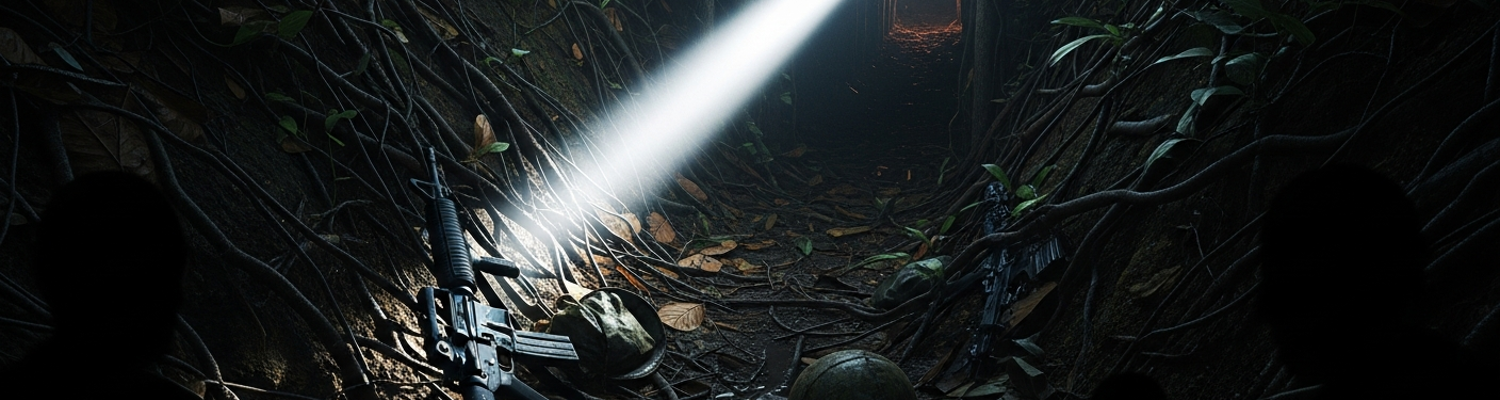

The Unofficial War Beneath The War
Beneath the jungle floor of I Corps, the Viet Cong had engineered a second war. This was a conflict fought in darkness and tight spaces, a three-dimensional battlefield for which standard Marine Corps infantry doctrine had no immediate answer. Confronted with an enemy that could materialize from the earth, strike, and then vanish, the Corps was forced into a rapid and punishing process of field adaptation. No established units existed for this kind of fighting. The solution arose organically from battlefield necessity. Volunteers were sought from infantry and combat engineer outfits. These men were not selected through any formal process but by a grim battlefield calculus: they had to be small in stature, thin, and possess a specific psychological resilience to willingly enter the dark. These impromptu teams, often just two or three individuals, became known as tunnel rats. While the U.S. Army had more officially recognized groups, Marine units from Da Nang to the Demilitarized Zone developed their own specialists. A review of operational logs shows that Force Reconnaissance Marines, already tasked with deep intelligence gathering, sometimes participated, though the bulk of the work fell to line infantrymen.
This was not a technologically advanced specialty. The most important equipment decision was what to leave behind. Helmets, flak jackets, and standard-issue M16 rifles were useless baggage in corridors sometimes only three feet high. A Marine would strip to his trousers, the better to feel for tripwires against his bare skin. His arsenal was reduced to its most primal elements: a flashlight, a combat knife, and a handgun. The standard M1911A1 pistol, while powerful, proved problematic. Its muzzle flash and thunderous report in a confined dirt tube could cause temporary blindness and ruptured eardrums. Many sought out .38 Special revolvers or other smaller caliber weapons as alternatives. Communications were almost nonexistent beyond a simple wire that might be spooled out behind them, a fragile link to the world above. These Marines were not a formal unit but a decentralized, operational necessity, a capability that materialized within rifle squads and engineering platoons whenever a trapdoor was found in the jungle floor.
Descending into a tunnel was a full-sensory assault. The immediate plunge into absolute, suffocating darkness was the first shock, a blackness that night vision devices of the era could not penetrate due to the lack of ambient light. The only illumination came from a fragile, battery-powered flashlight. Its beam was a small circle of safety in an infinite void, but also a beacon announcing one’s position to anyone waiting ahead. Sound became distorted and terrifying. The scrape of a boot against dirt, the drip of water, or the scuttling of unseen creatures were amplified, while the muffled sounds of the surface war seemed a world away. The air itself was an enemy, thick with humidity, low on oxygen, and foul with the smell of damp earth, human waste, and death. Every inch of progress was a battle against claustrophobia, the oppressive weight of the earth pressing in from all sides triggering a primal fear of being buried alive.
Physical demands compounded the psychological terror. Marines contorted their bodies through narrow U-bends designed to trap intruders and block gas. Heat exhaustion was a constant threat in the stagnant, humid air. The ever-present danger of booby traps required a heightened state of awareness that was mentally exhausting. A misplaced hand could find a punji stake, a tripwire connected to a grenade, or even venomous snakes deliberately left as living traps. Combat, when it happened, was a desperate, intimate affair at arm’s length in a space too tight to properly aim or maneuver. The psychological toll was immense. The combination of sensory deprivation, isolation, claustrophobia, and the constant, high-stakes threat of a violent, unseen death created levels of stress that could cause even the most hardened combat veterans to freeze. Research and after-action reports from the period indicate that the experience produced a unique and severe form of operational stress, pushing Marines to their absolute physiological and psychological limits.
An Arsenal Born of Desperation
The subterranean environment forced a violent reassessment of a Marine’s basic loadout. It created urgent, life-or-death demands for equipment that did not officially exist within the Marine Corps supply system. A close review of operational logs from units operating near Da Nang and throughout the I Corps Tactical Zone reveals a consistent pattern of equipment failure. Standard-issue gear was not inconvenient; it was actively hazardous. The M17 protective mask, for example, proved a liability. Its bulky profile and cheek-mounted filter pouches snagged constantly in the narrow, twisting passages. More critically, a Marine caught in a tunnel filled with CS gas or suffering from oxygen depletion had no practical way to change the M17’s internal filters without removing the mask entirely, a fatal flaw in a contaminated, confined space. The demand arose for a compact, low-profile respirator, something that could be worn for extended periods without obstructing vision or movement. No such item was available through standard channels.
Lighting was an equally pressing issue. The ubiquitous MX-991/U angle-head flashlight, while durable, was cumbersome. Its beam was often too broad, illuminating the user as much as the path ahead, and the need to hold it occupied a hand that was essential for navigating or wielding a weapon. The humid, dirt-filled environment caused batteries to corrode and fail unpredictably, plunging a Marine into absolute blackness at the worst possible moment. The requirement was for small, reliable, low-signature light sources, ideally head-mounted. This technology was not yet a part of the standard infantry issue.
This drive for specialized equipment was most pronounced in the selection of weaponry. The standard M16 rifle was far too long to be maneuvered around the sharp, earthen corners of a tunnel complex, making it useless underground. This forced tunnel rats to rely on handguns as primary weapons. While the Corps-issued M1911A1 .45 caliber pistol was a powerful and trusted sidearm, it created a sensory nightmare in subterranean confines. Firing the large .45 ACP round inside a three-foot-wide dirt tube produced a deafening report and a brilliant muzzle flash that could induce temporary deafness and blindness, disorienting the shooter and giving away their exact position. After-action reports frequently cite this issue, documenting a desperate search for alternatives. Field analysis shows that Marines began to seek out revolvers, particularly those chambered in .38 Special. Their enclosed cylinders mitigated some flash and they were less prone to jamming from dirt and mud than a semi-automatic’s slide action. Some enterprising individuals acquired personally owned pistols or scavenged non-standard weapons like the Smith & Wesson Model 10 or even suppressed pistols, but these were exceptions. The demand for a purpose-built, short-barreled weapon with reduced flash and report was clear and immediate.
The novelty of these highly specialized requirements created significant procurement hurdles for a logistics chain designed for mass-produced, standardized materiel. The Marine Corps supply system of the 1960s, managed from depots in places like Albany, Georgia, and Barstow, California, was structured to acquire and distribute items listed in the official Table of Organization and Equipment. A battalion needed a set number of rifles, flak jackets, and helmets, all with established National Stock Numbers (NSNs) that could be requisitioned through a formal, bureaucratic process. There was no NSN for a compact tunnel respirator or a low-flash .38 caliber revolver. The entire concept of specialized subterranean gear was a tactical improvisation, not an established part of Marine Corps doctrine (ref: USMC After-Action Report, 3rd MAF, Subj: Subterranean Ops, May 1968). When a squad leader in the field identified a need for a new piece of gear, there was no official channel to rapidly develop, test, and procure it. The system was oriented toward multi-year acquisition programs for major weapon systems, not the rapid fielding of niche equipment for a few dozen specialists. This disconnect forced Marines at the platoon and company level to rely on informal, ad-hoc solutions. They bartered with Army or Seabee units, used personal funds to buy commercial equipment, or modified existing gear in unauthorized ways. Archival records show a clear absence of official requisitions for this specialized equipment, not because the need did not exist, but because the procurement framework had no category for it.
Doctrine of the Disposable Assault
The developing doctrine was a high-risk departure from conventional infantry tactics. It was predicated on using the enemy’s own subterranean arteries against them, not for clearance but for aggressive, rapid flanking maneuvers. The concept, born out of necessity in the field, called for highly mobile, lightly equipped Marine assault teams to penetrate a tunnel system, bypass initial pockets of resistance, and emerge behind established enemy lines. A review of after-action reports from Marine infantry battalions operating in Quang Tri Province shows this was not a formalized part of the training cycle, but a field-expedient adaptation. These teams stripped themselves of all non-essential gear. Standard-issue M16 rifles, flak jackets, and even helmets were abandoned at the surface. The assault element was reduced to its essentials: a handgun, a knife, and a flashlight. The tactical calculation was that speed and surprise were more valuable than armor and firepower in the subterranean environment. A team of two or three Marines, unburdened by heavy equipment, could move faster and more quietly, exploiting the labyrinthine passages to achieve a tactical advantage that was impossible on the surface.
The very speed and dispersion that defined the rapid flanking maneuver created an almost impossible logistical problem. A team moving deep into a tunnel complex was a self-contained entity with a rapidly diminishing shelf life. Every minute underground was a drain on resources. Flashlight batteries died, ammunition was expended in brief, violent encounters, and medical supplies were used to treat injuries in complete darkness. The concept of a centralized supply point at the tunnel entrance became obsolete the moment a team moved beyond the first few hundred feet. To support these highly dispersed operations, planners needed immediate, decentralized resupply points. The theoretical solution involved establishing a daisy chain of small caches within the tunnel system itself, or having support teams follow the assault element to create temporary supply points. This rarely worked. The environment was too hostile and unpredictable. A follow-on team could be ambushed, a pre-staged cache discovered by the enemy, or a passage could be deliberately collapsed, cutting the assault team off completely.
The failure to align the aggressive tactical doctrine with a workable subterranean logistics plan placed the individual Marine in an untenable position. Archival analysis of unit logs reveals a pattern where assault teams were forced to choose between aborting their mission due to dwindling supplies or pushing forward into a state of extreme vulnerability. A squad leader deep underground had no reliable communication with the surface and had to make decisions based on an inventory measured in individual batteries and single magazines. The flanking maneuver, so logical on a commander’s map, dissolved into a desperate calculus of survival for the men executing it. The doctrine emphasized mobility, but mobility consumed resources that could not be replaced. The very lightness of their equipment, intended to provide an edge, ensured that their operational endurance was perilously short.
The Long Haul from Ship to Dirt
The naval supply chain, while powerful, was a blunt instrument. It was designed to move mountains of standardized materiel like pallets of ammunition, barrels of fuel, and crates of C-rations. It was not configured to handle urgent, small-batch requests for the specialized tools of tunnel warfare. An Amphibious Ready Group steaming on Yankee Station in the Tonkin Gulf had immense capacity, but its attack cargo ships (AKAs) and landing ship docks (LSDs) were floating warehouses organized around the Federal Stock Number (FSN) system. A request from a Marine squad leader near Con Thien for a dozen .38 caliber revolvers or a case of low-profile respirators represented a logistical anomaly. These items possessed no FSN, the 11-digit code that was the lifeblood of the procurement system. Without that number, the item did not officially exist in the vast computerized inventories of the Force Logistic Command (FLC) headquartered at Da Nang. The request would have to be handled as a special case, a deviation that slowed the entire process and required manual overrides and command-level approval for what was, on the ground, a life-or-death necessity.
The physical transfer from ship to shore was its own gantlet of delay and vulnerability. Once an ad-hoc solution was approved and a crate of, for example, commercial flashlights was sourced, it began a perilous journey. From the hold of a ship anchored miles offshore, the small crate would be loaded into the well deck of a landing ship dock and transferred onto a Landing Craft Utility (LCU). That slow-moving vessel, designed for beach assaults and not precision logistics, would then make the long transit to a crowded port facility like Da Nang or a more primitive landing zone like the one at Đông Hà. A single LCU making its approach was an obvious and slow-moving target. Upon arrival, the special-order crate was just one of hundreds of items being offloaded in a chaotic environment, vulnerable to being lost, misdirected, or simply buried under pallets of higher-priority, standardized supplies. Archival records from the Force Logistics Support Groups (FLSG) at Da Nang and Đông Hà reveal a system overwhelmed by the sheer volume of materiel, where a small, uniquely marked box was at constant risk of disappearing into the administrative chaos. From the beach or port, it then faced another dangerous leg of its journey by truck convoy up Highway 1, a route infamous for ambushes and mines, to a forward supply depot, from which it would, eventually, be distributed to the requesting unit.
This extended and fractured pipeline created a debilitating time lag between a tactical need and its fulfillment. A squad discovering a tunnel complex and identifying an immediate equipment shortfall could wait weeks, or even months, for a response. The dispersed and ad-hoc nature of tunnel warfare teams compounded the problem. They were not a formal battalion with a dedicated supply officer integrated into the FLC’s planning. They were small, often company-level assets scattered across the I Corps Tactical Zone, from Khe Sanh to the valleys around Da Nang. The logistics system was not designed to service dozens of distinct, low-volume customers with unique needs. It was structured to push supplies out to established divisions and regiments. For a three-man team operating in a remote sector, this meant their specific, urgent requirements were often invisible to the massive supply apparatus churning offshore. The very doctrine of using dispersed, mobile teams was undermined by a supply chain that could not keep pace, leaving Marines to innovate with what they had or what they could barter for.
The Attrition of Thirst and Ammunition
A review of medical field reports from Marine units operating in the tunnel-laced regions of Quang Tri Province reveals a consistent and debilitating pattern of acute dehydration. The doctrine of rapid penetration demanded that assault teams shed all but the most essential gear, and in the grim calculus of survival, spare water was often the first casualty. A standard one-quart canteen was heavy, bulky, and viewed as a hindrance in the three-foot-high confines of a typical Viet Cong tunnel. A Marine descending into the earth carried ammunition, a flashlight, and a sidearm, but rarely enough water to sustain him in an environment where ambient temperatures could soar and oxygen was scarce. The physical exertion of contorting through tight passages in the humid, stagnant air caused rapid fluid loss through sweat. Within an hour, signs of severe heat stress would manifest. Dizziness, muscle cramps, and a dangerous decline in cognitive function were common. This was not a peripheral concern; it directly compromised mission effectiveness at the most fundamental level. A Marine suffering from dehydration was slower, his decision-making impaired, and his ability to engage in the sudden, violent combat of the tunnels was severely degraded.
Ammunition was another point of critical failure. The logistical decision to equip tunnel rats with handguns instead of rifles was a tactical necessity, but it created an immediate firepower deficit. A Marine armed with a standard-issue M1911A1 pistol carried 7-round, single-stack magazines. Even with a few spares, his total combat load might be less than 50 rounds. An engagement in the blackness of a tunnel was a brief, terrifying affair of muzzle flashes and instinct shooting. A Marine could expend his entire ammunition supply in seconds, leaving him with only a knife in a space too confined for its effective use. After-action reports from tunnel-clearing operations near Da Nang consistently document assault teams forced to withdraw not because of enemy action, but because they had run out of ammunition. This shortage was a direct consequence of the logistical disconnect between the needs of these ad-hoc teams and a supply chain built for conventional infantry battles. There were no specialized bandoliers or load-bearing equipment for carrying extra pistol magazines underground; a Marine simply stuffed what he could into his pockets, a desperate, last-minute improvisation for a life-or-death task.
Beyond the immediate crisis of dehydration was the persistent, corrosive problem of contaminated water. The very tunnels Marines were sent to clear often contained the only available water sources, typically in the form of stagnant pools or captured enemy containers. A Marine, pushed to the limits of thirst by the suffocating heat, faced a desperate choice. Field medical records show a significant incidence of diarrheal diseases among units engaged in subterranean warfare. Soldiers in Vietnam were hospitalized for diarrhea four times more often than for malaria. Pathogens like E. coli and Shigella were rampant, and ingesting them meant days or weeks of incapacitating illness. While iodine purification tablets were issued, they were often in short supply at the squad level, lost in the chaos of field operations, or simply not available when a Marine, isolated deep in a tunnel, made the decision to drink from an unclean source. This had a direct impact on mission endurance. A single sick Marine could compromise his entire team, forcing an early end to an operation or becoming a liability that had to be evacuated under hazardous conditions. The lack of clean water eroded the strength of these units from the inside out.
Medicine in a Six-Foot Grave
A review of casualty reports from subterranean engagements reveals a distinct and horrifying profile of injuries for which standard field medicine was tragically unprepared. The detonation of a single grenade in a three-foot-wide dirt passage did not just produce shrapnel wounds; it created a contained supersonic overpressure wave that ruptured lungs, collapsed sinuses, and caused massive internal bleeding without leaving a visible mark. Blast injuries were compounded by the environment itself. A Marine scrambling away from an explosion could be impaled on sharpened punji stakes, suffer deep lacerations from the rough-hewn walls, or sustain severe burns. Treating these complex traumas in absolute darkness, wedged in a dirt-choked corridor, was a near impossibility. A Navy Corpsman attached to a Marine rifle company was equipped with a standard M3 or M5 medical bag, a bulky satchel designed for open-field combat. Inside, he had battle dressings, tourniquets, and morphine syrettes. All were vital, but all were designed to be applied with space, light, and some measure of time. None of these were available in a tunnel.
To treat a casualty, a corpsman first had to reach him, crawling through the same contaminated, booby-trapped darkness. Then, by the light of a fragile flashlight, he had to attempt procedures in a space so tight he could barely move his elbows. Applying a simple battle dressing, an act that took seconds on the surface, became a desperate, fumbling struggle in the dirt, increasing the risk of wound contamination. Evacuation was the only real medical option, but it was a brutal and prolonged process. There were no stretchers. A wounded Marine had to be physically dragged, inch by inch, back through the twisting labyrinth, his injuries scraping against the earth, his body contorting around sharp bends. A wound that might have been survivable on the surface became fatal during the hours it could take to haul a man back to the tunnel entrance. The 'golden hour' for trauma care, the critical window for intervention, did not exist underground. It was a black hole of time and suffering, where the tools of field medicine were rendered useless by the sheer physical constraints of the environment.
The logistical pipeline, stretching back to naval vessels steaming miles offshore, was completely misaligned with these immediate, specialized medical needs. A corpsman in the field might identify a critical requirement, for instance, a compact, vacuum-sealed chest wound kit or a more effective, fast-acting painkiller than morphine that didn’t depress respiration, but there was no formal mechanism to fulfill such a request. The naval supply system, managed by the Force Logistic Command in Da Nang, was built on the Federal Stock Number system. It was designed to move pallets of standardized goods, not to rapidly procure or field-test novel medical devices. A request for an item without an FSN simply vanished into a bureaucratic void. Archival analysis shows that while the logistics system could move mountains of standard supplies like C-rations and artillery shells, it was deaf to the specific, life-saving requests emanating from the subterranean battlefield. This failure had a direct and measurable impact on Marine casualties. The inability to get the right medical supplies to the right place at the right time meant that treatable injuries became fatal. A Marine with a severe arterial bleed from a punji stake might die because the only man who could help him, the corpsman, was stuck several bends back in the tunnel, unable to reach him in time. Another might survive the agonizing extraction from the tunnel only to die from a rampant infection because the necessary broad-spectrum antibiotics were not part of the standard individual first-aid kit and were not available at the company level.