
Stopgap Tanker Conversion and Hybrid Propulsion
At 14,000 feet over the Nevada test ranges in early 1954, manifold pressure inside the number three Pratt and Whitney R-4360 Wasp Major engine plummeted to zero. The supercharger impeller shaft sheared off its internal mountings. Twenty-eight cylinders swallowed pulverized magnesium shavings. Oil pressure collapsed instantly. A violent mechanical grinding vibrated through the heavy yoke of the B-50 Superfortress. The flight engineer frantically feathered the propeller to prevent the 3,500-horsepower radial powerplant from tearing itself off the wing. Archival evidence shows this specific type of catastrophic engine failure forced Strategic Air Command planners to reevaluate their aerial refueling hardware. The military required a stopgap tanker to support rapid deployments of tactical fighters across the Pacific. Boeing lacked the production capacity to build a completely new fleet due to existing B-52 bomber contracts.
The Defense Department awarded the conversion contract to Hayes Aircraft Corporation in Birmingham, Alabama.
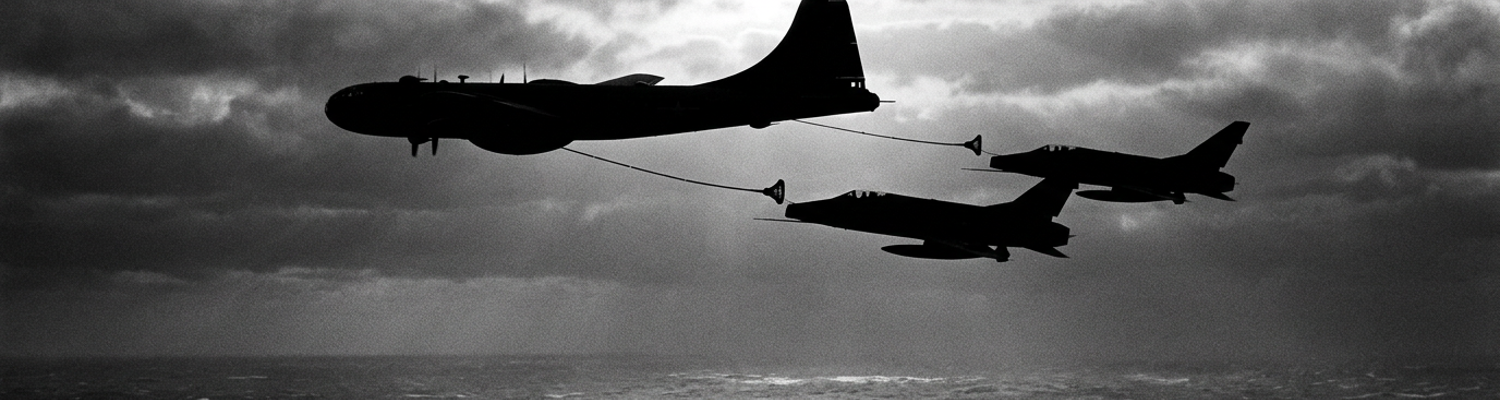
Engineers at the Hayes facility at the Birmingham Municipal Airport began receiving hundreds of obsolete World War II era B-29 and post-war B-50 bomber airframes. Factory workers stripped the defensive gun turrets, radar bombing equipment, and heavy armor plating to reduce base weight. Inside the cavernous bomb bays, technicians installed high-capacity aluminum aviation fuel tanks and 4,000 feet of specialized transfer plumbing. The rear fuselage required localized structural reinforcement to support the new triple-point probe-and-drogue refueling system. Two hose reels were mounted in aerodynamic pods on the wingtips. A third reel deployed directly from the modified tail compartment.
A close review of operational logs indicates the resulting KB-50 tankers began rolling out of the Alabama plant in 1956.
Tactical Air Command assigned these initial variants to the 421st Air Refueling Squadron stationed at Yokota Air Base in Japan. The modified bombers were dangerously slow. When examining the historical record, it becomes clear that the piston-engine KB-50 could not safely refuel the new Century Series jet fighters. F-100 Super Sabres and F-101 Voodoos approached their stall speeds at the tanker maximum cruising speed of 230 knots. Fighters routinely fell out of the sky while attempting to connect to the trailing refueling baskets.
Hayes Aircraft engineers initiated a major redesign to increase the top speed of the aging airframe.
They integrated twin external General Electric J47-GE-23 turbojet engines into pods suspended outboard of the radial engines on the wings. Each twelve-stage axial-flow compressor jet provided 5,200 pounds of additional thrust. Mechanics had to route specialized JP-4 jet fuel lines through the main wing spars. This separated the jet propulsion system entirely from the 115-octane aviation gasoline required by the R-4360 piston engines. The cockpit required entirely new throttle quadrants. Technicians installed auxiliary instrument panels to monitor turbine exhaust gas temperatures and jet fuel flow rates. This hybrid propulsion system birthed the KB-50J variant. The jet pods boosted the tanker maximum speed past 400 knots during the refueling phase at 30,000 feet. F-100 pilots could now maintain a stable angle of attack while plugging into the drogue.
The integration of the J47 engines added high structural stress to the outer wing joints of the twenty-year-old bomber design.
Ground crews at Langley Air Force Base regularly discovered hairline fractures along the engine pylon attachment points. At maximum takeoff weight, the four piston engines and two turbojets of the KB-50J consumed 450 gallons of fuel per hour just to reach operational altitude (Technical Order 1B-50K-1).
Forward Deployment and Tropical Maintenance Failures
On August 23, 1958, Chinese People Liberation Army artillery batteries opened fire on the island of Kinmen. Tactical Air Command initiated an immediate deployment of the Composite Air Strike Force to the Pacific theater. Archival evidence shows the 429th Air Refueling Squadron received mobilization orders at Langley Air Force Base within forty-eight hours of the initial bombardment. Ground crews loaded the KB-50J bombers with spare R-4360 cylinders, heavy hydraulic jacks, and wooden crates of specialized turbine oil. Executing a trans-Pacific island-hopping route, the squadron passed through Hickam Air Force Base in Hawaii, Wake Island, and Andersen Air Force Base in Guam. Final deployment orders sent them to forward operating locations across the Philippines and Taiwan.
Temperatures on the flight line at Clark Air Base routinely exceeded 105 degrees Fahrenheit.
Mechanics quickly discovered that this intense tropical heat caused the neoprene seals inside the Hayes-designed refueling hose reels to expand. Highly flammable JP-4 jet fuel began leaking directly into the unpressurized aft fuselage compartments. Working through the night under strict blackout conditions, maintenance personnel removed the hardware. They replaced the compromised seals with improvised gaskets cut from heavy-duty rubber truck tires. The modified bombers were bleeding fuel before they even reached the runway.
A close review of operational logs indicates the sheer weight of the fully loaded tankers pushed the aging B-50 airframes to their structural limits during takeoffs from Tainan Air Base on the southwestern coast of Taiwan.
Advancing the four piston engine throttles to maximum manifold pressure, pilots simultaneously engaged the twin J47 turbojets. The heavy aircraft required nearly the entire 10,000-foot concrete strip to achieve rotation speed. Once airborne, the squadron established continuous aerial refueling tracks directly over the Taiwan Strait. Planners designated specific airspace blocks for these orbits. Operating primarily at 27,000 feet along the 24th parallel north, tanker crews flew exact figure-eight patterns. These tracks provided extended loiter times for land-based F-100D Super Sabres and F-101 Voodoos flying combat air patrols between the mainland and the island. Radar operators monitored Chinese MiG-17 formations circling just twenty miles to the west.
Maintaining these orbits required exact mechanical synchronization between the tanker crews and the thirsty fighter squadrons.
Inside the cockpit, the KB-50J flight engineer had to manually balance the fuel transfer pumps. This action prevented the center of gravity from shifting violently as thousands of pounds of JP-4 flowed out through the wingtip and tail drogues. Approaching the trailing baskets at 250 knots, F-100 pilots pushed their jets to the absolute maximum safe structural speed of the tanker. The physical connection often proved violent. Striking the drogue assembly with a heavy metal probe, the fighter sent severe kinetic shockwaves up the 75-foot reinforced hose. Tensioner springs inside the KB-50J wing pods frequently snapped under the sudden load. When a spring failed, the hose whipped uncontrollably in the slipstream.
Evasive maneuvers were required instantly to avoid ingesting the flailing metal basket into the jet air intakes.
Broken hoses meant aborted missions and fighters returning to base on emergency fuel reserves. To maintain the continuous fighter cover demanded by the theater commanders, the 429th Air Refueling Squadron kept multiple tankers airborne simultaneously in a stacked formation. A primary KB-50J operated at 25,000 feet while a secondary reserve aircraft circled at 28,000 feet. Should the lower tanker experience a hose reel jam or an engine failure, the reserve aircraft would dive down to take its place on the track. September weather patterns in the western Pacific introduced severe turbulence into these exact coordinates. Massive cumulonimbus cloud formations developed over the Strait due to tropical depressions.
Storm cells forced the tankers to climb above 30,000 feet to find smooth air.
Operating at this altitude heavily taxed the R-4360 radial engines. Cylinder head temperatures spiked into the red zone as the superchargers struggled to pull enough oxygen from the thin atmosphere. Flight manuals explicitly warned against running the powerplants at high settings in thin air for extended periods. Disregarding the technical orders, crews kept the throttles pushed forward to ensure the fighters received their fuel. Post-flight teardown inspections by mechanics at Kadena Air Base in Okinawa documented multiple instances of cracked exhaust manifolds and burned exhaust valves (NARA Record Group 342).
Mainland Chinese Electronic Jamming Operations
Archival evidence shows that on September 8, 1958, Chinese People Liberation Army signal battalions activated Soviet-built R-118 high-frequency ground transmitters along the jagged coastline of Fujian province. Positioned directly adjacent to the 130mm artillery emplacements at Xiamen, these high-powered arrays began broadcasting continuous amplitude-modulated noise across the 225 to 400 megahertz spectrum. The ground antennas utilized a directional feed to push the signal directly eastward across the 110-mile expanse of water. This exact frequency band housed the primary tactical aviation channels utilized by the United States Air Force.
A close review of operational logs indicates that the high-powered mainland Chinese electronic jamming directed against Allied tactical aviation frequencies specifically targeted the AN/ARC-27 UHF radio sets installed in the KB-50J tankers.
Flight engineers monitoring the communication panels inside the unpressurized bomber compartments reported heavy spikes of heterodyne interference. The static manifested as a high-pitched oscillating mechanical squeal that physically degraded the audio output of the standard-issue H-75/AIC headsets. This deliberate flooding of the electromagnetic spectrum blocked the line-of-sight voice transmissions required to coordinate aerial refueling tracks over the Taiwan Strait. Chinese technicians synchronized their jamming cycles with the scheduled launch windows of F-100D Super Sabres departing from Tainan Air Base and F-101 Voodoos from Clark Air Base. As the heavily loaded fighters climbed through 15,000 feet, their vacuum-tube receivers absorbed the full brunt of the coastal interference.
The resulting static drowned out all ground control intercept vectors.
Severe communication blackouts disrupted coordination between KB-50J tankers and incoming strike fighters across the designated refueling sectors. Operating at 27,000 feet near the 24th parallel north, tanker commanders relied on precise timing to meet the fast-moving jets. The Century Series fighters burned JP-4 jet fuel at a high rate while carrying heavy ordnance loads and required exact intercept coordinates to avoid engine flameouts over open water. Without clear UHF voice contact, the 429th Air Refueling Squadron crews could not transmit altimeter settings or localized heading corrections to the approaching pilots. The AN/APN-69 rendezvous radar systems mounted in the bellies of the tankers experienced heavy ground-clutter interference from the mainland jamming arrays.
Radar scopes filled entirely with green static snow.
Navigators aboard the KB-50Js resorted to dead reckoning and stopwatch timing to maintain their figure-eight orbits. Fighter pilots flying out of Kadena Air Base in Okinawa had to navigate to the pre-briefed coordinates using basic automatic direction finders. They flew toward the general track area hoping to spot the massive aluminum bombers against the heavy cumulonimbus cloud decks common in the region. When examining the historical record, it is clear that these blackouts forced command decisions that directly altered standard operating procedures. Tactical Air Command ordered the tankers to deploy their three refueling hoses continuously while in the orbit area, rather than waiting for radio confirmation from the incoming fighters. The 75-foot reinforced rubber hoses trailed in the slipstream for hours.
This extended deployment exposed the tensioner springs and metal drogue baskets to sustained aerodynamic stress.
Fighter pilots arriving at the rendezvous point broke radio silence only by flashing their landing lights to signal their fuel state. The F-100D pilots approached the deployed drogues visually, matching the 400-knot speed of the tanker without any verbal clearance from the boom operator in the tail compartment. The flight engineer had to monitor fuel flow meters manually to detect when a fighter made a successful hard connection with the drogue. A single missed intercept meant the fighter pilot would exhaust their fuel reserves in less than twelve minutes. Ground crews at Tainan Air Base documented a severe increase in maintenance faults on the tanker communications gear following these missions.
Mechanics frequently pulled the AN/ARC-27 radio units from the aircraft racks to replace blown R-F amplifier tubes.
The constant bombardment of high-wattage jamming signals caused the internal components of the receivers to overheat during eight-hour orbit missions. Supply chains struggled to provide enough replacement vacuum tubes to keep the squadron airborne. Maintenance logs show the 429th depleted its entire ninety-day supply of replacement radio tubes in three weeks (Logistical File 58-A-412).
Scavenged High-Frequency Radio Integration
A close review of operational logs indicates that on September 12, 1958, commanders at Tainan Air Base ordered an immediate hardware overhaul to bypass the Chinese coastal jamming arrays. Avionics technicians assigned to the 429th Air Refueling Squadron stripped high-frequency Collins 618S transceivers out of grounded C-124 Globemaster transport planes. The standard AN/ARC-27 UHF radio sets inside the KB-50J tankers lacked the wattage to punch through the mainland interference. Maintenance crews hauled the 60-pound HF units onto the flight line. They physically bolted the heavy metal boxes to the reinforced bulkheads behind the flight engineer station.
Integrating these scavenged radios required mechanics to cut directly into the bomber primary 28-volt direct-current electrical bus.
Technicians soldered heavy-gauge coaxial cables along the bare aluminum ribs of the fuselage. They bypassed the standard relay switches. New audio outputs were wired straight into the intercom distribution panel. The original vacuum-tube amplifiers experienced severe overheating due to the heavy electrical draw of the continuous eight-hour orbit missions. Mechanics installed secondary cooling fans scavenged from radar consoles to blow ambient air across the exposed glass envelopes of the radio tubes. The fix worked. This field modification allowed the flight engineer to monitor long-range command frequencies without removing his standard-issue H-75/AIC headset during active refueling operations.
Generating a functional high-frequency transmission from a moving aircraft required an antenna length exceeding the entire wingspan of the B-50 airframe.
Archival evidence shows ground crews fabricated trailing long-wire antennas from heavy spools of uninsulated copper communication line to solve the wavelength deficit. Mechanics drilled exit ports through the unpressurized aft lower fuselage directly adjacent to the tail drogue housing. Inside the cramped tail compartment, they mounted hand-cranked steel winches salvaged from World War II era bomb hoist mechanisms. Crew chiefs attached three-pound lead weights, originally designated for heavy machinery balancing, to the terminal ends of the copper wire to provide aerodynamic stability. When the KB-50J reached its assigned orbit altitude of 27,000 feet along the 24th parallel north, an enlisted airman manually unspooled exactly 200 feet of the heavy wire into the aircraft slipstream.
The uninsulated copper dragged behind the four spinning R-4360 radial engines and twin turbojets.
Drag increased exponentially. This physical extension exactly matched the specific quarter-wavelength required to transmit on the 4.7 megahertz band. Inside the cockpit, the flight engineer adjusted a rotary impedance matcher. He synchronized the scavenged Collins transceiver with the trailing copper line. The manual tuning process required the engineer to watch a small analog needle on the voltage standing wave ratio meter while turning a stiff Bakelite knob. Turbulence frequently whipped the deployed wire violently against the outer aluminum skin of the tail section.
When examining the historical record, the physical integration of these trailing wires restored command connectivity across the active combat zones of the Taiwan Strait.
High-frequency radio waves propagated differently than the blocked UHF signals by refracting off the ionosphere and dropping vertically into the receiver. This atmospheric bounce completely bypassed the line-of-sight R-118 jamming transmitters positioned on the Fujian coast. Tanker crews orbiting in the designated refueling tracks began receiving continuous, static-free intercept vectors directly from ground controllers stationed 600 miles away at Clark Air Base in the Philippines. The flight engineer relayed these precise coordinates through the tanker internal intercom to the pilot. The pilot then adjusted the autopilot heading to meet the incoming F-100D Super Sabres.
Sustaining this communication link demanded constant physical labor from the aft compartment crew.
Changes in airspeed or barometric pressure altered the drag on the trailing wire. Tension fluctuated wildly. The operator had to continuously crank the steel winch in and out by several feet. This prevented the copper line from snapping under extreme aerodynamic tension. Friction from the rapid unspooling routinely burned through the heavy leather gloves worn by the enlisted crew members operating the winch. A sudden drop in airspeed below 220 knots caused the heavy lead weight to sag directly into the deployment path of the rear refueling hose (Technical Report 429-HF-2).
Drogue Tensioner Upgrades and Coupling Failures
A close review of operational logs indicates the integration of twin J47 turbojets created severe aerodynamic complications for the trailing refueling gear. Pushing the heavy KB-50J bomber to 400 knots allowed the Century Series fighters to maintain a safe angle of attack during fuel transfer. The increased airspeed subjected the 75-foot reinforced rubber hoses to extreme slipstream forces directly over the Taiwan Strait. Factory-installed tensioner springs inside the wingtip pods failed to maintain constant pressure against the unspooling line. The standard metal drogue baskets oscillated wildly in the turbulent air above 25,000 feet.
F-100D Super Sabre pilots approaching from the rear found it physically impossible to align their fuel probes with a target moving in an unpredictable three-foot circular pattern.
Aborted intercepts spiked during the first two weeks of September 1958. Fighters burned through their emergency reserves attempting multiple approaches on the flailing equipment. The original Hayes Aircraft Corporation coil springs were engineered for a maximum towing speed of 230 knots. Archival evidence shows maintenance personnel assigned to the 429th Air Refueling Squadron at Tainan Air Base initiated an immediate redesign of the tensioning mechanisms. Ground crews dismantled the aerodynamic pods housing the wingtip hose reels. They removed the factory-issue aluminum tensioners and discarded the weak internal springs. Supply officers sourced heavy-gauge carbon steel suspension coils from local heavy-duty truck depots in southern Taiwan.
Mechanics cut these industrial springs down to exact six-inch lengths using acetylene torches on the flight line.
Fitting the stiffened steel into the bomber reel assembly required intense physical labor. Technicians compressed the heavy coils using hydraulic strut clamps borrowed from C-124 Globemaster landing gear maintenance kits. Locking the modified tensioners into place stabilized the deployment rate of the heavy hoses. The stiffened springs absorbed the kinetic shock of the 400-knot slipstream and held the drogue baskets completely rigid in the air. Securing a stable target exposed a secondary failure point in the refueling hardware. Once the F-100D pilots successfully drove their probes into the basket, the internal coupling mechanism frequently failed to hold the connection.
Severe updrafts generated by cumulonimbus cloud formations over the Strait violently shoved the aircraft up and down during fuel transfer.
The standard hydraulic locking toggles inside the drogue receiver lacked the mechanical grip to secure the fighter probe collar against this vertical shear. The heavy metal coupling decoupled without warning. When examining the historical record, it is clear that accidental disconnects at full fuel pressure created highly dangerous conditions. High-octane JP-4 sprayed directly out of the open drogue valve when the fighter broke away prematurely. The raw fuel washed over the canopy and air intakes of the F-100D. Engine flameouts over the open ocean became a daily hazard for the Composite Air Strike Force.
Machinists stationed at Kadena Air Base in Okinawa began fabricating custom modification kits to increase the grip strength of the probe-and-drogue couplings.
Technicians stripped the brass receiver housings out of the drogue assemblies. They used heavy steel files to manually alter the engagement angle of the internal locking tracks. The original shallow grooves were ground down into sharp, ninety-degree notches. Mechanics replaced the factory-issue aluminum locking toggles with reinforced steel pins machined from discarded engine mounts. Reassembling the drogue hubs, they packed the new steel pins with high-temperature industrial grease to prevent binding at altitude. When an incoming fighter pushed its probe into the modified basket, the heavy steel pins snapped into the probe collar groove with a high increase in mechanical force.
This hard connection locked the two aircraft together through severe turbulence.
Breaking the seal now demanded a deliberate maneuver from the receiving aircraft. The F-100D pilot had to retard the jet throttle to idle and deploy the speed brakes. This generated enough reverse aerodynamic drag to physically rip the probe out of the reinforced steel receiver toggles. Ground crews inspected the couplings after every mission and routinely found deep gouges carved directly into the brass fittings (Maintenance Log 429-B).
Cyclic Stress and Galvanic Wing Spar Corrosion
Archival evidence shows the 429th Air Refueling Squadron pushed the physical limits of the twenty-year-old bomber design during the September 1958 deployments. Taking off from Tainan Air Base at a maximum gross weight of 173,000 pounds placed heavy load factors on the main landing gear trunnions. The KB-50J airframes carried 10,000 gallons of highly flammable aviation fuel divided between high-octane avgas and JP-4 jet propellant. Climbing to 30,000 feet over the Taiwan Strait required all six engines running at maximum continuous power for over forty-five minutes. The aluminum wings flexed violently under the combined weight.
A close review of operational logs indicates the designated refueling tracks near the 24th parallel north subjected the heavily loaded tankers to severe aerodynamic stress.
Maintaining 400 knots in thin air to service incoming F-100D Super Sabres forced the airframe into an unnatural flight envelope. The original B-29 and B-50 wing architecture relied on 24ST aluminum alloy extrusions designed for high-altitude level bombing at much lower gross weights and slower speeds. Adding the outboard J47 turbojet pods shifted the center of lift outward. This modification introduced high-frequency harmonic vibrations directly into the outer wing panels. Flight engineers recorded constant structural buffeting during the figure-eight orbits.
The cyclical loading and unloading of the wing structures during hours-long loiter times initiated microscopic stress fractures along the upper and lower spar caps.
Thousands of pounds of fuel sloshing in the unbaffled bomb bay tanks during turbulent weather patterns compounded the twisting forces acting on the central fuselage torsion box. Mechanics documented the physical toll on the flight line. During scheduled 100-hour phase inspections at Clark Air Base in the Philippines, maintenance personnel uncovered severe structural degradation hidden beneath the aluminum skin. Ground crews stripped the engine nacelle fairings and opened the primary wing inspection ports to check the flight control cables. They discovered extensive internal metal fatigue centralized around wing station 144, directly inboard of the piston engine mounts.
The heavy cyclic stresses of the maximum-weight refueling orbits had sheared the solid aluminum rivets connecting the spar webs to the fuselage bulkheads.
Technicians applying fluorescent dye penetrant found jagged cracks radiating outward from the fastener holes. The tropical operating environment of the Pacific theater accelerated the mechanical decay. High humidity and high-salinity coastal air penetrated the unsealed wing cavities during deployments at Tainan Air Base. Archival evidence shows this salt-laden moisture pooled inside the lower wing skins and initiated rapid galvanic corrosion between the steel bolts and the aluminum spars. Mechanics inspecting the primary load-bearing structures found thick layers of white, powdery aluminum oxide eating through the metal.
The chemical reaction actively dissolved the structural integrity of the wing roots.
Structural engineers from the Tactical Air Command arrived on-site to assess the damage. They ordered immediate localized reinforcements using heavy-gauge aluminum doubler plates riveted directly over the corroded spar sections. The stopgap repairs required four hundred man-hours per aircraft. Drilling out the compromised rivets exposed even deeper internal flaking within the layered metal of the spar caps. Maintenance commanders at Clark Air Base issued explicit technical directives restricting the maximum takeoff weights for the modified tankers to 155,000 pounds. Squadron commanders rejected these limits.
Generating the required fuel offload to keep the combat air patrols airborne over the Taiwan Strait demanded fully loaded aircraft.
The 429th Air Refueling Squadron continued launching the compromised KB-50Js at 173,000 pounds. Ground crews resorted to painting over the smaller stress fractures with heavy zinc chromate primer to seal out the corrosive tropical moisture (Inspection Report 10-14-58).
Catastrophic In-Flight Disintegration and Fleet Retirement
A close review of operational logs indicates the structural breaking point for the aging bomber design arrived on October 14, 1964. KB-50J tail number 48-065 departed from Takhli Royal Thai Air Force Base to support Yankee Team combat missions over Southeast Asia. Ground crews had loaded the airframe with maximum fuel capacity in the cavernous bomb bay tanks, pushing the gross takeoff weight past 170,000 pounds. Climbing through dense tropical air to reach the designated refueling track, the heavy aircraft encountered severe thermal turbulence. Flight engineers manually adjusted the throttle quadrants, attempting to balance the thrust between the four piston powerplants and the twin jet pods.
Aerodynamic loads forced the starboard wing to flex violently upward.
Rotational torque applied to the wing root exceeded the structural limits of the twenty-year-old design. Decades of cyclic stress and undetected galvanic corrosion had severely weakened the 75ST aluminum wing box at station 144. Main load-bearing spar caps failed completely. A violent snapping sound echoed through the unpressurized fuselage as the metal tore apart. Catastrophic separation of the entire starboard wing occurred just outboard of the number three piston engine mount.
This structural separation ruptured the internal self-sealing fuel bladders.
Thousands of gallons of highly flammable JP-4 jet propellant and 115-octane aviation gasoline poured directly into the slipstream. Sparks from the sheared electrical harnesses ignited the volatile mixture instantly. An expanding fireball engulfed the tumbling aircraft before it plummeted into the dense jungle canopy below. This catastrophic mid-air disintegration forced theater commanders to instantly ground every remaining modified B-50 airframe across the Pacific. Archival evidence shows crash investigators reaching the impact site uncovered a highly significant mechanical failure hidden within the shattered wing roots.
Technicians cutting into the surviving metal components found thick layers of white aluminum oxide chemically degrading the primary structural fasteners.
Salt-laden moisture from years of tropical deployments had pooled inside the unsealed lower wing skins, actively dissolving the integrity of the airframe through galvanic corrosion. Fluorescent dye penetrant tests on other grounded aircraft stationed at Yokota Air Base revealed identical jagged stress fractures radiating outward from the fastener holes. Tactical Air Command engineers determined that reinforcing the corroded spars would require completely rebuilding the torsion boxes on every aircraft. Ground crews lacked the heavy industrial machinery required to manufacture replacement 75ST aluminum extrusions on the flight line. The airframes were beyond repair.
By March 1965, the Department of Defense issued the official phase-out directive, permanently retiring the entire KB-50 fleet from active service.
The era of the piston-engine aerial refueler ended abruptly in the scrapyards of the American southwest. When examining the historical record, the sudden loss of the hybrid tankers accelerated the tactical integration of the Boeing KC-135 Stratotanker. This purpose-built, all-jet replacement completely altered the standard operating procedures for aerial refueling operations. Powered by four Pratt and Whitney J57-P-59W turbojet engines, the swept-wing KC-135 easily cruised at 35,000 feet. Engineers designed the new airframe to effortlessly match the 400-knot speed of modern Century Series fighters without pushing its powerplants into dangerous temperature zones.
Planners completely discarded the unpredictable trailing hose-and-drogue systems that had physically exhausted the KB-50 crews over the Taiwan Strait.
Boeing engineers installed a rigid, hydraulically controlled flying boom under the tail section of the new jet. An enlisted boom operator lay prone in a specialized aft compartment, physically steering the heavy metal nozzle directly into a dorsal receptacle on the receiving fighter using V-shaped aerodynamic ruddervators. This hard physical connection bypassed the fragile tensioner springs and allowed for fuel transfer rates exceeding 1,000 gallons per minute. While the Stratotankers took over the high-altitude orbit tracks, ground crews stripped the remaining KB-50Js of their classified avionics. The hybrid design was obsolete. Pilots flew the surviving B-50 airframes one final time to the dry desert storage facilities at Davis-Monthan Air Force Base in Arizona. Maintenance teams parked the obsolete bombers in long rows on the baked earth to await the scrapping shears (Storage Record 65-DM).