
German Coastal Minefields at Cap de la Hague
Between June 6 and June 25, 1944, naval clearance divisions operating along the western approaches to Cherbourg sustained vessel casualty rates of twenty four percent. One out of every four sweepers suffered hull collapse, acoustic shock fractures, or catastrophic disintegration. Below the water line, an acoustic detonation five yards off the beam generated shock waves that fractured cast iron sea chests. These blasts ruptured diesel fuel lines. They instantly threw enlisted enginemen into spinning reduction gears.
The Raz Blanchard ripped through mooring cables at eight knots.
Kriegsmarine naval engineers deliberately placed dense moored contact arrays paired with acoustic influence mines across the tidal approaches of Cap de la Hague. They exploited this violent hydraulic current. Records show the 8th Sperrbrecher Flotilla deployed EMC contact mines anchored by heavy cast iron sinkers. These were set to hover twelve feet beneath the surface at mean low water. Each casing carried three hundred kilograms of hexanite. German ordnance teams rigged them with chemical Hertz horn switches that ignited upon five pounds of impact pressure. Directly beneath these buoyant spheres lay LMB acoustic ground mines. They sat on the rocky granite seabed at depths between twenty and thirty five fathoms.
German ordnance teams equipped these bottom mines with carbon granule acoustic hydrophones.
Technicians tuned these sensors precisely to the acoustic frequencies of Allied reciprocating steam engines and high speed bronze propellers. When a wooden hulled yard minesweeper passed overhead, the engine harmonics vibrating through the sea chest triggered the sensitive electrical relay. This fired the explosive block without physical contact. The expanding gas bubble rose at four thousand meters per second. It lifted the wooden keel out of the water before breaking its spine under gravitational collapse.
Steel sweep cables snapped under the combined drag of current and sunken deadweight.
When examining the historical record preserved in the National Archives microfilm series T314, rolls detailing the defensive logs and sector artillery maps of the German LXXXIV Army Corps expose the coordination between these waterborne mine belts and shore installations. German defensive logs confirm that the coastal batteries of Marine Artillerie Abteilung 260 maintained firing grids calibrated to the exact coordinates of the mine channels. These gun pits sat positioned along the cliffs at Auderville and Battery Bromhay. Archival evidence shows that German coastal artillery plotters had pre registered four 150 millimeter SK C/28 naval guns onto the open gaps left between the acoustic arrays. Enlisted crews on the sweep decks worked with grease guns and cable cutters under direct visual observation from German rangefinders. These optical units sat mounted on concrete observation posts three hundred feet above the surf.
A close review of operational logs indicates that the German LXXXIV Corps artillery command treated the minefield as an impact funnel.
They designed this zone to force Allied sweeping groups into pre ranged target zones. High explosive fragmentation shells could then detonate above the thin pine decking. No vessel could alter heading to evade incoming fire without drifting directly into an acoustic trigger zone. Inside the engine spaces of the sweeping craft, diesel exhaust mixed with sulfuric acid fumes. Bilge pumps choked on displaced oakum and splintered framing. Sweepers attempting to sever the one inch wire mooring lines of the EMC arrays with Oropesa floats found their paravane cutting jaws worn smooth. Abrasive granite sand suspended in the churned surf destroyed the cutting edges.
When an acoustic influence mine detonated in the turbulent shallows off the cape, the hydraulic shock sheared bronze mounting bolts off the main propulsion shafts.
This left the vessels dead in the water against a ten knot ebb tide setting north northwest toward Alderney. Sailors stationed aft on the fantail handled wet, frayed wire ropes that coiled under tension. These cables sliced through leather work gloves. They severed fingers when deck winches jammed under sudden tidal drag. German defensive fire control sheets from the T314 microfilms show that shore batteries tracked these disabled hulls by plotting their drift through tidal eddies. They coordinated battery salvos that hit at intervals of forty five seconds.
Mine Squadron 7 Mechanical Sweeping Gear
Steel hulls amplified every underwater detonation directly into the spines of the men standing watch.
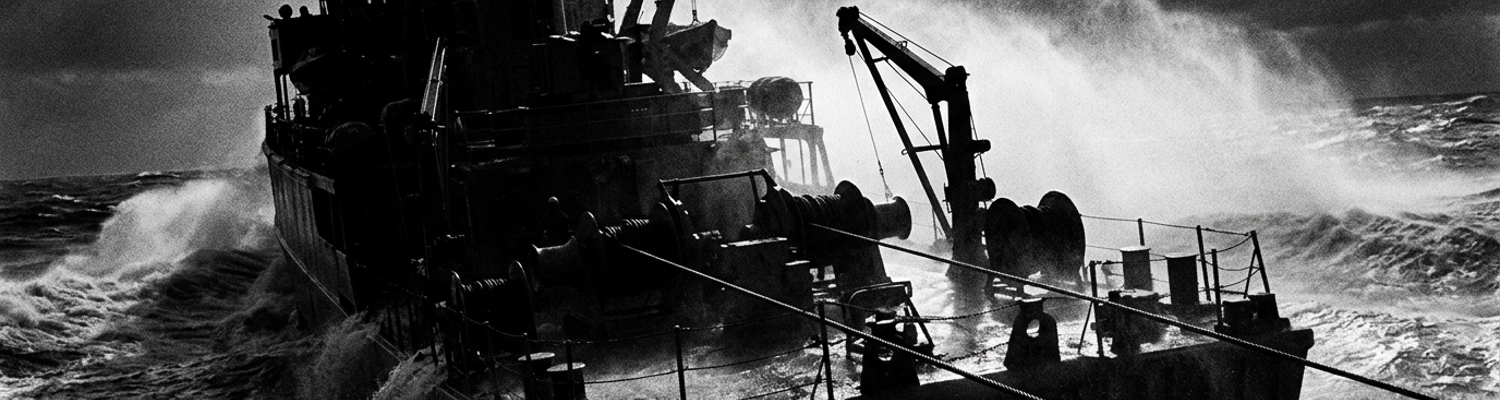
On the fantails of Auk class fleet minesweepers like USS Broadbill and USS Pheasant, deck divisions handled mechanical clearance rigs under constant heavy tension. Archival evidence shows that paired Oropesa sweep gear formed the primary countermeasure against German moored mine belts off the Cherbourg peninsula. Winch operators dropped heavy steel kites over the stern to force the leading sweep wire down to the target depth. Cigar shaped Oropesa floats planed outward on the surface to hold the towing wires spread broad across the ship wake. Along these serrated steel sweep cables, enlisted deck crews clamped explosive wire cutters at regular fifty foot intervals. Each cutter contained a spring loaded mechanical trigger and an enclosed explosive cartridge. Contact occurred when a German mine taut mooring cable slid along the sweeper dragging wire. The cable dropped straight into the cutter throat.
This impact instantly tripped the firing pin.
A hardened chisel drove across the anvil and severed the one inch steel mooring line under water. Relieved of its cast iron sinker, the buoyant contact mine breached violently into the wake. Gun crews on 20 millimeter Oerlikon mounts attempted to sink the floating casing before the waves shoved it into the trailing vessel screws. Sweeping gear sheared off whenever the floats struck granite reefs. To counter German influence ordnance, these same Auk class vessels ran acoustic hammer noisemakers alongside their mechanical sweeps. When examining the historical record of Mine Squadron 7, ship logs document the continuous deployment of mechanical hammer boxes suspended over the bow or towed abreast in the water column. Internal pneumatic pistons or electric solenoids drove these units. Heavy hardened hammers repeatedly struck heavy steel diaphragms at fixed frequencies of several hundred cycles per second.
This sustained underwater clatter simulated the acoustic signature of high tonnage cargo ships.
The noise detonated LMB bottom mines well ahead of the sweeper bow. The resulting shock waves traveled back through the water. They hammered directly against the vessel unarmored hull plating. In the lower bilge spaces, enlisted firemen watched rivets shear off frames under the constant vibration. Seawater sprayed through weeping seams. Pump packings loosened from their beds. Watchstanders in the engine rooms suffered balance loss and severe ear hemorrhages from the relentless mechanical reverberation through the double bottom tanks.
Holding position was non negotiable.
A close review of operational logs indicates that Allied sweeping doctrine enforced an inflexible, geometric formation holding pattern across all assigned clearance vectors. Units maintained an exact staggered echelon formation. They positioned each trailing sweeper within the fifty yard overlapping safety margin cleared by the lead vessel paravanes. Navy tactical directives fixed operational sweeping speed strictly between eight and ten knots. Maintaining this precise velocity across the Raz Blanchard proved physically brutal. Eight knot tidal currents hit the ships broadside on uncharted headings.
If a helmsman reduced throttle to compensate for drift, the submerged kites lost hydrodynamic depression.
The gear dragged the sweep cables along the boulder strewn bottom. Increasing speed past ten knots caused the surface Oropesa floats to breach. They skipped wildly over the waves and collapsed the sweep width entirely. Helmsmen fought the wheel against thirty degree drift angles while steering straight across plotted mine boundaries. They were forbidden to alter course even when lookouts sighted free floating contact mines drifting forty yards ahead. A single vessel shearing out of station left an uncleared lane. This directly exposed the supply transports scheduled to enter the Cherbourg approaches six hours behind them.
Mooring cables jammed the port winch drums at 0420 on June 8.
Approach Run to the Cherbourg Channels
At 0430 on June 25, 1944, Mine Squadron 7 led the assault force out of the assembly area toward the northern coast of the Cotentin Peninsula. Rear Admiral Morton Deyo Task Force 129 waited twenty miles astern. They relied entirely on the sweeping units to open deep draft assault corridors through the German defensive fields before naval gunfire support commenced against Cherbourg. A close review of operational logs indicates that the sweepers entered the marked approach lanes under complete radio silence. They ran straight toward the shore installations on headings of 165 degrees true. Tactical plans required the nine vessels of the squadron to carve two distinct approach channels. They worked alongside British sweeps of the 9th Flotilla.
These lanes were designated Fire Support Area 1 and Fire Support Area 2.
Fire Support Area 1 accommodated the heavy bombardment units USS Nevada, USS Tuscaloosa, and USS Quincy. At the waterline, deck crews on the lead Auk class sweeps deployed acoustic hammers and mechanical cutters into waters choked with submerged granite outcrops. The sea state pushed heavy spray across the forward 3 inch gun mounts as the hulls cleared the five fathom line off Pointe de Jardeheu. Steering deviation was strictly forbidden by fleet doctrine. Archival evidence shows that operational doctrine forced every sweeper to maintain an unbroken, rigid echelon right formation at a measured velocity between eight and nine knots. Running any faster pulled the Oropesa paravane floats out of trim. Dropping speed below eight knots caused the depressor kites to plane along the rocky bottom and foul the cutting wire.
This rigid spatial geometry meant the ships could not deviate from their plotted clearance tracks by even twenty yards.
To the south, German coastal artillery observers on the high cliffs at Querqueville and Auderville tracked the incoming line through split image optical rangefinders. Marine Artillerie Abteilung 260 held fire control over the approach funnel. Four 150 millimeter SK C/28 guns in casemates and Battery Hamburg four 240 millimeter heavy barrels were pre sighted to the exact hydrographic boundaries of the clearance corridor. The swept lane measured only four hundred yards across. Every ship in Mine Squadron 7 was trapped on a fixed, unvarying heading straight down the throat of the German firing solutions. Evasive maneuvers were impossible without running the trailing vessels directly into severed contact mines drifting down the wake of the lead sweepers.
Splashes from German ranging salvos walked across the sweep lines at 0915.
When examining the historical record of Task Force 129, after action reports reveal the mechanical strain this tactical lock in inflicted on the sweep crews. Heavy armor piercing and high explosive ordnance burst in the water column within fifty yards of USS Pheasant and USS Broadbill. The blasts threw tons of brine over the open bridge wings. Shell fragments punctured thin quarter inch hull plating above the water line. They sliced through exposed pneumatic lines feeding the acoustic noisemakers. Below deck, enlisted machinists stood directly over hot reduction gears in four foot bilge wells. They braced themselves against bulkheads as acoustic concussions and near miss water hammer bent propeller shaft struts. Helm orders were limited to micro adjustments of one or two degrees of rudder to counter the six knot transverse tidal rip off Cap de la Hague.
If a helmsman threw the wheel over to dodge an incoming straddle, the sweep wires would instantly cross.
This snagged the explosive cutters and collapsed the protective swept envelope around the follow on battleships. At 0945, Battery Hamburg opened fire with all four heavy barrels. Near the entrance to Fire Support Area 1, German gunners bracketed the sweeping formation with red dyed 240 millimeter target marking shells. The shock waves from these heavy rounds ruptured seawater intake gaskets inside the auxiliary engine room of USS Chickadee. This flooded the lower deck grating with twelve inches of oily bilgewater. Enlisted repair parties worked with wooden wedges and rubber gaskets under emergency lanterns. The ship held its nine knot track into the battery primary field of fire. By 1012, Mine Squadron 7 had cut twenty two moored contact mines without breaking line formation. They delivered the first deep draft bombardment lane to within 12000 yards of the Cherbourg mole.
Coastal Artillery Fire from Battery Hamburg
Tungsten hardened steel fragments tore through unarmored hull plating at three thousand feet per second.
Archival evidence shows that Marine Artillerie Abteilung 260 controlled the heavy casemates of Battery Hamburg. They utilized four 240 millimeter SK L/40 naval rifles anchored in fortified concrete emplacements behind Querqueville and Fermanville. German battery commanders used stereoscopic optical directors coupled with FuMO 214 Wurzburg radar sets to establish precise range gates across the swept corridors of Fire Support Area 1. At 1014, coastal gunners concentrated four gun battery salvos on the leading Auk class sweepers, USS Pheasant and USS Broadbill. They walked heavy caliber high explosive rounds across a two hundred yard spread. Each five hundred pound projectile threw geysers of displaced brine eighty feet into the air. This created massive hydraulic displacement that lifted the sweepers sterns clear of the water.
Deck logs from Mine Squadron 7 record that the German salvos achieved immediate straddles within three firing cycles.
They dropped armor piercing and high explosive shells less than twenty five yards off the port quarters of the lead echelon. Squadron doctrine mandated rigid eight knot clearance speeds down pre calculated channels. The ships could neither alter course nor make radical throttle adjustments to spoil the shore fire control solutions. Shell splinters shredded the port bridge wing of USS Pheasant. When examining the historical record of the 25 June engagement, damage reports confirm that jagged fragments sheared directly through the unarmored quarter inch mild steel bulkheads of the sweepers deckhouses. High velocity shell splinters whistled through the forward superstructure. They cut electrical wiring bundles and gutted the radio spaces.
On USS Broadbill, high velocity steel shards pierced the pilot house casing.
These fragments severed hydraulic telemotor lines and instantly drained pressure from the steering engine. Helmsmen lost rudder response while the ship drifted across the edge of the active mine belt. The engineering division had to rig emergency manual steering tackles directly to the rudder quadrant in the cramped aft steering compartment. Concurrently, jagged metal fragments ripped across the fantails of both lead vessels. They struck exposed winch drums, towing bitts, and deck machinery. A jagged casing shard severed the port side Oropesa sweep wire on USS Pheasant under six tons of mechanical tension. The parted wire whipped violently across the deck before plunging to the seabed along with its paravane depressor kite.
The sudden loss of tow resistance spun the vessel fifteen degrees off its axis.
This pulled the starboard float into the path of trailing clearance craft. Bilge pumps ran continuously to clear seawater entering through perforated hull seams. A close review of operational logs indicates that the enlisted deck force had to re rig replacement sweep gear while remaining locked within the German battery pre registered target grid. Sailors hauled greasy three quarter inch replacement wire rope from the storage drums by hand. They clamped new mechanical explosive cutters onto the line while hot metal fragments rained across the wooden weather decks. Below the waterline, repeated shockwaves from near miss 240 millimeter detonations cracked auxiliary generator mounts. They bent the starboard propeller shaft of USS Broadbill. This generated severe rotational shudder through the engine beds.
Engine room crews worked waist deep in dirty water.
They secured loose steam valves with wire and braced cracked bedplates using oak shims. Repair parties drove wooden pine plugs into dozens of jagged splinter holes along the waterline. This prevented sea wash from reaching the lower ammunition handling spaces. By 1038, the lead sweepers maintained their heading toward the inner harbor. They dragged improvised single ship sweeps under continuous counter battery fire from MAA 260.
Hull Frame Damage from Acoustic Concussions
A close review of operational logs indicates that detonating acoustic influence mines transmitted explosive shockwaves through the water column at five thousand feet per second. These blasts struck the unarmored hulls of Mine Squadron 7 with instantaneous hydraulic hammer. Off Pointe de Jardeheu at 1042, an LMB bottom mine detonated twenty fathoms beneath the keel of USS Broadbill. Water does not compress. The subterranean pressure wave struck the outer plating. It buckled thirty feet of transversal structural T frames between bulkheads 42 and 58. Fasteners failed under instant shear stress. Along the garboard strake and keel plate, rows of three quarter inch hot driven steel rivets popped outward as flying metal projectiles.
This opened the lower seam to sea wash.
In the forward fire room, water tenders were launched upward into the overhead piping. They landed on displaced deck plates as pressurized oil lines snapped at their threaded flanges. Seawater rushed into the double bottom void tanks at four hundred gallons per minute. The engineering watch had to run portable submersible pumps directly from auxiliary storage batteries. Keel plates bent four inches out of true alignment. Archival evidence shows that structural distortion extended through the engine beds. It twisted the steel foundation girders that anchored the vessel diesel electric drive motors. On USS Chickadee, near simultaneous concussions from twin acoustic detonations collapsed secondary longitudinal stringers beneath the reduction gear casing.
Misalignment exceeded manufacturing tolerances within milliseconds.
Rotating bronze propeller shafts bound against their rubber lined stern tube bearings. This generated intense friction that scorched packing glands and filled the lower engineering flats with white smoke. Below the floor plates, damage control parties placed four by four fir timbers against the weeping forward engine room bulkhead. They wedged mechanical screw jacks into position to halt frame deflection before the watertight doors buckled. Command logs record that the squadron commander refused permission to back down or drop out of line. He ordered vessels with dished bottom plating to trim ballast tanks forward. This kept the warped midship frames above the hydrodynamic pressure plane created by their eight knot passage.
Parted steel wires cleared the fantails in fractions of a second.
When examining the historical record of the approach channel, damage reports reveal that high explosive concussions repeatedly severed mechanical sweep gear. This transformed heavy cables into uncontrollable whipping hazards across open decks. Shrapnel from Battery Hamburg 240 millimeter guns combined with hydraulic shockwaves to part the port sweep wire of USS Pheasant under four tons of active towing strain. Relieved of tension, the broken three quarter inch plow steel cable recoiled across the fantail at three hundred miles per hour. It sliced through pipe stanchions and took off deck cleats before trailing over the stern. The trailing submerged end was sucked directly into the starboard propeller wash.
Within seconds, eighty feet of serrated steel cable fouled the three bladed bronze screw.
The mass jammed the shaft solid against the strut bearing. It stalled the starboard propulsion motor under full electrical load. Dead in the water on one side and turning circles under an ebb tide, the sweeper drifted into the pre ranged impact zone of Marine Artillerie Abteilung 260. Deck division sailors crawled across spray soaked teak decking under active counter battery fire. They used oxyacetylene cutting torches and pneumatic wire cutters over the transom to hack away the fouled turns before the trailing sweepers pushed past them.
Mechanical Catastrophes Inside Sealed Engine Spaces
Condition Zebra sealed the engine rooms from the outside world.
Archival evidence shows that standard Fleet damage control doctrine required the absolute closure of all lower escape scuttles once Mine Squadron 7 entered the swept channels off Cap de la Hague. Damage control parties slammed down heavy steel hatches. They hammered the dogging levers into their bronze wedges. This locked engineering ratings inside the lower machinery flats beneath the waterline. Ventilation blowers drew air through narrow topside cowls. To prevent the intake of toxic funnel gases and shell smoke during counter battery fire, engineering officers ordered the intake dampers choked back. Temperatures in the lower fire rooms rose past 110 degrees Fahrenheit within twenty five minutes of setting the condition.
Boiler room firemen second class and water tenders stood watch on vibrating steel floor plates.
They stripped to their undershirts while monitoring steam drum pressure gauges and burner sight glasses. Sweat pooled in their leather work shoes and washed salt into their eyes. Mechanical dogging dogs jammed tight against rubber gaskets from topside water pressure. The watchstanders could not open the escape trunks without flooding the propulsion plant. This left them physically sealed alongside high pressure boilers while hulls flexed under underwater concussions. The shock waves struck without warning from below the double bottom plating. When examining the historical record of the 25 June action, damage reports reveal that underwater detonations from German LMB bottom mines generated instantaneous acceleration spikes exceeding forty times the force of gravity.
At 1052, an acoustic ground detonation off the starboard quarter of USS Broadbill produced a concussive shock wave.
This blast hammered the machinery foundation girders upward by three inches. Cast iron brackets snapped instantly. Auxiliary steam piping operated at one hundred and fifty pounds per square inch to feed boiler injectors and fuel oil heaters. These pipes severed at unreinforced flanged elbow joints. Superheated auxiliary steam erupted into the confined watch spaces. It displaced breathable oxygen and drove the ambient compartment temperature toward boiling point. The initial upward heave and subsequent lateral displacement hurled engineering personnel violently across the engineering flat. Machinists and firemen crashed into bare structural machinery bulkheads, reduction gear housings, and exposed valve wheels.
Men suffered fractured clavicles, deep scalp lacerations, and severe thermal burns.
Escaping steam stripped the skin from their arms and faces before they could locate emergency breathing apparatus. A close review of operational logs indicates that the physical trauma inside USS Chickadee disabled four watchstanders in the auxiliary space simultaneously. Concussive pressure waves buckled the cast iron casing of the starboard turbo generator. Sheared half inch flange bolts sprayed boiling water across the lower switchboards. Blown distribution fuses plunged the space into total darkness. Surviving water tenders crawled across slick steel diamond plates to find ruptured line isolating valves by touch alone. Fleet doctrine strictly forbade opening the upper scuttles to evacuate wounded men while the squadron remained engaged with Battery Hamburg.
Repair parties descending through the airlock trunks had to pry loose deformed hatch dogs with steel pinch bars.
The bulkheads had racked out of square by half an inch. Enlisted water tenders stood in fourteen inches of scummy bilge water contaminated with fuel oil and boiling condensate. They wrapped asbestos lagging around cracked auxiliary pipes while the vessel maintained its rigid eight knot sweeping formation through the minefield. Emergency feed pumps took suction from reserve feed tanks at 1104.
Psychiatric Trauma Among Watertight Compartment Crews
Men locked beneath the waterline had no way of knowing whether the next vibration was a near miss shell or a hull rupture.
Archival evidence shows that by 1115 on June 25, engineering ratings on USS Broadbill and USS Pheasant had endured over five continuous hours of low frequency shockwaves transmitted directly through the sea floor. Watchstanders inside the lower handling rooms and bilge flats operated completely blind to the surface tactical picture. They were sealed behind ten dog watertight steel hatches under Condition Zebra. Every detonation of an LMB ground mine or near miss salvo from Battery Hamburg sent hydraulic pulses crashing through the mild steel frames. This produced sustained mechanical resonance that exceeded one hundred and thirty decibels across the enclosed steel compartments. Without visual cues to anticipate the physical blows, the human nervous system began to unravel.
Inside the forward fire room of USS Pheasant, two firemen second class suffered sudden acute psychiatric collapse.
They dropped their fuel oil valve wrenches and curled into fetal positions beneath the main steam manifold. Other trapped personnel experienced uncontrollable hyperventilation. They vomited bile into the bilges as adrenaline surges failed to find a physical outlet. A near miss 240 millimeter artillery round exploded thirty yards off the port beam. The resulting concussive displacement slammed against the hull plates. This caused a machinist mate third class to claw violently at the sealed dogging levers of the escape trunk until his fingernails tore down to the quick. Panic spread through the confined spaces within seconds. When examining the historical record of Mine Squadron 7, division damage control officers noted that isolation from topside intercom circuits stripped watchstanders of basic situational comprehension.
The sound powered telephone circuits repeatedly shorted out.
Acoustic shockwaves cracked ceramic bulkhead junction boxes. This plunged lower repair parties into sensory deprivation broken only by the shriek of overstressed steam fittings. Trapped men could hear the hydrophone clicks and the distant cavitation of plunging ordnance through the hull before the ocean surface amplified the blast. Fleet doctrine forbade them from leaving their duty stations. Engineering officers drew Colt .45 service pistols in two separate auxiliary spaces to prevent ratings from unseating the emergency dogging wedges. They forced men in catatonic states to remain strapped to vibrating diesel generator beds as oily bilge water rose past their ankles. Physical damage to human inner ears was instantaneous.
A close review of operational logs indicates that post action medical evaluations conducted aboard the repair ship USS Vulcan and fleet stations in Portland documented widespread acoustic trauma among the squadron lower deck personnel.
Battalion medical officers recorded that over forty percent of the engineering watchstanders evaluated from USS Chickadee and USS Broadbill suffered bilateral ruptured tympanic membranes. Dried blood filled their external auditory canals. The explosive hydraulic pressures generated by submerged hexanite detonations had driven the ships steel bulkheads inward by fractions of an inch. This displaced air volume inside closed compartments fast enough to shatter delicate middle ear structures. Shipboard corpsmen distributed half grain morphine syrettes and heavy doses of sodium phenobarbital to suppress hysterical shivering. The vestibular damage left dozens of men incapable of standing upright. Medical logs from June 26 detailed profound combat fatigue accompanied by retrograde amnesia, severe horizontal nystagmus, and continuous muscular tremors.
Base hospitals at Weymouth admitted thirty one ratings from Mine Squadron 7 for psychiatric observation on the evening of June 27.
Post-Operation Fleet Mine Clearance Aftermath
By 1215 on June 25, every primary bombardment corridor off the northern Cotentin coast was clear of moored contact mines.
Archival evidence shows that the successful cutting of twenty two contact mines across Channel L and the western approaches opened two deep draft fire channels designated Fire Support Areas 1 and 2. Mine Squadron 7 held its stepped echelon formation through artillery bracket fire. Rear Admiral Morton Deyo capital ships steamed directly into pre plotted firing positions inside the fifteen fathom curve. From distances between 12000 and 18000 yards, the dreadnoughts USS Nevada, USS Texas, and USS Arkansas opened sustained counter battery fire against fortified harbor works. Cruisers USS Tuscaloosa, USS Quincy, HMS Glasgow, and HMS Enterprise supported them. Heavy 14 inch and 12 inch naval shells pulverized the exposed embrasures of Battery York at Querqueville.
They detonated ammunition stores near the inner mole and temporarily silenced the 240 millimeter rifles of Battery Hamburg at Fermanville.
These long range broadsides disrupted German fire control telemetry directed against the beachheads. This prevented Marine Artillerie Abteilung 260 from shelling the flanks of the advancing U.S. VII Corps. Infantrymen of the 9th, 79th, and 4th Divisions breached the outer fortifications of the Cherbourg Landfront and took the high ground at Fort du Roule under this naval barrage. Heavy naval gunfire pinned the German battery crews inside reinforced concrete bunkers. When examining the historical record of Task Force 129, action reports establish that clearing these assault corridors allowed capital ships to close the range without a single heavy warship detonating a moored or influence weapon. The swept water gave destroyer divisions room to maneuver within four thousand yards of the seaward breakwaters.
They laid chemical smoke screens that blinded German rangefinder posts on the cliffs.
The tactical price exacted on the sweeping vessels forced an immediate re evaluation of Fleet practices. Five minesweepers in Mine Squadron 7 had sustained extensive hull buckling, sheared propeller shafts, or splinter perforated engine rooms while maintaining rigid formation under shore battery fire. Command officers recognized that the doctrinal demand for unyielding geometric alignment had nearly converted the entire clearance unit into stationary targets for pre ranged coastal guns. A close review of operational logs indicates that Twelfth Fleet command and the Commander of Naval Forces Europe initiated immediate revisions to mechanical clearance doctrine in the weeks following the Cherbourg engagement. Fleet tactical boards abolished the mandatory rule requiring sweeping flotillas to maintain fixed, unvarying eight knot speeds down narrow corridors while taking fire from casemated coastal artillery.
New instructions granted sweeping group commanders tactical autonomy.
They could execute radical speed adjustments and zigzag maneuvers whenever coastal batteries established radar or optical straddles. Operational doctrine banned unescorted daylight sweeping runs within range of known shore guns unless dedicated destroyer screening groups laid continuous chemical smoke blankets across the clearance line. Planners rescheduled future clearance of fortified approach funnels for nighttime hours or delayed operations until land based air wings conducted preliminary bombing runs against coastal artillery observation posts. Winch deck crews received emergency axes alongside hydraulic cable cutters. Archival evidence shows that physical equipment modifications accompanied these strategic shifts to protect fantail crews handling mechanical sweep wire under heavy tension. Navy maintenance depots retrofitted Auk class sterns with pneumatic emergency slip hooks and quick release pelican clamps directly over the main towing bitts.
This eliminated the requirement for sailors to manually cut jammed six ton towing wires with hand torches under shellfire.
Deck safety directives prohibited the mid channel re rigging of Oropesa paravane kites while inside registered coastal artillery zones. They ordered crippled craft to slip fouled cables instantly and clear the channel on single engine propulsion. Down below, damage control teams replaced rigid cast iron auxiliary fittings with flexible bronze braided hosing. They mandated that lower fire room dogging levers stay unlatched on counter weighted safety catches during active runs. These equipment modifications were formally codified into Twelfth Fleet Tactical Bulletin 14 44 at Portland on July 18, 1944.