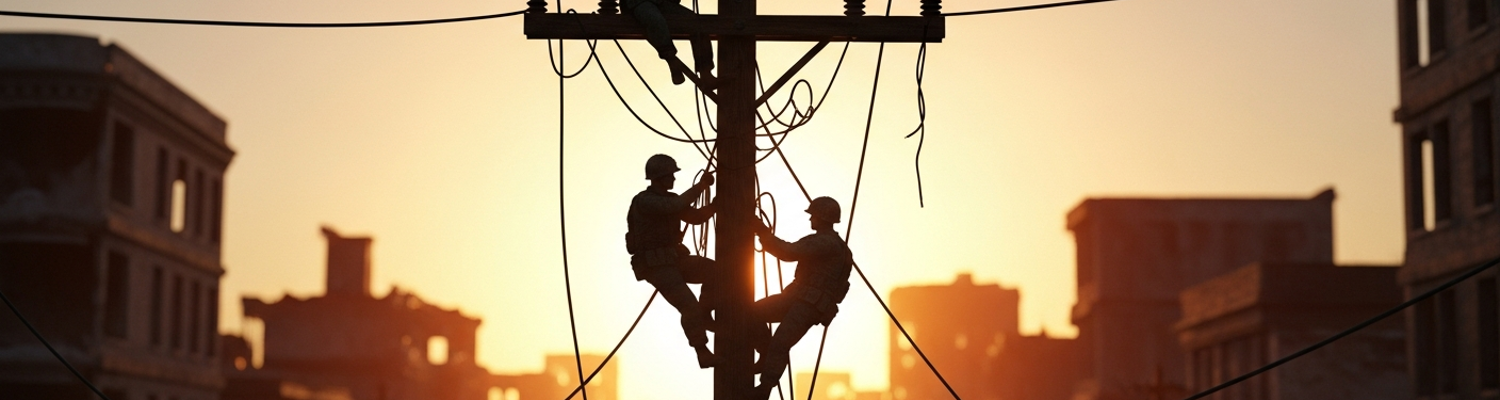

The Bakelite handset of the teletype machine was cold. Inside the cramped signal tent at Yokohama, the familiar clatter of the message printer had stopped. An unnerving silence took its place, broken only by the grating squeal of a stripped gear. For the operators of the 8th Army Signal Section, this was not an anomaly. It was the infuriating norm.
The silence of one machine mirrored the quiet across a shattered nation.
A review of operational logs from late 1945 (NARA Record Group 338) details the communications collapse that confronted American occupation forces. The strategic bombing campaign had systematically dismantled Japan’s civil and military communication networks. In Tokyo alone, firebombing raids destroyed the Ministry of Communications building. Nineteen of its principal telephone exchanges were gutted, their copper wiring melted and switchboards incinerated. Across the country, an estimated 1.6 million telephones, roughly half the nation’s total, were inoperable. The damage severed long-distance trunk lines, toppled radio broadcast towers, and flooded underground cable conduits. A formal survey of telegraph and telephone facilities confirmed they could not perform their primary function. What remained was a fragmented, barely functional system.
This technological ruin created an immediate crisis for the Supreme Commander for the Allied Powers (SCAP). The premise of the occupation, outlined in plans like Operation Blacklist, depended on swift and total control over the disarmed Japanese military and the civilian population. This required communication. Directives from General MacArthur’s headquarters in the Dai-Ichi Building had to be disseminated nationwide. This was necessary to prevent public disorder, manage the repatriation of millions of demobilized soldiers, coordinate the distribution of food and medical supplies, and begin political reform. Civil affairs teams, tasked with overseeing local Japanese government functions, operated in an information vacuum. They could not reliably report conditions or receive orders. Establishing a functioning network was a primary initial mission, essential for imposing the terms of surrender.
Command was deaf and blind.
For arriving Signal Corps units, like the 232nd Signal Operations Company and the 71st Signal Service Battalion, the task was a logistical disaster. They were ordered to build a command and control network from wreckage. Initial efforts focused on establishing links between critical hubs: Tokyo, Yokohama, Osaka, and key airfields like Atsugi. There was a shortage of compatible American equipment. This forced signalmen to become battlefield mechanics, attempting to splice U.S. military-grade wire with scorched Japanese cables. They tried to interface American switchboards with Japanese-made magneto telephone sets. Operational reports detail teams from the Eighth Army laboriously stringing new lines by hand across bomb-cratered urban landscapes. A captured Japanese radio chart became a tool for monitoring residual communications, but establishing their own reliable network was a constant, frustrating struggle.
The immediate objective of the Army Signal Corps upon entering Japan was the rapid establishment of secure communication networks. This was dictated by the core tenets of Operation Blacklist. Units like the 232nd Signal Operations Company in Yokohama and the 71st Signal Service Battalion in Tokyo were tasked with weaving a web of connectivity from nothing. Their primary directive was to link General MacArthur’s headquarters with every major military government team and prefectural capital. The plan demanded a multi-layered approach. High-speed teletype circuits were needed for encrypted command-level traffic. Extensive telephone switchboards were required to manage the administrative burden of demobilization and supply. Mobile radio nets were necessary to provide flexibility. A close review of archival records shows the initial deployment focused on creating a star network topology with Tokyo at its center. This ensured all information flowed through, and was controlled by, SCAP headquarters. This structure was designed for security and command authority, preventing unsanctioned communication between Japanese administrative regions. The establishment of communications security (COMSEC) units in 1946 was a direct response, tasked with safeguarding American transmissions.
The scarcity of resources forced Signal Corps personnel into a state of constant improvisation. American equipment, from SCR-300 walkie-talkie radios to heavy-duty W-110-B field wire, was often incompatible with the fire-damaged Japanese infrastructure. Operational logs detail the painstaking process of adapting. Signalmen became battlefield electricians, fabricating splice joints between American copper-clad steel wire and the scorched remnants of Japanese paper-insulated city cables. A significant hurdle was the mismatch in power standards, forcing teams to jury-rig voltage converters or cannibalize Japanese military generators to power American BD-71 switchboards. In many cases, the only available option was to salvage. Teams from the 71st Signal Service Battalion systematically stripped wrecked buildings and abandoned military sites for usable copper wire, vacuum tubes, and connectors. They discovered that the Japanese Type 2 field telephone used different signaling protocols and power sources than its American EE-8 counterpart, making direct integration impossible without workshop-level modifications. This ad-hoc engineering became the standard operating procedure.
These re-established communication lines directly enabled the coordination of security and administrative functions. A directive concerning the distribution of medical supplies would originate from a teletype machine in Tokyo. It would travel over a newly strung pole-and-wire line to the I Corps headquarters in the Osaka-Kyoto region. From there, it would be relayed via a patched-in telephone connection to a local military government detachment. In Hiroshima, where the communications infrastructure had been atomized, a Civil Affairs team might receive that order and then rely on a short-range SCR-536 handie-talkie to direct Japanese work crews at a distribution point. This chain of communication, fragile at every link, was the nervous system of the occupation. It allowed SCAP to manage the complex process of disarming millions of Japanese soldiers, track and contain outbreaks of disease, and oversee the initial distribution of food aid. The success of these ground-level tasks depended entirely on the Signal Corps' ability to make a dead network live.
The integrity of the International Military Tribunal for the Far East (IMTFE), convened in the shell of the Imperial Japanese Army Ministry Building in Ichigaya, Tokyo, depended on more than legal arguments. An unseen battle was waged across the electromagnetic spectrum by elements of the U.S. Army Signal Corps. A review of archival records from SCAP’s G-2 (Intelligence) Section reveals a deep concern for information security. This went beyond preventing leaks of testimony. It was a counter-intelligence operation designed to shield the judicial process from external disruption, whether from die-hard militarists, criminal elements, or foreign agents. The establishment of dedicated COMSEC units was a direct answer to this threat, embedding signal intelligence specialists into the tribunal’s operations. Their mission was to build a secure communications bubble around the IMTFE and simultaneously listen for hostile whispers in the static.
Signal intelligence personnel, often drawn from the 441st Counter Intelligence Corps (CIC) Detachment and working with the Eighth Army’s signal battalions, systematically monitored local Japanese communications. The primary organization for this was the Civil Censorship Detachment (CCD), which, under the operational control of G-2, functioned as a massive surveillance apparatus. An examination of their procedures shows a multi-pronged effort. Teams of Japanese-speaking American Nisei and trained local hires staffed listening posts. They sampled a significant percentage of all civilian telephone calls, telegrams, and postal correspondence across Tokyo. Their mandate was broad: to detect any activity inimical to the occupation’s objectives. In the context of the IMTFE, this meant listening for keywords related to defendants like Hideki Tojo, or judicial figures like Tribunal President Sir William Webb. They scanned for plots to intimidate witnesses, plans for protests, or the organization of ultra-nationalist groups. The volume was enormous. Records indicate that at the program’s height, over 800,000 telephone calls and millions of letters were monitored, with important details translated and compiled into daily intelligence summaries for SCAP command.
Parallel to this monitoring, Signal Corps engineers faced the task of maintaining robust communication links for the court’s own operations. These were not pristine, standardized networks. They were systems assembled from a mixture of American military hardware and salvaged Japanese components, often housed in damaged infrastructure. The Ichigaya courtroom itself became a hub of improvised engineering. Signalmen from units like the 71st Signal Service Battalion ran hundreds of miles of W-110-B field wire through the building’s corridors. This connected the judges’ chambers, translation booths, and the prosecution and defense offices. Antennas for radio transmissions were strung across the rooftops, linking the tribunal directly with MacArthur’s GHQ and, through a series of relays, back to Washington. These circuits were the lifeline of the trial, carrying classified cables, transcripts, and urgent requests for evidence. The constant threat of mechanical failure, power fluctuation, or incompatibility between American SCR-series radios and Japanese broadcast equipment meant maintenance was a non-stop effort.
A review of operational logs from the Eighth Army reveals a persistent battle fought with wire cutters and soldering irons. For the technicians of the 71st Signal Service Battalion, headquartered in the San Shin Building in Tokyo, the daily reality was a cycle of repetitive repair. The firebombing raids had left a legacy of phantom problems. A line that tested clear one moment could fail the next as shifting rubble severed a connection or rainwater seeped into a poorly insulated splice. Signalmen descended into flooded, debris-choked manholes to trace faults, often working by flashlight in near-total darkness. They discovered that Japanese paper-insulated cables, when exposed to moisture, became useless. This forced them to painstakingly pull and replace entire sections with American W-110-B twisted-pair field wire. It was brutal, physical labor, stringing the heavy, tar-covered wire across skeletal city blocks.
This state of disrepair placed a direct burden on the military police units. A functioning telephone line was the primary link between an MP checkpoint and its headquarters. When a patrol from the 8th Military Police Brigade detained an individual for a curfew violation, the ability to quickly verify their identity was paramount. A dead line, a common occurrence, meant delays. Archival evidence shows instances where MPs were forced to use runners or dispatch jeep patrols simply to relay a message. This forced Signal Corps teams into a reactive posture, constantly redeploying to fix outages that directly impacted security. A downed connection between a local police box and the area MP barracks could leave both parties blind.
Adapting to the ruined infrastructure required a level of field improvisation that became standard. American equipment was not designed to interface with what remained of the Japanese system. Technicians discovered that the Japanese Type 2 and Type 92 field telephones used different signaling protocols and power sources than the standard American EE-8 field phones. To make them work, signalmen had to perform workshop-level modifications in the field. They often cannibalized parts from several damaged Japanese sets to make a single one functional with an American BD-71 six-line switchboard. These switchboards, weighing over 50 pounds, became the nerve centers of local command posts. Connecting them was a puzzle. A single connection might involve splicing American W-110-B wire to a salvaged Japanese line, which then ran into a fire-damaged but partially-repaired civilian exchange. Each splice point was a potential failure.
The most persistent adversary was the fundamental breakdown of Japanese civil infrastructure. The bombing campaign had effectively severed the nation’s power grid, leaving cities like Tokyo in a state of near-perpetual blackout. For Signal Corps units, this presented a formidable problem. Their American-made equipment, from the delicate vacuum tubes in SCR-399 radio transmitters to the motors driving TG-7-B teletype repeaters, was designed for the stable 120-volt, 60-cycle alternating current of the American electrical system. The surviving Japanese grid, where it functioned at all, provided a sputtering 100-volt, 50-cycle current. This incompatibility rendered direct connection impossible without risk of equipment damage. The only solution was to deploy portable gasoline-powered generators, such as the PE-75, at every significant communications node. These generators, designed for field use, became a permanent feature of the occupation's urban landscape. This created its own logistical chain of weakness. A steady supply of gasoline was required to keep the network alive. The generators themselves, not intended for continuous 24/7 operation, suffered frequent mechanical failures.
This fragile network was then subjected to Japan’s extreme weather. Archival meteorological data cross-referenced with unit after-action reports from late 1945 shows a direct correlation between weather events and communication failures. In October 1945, Typhoon Louise swept across the Kanto Plain with winds exceeding 100 miles per hour. The heavy W-110-B field wire, which signalmen had laboriously strung, was snapped by the wind or torn down by flying debris. The typhoon’s torrential rains flooded underground cable conduits and manholes, shorting out thousands of splices. A line that worked one minute was dead the next. Following the storm, line patrols from the 232nd Signal Operations Company were dispatched into the wreckage. They were tasked with physically walking or driving the length of entire circuits to visually locate and repair each break. Winter brought heavy snow and ice, the added weight causing lines to sag and break.
Compounding every technical challenge was an acute lack of spare parts. The trans-Pacific supply chain prioritized ammunition, food, and medical supplies. Specialized electronic components like rectifier tubes and signal relays were a lower classification. An examination of supply requisitions from 1946 shows a consistent pattern of unfulfilled orders for basic maintenance items. When a single vacuum tube failed in a radio receiver or a gear stripped in a teletype machine, there was often no replacement available in the entire theater. This forced Signal Corps technicians to become masters of cannibalization and field fabrication. They systematically stripped components from equipment already deemed non-repairable, creating a dwindling stockpile of scavenged parts. A technician might spend hours removing a single capacitor or resistor from a destroyed radio set to bring another back to life. In more extreme cases, they were forced to manufacture parts from raw materials, using hand tools to shape a new bracket from scrap metal or painstakingly rewinding a burned-out transformer coil with salvaged copper wire.