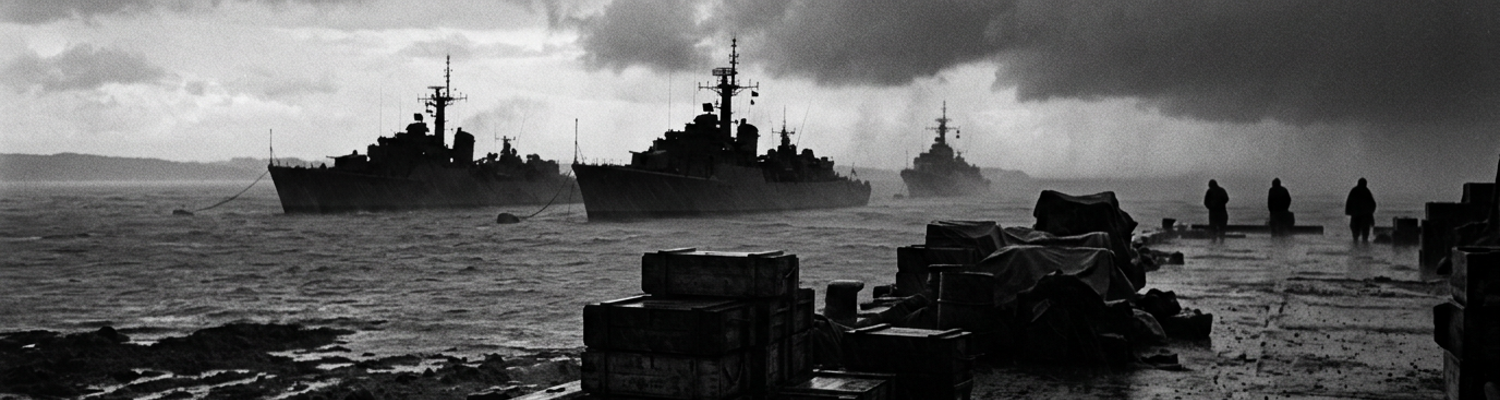

Yellow Sea Escort Operations and Vessel Weight Limits
Archival evidence shows that by October 1951, the United States Eighth Army command structure demanded the immediate fortification of forward island outposts along the Korean peninsula. Army engineers generated requisitions for thousands of heavy timber beams. These beams supported the construction of subterranean bunkers on exposed islands like Chodo and Sokdo. Navy planners fought the directive immediately.
Task Group 95.1 operated without dedicated cargo vessels. Rear Admiral George Dyer submitted formal protests. Loading heavy lumber onto the decks of combat frigates compromised ship stability. It blocked gunnery arcs.
Army supply officers ignored these protests. They dumped tons of raw pine logs and unpalletized crates of perishable medical stores directly onto the docks at Inchon. Bureaucratic infighting paralyzed the loading process for three entire days. Navy captains eventually ordered their own deck divisions to physically lash the timber to the steel decks of the frigates using heavy wire rope (Standard Navy Stock Number 4010-120).
The resulting payload blocked access to the aft 4-inch gun mounts on multiple Bay-class frigates.
A close review of operational logs indicates the route to the isolated island positions presented severe hydrographic hazards. The Yellow Sea features a tidal range exceeding thirty feet. This creates rapid currents. Massive mudflats are exposed twice a day. Task Group 95.1 commanders had to thread top-heavy ships through narrow channels without accurate depth charts.
Naval convoys navigated hazardous shallow waters. Ship engineers recorded that the shallow drafts forced seawater intakes to suck in dense coastal silt. Abrasive mud clogged the steam condensers. Boiler temperatures spiked rapidly. Engine room crews manually scraped the intake valves while the ships were underway.
On October 14, the frigate HMS Black Swan scraped a submerged sandbar off the coast of Sokdo. The impact sheared off a section of its port propeller blade.
The resulting mechanical vibration forced the ship to reduce speed to four knots.
North Korean shore batteries positioned on the Amgak peninsula frequently tracked these slow-moving convoys. Escort commanders requested counter-battery fire from Fifth Air Force fighter-bombers. Air Force liaisons denied these requests. They cited a lack of available aircraft.
Delivering the cargo required anchoring just outside the mudflats. Payloads were transferred into small flat-bottomed wooden junks operated by local South Korean partisans. Heavy pine logs frequently snapped the mooring lines during the transfer process. Thin wooden hulls of the reception boats were crushed.
Medical stores proved highly difficult to offload. Navy corpsmen carried crates of glass plasma bottles down rope cargo nets. The frigates rolled heavily in the coastal swell. Army liaisons stationed on the islands repeatedly broadcasted complaints over unencrypted radio frequencies.
Naval intelligence intercepted North Korean radio traffic. Enemy spotters used the Army broadcasts to calculate exact offloading schedules.
One 76mm artillery shell struck the water fifty yards from a junk loaded with surgical equipment.
Typhoon Ruth Coastal Convoy System Failures
Archival weather logs from the Joint Typhoon Warning Center indicate that a massive low-pressure system rapidly intensified east of the Philippines on October 13. This system moved aggressively northward. Typhoon Ruth battered the Korean theater with severe gales and extreme sea states. Barometric pressure plummeted to 940 millibars.
Navy meteorologists stationed at Yokosuka issued urgent fleet-wide advisories. All vessels received instructions to immediately seek sheltered anchorages.
Eighth Army supply commanders stationed in Seoul explicitly countermanded these naval weather directives.
Army officers prioritized their construction schedules for the island bunkers over fleet safety protocols. They ordered the Task Group 95.1 supply convoys to proceed toward the exposed anchorages of Chodo and Sokdo.
A close review of operational logs reveals that sustained wind speeds exceeded ninety knots by the morning of October 15.
The storm system transformed the Yellow Sea into a chaotic hazard zone. Shallow coastal shelves compounded the wave action. Steep swells measured thirty-five feet from trough to crest. Heavy weather forced coastal convoy escorts to battle sea swell damage. Green water crashed over the bows of the Bay-class frigates. Tons of ocean water smashed into the forward superstructures.
Shattered reinforced bridge windows on the HMS Whitesand Bay rained glass onto the deck. Seawater flooded the combat information center. Primary surface-search radar consoles shorted out. Structural rivets popped along the forecastle plating.
Unsecured ammunition boxes broke loose below decks. Damage control teams fought to secure the heavy metal crates. The boxes slid violently across the steel deck plates with every roll.
Army liaisons on the mainland continually broadcasted demands for the immediate delivery of the bunker timber over unsecured radio channels.
Radio operators aboard the frigates transcribed these hostile demands while standing in two feet of freezing seawater.
Offloading the deck-lashed pine logs in these conditions proved mechanically disastrous. Escort commanders dropped their heavy bower anchors near the coastal mudflats. Severe storm swells caused the frigates to pitch up to forty degrees off their center axis. Local South Korean partisans attempted to maneuver their flat-bottomed wooden junks alongside the steel warships.
Towering thirty-foot waves repeatedly slammed the fragile wooden junks against the armored hulls of the escorts. Navy deck crews attempted to use mechanical ship davits to lower the heavy timber bundles. Violent rolling motions applied extreme kinetic stress to the heavy wire ropes. Steel lifting cables snapped under the dynamic load.
Bundles weighing several tons crashed directly onto the decks of the small reception boats.
Four wooden junks completely splintered and sank within ten minutes.
Army quartermasters observing the disaster from the island shores accused the Navy crews of deliberately sabotaging the supply drop. They filed official reprimands against the escort captains via open radio channels. Navy deck divisions abandoned the mechanical davits entirely.
Sailors resorted to physically pushing the heavy pine logs over the side into the churning water using pry bars.
Severe gales immediately caught the floating timber. Rapid tidal currents combined with the storm surge to scatter the logs across miles of open ocean. Escort vessels continued to take heavy rolls. A massive wave tore a secured medical crate from its lashings near the aft superstructure.
Hundreds of glass morphine syrettes shattered against the aft gun mount.
Yellow Sea Island Army Engineer Outposts
Archival evidence shows that by early October 1951, Eighth Army command directed detachments of the 73rd Engineer Combat Battalion to occupy a string of barren landmasses off the North Korean coast. Elements of these engineering units deployed to coordinates 38 degrees 32 minutes North, 124 degrees 59 minutes East. This marked the center of Chodo. Sokdo sat just miles away.
The engineers received explicit directives from Seoul to construct deep subterranean radar bunkers and heavy anti-aircraft emplacements. These sites supported Fifth Air Force early warning networks. The networks tracked enemy MiG-15 fighters operating near the Yalu River.
Army planners drafted these fortification blueprints based on standard mainland supply algorithms. They entirely ignored the physical constraints of the Yellow Sea archipelago.
The islands lacked basic natural resources required for military construction. Not a single tree grew on the exposed western slopes of Chodo. The soil consisted of heavily compacted clay and shattered shale. Excavating deep trenches without pneumatic drills and industrial explosives proved mechanically impossible.
Every bag of Portland cement required to pour the bunker foundations had to cross miles of hostile water.
A close review of operational logs reveals that the island garrisons depended entirely on naval transport for defensive fortification material. Eighth Army quartermasters generated daily requisitions for thousands of board feet of heavy pine timber. They ordered corrugated steel roofing and high-tensile steel rebar. Supply officers transmitted these demands directly to the naval command at Inchon without consulting fleet loading masters.
Naval officers pushed back against the directives immediately. They pointed out that the Commonwealth frigates and aging American destroyers assigned to Task Group 95.1 lacked deep cargo holds. They lacked mechanical heavy-lift cranes found on dedicated transport vessels.
Army colonels stationed safely on the mainland dismissed these technical limitations. They ordered military police units at the Inchon docks to enforce the immediate loading of the construction materials onto the warships.
Navy deckhands had to physically drag wet two-ton bundles of raw lumber up the narrow gangways of combat vessels.
The sheer weight of the raw materials exceeded the maximum deck load capacities of the Bay-class frigates.
Navy engineers calculated that stacking wet pine logs on the upper decks raised the ship center of gravity past safe operational limits. Structural torsion from the heavy cargo caused steel rivets to pop along the hull plating before the ships even cleared the harbor breakwater.
Navy captains had to steer the overloaded warships through unmapped coastal channels. They fought severe top-heavy rolls caused by the unsecured timber shifting on the steel decks. Upon reaching the coordinates off Sokdo, the frigates encountered the next mechanical failure point. The Army engineers on the islands possessed no motorized amphibious landing craft.
They expected the deep-draft warships to drive directly onto the tidal mudflats to unload the cargo.
Warships draft twelve to fifteen feet of water.
Grounding a steel frigate on a coastal mudflat would permanently trap the vessel under the direct line of sight of North Korean 76mm shore batteries. The naval commanders refused the Army demands. They anchored two miles offshore in deep water. They radioed the Army engineers to send out local South Korean fishing junks to retrieve the heavy cargo.
Army radio operators screamed over unencrypted channels. They demanded the ships move closer to the beach. Navy deck divisions ignored the hostile radio traffic.
Sailors used hand-cranked winches to lower the heavy bundles of rebar and timber over the side of the pitching frigates. The offloading process rapidly devolved into a chaotic salvage operation. Tides running at six knots caught the heavy pine logs the second they hit the water. The rapid currents snapped the thin mooring lines of the reception boats.
Army engineers standing on the frozen beaches of Chodo watched thousands of board feet of construction timber drift northward toward enemy-held waters.
Command logs from the 73rd Engineer Combat Battalion show that out of three hundred logs dispatched on October 12, only forty-two reached the island shores. The engineers had to halt construction on the primary radar bunker. A lack of structural shoring caused the main excavation trench to collapse under its own weight.
Two gasoline-powered water pumps broke down after ingesting heavy coastal sand.
Revetment Collapse and Forward Bunker Security
Archival meteorological data from October 15 records Typhoon Ruth dumping fourteen inches of rain across the Yellow Sea archipelago in under twelve hours. The resulting deluge devastated the primary subterranean excavations on Chodo.
Elements of the 73rd Engineer Combat Battalion had previously dug six-foot-deep communication trenches through the compacted clay along the western elevation of the island. The storm surge pushed twenty-foot coastal waves directly into the low-lying revetments.
Seawater breached the temporary earthen berms at 0400 hours.
This tidal influx mixed with the torrential rainfall to completely saturate the exposed shale walls of the radar bunkers. Without the heavy timber shoring that had been lost at sea during the botched naval offloads, the trench walls lacked any structural reinforcement. Over three hundred linear feet of primary defensive trench line collapsed inward.
Thousands of tons of liquefied mud buried the foundational excavation sites.
A close review of post-action engineering logs reveals the precise mechanical failures that followed the collapse. Platoon commanders ordered their men to deploy heavy-duty gasoline water pumps to drain the primary anti-aircraft emplacements. The abrasive mixture of seawater and pulverized shale bypassed the rudimentary intake filters on the three-inch centrifugal suction hoses.
Internal combustion engines seized entirely within twenty minutes of operation.
Engineers resorted to forming manual bucket brigades in winds exceeding ninety knots. They stood waist-deep in freezing water. They passed canvas buckets of heavy sludge up the collapsed embankments while heavy rain continuously refilled the pits. Mainland Eighth Army headquarters transmitted orders demanding the immediate completion of the concrete pouring for the early warning radar foundations.
Forward radio operators transcribed these demands using waterproof grease pencils inside flooded canvas tents. The tents were actively tearing apart under the barometric pressure drops.
The mainland commanders threatened court-martial for any delays in the construction schedule.
Securing the defensive perimeter under these atmospheric conditions required continuous physical labor. The 73rd Engineer Combat Battalion had to maintain active guard posts facing the Amgak peninsula. Intelligence reports indicated North Korean amphibious infiltrators utilized heavy storms as cover for coastal raids.
Soldiers manning the forward observation bunkers found their primary fighting positions rapidly filling with coastal runoff. Sandbag fortifications dissolved as the heavy canvas rotted and tore under the sheer volume of rushing water. Infantrymen used standard-issue steel entrenching tools to frantically dig secondary drainage ditches around the heavy machine gun emplacements.
The wet clay adhered to the metal shovels. Troops had to scrape the mud off with their bare hands after every single strike into the earth.
Mud coated the receivers of their M1 Garand rifles and jammed the operating rods.
Clearing a single weapon required complete disassembly in the dark.
Archival evidence shows that local command decisions on the ground directly contradicted the mainland directives. A company captain on Sokdo ordered his engineers to abandon the flooded radar foundations entirely. He redirected all available manpower to physically bracing the collapsing perimeter bunkers using salvaged driftwood and the few intact pine logs that had washed ashore.
Men worked in rotating shifts of four hours to prevent severe hypothermia. They drove wooden stakes into the liquefied soil using ten-pound sledgehammers. Gale-force winds threatened to knock them off the exposed cliffs.
North Korean 76mm artillery shells began impacting the waters just off the eastern shore at 0730 hours. The enemy spotters utilized the storm noise to mask their firing signatures.
Shrapnel embedded itself deep into the mud walls of the collapsing revetments.
Inter-Service Supply Priority and Cargo Disputes
Archival evidence shows that by October 6, severe inter-service friction erupted between Navy deck officers of Task Group 95.1 and Eighth Army supply coordinators operating out of the commercial port of Inchon near coordinates 37 degrees 28 minutes North, 126 degrees 37 minutes East. The concrete docks became a bottleneck of conflicting operational directives.
Army quartermasters acting under direct orders from Far East Command in Seoul demanded the immediate embarkation of heavy construction materials destined for the 73rd Engineer Combat Battalion outposts on Chodo. Naval transport masters reviewed the manifest sheets and outright refused to authorize the loading sequence.
Combat vessels like the Bay-class frigate HMS Cardigan Bay lacked the deep internal cargo holds required to safely stow thousands of board feet of raw unseasoned pine timber.
Army officers dismissed these structural limitations. They ordered civilian stevedores to bypass the naval chain of command. The stevedores began hoisting two-ton bundles of wet lumber directly onto the steel weather decks of the warships using aging steam-powered dockside cranes.
The massive weight of the unseasoned wood immediately compressed the forward suspension springs of the dockyard cranes. Three primary steel lifting cables snapped in rapid succession.
A close review of operational logs indicates the supply crisis rapidly escalated into a direct command clash. The dispute centered on whether to allocate the highly restricted deck space to the heavy fortification timber or palletized emergency medical stores. Eighth Army engineering colonels prioritized the twelve-by-twelve-inch pine beams required to shore up subterranean early warning radar bunkers against coastal artillery strikes.
Naval medical liaisons assigned to the island garrisons simultaneously submitted urgent requisitions for type-O blood plasma. They requested sterile surgical instruments and wooden crates of morphine syrettes to treat personnel injured during the ongoing North Korean bombardments. Field hospitals on Sokdo reported low stockpiles of basic gauze bandages and iodine.
There was simply no physical surface area on the frigates to accommodate both manifests simultaneously.
Loading the heavy timber required deck divisions to lash the massive logs across the aft deck plates using half-inch galvanized wire rope and heavy steel turnbuckles. This specific load configuration physically blocked the watertight hatches leading to the lower ammunition magazines and the aft sickbay.
Stowing the fragile medical crates alongside the wet timber exposed the uninsulated wooden boxes to heavy saltwater spray and freezing offshore wind temperatures.
Seawater easily penetrated the unsealed medical crates.
Fleet commanders ordered their deck crews to halt the timber loading process entirely to prioritize the embarkation of the medical supplies. Army military police units stationed on the Inchon piers physically intervened. They drew their standard-issue sidearms to prevent the civilian stevedores from moving the plasma crates toward the gangways.
The ensuing standoff paralyzed supply operations for forty-eight hours. Unprotected medical stores sat exposed on the open concrete docks.
Heavy autumn rain saturated the thin cardboard packing materials surrounding the glass plasma bottles. Navy corpsmen eventually attempted to hand-carry the surviving medical supplies up the narrow aluminum gangways of the frigates. They had to navigate around massive stacks of pine logs that the Army had already forcefully loaded onto the port side of the ships using the surviving dockyard cranes.
The uneven weight distribution caused the HMS Cardigan Bay to list three degrees to port before it even detached from the heavy mooring bollards. Engine room personnel reported that the asymmetrical hull displacement forced the portside boiler intake valves below their designated operational waterline.
Thick harbor sludge immediately clogged the primary steam condensers.
Boiler temperatures on the frigate spiked past 450 degrees Fahrenheit within ten minutes of engine ignition. Engineering crews had to manually vent the high-pressure steam directly into the freezing harbor air to prevent a catastrophic turbine casing fracture.
Army supply officers standing on the pier recorded the venting steam as a deliberate Navy delay tactic. They filed official insubordination reports against the frigate captain over the open radio network.
BUMED Casualty Triage and Civilian Contractor Invoices
A close review of post-storm medical logs from October 17 reveals severe inter-service friction over casualty evacuation protocols. Soldiers from the 73rd Engineer Combat Battalion at coordinates 38 degrees 32 minutes North, 124 degrees 59 minutes East suffered extreme crush injuries when the primary radar bunker trenches collapsed under tidal flooding.
Army medical coordinators stationed in Seoul mandated the immediate maritime extraction of all wounded personnel to mainland hospitals. Navy Bureau of Medicine and Surgery (BUMED) officers deployed aboard the HMS Black Swan rejected this directive entirely.
BUMED triage protocol required stabilizing patients suffering from hemorrhagic shock in the shipboard sickbay before initiating any transit across the turbulent Yellow Sea. Pumping whole blood into patients required gravity-fed glass IV bottles that shattered easily when the ship rolled.
The Bay-class frigates lacked stabilized operating tables. Ship surgeons had to perform emergency amputations while the steel hull pitched violently in the residual thirty-foot typhoon swells.
Army radio operators transmitted repeated demands for the ships to raise anchor and sail immediately.
The resulting administrative dispute left heavily bleeding soldiers stranded on the frozen tidal mudflats for six hours.
Executing the actual triage process exposed massive mechanical and doctrinal failures between the branches. Navy corpsmen attempted to load the wounded engineers using rigid wire Stokes litters. They had to manually hoist the heavy metal baskets up the side of the rolling warships using basic block and tackle pulley systems.
Army liaisons on the beach dictated a triage sorting system based entirely on unit priority and officer rank. BUMED surgeons ignored the Army sorting tags completely.
Medical officers prioritized severe abdominal trauma over minor extremity fractures regardless of a patient military grade. A Navy lieutenant commander physically barred an Army captain from loading a stable infantryman into the highly restricted sickbay space.
The shipboard medical wards consisted of simple canvas cots lashed directly to the exposed steam pipes in the aft compartments. Heavy vibrations from the damaged port propeller transferred directly into the metal cots. Temperatures inside these makeshift wards frequently exceeded one hundred degrees Fahrenheit.
Four patients died from secondary infections before the frigate engines even engaged.
Archival evidence shows the casualty crisis compounded when Far East Command attempted to outsource medical overflow to local civilian contractors. Japanese surgical teams deployed by the Kanto Medical Corporation and South Korean maritime transport operators demanded upfront hazard pay for operating near the Amgak peninsula artillery zones.
BUMED administrative clerks required all civilian contractors to submit NAVMED Form 44 to process any financial reimbursement. Army supply officers distributed standard Department of the Army Quartermaster requisition slips instead.
This incompatible paperwork caused a massive processing backlog at the joint accounting office in Tokyo. It generated thousands of pages of rejected invoices.
Civilian doctors refused to board the flat-bottomed wooden transport junks without physical payment in Military Payment Certificates.
Entire surgical teams sat on the concrete docks at Inchon counting paper scrip while North Korean artillery shells impacted the island perimeters.
Financial disputes rapidly halted emergency medical supply lines across the entire theater. Civilian supply companies based in Yokohama submitted high-value claims exceeding fifty thousand dollars for medical stores destroyed during the botched naval offloads at Chodo.
BUMED auditors rejected liability for the thousands of glass morphine syrettes that shattered against the aft gun mounts of the frigates. They cited improper Army loading procedures as the primary cause of the destruction.
Eighth Army commanders refused to authorize the reimbursements from their own branch budget allocations. Contracted vendors responded by freezing all outbound shipments of type-O blood plasma, sterile surgical gauze, and heavy canvas field tents.
Joint Task Force accountants attempted to mediate the standoff by issuing emergency promissory notes to the supply managers. Foremen representing the civilian shipping companies rejected the unbacked paper and ordered their stevedores to lock the dockside warehouses.
Heavy steel padlocks secured the doors of the primary medical supply depots at 1800 hours.
Bureaucratic Friction and Chain of Command Failures
Archival evidence shows that by the morning of October 16, administrative paralysis directly degraded the survival margins of Task Group 95.1. Navy meteorologists at Yokosuka issued urgent fleet directives mandating an immediate withdrawal to deep-water anchorages as Typhoon Ruth intensified.
Eighth Army supply coordinators operating out of Seoul explicitly countermanded these naval weather protocols.
Army colonels prioritized the strict construction schedules of the 73rd Engineer Combat Battalion stationed on Chodo over basic maritime safety. Far East Command required the submission of a tripartite Joint Action Form 104 to authorize any deviation from the established supply manifest.
Naval officers aboard the HMS Whitesand Bay transmitted requests to abort the offloading sequence at 0600 hours due to thirty-five-foot swells. Army liaisons on the mainland refused to sign the diversion paperwork. They accused the Navy escort captains of cowardice over unencrypted radio channels and demanded the supply drops continue.
This administrative standoff trapped five overloaded combat frigates in the shallow coastal shelf for fourteen continuous hours.
Inter-service ego directly caused catastrophic mechanical failures during the resulting weather emergency. Army engineers standing on the frozen mudflats at coordinates 38 degrees 32 minutes North, 124 degrees 59 minutes East demanded the immediate transfer of high-tensile steel rebar. Navy deck commanders argued that operating heavy steam winches while the ships pitched forty degrees off their center axis would destroy the lifting equipment.
Ground commanders dismissed these technical warnings and threatened to file formal insubordination charges against the ship captains. Navy sailors eventually engaged the forward steam winches under direct protest.
The violent rolling of the frigate applied extreme lateral torsion to the uncompensated steel lifting cables. Heavy wire ropes snapped under the dynamic load. They whipped across the weather deck at high velocity. A severed cable struck the primary steam pipe feeding the forward winch motor.
High-pressure steam vented directly into the freezing storm air.
A close review of operational logs indicates the coastal crisis exposed severe structural flaws in joint-service command architecture along the Korean peninsula. The Eighth Army reported directly to headquarters in Seoul. Task Group 95.1 answered to the Commonwealth naval command in Tokyo.
Neither branch possessed the authority to issue binding tactical orders to the other during active combat operations.
This divided chain of command generated highly dangerous communication practices. Army quartermasters transmitted exact ship anchoring coordinates and cargo manifests in plain English over standard VHF radio frequencies. Navy signals intelligence operators begged the ground units to encrypt their transmissions.
Army radio operators ignored the warnings. They cited a lack of available encryption pads and the urgent need to coordinate the local South Korean fishing junks.
North Korean artillery spotters stationed on the Amgak peninsula transcribed every unencrypted broadcast.
The lack of unified coordination allowed enemy forces to exploit the inter-service friction with lethal precision. Enemy gunners used the loud arguments between the Army engineers and the Navy deck officers to triangulate the exact positions of the anchored frigates.
Fifth Air Force reconnaissance planes had photographed North Korean 76mm shore batteries moving into the Amgak cave systems three days prior. Air Force intelligence officers routed these photographs through the standard Army chain of command. Bureaucratic bottlenecks at the joint intelligence clearinghouse in Seoul delayed the distribution of these target coordinates to the naval task group.
Escort commanders sailed into the narrow channels entirely blind to the newly positioned artillery threats. Enemy batteries opened fire at 0815 hours on October 17.
The first 76mm shell detonated in the water twenty yards off the port bow of the HMS Black Swan.
Ship engineers frantically attempted to build steam to maneuver out of the impact zone. Thick coastal mud had already clogged the primary boiler intake valves during the fourteen-hour administrative delay. Boiler temperatures spiked past safe operational limits. The engine room crew had to shut down the port turbine entirely.
The frigate could only generate four knots of speed while navigating the shifting tidal channels under active enemy fire. Army engineers on the beach watched the naval vessel take evasive action and immediately broadcasted another complaint about the delayed cargo delivery.
Navy radio operators physically unplugged their receiver headsets.