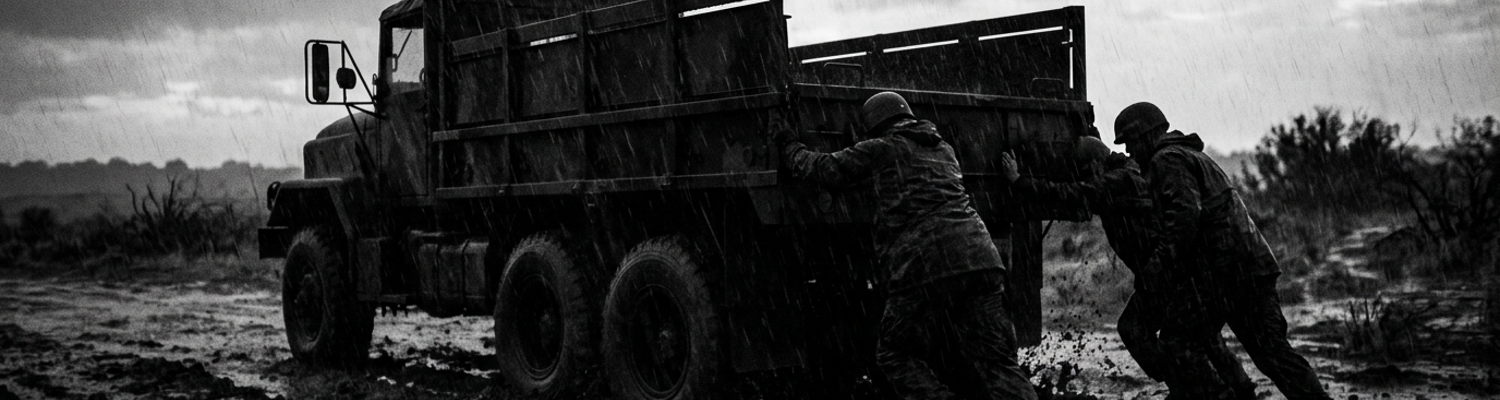

Tropical Storm Gordon and Route Nationale 1 Severance
Archival evidence shows that environmental collapse struck a force already depleted of physical stamina. Weeks before the weather broke, continuous operations had pushed the infantry into physical collapse. Rifle companies from the 10th Mountain Division operated on three broken hours of sleep each night. They survived on cold Meal Ready-to-Eat rations that failed to match the energy burned in the suffocating Caribbean humidity. Across the jagged terrain encircling Port-au-Prince, endless foot patrols ground leather combat boots down to the welt. Peeling skin from soaked feet triggered severe fungal rot. Waterborne dysentery spread steadily through the platoon bivouacs. Soldiers were dehydrated and weak before any weather crisis materialized.
Sleep deprivation dictated daily life.
In mid-November 1994, Tropical Storm Gordon swept across southwestern Haiti. The storm dumped over fourteen inches of rain across deforested mountain slopes within forty-eight hours. Devastating mudslides tore down hillsides into the lowlands. Torrents of liquified clay and uprooted trees tore through coastal defiles. This severed primary arterial transit along Route Nationale 1. Connecting the primary supply node at the capital docks with northern detachments in Saint-Marc, Gonaives, and Cap-Haitien, this narrow two-lane asphalt corridor represented the sole land transit route on the western side of the island. Flash floods roaring through the Montrouis corridor ripped away multi-ton bridge abutments. Wide chasms appeared where solid pavement had existed hours earlier.
The northern highway ceased to exist as a functional supply route.
When examining the historical record, engineering logs from the 41st Engineer Battalion (NARA Record Group 338) revealed that more than twenty drainage culverts ruptured along the Artibonite river basin. Entire miles of roadway submerged beneath four feet of thick sludge. Forward outposts were isolated from all ground-based replenishment. Joint Task Force 190 was built around the 10th Mountain Division. A close review of operational logs indicates that this command was forced to deploy motorized supply and security convoys across impassable river valleys. Convoys assigned to the 10th Forward Support Battalion and divisional cavalry troops received orders to plunge into swollen braided crossings across the Artibonite and Montrouis drainage basins.
No bypass bridges remained intact.
Drivers pushed M998 utility trucks and M923 five-ton tactical transports straight into roaring channels. Brown currents surged above hood lines and swept cargo off flatbeds. Mechanical failures followed almost immediately. Silty sediment forced its way past compromised axle seals. The grit mixed with gear lubricant to abrade the steel ring gears. Drive axles locked without warning. Hitting deep water at speed caused spinning engine cooling fans to bend backward into radiator cores. Aluminum cooling fins shredded. Engine blocks overheated. Submerged alternators drowned out 24-volt electrical systems in mid-crossing. Loaded vehicles stalled in five feet of churning mud. Heavy recovery winches snapped against submerged limestone boulders.
Institutional conflict between service branches compounded the physical breakdowns.
Division commanders requested offshore assistance. They asked for Navy landing craft utility vessels and Marine Corps CH-53 heavy helicopters to transport rations and fuel past the severed washouts. Joint headquarters staff officers hesitated. They cited incompatible communications protocols and jurisdictional limits established by theater command directives. Navy planners declined to commit shallow-draft landing craft across uncharted sandbars along the Montrouis shallows. Air Force flight controllers argued with Army supply officers over cargo manifests and landing strip clearances. Joint staff officers debated operational jurisdiction in air-conditioned operations rooms in Port-au-Prince. Forward infantrymen stood waist-deep in the Artibonite floodplain. They hand-carried forty-pound ration crates through running mud to keep remote perimeter garrisons alive.
Not by choice. By direct order.
Hydrolocked HMMWV Engines and Convoy Equipment Casualties
Deep water destroyed more vehicles than hostile fire ever did.
Archival evidence shows that Charlie Company of the 2nd Battalion, 14th Infantry Regiment pushed north from Gonaives toward Ennery along Route 109. Their vehicles lacked basic fording modifications. Standard M998 High Mobility Multipurpose Wheeled Vehicles possessed a factory wading threshold of thirty inches. Deep-water fording kits consisted of an elevated dry-element air cleaner snorkel pipe mounted to the right front fender, sealed dipstick tubes, and pressurized vent lines running to transmission cases. Joint Task Force 190 supply officers had left these kits behind in storage facilities at Fort Drum. They were attempting to trim sea-lift weight allocations. Convoy drivers encountered sunken defiles outside of Montrouis. Road cuts dipped five feet beneath brown runoff. Water surged directly into the unprotected passenger-side air intake louvers.
The 6.2-liter Detroit Diesel V8 engines drew raw liquid past saturated paper filters directly into the intake manifolds.
Water cannot be compressed. Pistons traveling upward on the compression stroke struck the unyielding liquid volume inside the combustion chambers. Forged steel connecting rods sheared. Some twisted into S-shapes. Fractured pistons punched jagged holes through engine blocks. Starter motors burned through wiring harnesses as drivers desperately tried to restart dead engines while submerged past the window frames.
Water snapped hardened steel rods in milliseconds.
A close review of operational logs indicates that the immobilization of lead vehicles triggered catastrophic traffic bottlenecks along narrow causeways bordering the Artibonite delta. Dead trucks sat anchored in five-foot road cuts near the Petite Riviere de l'Artibonite junction. Trailing supply elements from the 10th Forward Support Battalion ground to a halt along soft, crumbling road shoulders. Divisional heavy recovery capabilities rested entirely on a handful of M984 Heavy Expanded Mobility Tactical Truck wreckers and M578 light armored recovery vehicles. Dispatchers ordered these heavy platforms forward. The forty-ton wreckers broke through eroded roadbeds. They sank up to their transfer cases in saturated mud.
Within four hours, three of five designated recovery vehicles in the northern sector were disabled.
They snapped their sixty-thousand-pound steel winch cables. Hydraulic pumps burned out attempting to drag submerged five-ton cargo trucks against roaring four-knot currents. Dozens of M923 trucks carrying five-thousand-gallon fuel bladders, dry rations, and Class VIII medical supplies stood trapped in fast-rising floodwaters behind the disabled wreckers. Drivers abandoned cabs as the Artibonite River breached adjacent irrigation levees. Flatbeds submerged. Over forty pallet loads of whole-blood plasma, field dressings, and dry rations were ruined before they could reach northern perimeter garrisons.
Army maintenance officers requested direct recovery intervention from Atlantic Command.
When examining the historical record, these officers asked for Navy CH-53E Super Stallion heavy-lift helicopters stationed aboard the USS Dwight D. Eisenhower. The goal was to airlift stranded supply pallets out of the waterlogged defiles. Joint naval flight operations staff rejected the emergency support requests. They stated that Army cargo netting lacked certified naval sling attachments. Flight deck cycles were allocated strictly for contingency air cover. Marine Corps officers commanding an amphibious detachment near Gonaives declined to dispatch tracked AAV-7 amphibious assault vehicles into the inland river cuts. They cited theater command rules that prohibited committing Marine armored assets to unreconnoitered inland waterways without explicit approval from the Joint Task Force commander. Trapped Army truck companies watched floodwaters rise past the cargo gates of unrecovered supply transports parked along the Montrouis corridor. Salt and silt contaminated thirty thousand gallons of bulk diesel fuel by nightfall.
The fuel was completely unrecoverable.
Tactical Radio Failures and Optic Degradation in Rain Squalls
Electronic systems failed at the same rate as the combustion engines.
Archival evidence shows that torrential downpours rapidly overwhelmed the field sealing of the AN/PRC-119 Single Channel Ground and Airborne Radio System units mounted across tactical vehicles. Built for European temperate climates rather than sustained Caribbean tropical deluges, the RT-1439 transceivers suffered cascading water ingress. Rain forced its way past deteriorating neoprene rubber gaskets around front panel connector ports. Water seeped into the BA-5590 lithium battery compartments. Internal power distribution buses shorted out. Convoys moved along the Montrouis corridor toward Gonaives. Moisture saturated the internal desiccator plugs. Condensation formed directly across the solid-state circuit cards. Drivers keyed the handsets. Power surges melted internal microcircuits. The frequency-hopping systems lost clock synchronization.
Convoys from the 2nd Battalion, 14th Infantry Regiment suddenly vanished from the divisional command frequency net.
Joint Task Force 190 headquarters in Port-au-Prince lost all contact. Forward units found themselves unable to transmit medical evacuation requests. They could not report river flood depths. Confirming position coordinates along the severed coastal plain became impossible. Loss of radio contact left entire companies isolated without situational awareness.
Army communications officers attempted to re-establish emergency contact.
When examining the historical record, they requested access to ultra-high frequency satellite channels controlled by Navy task groups stationed aboard the amphibious assault ship USS Wasp. Naval communications watch officers denied the patching requests. They stated that Army vehicular tactical radios operated outside standard fleet security architecture. Joint satellite bandwidth was reserved exclusively for offshore surface-to-air defense links. Theater communications planners at Atlantic Command refused to release common cryptographic key tapes. They cited strict handling regulations that forbade distributing naval keying material to wet Army field units lacking secure vault facilities. Platoon leaders were left to run foot couriers through waist-deep flood channels between isolated vehicle clusters. Joint command ships ten miles offshore monitored blank radar screens without situational awareness of the inland catastrophe.
A close review of operational logs indicates that nighttime navigation collapsed entirely due to optic failures.
Vehicle drivers and mounted gunners operating in open-topped HMMWVs relied on early-generation AN/PVS-7A and AN/PVS-7B night vision goggles. Torrential sheets of descending water caused total optical disruption across the single-tube, dual-eyepiece devices during Tropical Storm Gordon. Ambient starlight and skyglow vanished under cloud cover. The Generation-II and early Generation-III image intensifier tubes were starved of photon amplification. Heavy rain created a solid sheet of reflected water particles. This generated severe scintillation and green blooming that obscured road edges. Moisture breached the purge valves of unpressurized goggle housings. Internal glass elements were coated with thick fog that could not be cleared in the humid Caribbean air.
Drivers attempting to steer along the edges of Route 109 experienced complete loss of depth perception.
They were unable to distinguish saturated dirt tracks from eight-foot-deep flooded ditches. Vehicles veered off washed-out embankments. M998 cargo trucks tipped into roaring irrigation canals. Soldiers were pinned beneath overturned vehicle frames. Night vision goggles became dead weight strapped to wet Kevlar helmets.
Convoy commanders made the direct tactical decision to violate blackout restrictions.
They activated vehicle high-beam headlights to keep supply columns from plunging into flood channels. Light beams reflected off the falling rain into blinding white walls. Forward visibility was reduced to less than five feet. Operational security across the valley was compromised. Marine Corps liaison officers at Port-au-Prince criticized the Army convoy commanders for breaking blackout protocol. They filed official joint task force incident reports regarding operational discipline. Army drivers struggled to pull overturned five-ton trucks out of deep mud pits near Petite Riviere de l'Artibonite while these reports were being drafted.
Navy Lighterage Denials and Inter-Agency Supply Gridlock
Archival evidence shows that by mid-November, Joint Task Force 190 sought immediate waterborne alternatives. Mudslides had completely closed the coastal choke points at Montrouis. Army planners submitted formal operational requests to the maritime component commander. They asked for Landing Craft Utility 1610-class vessels and LCM-8 mechanized landing craft from Assault Craft Unit 2. The plan was to run shallow-draft shuttle runs between the primary docks at Port-au-Prince and the small coastal anchorage at Saint-Marc.
Naval commanders promptly refused the mission.
Navy hydrographic assessment teams reported that floodwaters from the Artibonite River had dumped hundreds of tons of suspended silt into the coastal shelf. Bottom contours shifted. Uncharted sandbars formed throughout the shallows of the Golfe de la Gonave. Operating with an eight-foot loaded draft, the steel-hulled landing craft faced significant risk of bottom grounding. Rudder damage on unmapped underwater coral heads was a high probability. Fleet doctrine strictly prohibited beaching landing craft on unreconnoitered coastlines without on-site hydrographic clearance from Naval Special Warfare combat swimmers or side-scan sonar survey detachments.
Navy surface officers chose ship preservation over Army resupply timelines.
When examining the historical record, message traffic between Joint Task Force 190 headquarters and the naval task group stationed aboard the USS Wasp reveals unyielding procedural resistance. Army transportation coordinators pointed out that Saint-Marc featured concrete seawalls. The harbor water was deep enough to accommodate lighterage without requiring combat beach landings. Naval staff officers countered that civilian fishing debris, loose mooring lines, and floating timber washed down from flooded defiles posed severe risks to vessel propeller shafts and seawater cooling intakes. Dedicated salvage tugs and forward repair facilities were not stationed in the northern sector. Fleet operational risk directives gave maritime commanders complete unilateral authority to deny transit into coastal zones lacking certified bathymetric maps.
Forward garrisons for the 10th Mountain Division at Gonaives and Cap-Haitien sat physically severed from coastal supply lines.
Dozens of palletized bulk fuel containers and ration bundles were grounded on Port-au-Prince staging aprons. The ocean was an impassable barrier.
A close review of operational logs indicates that the maritime refusal pushed friction directly back into the crowded docks of Port-au-Prince. Bitter administrative battles sparked across the waterfront. Conflicting priorities erupted at the primary deep-water wharf. The Army 46th Support Group, Navy cargo handling battalions, and civilian relief directors from the United States Agency for International Development and Catholic Relief Services all demanded access. Commercial humanitarian vessels arrived carrying thousands of tons of bulk grain, rehydration salts, and water purification units. Army movement control teams demanded immediate offloading priority for Class I combat rations, 5,000-gallon collapsible fuel bladders, and crated diesel engine replacement components.
Civilian non-governmental organizations claimed presidential executive priority for emergency famine prevention.
They insisted that military cargo staging operations should step aside so private charter freighters could clear their holds. Army convoy dispatchers argued that without operational military trucks and secure communication hubs, civilian relief supplies could never move inland past the southern flood boundary anyway. Administrative disputes halted the distribution line before engine failures could.
Port terminal records confirm that naval harbor control officers resolved the operational dispute by locking down the pier berthing schedule. They wanted to avoid political entanglements. Navy authorities refused to clear civilian break-bulk cargo ships to dock without formal diplomatic waivers from the United Nations mission. They simultaneously denied Army material-handling equipment access to the quayside until security sweeps were executed by naval shore patrols. Two hundred M923 five-ton transports sat idle along Boulevard La Saline with empty fuel tanks. They awaited clearance stamps from inter-agency liaison committees. Four thousand bags of unprocessed flour hardened into solid paste in open storage under tropical downpours.
The supplies never moved.
Perimeter Misidentification and Near-Miss Fratricide Incidents
Isolation stripped modern infantry of its command structure.
Archival evidence shows that floodwaters halted a twelve-vehicle resupply column from the 10th Forward Support Battalion near the coastal bend outside Saint-Marc. The detachment commander ordered an immediate perimeter defense. Stranded drivers pushed drowned M923 five-ton cargo trucks and disabled M998 HMMWVs into an improvised circular coil along an elevated road berm. Torrential wind squalls from Tropical Storm Gordon tore sheets of rain across the salt marsh at forty knots. Visibility dropped to zero. Water had saturated the RT-1439 receiver-transmitters of the SINCGARS radio sets. The convoy had no link to the tactical operations center of the 2nd Battalion, 14th Infantry Regiment six miles north.
Squad leaders paced off fields of fire on foot.
They waded through knee-deep silt to hand-position M249 squad automatic weapons and M60 machine guns across vehicle tailgates. Hand-and-arm signals failed in the driving sheets of rain. Platoon sergeants yelled directly into the ears of young riflemen. They screamed over the engine idle of two running trucks and the thundering roar of storm runoff cutting channels through the roadbed beneath their tires. AN/PVS-7 night vision goggles were blinded by green optical flare. Gunners peered through fogged polycarbonate ballistic glasses into absolute pitch-black darkness. They were unable to see beyond ten yards.
Radio silence severed small squads from the broader command structure.
A close review of operational logs indicates that this total loss of situational awareness brought isolated units to the brink of lethal fratricide. Civilian directors from the International Criminal Investigative Training Assistance Program and military planners from the Joint Task Force had established armed patrols in Port-au-Prince. These were newly formed Haitian Interim Public Security Force units. These auxiliary police units were tasked with enforcing municipal curfews and deterring looters across the coastal district between Montrouis and Gonaives. Inter-agency coordination had failed completely. Joint task force staff officers had issued no operations graphics, frequency assignments, or patrol schedules to forward Army transportation units.
A six-man auxiliary police patrol moved south along the washed-out centerline of Route Nationale 1.
They were dressed in dark civilian waterproof slickers or unmarked field jackets. They carried M1 Carbines, twelve-gauge shotguns, and Israeli-made Galil rifles. Neither group knew the other existed in the sector.
When examining the historical record, logs from the 2nd Battalion, 14th Infantry (NARA Record Group 338) indicate that the auxiliary patrol stumbled directly upon the forward listening post of the stranded support convoy at 0240 hours. The armed Haitians moved through a drainage culvert to bypass an impassable breach in the road. They approached within twenty yards of an entrenched perimeter machine-gun position. High winds drowned out the standard challenge and password shouted by a startled nineteen-year-old machine gunner. Vehicle crews saw armed figures carrying long guns emerge from the brush in total darkness. They racked charging handles on M2 heavy machine guns and flipped selector switches from safe to semi-automatic on M16A2 rifles.
A gunner discharged a single warning round.
The bullet struck an asphalt berm inches from the lead auxiliary officer. The impact showered the Haitian patrol in stone chips. Before defensive perimeter crossfires could open up, the auxiliary commander dropped into the mud. He waved an amber chemical light stick issued by United States military police liaisons in Cap-Haitien. The patrol spent the next four hours face-down in freezing floodwater with five-point-five-six millimeter rifle barrels pressed against their backs. They were held at gunpoint. An unflooded courier HMMWV from Saint-Marc reached the perimeter at sunrise. The standoff ended. The 10th Mountain Division logged the near-lethal incident as a standard communications failure. Division clerks filed the report under routine operational constraints rather than hostile contact. The official record erased the near-miss entirely.