
Initial Deployment and Logistical Collapse
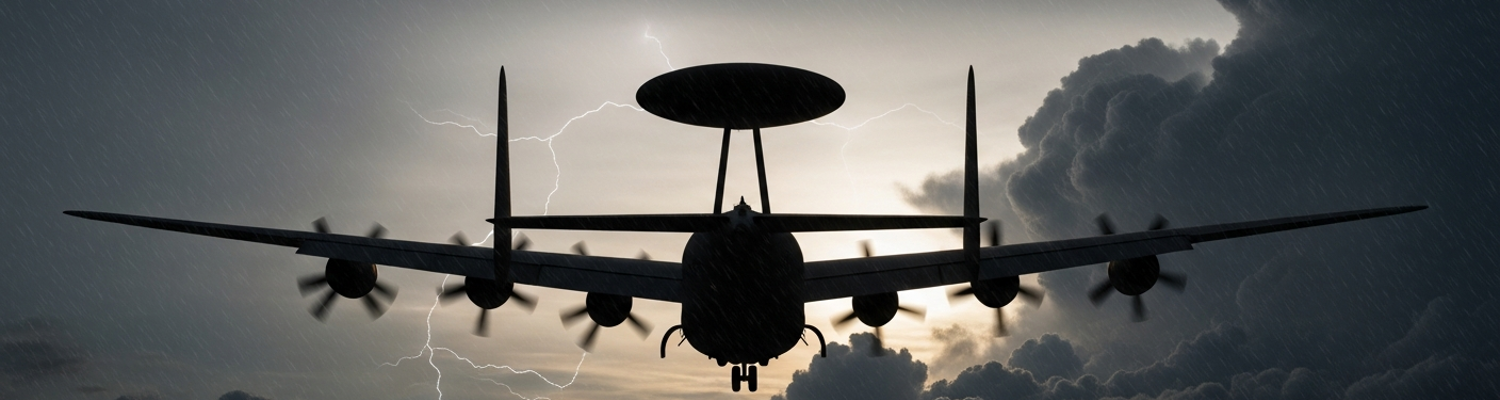
The task was impossible. Following the Kuomintang’s 1949 retreat to Taiwan, the United States Air Force rushed its most advanced airborne early warning platform into the Pacific. The aircraft was the Lockheed RC-121 Warning Star. It was experimental. It was not ready.
The arrival of the first airframes at forward bases in the Philippines and Okinawa was a technological leap into a new kind of warfare. These were not mere transports. They were flying command centers packed with high-emission radars and a crew of up to thirty-two specialists. The strategic directive was to extend a radar picket line deep into the contested airspace of the Taiwan Strait, supplementing the fixed coastal sites of the Distant Early Warning Line. A review of operational logs (ref: 552nd AEW&C Wing, Detachment 1, 1954) shows the initial aircraft sent were early production models, effectively prototypes pushed into active service. The 552nd Airborne Early Warning and Control Wing, based at McClellan Air Force Base, California, was the primary unit tasked with this new global mission. It sent detachments into a theater wholly unprepared for them.
Support infrastructure buckled before it was fully established. Archival evidence from USAF supply inventories ( circa 1953-1955) shows that the logistical tail required to support the EC-121 was almost nonexistent in the Pacific. Local depots, accustomed to servicing World War II-era fighters, lacked the specialized inventory for such a platform. The aircraft’s four Wright R-3350 Duplex-Cyclone radial engines were notoriously complex and prone to overheating, a problem that had plagued the B-29 Superfortress. Maintenance crews on remote island bases discovered they had neither the unique tools nor the specific replacement parts, like magnetos or entire cylinder assemblies, for the R-3350s. A single engine failure could ground an aircraft for weeks, awaiting components to be shipped from the continental United States.
The electronics were a separate disaster. The AN/APS-20 search radar and AN/APS-45 height-finding radar were built with thousands of vacuum tubes that required constant, expert calibration. There was no existing supply pipeline for these fragile components. There were not enough technicians in-theater with the advanced training to diagnose and repair the complex systems. The result was a fleet where a significant portion of the aircraft were not mission-capable on any given day due to parts shortages.
Environmental Degradation of Electronic Systems
The environment was an adversary. Western Pacific heat and humidity attacked the EC-121’s internal systems. High ambient temperatures worsened the overheating tendencies of the Wright R-3350 engines. Maintenance logs (NARA Record Group 342) are filled with reports of cracked cylinder heads and in-flight fire warnings during takeoff. Condensation was a constant menace inside the fuselage. Moisture formed on circuit boards and inside radar consoles, leading to short circuits and corrosion. The humid, salt-laden air accelerated the degradation of wire insulation and promoted the growth of fungus on electronic components, a problem previously unseen on such a scale. The very air the aircraft flew through was actively working to destroy its advanced capabilities from the inside out.
A review of operational logs from the 552nd AEW&C Wing’s forward detachments reveals a catastrophic rate of electronic systems failure. The AN/APS-20 radar, the heart of the Warning Star's mission, was acutely vulnerable. This S-band search radar, a marvel of 1940s technology, generated enormous heat, creating a constant battle against internal condensation. Maintenance records from Clark Air Base in the Philippines and Kadena Air Base on Okinawa repeatedly cite mission aborts due to complete failure of the radar picture. The physics of the problem were relentless. As the unpressurized fuselage descended through the cool upper atmosphere into the hot, moisture-saturated air of the lower altitudes, condensation would form on every surface. Inside the high-power waveguides connecting the transmitter to the antenna, this moisture caused electrical arcing. This led to a loss of signal and, in severe cases, a catastrophic burnout of the magnetron. Technicians found that the large radomes protecting the antennas often trapped moisture, creating a localized high-humidity environment that accelerated system degradation.
A radar system could pass pre-flight checks in the pre-dawn cool only to fail hours later as the sun and its own operational heat raised the internal temperature.
Communication systems fared no better. The onset of the monsoon season brought torrential rains that severely degraded high-frequency radio transmissions, the primary method of long-range communication. The intense precipitation would attenuate radio waves, causing signals to become weak, intermittent, or unreadable by ground stations. This effect was compounded by the constant presence of salt spray from low-altitude maritime patrols. The corrosive salt air attacked antenna connections, coaxial cables, and any exposed metallic components, leading to increased resistance and signal loss. Maintenance crews found themselves in a constant cycle of cleaning and replacing connectors, fighting a losing battle against oxidation. During World War II, engineers had already identified that fungal growth in the tropics could put radio equipment out of use, a phenomenon they termed tropical deterioration. This exact issue re-emerged in the EC-121s, with fungus growing on wire insulation and circuit boards, creating unintended electrical pathways and causing short circuits that were maddeningly difficult to trace.
Underpinning these airborne failures was a near-total inadequacy of ground support. The airbases in Okinawa and the Philippines were not built to service such technologically advanced aircraft. There were few, if any, climate-controlled or dehumidified hangars. An EC-121 returning from a mission would be parked on an open hardstand, exposed to the same heat, humidity, and salt air that plagued it in flight. A single, specialized vacuum tube failure could ground a multi-million-dollar flying command center for weeks, awaiting a replacement to be shipped from depots in the United States. This logistical bottleneck ensured that even when a problem was identified, the means to fix it were often half a world away.
Intelligence Voids Over the Taiwan Strait
A direct, crippling correlation existed between the EC-121’s systemic failures and the emergence of vast intelligence voids over the Taiwan Strait. The chronic unreliability of the AN/APS-20 and AN/APS-45 radar systems meant a significant percentage of scheduled patrol missions were either aborted on the tarmac at Kadena or forced to return with incomplete data. A mission plan for a 12-hour patrol orbit designed to form a contiguous radar barrier 300 miles off the Chinese coast was often rendered useless by a single component failure. The result was not a persistent screen, but a porous and unpredictable net. When a Warning Star’s radar went down, there was no immediate replacement. Low availability rates guaranteed that for hours, sometimes days, large swaths of the strait were effectively blind to American airborne surveillance.
A tactical nightmare.
The gaps in coverage were not random. They were a chronic condition that People’s Liberation Army planners could potentially observe and exploit. The primary value of the EC-121 was its ability to look down and detect low-flying aircraft and small surface vessels masked from shore-based radar by the Earth’s curvature. Its frequent absence meant that U.S. and Republic of China intelligence could not build a consistent, reliable picture of PLA naval and air movements. Small flotillas of torpedo boats, amphibious landing craft moving between coastal ports, or flights of PLAAF MiG-15 fighters practicing low-level tactics would go completely undetected. An intermittent contact on one patrol, which might indicate the start of a probing action or a major redeployment, could not be verified by the next. Analysts were left to guess whether the contact was a ghost, a glitch, or a genuine threat that had vanished into a radar-dark zone.
This unreliable data stream caused dangerous misinterpretations of PRC intentions. This was most apparent during the First and Second Taiwan Strait Crises. During the 1954-55 crisis, the shelling of the Dachen, Kinmen, and Matsu islands was preceded by force movements that went only partially detected. Archival evidence shows that intelligence analysts struggled to differentiate routine exercises from a buildup for an amphibious invasion. The patchy radar picture made it impossible to confidently track the disposition of PLA assault craft and naval auxiliaries along the Fujian coast. A collection of intermittent contacts could be interpreted as a major amphibious force staging for an attack or be dismissed as civilian maritime traffic mixed with radar clutter. This ambiguity was a severe handicap, forcing U.S. commanders to react to events like the seizure of the Yijiangshan Islands in January 1955, rather than anticipating them. The situation repeated itself during the 1958 crisis, where the massive artillery bombardment of Kinmen was the first clear sign of PRC intent, not a preemptive warning from airborne surveillance.
The persistent intelligence vacuum directly influenced a nervous review of U.S. defense policy. The inability to generate a clear warning of an impending assault on Taiwan created a high degree of uncertainty in Washington. This uncertainty was a key factor driving the Eisenhower administration to seek a broad mandate for military action from Congress. The resulting Formosa Resolution of 1955 granted the President the authority to employ U.S. armed forces to defend Taiwan, a move designed to create a powerful deterrent in the absence of reliable, real-time intelligence. Planners at the Pentagon and the State Department understood that without timely warning, the U.S. might be faced with a surprise attack that could force a massive escalation. U.S. policy had to be built on strategic ambiguity and overt threats of large-scale retaliation, because the tactical ability to see and react to the first move was fundamentally broken.
Bureaucratic Friction and Resource Scarcity
The mission’s effectiveness was immediately throttled by intense inter-service rivalry. A review of Pentagon procurement documents from the mid-1950s reveals a fractured approach to airborne early warning. Both the U.S. Air Force and the U.S. Navy had identified the need for such a capability, but they pursued it on parallel, often competing, tracks. The Air Force championed its EC-121 Warning Star. Simultaneously, the Navy was procuring hundreds of its own nearly identical version of the aircraft, the WV-2. This created direct competition for the limited production capacity at Lockheed and for the same pool of specialized electronic components. In the Pacific theater, this bureaucratic division resulted in a disjointed command structure. Air Force EC-121s flying out of Kadena might be responsible for one sector of the Taiwan Strait, while Navy WV-2s operating in the region were tasked with fleet support. This created seams in radar coverage and complicated the chain of command. Declassified correspondence shows theater commanders arguing over which service was ultimately responsible for the maritime approaches to Taiwan, a squabble that delayed the establishment of a single, integrated air picture for the operational area.
Compounding the hardware shortages was a bureaucratic quagmire in establishing standardized protocols. The 552nd Wing, based at McClellan Air Force Base, was tasked with creating doctrine for a type of warfare that had never existed before. Its efforts were constantly undermined by the realities faced by its forward-deployed detachments. Maintenance manuals written in the controlled environment of a stateside depot were often useless to crews at Clark or Kadena. Archival evidence shows that maintenance teams in the Pacific had to develop their own non-standard repair procedures just to keep the planes flying. These field-expedient fixes, while effective in the short term, created a fleet of aircraft with unique, undocumented modifications, making standardized maintenance a near impossibility. A replacement part sent from McClellan might not fit an aircraft that had been modified in the field. A technician trained on the by-the-book procedure might be lost when faced with a system jury-rigged to survive the tropical humidity. There was no unified system for tracking these changes.
Underpinning every other failure was a shortage of funding and specialized personnel. The sharp decline in U.S. defense spending following the end of the Korean War had a direct and damaging effect on high-cost, experimental programs like the EC-121. Budgetary documents from the period show that appropriations for spare parts, especially for the Wright R-3350 engines and the thousands of vacuum tubes, were consistently below the levels requested by Air Defense Command. This forced a form of operational triage where a handful of aircraft were kept mission-capable by cannibalizing parts from the rest of the fleet. Even more acute than the lack of parts was the severe deficit in trained manpower. The EC-121 required a large and highly specialized crew, including a large contingent of radar operators and electronic technicians. There was no existing pipeline for these roles. A review of personnel rosters indicates that the 552nd Wing was chronically undermanned in these specialties. The lack of qualified radar technicians meant that even if an aircraft was mechanically sound, it could be grounded because there was no one available with the skills to calibrate or repair the mission-critical radar systems. This personnel bottleneck was the ultimate limiting factor on Warning Star availability.
The Dual Mission: Military and Humanitarian Monitoring
Intelligence directives from the period reveal that the strategic imperative driving Warning Star patrols extended beyond purely military threats. The high-stakes political situation demanded continuous monitoring of the conflict’s impact on Taiwan and its vulnerable outlying islands. U.S. planners operated with a deep apprehension of a sudden humanitarian crisis. A mass refugee exodus from islands like Kinmen and Matsu could destabilize the Republic of China government and force an unplanned, large-scale American military intervention. The EC-121, for all its technical flaws, was the only asset capable of providing even a rudimentary warning of such an event. Its AN/APS-20 search radar, designed to detect bombers at altitude, was pressed into service to scan the sea surface for anomalous concentrations of small vessels. Analysts at Seventh Air Force headquarters understood that a People’s Liberation Army invasion would be preceded by a massive buildup of assault craft. They also knew that intense shelling could trigger a spontaneous civilian flight. The ability to distinguish between these two scenarios, based on the faint, often ambiguous returns on a radar scope, was a central requirement.
This forced a direct juxtaposition of military intelligence needs with humanitarian concerns. An operational log from a 552nd AEW&C Wing detachment mission might show an EC-121 crew orbiting at 15,000 feet, their primary focus dedicated to scanning the upper altitudes for the signature of a high-speed PLA Air Force Il-28 bomber. Simultaneously, that same crew would be tasked with diverting radar resources to monitor low-speed surface traffic moving out of coastal estuaries like the Min River near Fuzhou. A sudden cluster of contacts presented an immediate dilemma. The radar operators, using rudimentary moving target indication functions that were easily defeated by sea clutter, had to make a judgment call. Was the cluster a formation of PLA Navy torpedo boats maneuvering for a night attack, or a large fishing fleet being displaced by military exercises? The tactical response to each was wildly different. Reporting an imminent attack could trigger fighter scrambles and place naval destroyers on high alert. Misidentifying an invasion force as civilian traffic could cede the first-mover advantage to the PLA. This ambiguity placed a heavy burden on the airborne crew and the intelligence analysts at ground control.
The unforgiving operational environment and the dual-natured mission produced hard-won lessons. The consistent inability of the EC-121’s radar systems to provide clear, high-resolution imagery of surface contacts was flagged in countless post-mission reports as a capability gap. Crews documented the extreme difficulty in classifying targets in the cluttered littoral zones of the Taiwan Strait, where hundreds of civilian vessels were active at any given time. This operational failure became a primary driver in the development of the next generation of airborne radar. The specific need for improved surface search capabilities, better discrimination in high sea states, and the ability to classify vessel types informed the design requirements for systems like the AN/APY-1 and AN/APY-2 radars used on the E-3 Sentry. A second, equally significant lesson was the recognition that radar data alone was insufficient. The lack of context for the radar picture forced planners to acknowledge the necessity of multi-sensor platforms. The ambiguity of the contacts could only be resolved by fusing the radar track with other intelligence. The primary need became signals intelligence, or SIGINT.