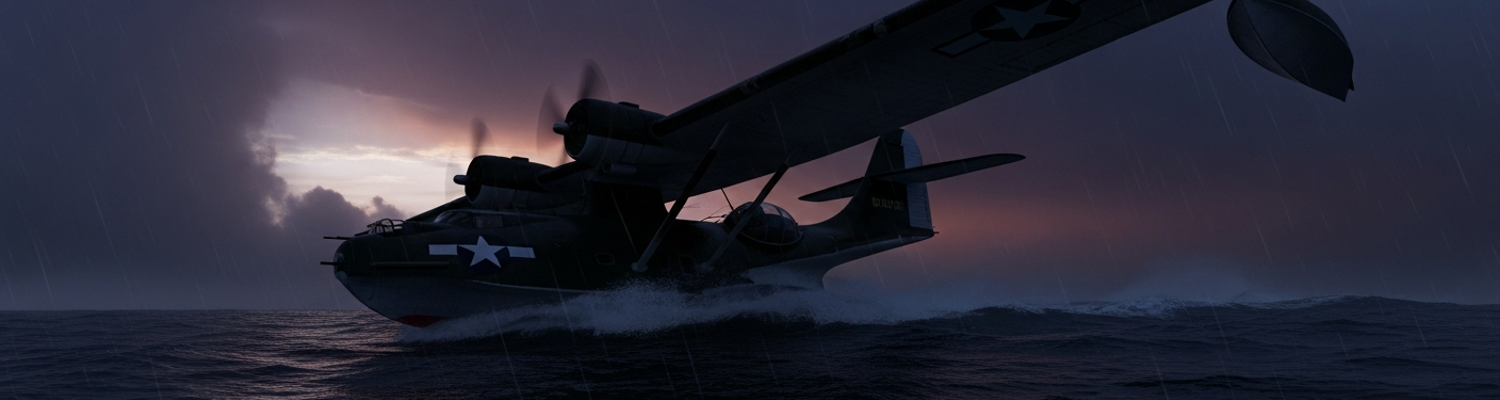

Operational logs from the Solomon Islands campaign document a machine stretched to its absolute limits: the Consolidated PBY Catalina. Its most demanding function was long-range reconnaissance. With a sprawling wingspan of 104 feet and a mission range exceeding 2,500 miles, the PBY was one of the few assets capable of patrolling the vast, empty quarters of the Pacific separating island chains. Crews from squadrons like VP-11 and VP-12 would lift off from the waters of Tulagi harbor or Henderson Field’s rudimentary strips for missions that routinely surpassed twelve hours. These were grueling flights spent scanning the horizon for any sign of the Imperial Japanese Navy’s movements through the channel running down the Solomon chain, an area known to crews simply as The Slot. The Catalina’s slow speed, topping out around 179 mph, made it easy prey for faster Japanese fighters. Its defense lay in its multiple .30 and .50-caliber machine gun positions and the resilience of its airframe. It was a vulnerable machine, often flying alone. Weather in the Solomons was an enemy in itself. Sudden, violent thunderstorms could tear at the aircraft and completely obscure visibility. The strain on the two Pratt & Whitney R-1830 engines was constant, and the psychological toll on the aircrews undertaking these lonely, high-risk patrols was a persistent operational concern.
By April 1943, anti-submarine warfare had become another demanding role for the overtaxed Catalina squadrons. Royal Australian Air Force operated Catalinas began extensive mine-laying operations on April 23, 1943, designed to bottle up Japanese shipping and force submarines into deeper, more predictable waters where they could be hunted. In the Atlantic, PBYs known as Mad Cats were being fitted with the new Magnetic Anomaly Detector (MAD) gear, a device that could sense the metallic mass of a submerged submarine. While this technology was still being refined for widespread use in the Pacific, the core tactics were the same. PBYs would fly low, monotonous patterns over convoy routes and the approaches to Allied bases like Espiritu Santo. Their crews scanned for the faint trace of a periscope. An attack involved dropping a pattern of 325-pound depth charges, a dangerous maneuver for the slow-moving aircraft. The effectiveness of these missions was often a matter of persistence and coordination with surface ships. Later in the war, specially outfitted Black Cat PBYs, painted matte black for night operations, would become exceptionally effective submarine and ship hunters, using early airborne radar to turn darkness into an advantage.
This is where the Catalina’s amphibious nature proved its worth, transforming it from a patrol bomber into a lifeline. In its air-sea rescue role, codenamed Dumbo, the PBY became a symbol of hope for downed airmen. From January to August 1943 alone, rescue flights based around Guadalcanal saved 161 aviators. A Dumbo mission was a high-stakes affair. Pilots had to land their large, unwieldy flying boats on the open ocean, often in rough swells and sometimes under fire from nearby enemy shore batteries. Pulling exhausted or wounded men from the water and then managing a takeoff from a hostile sea pushed both the crew and the airframe to their breaking point. Beyond these dramatic rescues, the Catalina served a more routine, but equally important, logistical function. They were the only aircraft capable of reaching isolated Marine detachments or coastwatcher units on islands without airstrips, landing in sheltered lagoons to deliver mail, ammunition, and medical supplies like plasma and quinine. They ferried spare parts that kept fighter squadrons at forward bases operational and transported personnel between the scattered Allied holdings, a vital connective tissue in a theater defined by immense distances and water.
When examining the historical record, the Consolidated PBY Catalina emerges as an aircraft born from a different era, thrust into a conflict its designers had not fully envisioned. Its entire architecture was a product of mid-1930s naval requirements that prioritized endurance and range above all else. The result was a large, aerodynamically clean flying boat with a massive 104-foot parasol wing packed with fuel, powered by two reliable but ultimately underpowered Pratt & Whitney R-1830 Twin Wasp engines. These engines gave the Catalina its legendary reach, but at a punishing cost in performance. The aircraft’s maximum speed was an optimistic 196 mph, but operational logs from squadrons in the Solomons show that its typical cruising speed on a long patrol was a sluggish 125 mph. Against a Mitsubishi A6M Zero, which could easily exceed 330 mph, the Catalina was a floating target. It could not run. It could not out-climb. It could not out-maneuver its opposition. Tactical doctrine for a PBY caught in the open was to drop as low as possible to the waves to prevent an attack from below and hope that cloud cover was nearby.
This defensive posture was made far more desperate by the Catalina’s initial defensive armament. Early PBY-5 models that formed the backbone of patrol squadrons at the start of the Pacific war were severely under-gunned. A close review of their specifications reveals a defensive suite consisting of just three .30 caliber machine guns: one in a bow turret and two in the now-iconic waist blisters. These weapons were wholly inadequate against the speed and armament of Japanese fighters, which often carried a combination of 7.7mm machine guns and devastating 20mm cannons. Combat reports from Patrol Wing 10 in the Philippines campaign detailed the futility of fending off determined attacks. The .30 caliber rounds simply lacked the mass and energy to inflict critical damage on an enemy fighter making a high-speed pass. While later PBY-5A models and field modifications by desperate crews in places like Halavo Seaplane Base on Florida Island introduced .50 caliber M2 Browning machine guns into the waist positions, it was a partial solution at best. The Catalina’s airframe itself was a point of failure. Early versions lacked self-sealing fuel tanks and armor protection for the crew. A single well-placed burst of cannon fire or even tracer rounds into the vast, unprotected wing tanks could, and often did, turn the patrol bomber into a plume of fire and falling debris.
The very environment of the Pacific theater amplified these mechanical weaknesses into daily operational threats. The campaign in the Solomon Islands was fought across immense stretches of empty ocean, where navigational errors or engine trouble could be a death sentence. A patrol route stretching from Espiritu Santo toward The Slot was a lonely, 12-hour-plus journey with no friendly landmasses for diversion. Furthermore, the tropical climate was a relentless enemy. The hot, humid, salt-saturated air fostered corrosion that aggressively attacked airframes, wiring, and engine components. Maintenance crews at forward bases like Tulagi fought a constant battle against this decay with limited parts and tools. Weather fronts in the region were notoriously violent and unpredictable, capable of producing thunderstorms that could toss the large aircraft uncontrollably or tear at its control surfaces. Flying through these conditions at night, with only primitive instruments, pushed crews to the edge of their endurance. Landing a flying boat in the open ocean swells, whether to rescue a downed aviator or because the aircraft itself was crippled, was a feat of exceptional skill that frequently ended with the hull breaking apart under the strain.
A close review of operational logs from the Solomon Islands campaign shows how the PBY was systematically reshaped by battlefield necessity. The introduction of compact Air-to-Surface-Vessel, or ASV, radar sets was one of the most significant adaptations, transforming the slow patrol bomber into a nocturnal predator. Squadrons like VP-11, operating in the Solomons from late 1942, became the first dedicated Black Cat units. Their aircraft, painted in non-reflective matte black, were field-fitted with the British-designed ASV Mk. II radar. This system featured a series of prominent Yagi dipole antennas mounted under the wings and on the fuselage, a clear visual marker of its new purpose. The technology was rudimentary, presenting the operator with a simple green line on a cathode-ray tube, but it allowed crews to detect Japanese vessels from up to 20 miles away in complete darkness. This capability directly countered the Tokyo Express, the nightly runs of Japanese destroyers and transports resupplying Guadalcanal. A Black Cat crew could now hunt in the pitch black, throttling back their engines and gliding in at wave-top height to evade detection before dropping bombs or torpedoes. The Catalina's once-debilitating slowness became an asset, providing a stable platform for attack runs on an unsuspecting enemy.
The machine was pushed to its physical limits. To extend the Catalina’s already legendary range, maintenance crews at forward bases engaged in constant, and often unauthorized, fuel capacity modifications. Standard PBY-5 models were later retrofitted with self-sealing fuel tanks, which slightly reduced the total fuel load but drastically improved survivability against enemy fire. This was not enough for commanders who needed aircraft to patrol farther and loiter longer. Archival evidence shows that ground crews would install auxiliary fuel tanks inside the fuselage, often in the bomb bays or even in the main crew cabin, creating a cramped and hazardous environment. Some records describe the use of 500-gallon rubber gasoline tanks on mooring buoys, allowing a PBY to refuel in a forward anchorage before continuing its mission. These changes increased the gross weight of the aircraft, complicating the already difficult process of taking off from choppy seas and negatively affecting flight performance. The addition of unarmored fuel tanks inside the fuselage was a calculated risk, accepted in order to provide the operational reach required for long-range mining operations or deep reconnaissance over hostile waters.
The Catalina also became an impromptu cargo hauler. It was never designed for logistics, its interior filled with navigation gear, bunks, and armament stations. However, its unique ability to land on water made it the only viable transport for supplying isolated coastwatcher units and Marine detachments on islands without airstrips. Maintenance logs detail the process of stripping non-essential equipment from the fuselage to create space. These flying trucks were loaded with everything from ammunition crates and jerrycans of fuel to sacks of mail and medical supplies. A single PBY could deliver the specific spare parts, a carburetor for a Corsair, a magneto for a Dauntless, that kept an entire fighter squadron operational. They ferried personnel between the scattered islands, moving pilots, intelligence officers, and wounded soldiers across the vast distances of the Solomons. These ad-hoc cargo conversions were a testament to the versatility of the airframe and the ingenuity of the crews who depended on it.
Operational logs from April 1943 reveal a command structure in the Solomon Islands stretched to its breaking point. On April 1st, Rear Admiral Marc Mitscher took command of all Allied air assets in the theater, designated ComAirSols. He inherited a multiservice, multinational force of US Navy, Marine, Army, and Royal New Zealand Air Force squadrons just in time for Japan’s largest aerial offensive since Pearl Harbor. Operation I-Go. From Rabaul, Admiral Isoroku Yamamoto amassed nearly 350 aircraft, stripping planes from his carriers, to throw against Allied positions around Guadalcanal and New Guinea. For the commanders on the ground, the pressure was enormous. Mitscher later recalled this period as his toughest duty of the war, a daily battle of wits against an enemy appearing in overwhelming numbers. The Japanese objective was to halt the Allied offensive momentum gained after the costly Guadalcanal campaign, giving Japan time to build a new defensive perimeter. For Mitscher and his staff in the command post at Henderson Field, known as the Pagoda, every decision was fraught with risk, balancing the need to preserve their own limited aircraft against the necessity of blunting raids that sometimes numbered over 150 planes.
This command pressure was magnified by severe technical limitations in radar and communications. The primary early warning system on Guadalcanal was the US Army’s SCR-270 radar, a set that had detected the Pearl Harbor attack force. While it offered a long range of up to 150 miles, it was a primitive instrument. The SCR-270 could not determine the altitude of incoming raids, and its directional accuracy was poor, leaving fighter directors to guess at the true size and height of an enemy formation. Experienced operators could make rough estimates based on signal fade, but it was an imprecise art. This forced Allied fighters to scramble and climb laboriously to what they hoped was an advantageous altitude, often burning precious fuel only to find the enemy far above or below them. Compounding this was the unreliable Identification Friend or Foe (IFF) system. The early Mk. II IFF transponders were fragile and frequently malfunctioned, while the transition to the more effective Mk. III system was still underway in 1943. With Japanese aircraft sometimes using false IFF signals, American anti-aircraft gunners on ships and on shore were left with a terrifying choice: trust a flickering IFF return that might be a deception, or make a split-second identification based on visual cues of aircraft speeding towards them out of the sun.
The inevitable result was tragedy. Records from the period document multiple instances of friendly fire, born from the combination of jumpy nerves and faulty technology. One account from VP-11, a Catalina squadron active in the Solomons, notes the loss of one of its PBYs to friendly fire. In another documented case, a PBY Catalina (Bureau Number 2458) was so badly damaged by fire from a nervous convoy it was escorting that it was wrecked upon landing, per a USN accident report from May 1943. Perhaps the most grievous errors involved attacks on friendly submarines. American submarines operated under strict orders to remain within designated patrol areas, and any sub found outside these zones was presumed hostile. The combination of a slow PBY on patrol, a briefly surfaced submarine, and the inability to reliably communicate or identify each other created the perfect conditions for fratricide. The constant threat of misidentification by friendly aircraft was a persistent danger for all submarines in the theater.
Logs from 1943 reveal the PBY Catalina as the connective tissue of the Solomons campaign. Its amphibious nature was its greatest logistical strength. As Allied forces leapfrogged up the island chain, securing beachheads and hacking rudimentary airstrips out of the jungle, the Catalina was often the only aircraft capable of reaching them. Long before Naval Construction Battalions, the Seabees, could lay down Marsden Matting for land-based aircraft, a PBY could alight in a sheltered lagoon or the lee of an island to deliver the most critical supplies. These were not bulk cargo missions. They were surgical infusions of high-value equipment that kept the entire offensive moving. A single Catalina flying into the waters off Rendova or the Russell Islands might carry replacement magnetos for a grounded squadron of F4U Corsairs, crates of plasma and quinine to a forward aid station, or the mail that provided a fragile link home for isolated Marine detachments. This was the unglamorous work of sustainment, ferrying parts, personnel, and intelligence between a constellation of nascent bases.
The machine was already a relic. The arrival of the Consolidated B-24 Liberator in the Pacific theater during 1943 signaled the beginning of the end for the Catalina’s frontline service. The Navy, operating its own versions designated the PB4Y-1 Liberator, now had an aircraft that could perform many of the Catalina’s long-range patrol duties, but with decisive advantages in performance and protection. A direct comparison of their capabilities was telling. The Liberator, with its four Pratt & Whitney R-1830 engines, the same model used on the PBY but doubled in number, had a cruising speed of over 215 mph, dwarfing the Catalina’s 125 mph. It could reach a service ceiling of 28,000 feet and carry a bomb load of up to 8,000 pounds, compared to the PBY’s 4,000-pound capacity. Most importantly, the B-24 was heavily armed, bristling with up to ten .50-caliber machine guns, often in powered turrets, which gave it a fighting chance against enemy interceptors. As Seabees completed and expanded airfields on Guadalcanal, Nanumea, and Abemama, squadrons like the 30th Bombardment Group could stage B-24s for the very long-range reconnaissance and anti-shipping strikes that had once been the sole domain of the flying boat.
This shift pushed the PBY into the background. Its slow speed, a fatal flaw in a daylight dogfight, became an asset for other missions. The Catalina’s path to obsolescence was a gradual reassignment to roles where its weaknesses were less exposed and its strengths remained unmatched. Its most celebrated new purpose was in air-sea rescue, where Dumbo flights would loiter near strike zones, ready to land on the open ocean to retrieve downed airmen. The aircraft’s ability to land on water also made it the perfect platform for clandestine operations, inserting and extracting coastwatchers, Allied intelligence officers, and special forces teams from enemy-held islands. While the newer, faster, and more powerful PB4Y Liberators and, later, PB4Y-2 Privateers took over the high-threat patrol and bombing missions, the aging Catalina found a new, lasting purpose. It became the fleet’s ultimate utility player, a rescuer and covert transport that remained in service precisely because it could go where the new generation of land-based bombers could not.