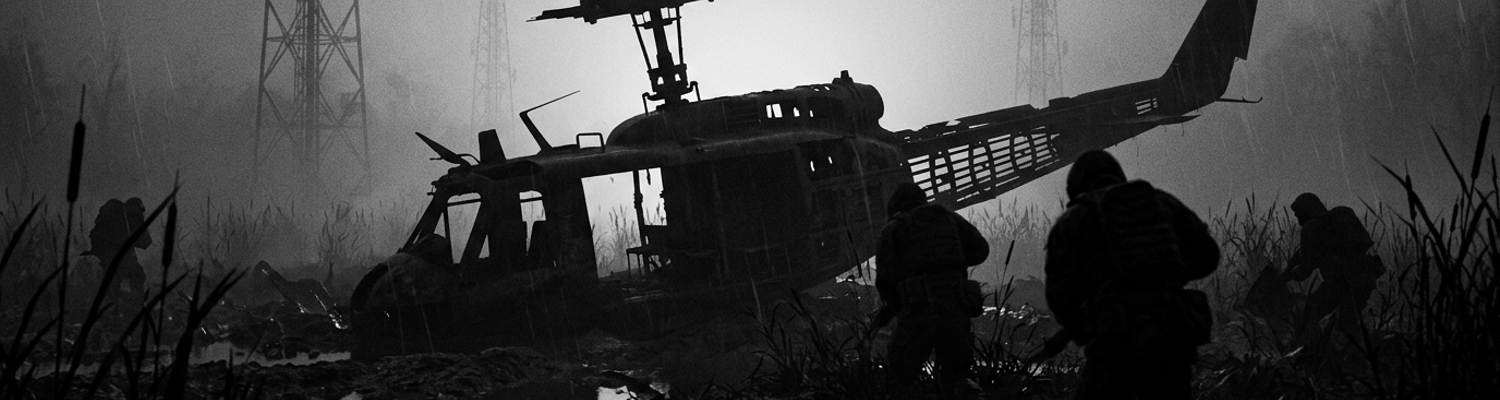

Scout Helicopter Wreckage and Signal Loss
A close review of operational logs indicates the first maintenance failure occurred before the skids ever left the tarmac. Seventy-two hours before the first rotor blade turned, command staff at Can Tho received an operation order. The directive demanded full reconnaissance of the northern quadrant of the U Minh Forest. Planners stared at an impossible timeline. Standard doctrine required a minimum of five days to establish airborne radio direction finding grids. Technicians needed this time to synchronize encrypted communication relays across the dense mangrove swamps of Military Region IV. Higher headquarters gave Troop A of the 7th Squadron, 1st Air Cavalry Division exactly three days to map enemy infiltration routes. The unit was ordered to coordinate localized artillery and launch a multi-ship hunter-killer package into heavily contested airspace. The ticking clock dictated that ground crews bypass standard avionics diagnostic checks on the command-and-control aircraft just to meet the departure schedule.
Frontline scout crews of Troop A were caught in a severe enemy ambush in early 1971 without real-time signal intelligence.
During the first week of February, two OH-6A Cayuse light observation helicopters descended to tree-top level over coordinate VR 845 120. They were searching for concealed bunker complexes belonging to the Viet Cong 9th Division. The dense triple-canopy foliage of the U Minh Forest completely obscured the ground below. Standard operating procedure required these low-level reconnaissance flights to be guided by continuous live intercepts of enemy radio traffic. Planners expected the airborne signal intelligence platforms to provide exact coordinates of active enemy transmitters. This data would allow the fragile scout ships to skirt heavily defended anti-aircraft positions. The scouts flew directly into a prepared kill zone spanning three square kilometers of flooded mangrove. Enemy combatants had positioned interconnected 12.7mm heavy machine gun nests in a triangular formation designed to crossfire on low-flying aircraft. No warning transmission reached the aviation headsets. The lead helicopter absorbed a concentrated barrage of tracer fire. The impacts severed its tail rotor drive shaft.
The aircraft spun violently into the swamp water at forty-five knots.
The absence of warning stemmed from an equipment malfunction thousands of feet above the battlefield. High-priority real-time signal intelligence feeds cut out suddenly. Tactical commanders were left blind during the initial enemy assault. An RU-21 twin-engine aircraft operated as the primary airborne radio direction finding platform. It orbited at ten thousand feet to monitor enemy frequencies. Technicians aboard the aircraft relied on the AN/ARQ-34 data link and the KY-28 secure voice system to push decrypted intercept data down to the Troop A Tactical Operations Center. Archival evidence shows that exactly four minutes before the Viet Cong opened fire, the primary alternator on the RU-21 experienced a severe voltage spike. The power surge tripped the circuit breakers feeding the encrypted radio relay. The transmission carrier wave flatlined. Down in the command bunker at Rach Gia, the tactical overlay maps went entirely static. Commanders tracking the flight paths of the hunter-killer teams lost all visibility on enemy troop concentrations staging beneath the canopy.
The digital feed on the command console reverted to a continuous squelch of white noise.
Aviation commanders sat in absolute silence for nine minutes. They possessed no data regarding the size of the ambush. They lacked information on the specific caliber of the anti-aircraft weapons or the exact location of the downed scout crew. The flight leader of the trailing AH-1G Cobra gunships requested target coordinates to suppress the enemy fire. The command center could only provide the last known grid reference of the scout ship before the signal loss. Gunship pilots initiated their dive sequences without any intelligence on radar-guided tracking systems. They deployed 2.75-inch folding-fin aerial rockets into the tree line blindly. Ground fire ripped through the plexiglass canopy of the lead Cobra. A single round shattered the pilot's cyclic control stick.
Experimental Sensor Relays and Armor Screening
During the first quarter of 1971, aviation mechanics at the Binh Thuy airbase retrofitted three UH-1H Huey helicopters. Command staff ordered the installation of a classified communications package designed to bridge severe signal gaps over the Mekong Delta. Troop A of the 7th Squadron, 1st Air Cavalry Division operated experimental airborne sensor relays in early 1971 to fulfill this requirement. Archival evidence shows these aircraft carried AN/ASQ-142 telemetry pods mounted directly to the external armament pylons. Technicians spent weeks routing heavy coaxial cables through the aluminum floorboards. These cables connected the external pods to a bulky receiver console in the troop compartment. Stripping the aircraft of its M60 door guns and armored seats became necessary just to maintain a safe hover out of ground effect due to the weight of the system. Operating these experimental sensor relays required the helicopter to fly in a continuous tight orbit at exactly four thousand feet. Any deviation in altitude or bank angle disrupted the line-of-sight microwave transmission.
The gyroscopic stabilization units inside the relay pods possessed a mean time between failure of only eleven hours.
Down in the mud of the U Minh Forest, the ARVN 9th Division initiated a major mechanized push using M113 armored personnel carriers. Ground commanders planned to drive a wedge through suspected Viet Cong supply caches located along the Cai Lon River. These armored tracks were highly vulnerable to rocket-propelled grenades in this restricted terrain. Navigating the dense environment required continuous flank security. The unit utilized remote television surveillance to screen ARVN 9th Division armor operations in the U Minh Forest. Specially modified observation helicopters carried early vidicon television cameras mounted in spherical chin turrets. Pilots flew ahead of the advancing columns. They pointed the lenses at the thick tree lines to detect enemy ambush sites. Analog video feeds traveled through the experimental sensor relays directly to a bank of cathode-ray tube monitors at the division headquarters. Intelligence officers watched the black-and-white screens in real time. They looked for heat signatures or unnatural clearings in the mangrove swamps that indicated fortified bunkers.
A close review of operational logs indicates the video transmission degraded significantly whenever the ambient air temperature exceeded ninety degrees Fahrenheit.
On the morning of March 14, ARVN 9th Division armor columns advanced toward coordinate WR 124 983 without any physical infantry screening their flanks. Heavy personnel carriers ground through the thick mud at five miles per hour. Above them, the Troop A sensor relay helicopter established its holding pattern. Flight crews in the observation ship pointed their television camera at a suspected tree line one kilometer ahead of the lead M113 track. Inside the chin turret, the primary vidicon tube overheated. Dust ingested during takeoff caused the cooling fan assembly to seize. Thermal expansion warped the glass envelope of the vidicon tube. This physical distortion shattered the internal vacuum seal. Temperatures inside the camera unit spiked to one hundred and forty degrees in less than three minutes. Headquarters immediately lost vertical sync on the remote television surveillance feed.
The intelligence officers stared at a rolling screen of gray static.
Commanders on the ground received no radio warnings about the equipment failure. Drivers in the M113s continued their advance along the narrow canal bank. They assumed the air cavalry was actively scanning the route ahead. Up in the relay helicopter, the crew chief attempted to manually reset the AN/ASQ-142 telemetry pod by cycling the main circuit breakers on the overhead console. This specific action sent an unsuppressed power surge through the coaxial cables. The voltage permanently burned out the high-gain UHF transmitter. Airborne relay networks across the sector collapsed instantly. Three hidden recoilless rifle teams belonging to the Viet Cong 400th Mobile Battalion opened fire from the exact tree line the camera had been assigned to monitor. At 0914 hours, the lead ARVN armored personnel carrier detonated a command-wired 105mm artillery shell buried beneath the mud of the canal path.
The explosion sheared the right drive sprocket off the hull and threw the vehicle track twenty yards into the swamp.
Biological Failure at Forward Operating Base Rach Gia
Archival evidence shows the electronic warfare screen over the U Minh Forest collapsed entirely on April 12, 1971. This failure traces directly back to a biological incident at Forward Operating Base Rach Gia. Positioned at grid coordinate VS 142 098, the compound sat on a reclaimed mudflat surrounded by stagnant tidal pools and decaying mangrove roots. A sudden outbreak of drug-resistant falciparum malaria struck the forward operating base during the second week of the month. Medical logs indicate the specific parasite strain originated in the Cambodian border regions. It possessed complete immunity to the standard-issue chloroquine-primaquine prophylactic pills distributed to American troops. Soldiers began reporting temperatures exceeding 104 degrees Fahrenheit. These fevers were accompanied by severe cerebral hemorrhaging, pulmonary edema, and acute renal failure within forty-eight hours of exposure. Command staff initially misidentified the localized cluster of infections as routine dengue fever. This error delayed the requisition and deployment of alternative quinine sulfate treatments by four days. Standing water inside the concertina wire perimeter bred thousands of Anopheles dirus mosquitoes. The insects easily bypassed the untreated canvas tent netting used by the night shift maintenance crews.
By the fifth day of the outbreak, the base medical dispensary exhausted its entire supply of intravenous saline solution.
When examining the historical record, the pathogen systematically targeted the most technically demanding occupational specialties operating in the Military Region IV sector. The disease incapacitated over forty percent of specialized signal personnel responsible for maintaining electronic warfare gear. These highly trained technicians belonged to the 407th Radio Research Detachment. This classified unit was tasked with servicing the AN/ASQ-142 telemetry pods and the TSEC/KY-28 secure voice cryptologic systems utilized by Troop A Air Cavalry. Repairing these sensitive microwave components required daily calibration using heavy oscilloscopes and frequency counters inside climate-controlled maintenance vans. With twenty-two out of fifty-four signal specialists strapped to medical evacuation cots, the preventative maintenance schedule completely disintegrated across the flight line. Cryptologic key generators demand precise voltage regulation to prevent the internal memory banks from automatically dumping their daily cipher codes. The few remaining healthy technicians worked thirty-six-hour shifts in ninety-eight-degree ambient heat. They attempted to replace burned-out vidicon tubes and resolder degraded coaxial connections on the helicopter armament pylons.
Sweat dripping from a mechanic's forehead into an open AN/ALQ-100 countermeasures pod caused a direct short circuit across the primary power transformer.
Aviation commanders at Can Tho ordered regular UH-1H helicopter crew chiefs to take over the electronic warfare maintenance duties just to keep the airborne relay aircraft flying. These conventional mechanics lacked the specific security clearances and the rigorous technical training required to service encrypted telemetry systems. On the morning of April 15, an untrained mechanic attempted to clean the gold-plated contacts of a KY-28 encryption unit. He used standard aviation engine degreaser instead of the mandated isopropyl alcohol. The harsh chemical solvent immediately stripped the protective conformal coating off the printed circuit boards inside the receiver console. Microscopic copper traces oxidized within hours in the heavy salt air blowing continuously off the Gulf of Thailand. When the aircrew powered on the system during their pre-flight run-up, the degraded circuits failed to synchronize with the airborne relay platform holding station at four thousand feet.
The ground station transmitter broadcasted an unencrypted beacon signal directly into contested territory for twelve uninterrupted minutes.
Viet Cong signal intelligence units operating deep inside the U Minh Forest immediately triangulated the rogue VHF transmission. Ground crews at Rach Gia remained completely unaware of the security breach. The diagnostic display panel on their end falsely indicated a secure locked connection. The automated fault-isolation software inside the receiving console had frozen due to a localized power drop in the maintenance bay. The base electrical generators struggled to simultaneously power the tactical operations center and the temporary refrigeration units brought in to store the bodies of three signal technicians who had succumbed to the parasite.
The primary fuel pump on the 60-kilowatt diesel generator seized at 1422 hours.
Cryptographic Failures and Maintenance Backlogs
A close review of operational logs indicates the severe personnel shortages within the 407th Radio Research Detachment directly triggered widespread equipment failures across the Rach Gia flight line. Medical evacuations had stripped Troop A of its primary avionics specialists by the third week of April 1971. The loss of technicians severely disrupted routine technical maintenance on tactical AN/ARC-54 radios installed across the helicopter fleet. These frequency-modulated transceivers required intensive daily servicing to function in the heavy humidity of the Mekong Delta. Ground crews were supposed to manually clean the rotary tuning capacitors and check the alignment of the internal frequency synthesis crystals after every fifty hours of flight time. Remaining mechanics possessed no training on avionics. They prioritized engine repairs over communications gear. Water vapor bypassed the degraded rubber O-rings on the radio casings. Condensation pooled inside the aluminum chassis. The moisture slowly shorted out the intermediate frequency amplifier stages and corroded the primary wiring harnesses.
By April 19, forty-two primary tactical radios sat completely inoperable on the maintenance bench.
Command staff at Can Tho ordered scout pilots to fly visual reconnaissance missions using uncalibrated backup transmitters. Archival evidence shows an afternoon patrol over grid coordinate VR 885 140. An OH-6A Cayuse helicopter attempted to call in an artillery strike on a suspected Viet Cong sampan. The pilot keyed the microphone on his degraded AN/ARC-54 radio. Moisture buildup had heavily corroded the silver-plated contacts on the transmission relay switch. The radio broadcasted a continuous carrier wave. This signal completely jammed the designated artillery coordination frequency across the entire northern quadrant of the U Minh Forest.
The stuck transmitter locked out all requests for fire support for twenty-seven minutes.
When examining the historical record, a secondary vulnerability emerged within the TSEC/KY-28 secure voice cryptologic systems. KY-28 speech encryption modules failed due to unaddressed component drift and lack of qualified repair staff. The unit relied on a series of precise timing oscillators to synchronize its encrypted signal with the receiving station. Ambient air temperatures inside the helicopter troop compartments regularly exceeded one hundred and ten degrees during midday operations. This intense heat caused the internal electronic components to physically expand. The expansion shifted the oscillator frequencies out of their narrow operational bands. Technicians normally corrected this thermal drift by attaching a specialized PRM-34 test set. They manually adjusted the phase-locked loops using non-metallic alignment tools. The localized malaria outbreak had hospitalized the only three soldiers at Rach Gia possessing the necessary security clearances and training to open the KY-28 chassis.
The encryption modules operated for fourteen consecutive days without a single calibration check.
Flight crews began experiencing complete decryption failures mid-mission. During a hunter-killer sweep near the Cai Lon River on April 22, the command-and-control Huey attempted to push updated enemy coordinates down to a pair of AH-1G Cobra gunships. The component drift inside the commander's KY-28 had exceeded the maximum synchronization tolerance of the receiver modules. The cryptologic key generators fell entirely out of phase. Instead of hearing the target grids, the gunship pilots received a deafening blast of digital static through their flight helmets. Standard operating procedure dictated that aircraft abort the mission and return to base upon losing secure communications. Ground commanders at the tactical operations center overrode this protocol to maintain pressure on the Viet Cong 9th Division. They authorized the aircrews to switch their radios to plain text. The pilots transmitted the exact coordinates of the enemy bunker complex over an open VHF channel.
Enemy radiomen operating captured American receivers intercepted the unencrypted grid references in real time.
Telemetry Tower Degradation at Binh Thuy Air Base
Archival evidence shows the physical collapse of the sector communication network accelerated rapidly at Binh Thuy Air Base. Located at grid coordinate WS 812 045 along the Bassac River, the sprawling installation housed the 34th General Support Group. It operated as the primary aviation logistics hub for Military Region IV. Base meteorology logs from late April 1971 record ambient relative humidity holding at ninety-eight percent for twenty-two consecutive days. This extreme atmospheric moisture trapped the exhaust output of three hundred helicopter turbine engines. Dozens of unshielded 100-kilowatt diesel generators ran continuously around the perimeter. Base engineers utilized low-grade high-sulfur diesel fuel shipped upriver from Vung Tau to power the tactical operations center and the heavily fortified perimeter lighting grids. Burning this specific fuel variant produced heavy quantities of particulate soot and sulfur dioxide gas. The localized microclimate forced these airborne pollutants to bond chemically with the suspended water vapor rolling off the Mekong Delta mudflats. A dense corrosive smog settled permanently over the base infrastructure at an altitude of just fifty feet.
The heavy atmospheric sludge coated every exposed surface on the flight line in a highly conductive microscopic film.
When examining the historical record, this specific environmental contamination directly targeted the primary UHF telemetry tower situated at the northern edge of the cantonment area. The ninety-foot steel lattice structure supported an array of AN/FRC-109 microwave parabolic dishes and stacked dipole antennas. These components were responsible for receiving data links from Troop A Air Cavalry aircraft. Signal officers had deliberately installed the receiver arrays directly downwind of the base power plant. This placement minimized the length of the underground coaxial cable runs leading into the command center. Particulate diesel soot accumulated rapidly on the exposed Teflon insulators separating the aluminum antenna elements. The sulfur-infused moisture ate through the thin anodized coatings on the UHF transmitter modules within seventy-two hours of their initial installation. Engineers from the 407th Radio Research Detachment attempted to manually scrub the receiver arrays using heavy wire brushes and industrial solvent while suspended from safety harnesses. Their aggressive cleaning methods inadvertently scored the polished interior surfaces of the microwave feed horns.
Deep scratches in the metal altered the reflection angles of the incoming radio waves.
A close review of operational logs indicates the telemetry tower suffered a complete cascade failure on the morning of May 2. Ground operators inside the Binh Thuy communication bunker monitored a scheduled reconnaissance flight operating deep in the U Minh Forest near coordinate VR 912 084. The airborne relay helicopter transmitted encrypted video and audio feeds back to the base on a designated 400-megahertz UHF frequency. Up on the tower, the accumulated diesel sludge bridged the gap between the primary transmitter dipole and its steel grounding bracket. The conductive soot allowed the high-power radio frequency energy to arc directly into the lattice superstructure. This electrical short caused a massive impedance mismatch at the antenna feed point. The voltage standing wave ratio spiked to a level of five-to-one. The transmitter's final amplifier tubes absorbed over four hundred watts of reflected power. Glass envelopes enclosing the amplifier filaments shattered under the sudden thermal load.
The primary receiver array immediately dropped the incoming telemetry link from the aircraft.
Commanders in the bunker watched their tactical display screens go completely black at 0714 hours. Technicians initiated emergency diagnostic protocols to bypass the destroyed amplifier stage and route the signal through a secondary receiver matrix. They quickly discovered the environmental contaminants had also penetrated the unsealed weatherproof housings of the backup preamplifiers mounted at the seventy-foot level of the tower. Corrosive moisture had heavily oxidized the copper grounding straps. This severed the electrical bond between the chassis and the tower frame. The backup receivers picked up the raw electromagnetic interference generated by the nearby diesel engines. They fed that noise directly into the decryption modules. Automated system processors down in the bunker interpreted the engine static as a valid encrypted data stream and attempted to decode it.
The logic boards entered an endless processing loop that locked out all manual operator inputs.
Encrypted Network Collapse During Enemy Engagement
Archival evidence shows on May 14, 1971, the localized telemetry architecture over the U Minh Forest completely failed at exactly 1522 hours. Troop A of the 7th Squadron, 1st Air Cavalry Division had deployed two OH-6A Cayuse observation helicopters to screen a suspected supply cache at grid coordinate VR 921 095. Above them, an experimental UH-1H relay aircraft orbited at four thousand feet. The crew attempted to push live AN/ASQ-142 telemetry data down to the Rach Gia tactical operations center. A close review of operational logs indicates the mechanical degradation began within the airborne receiver console's primary multiplexer unit. Extreme ambient humidity and sustained engine vibrations had loosened the retaining screws on the equipment rack. The multiplexer chassis rattled against the aluminum floorboards. The thermal paste separating the telemetry processor from its heat sink cracked and flaked away. Silicon transistors inside the logic board quickly exceeded their maximum operating temperature of one hundred and eighty degrees Fahrenheit. The hardware physically warped under the thermal stress. This severed the microscopic solder joints connecting the encrypted data link to the external UHF output transmitter.
The continuous telemetry feed degradation resulted in a complete severing of real-time intelligence streams.
Down at the Rach Gia command bunker, intelligence officers watched their cathode-ray tube displays freeze on a single frame of heavily distorted topographic data. The screens reverted to raw static seconds later. Tactical commanders possessed no situational awareness when the Viet Cong 9th Division initiated a coordinated anti-aircraft ambush from concealed bunker complexes along the banks of the Trem River. Down at tree-top level, the scout helicopters immediately took heavy 12.7mm machine-gun fire from three interlocking positions. The lead pilot of the primary OH-6A Cayuse banked sharply to evade the tracers. He attempted to contact a pair of AH-1G Cobras holding station three miles to the east. He keyed the microphone on his AN/ARC-54 frequency-modulated radio to transmit the enemy grid coordinates. The telemetry network collapse had already triggered a localized lockout across the encrypted VHF command frequencies. Without the airborne relay pushing the synchronized carrier wave, the scout's ten-watt radio transmission could not penetrate the dense triple-canopy foliage. The radio frequency energy absorbed entirely into the wet mangrove trunks and flooded marshland.
The headset generated nothing but a flat dead squelch tone.
When examining the historical record, this specific communication blackout meant the isolated frontline scout crews were unable to call in immediate gunship support or air artillery adjustments. The trailing OH-6A crew chief switched to a secondary frequency. He tried to contact Battery C, 2nd Battalion, 32nd Field Artillery to request a 105mm white phosphorus marker round on their own position. Artillery officers at the fire direction center required precise target corrections from the ground to avoid dropping high explosives directly onto the friendly aircraft. The telemetry collapse meant the Rach Gia command bunker could not verify the scout's exact location on the master plotting board. Artillery commanders refused to authorize the fire mission blind and ordered the battery to stand down. Up at three thousand feet, the Cobra gunship pilots physically saw the green tracer fire ripping upward through the jungle canopy. They could not initiate their attack dives. Standard operating procedure required a confirmed target grid and clearance from the scouts before deploying their payload of 2.75-inch folding-fin aerial rockets. The gunships circled uselessly above the engagement zone. The unsuppressed heavy machine guns systematically dismantled the tail boom of the primary observation helicopter.
A concentrated burst of armor-piercing incendiary rounds severed the pitch control cables at 1528 hours.
Materiel Command Autopsy of Signal Relay Failures
Archival evidence shows investigators from the United States Army Materiel Command arrived at Can Tho airbase on May 28, 1971. Their primary objective involved dismantling the burned wreckage of the airborne signal platforms to determine the exact cause of the U Minh Forest communication collapse. Military post-mortems identified single-point technical dependencies in experimental signal relay architectures. Engineers from the 1st Aviation Brigade board examined the recovered AN/ASQ-142 telemetry pods and the internal wiring of the RU-21 aircraft. They discovered the entire localized intelligence grid relied on a singular AN/URC-68 transceiver acting as the master synchronization node. If the phase-locked loop oscillator inside this specific radio drifted beyond four hundred hertz, the network automatically dropped all subordinate connections.
The entire electronic warfare screen over Military Region IV depended entirely on one unshielded quartz crystal.
A close review of operational logs indicates tactical commanders at the 7th Squadron, 1st Air Cavalry Division routinely ignored technical warnings regarding this structural bottleneck. Planners authorized deep reconnaissance missions without placing redundant backup relays in orbit. The investigative board disassembled the primary equipment racks pulled from the flight line. Technicians found the main power distribution bus lacked isolated circuit breakers for the individual KY-28 secure voice modules. A localized short circuit in a single encryption unit sent a massive voltage spike directly through the shared copper bus bar. This electrical surge instantly disabled the telemetry multiplexer and the high-gain UHF transmitters simultaneously. The architecture possessed no automated fail-safes to isolate the damaged components from the rest of the transmission chain.
Engineers documented fourteen distinct hardware failures originating from this specific unsuppressed wiring harness.
When examining the historical record, the biological collapse at Forward Operating Base Rach Gia triggered an immediate intervention from the Walter Reed Army Institute of Research. The disaster forced updates to medical prophylaxis protocols and ruggedized corrosion resistance standards for tropical relay stations. Medical officers analyzed blood samples drawn from the deceased technicians of the 407th Radio Research Detachment. They confirmed the presence of a highly aggressive chloroquine-resistant Plasmodium falciparum parasite strain. The Surgeon General's office immediately scrapped the existing tropical deployment medical guidelines across the theater. Field hospitals received emergency shipments of quinine sulfate and instructions to administer the drug alongside heavy doses of tetracycline. New directives mandated that all signal personnel operating near the U Minh Forest ingest daily prophylactic doses of dapsone. Unit commanders faced court-martial if they failed to enforce the strict biological countermeasures among the night-shift maintenance crews.
Medics recorded a sharp drop in acute renal failure cases within six days of the protocol shift.
The investigative board also targeted the physical degradation of the Binh Thuy telemetry towers. Army engineers rewrote the baseline manufacturing requirements for all electronic warfare equipment deployed to Southeast Asia under standard MIL-STD-810C. Previous guidelines allowed defense contractors to use standard cadmium plating on external hardware components. The updated directives required heavy anodization of all exposed aluminum antenna elements to combat the sulfur-infused smog rolling off the Bassac River. Technicians applied thick polyurethane conformal coatings directly to the printed circuit boards inside the AN/FRC-109 microwave receivers. This chemical barrier prevented the conductive diesel particulate matter from bridging the microscopic copper traces.
Assembly plants in California retooled their production lines to hermetically seal every rotary tuning capacitor inside pressurized nitrogen chambers.
Logistics officers at Can Tho implemented a rigid tracking system for the newly ruggedized hardware. Supply clerks recorded the exact humidity tolerance ratings on a master ledger before issuing any replacement telemetry pods to the flight line. Ground crews replaced the degraded Teflon insulators on the ninety-foot lattice towers with highly resistant ceramic standoffs. Signal technicians tested the new antenna feed lines using heavy-duty oscilloscopes. They verified the voltage standing wave ratio remained below the critical threshold.