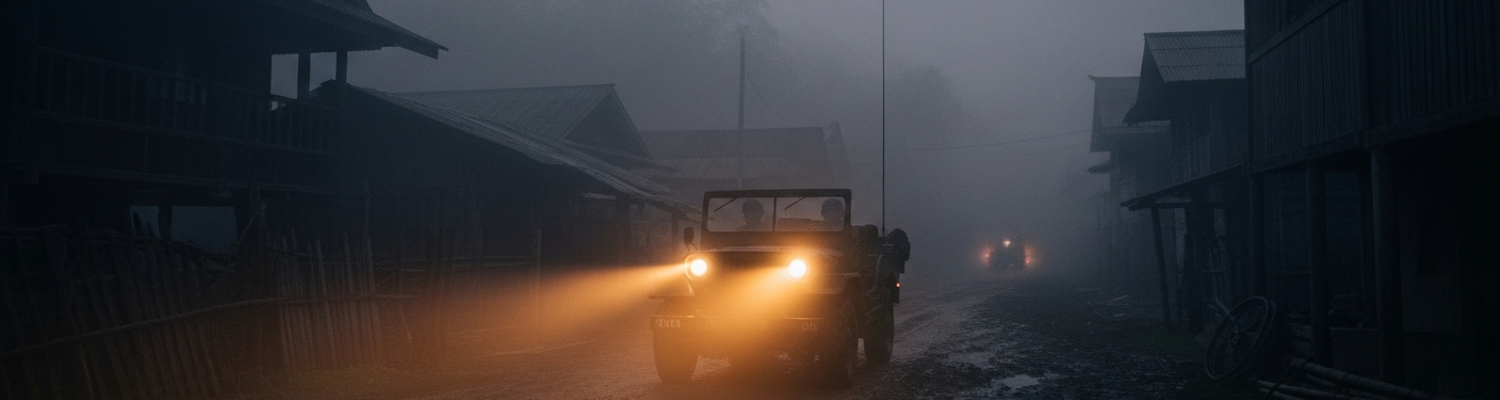

A close review of operational logs from early 1957 reveals the genesis of a crisis in the formal establishment of the High Commissioner’s Military Team, Miyako, or HICOM-MT. This was not a standard infantry or military police formation. It was a purpose-built hybrid, assembled on Okinawa and redeployed to Miyako-jima with a direct mandate from the High Commissioner's office. This command structure deliberately bypassed the standard Army G-2 intelligence directorate.
The unit consisted of a core from the Army's 317th Civil Affairs Group, augmented by a platoon from the 29th Military Police Company. A single understrength rifle platoon detached from the 27th Infantry Regiment, the Wolfhounds, provided tactical weight. Its formation was a direct reaction to a series of labor strikes and minor protests in Hirara, the island’s main population center. Command viewed these events not as a complex political problem but as a simple challenge to American authority. The HICOM-MT’s equipment reflected this thinking. The unit was issued brand-new M38A1 jeeps and M35 trucks, their olive-drab paint gleaming, intended to project an image of overwhelming American industrial might onto the narrow island streets.
The unit’s operational posture was dictated by a doctrine of overt, constant patrols through all populated areas. Archival evidence (USCAR Document 57-019B) shows detailed patrol schedules that focused almost exclusively on the paved roads of Hirara and the coastal routes connecting the main villages. Patrols were mounted in vehicle convoys of three to five jeeps, moving at a deliberately slow pace. Soldiers were instructed to remain helmeted, with weapons, primarily M1 Garand rifles and M3 submachine guns, held at a low ready. Direct interaction with the local population was actively discouraged. The goal was not engagement but intimidation. The HICOM-MT was a moving billboard for American control, a constant reminder of who was in charge.
This focus on overt shows of force came at a direct and ruinous cost to intelligence gathering. The HICOM-MT’s table of organization and equipment assigned almost all personnel and resources to the force projection mission. The unit’s S-2 intelligence section, the nominal brain of any military operation, consisted of a single lieutenant fresh from the Army Intelligence School at Fort Holabird and one enlisted analyst. They had no dedicated budget for informants, no organic translation support, and a collection of pre-World War II Japanese topographical maps that were dangerously out of date. Command’s prioritization of force projection created a state of profound operational blindness. The belief was that overwhelming strength made intelligence irrelevant. If the population was sufficiently cowed, their intentions did not matter. A review of HICOM-MT records for the thirty days preceding the Four-Bravo patrol incident shows over 400 logged patrol hours. Not a single new intelligence summary was filed.
A significant disconnect existed between the perception of the Miyako Island mission within the American military command and the conditions on the ground. From the perspective of planners on Okinawa and in reports sent back to the Pentagon, the HICOM-MT operation was a model of Cold War stability operations. Newsreels depicted American GIs as benevolent guardians, overseeing a peaceful transition. The gleaming jeeps and disciplined patrols were presented as evidence of an effective, low-intensity occupation where American authority was absolute. This narrative suggested that the local Ryukyuan population welcomed the security and economic input the American presence provided.
It was a projection of control that fulfilled a strategic objective for a global audience.
The actual sentiments of the Miyako population were far more complex and largely invisible to the American command. A close review of local records and post-incident analysis reveals a deep well of resentment that was neither monolithic nor openly violent, but pervasive. The economy of Miyako, traditionally based on fishing and small-scale agriculture, had been disrupted. While some individuals benefited from employment on the small USCAR facilities, many more were impacted by land requisitions for communication arrays and administrative buildings. Fishermen found their traditional grounds sometimes declared off-limits with little warning for naval exercises. These were not the actions of a benevolent protector but of a foreign power that prioritized its own strategic needs above the welfare of the islanders. This discontent was quiet and took the form of non-cooperation. It manifested in a sullen reluctance to engage with patrols and the development of a shadow information network that operated completely outside of official channels.
This operational blindness was a direct product of catastrophically superficial intelligence-gathering methods. The HICOM-MT S-2 section was, on paper, the nerve center for understanding the local environment. In practice, it was an intelligence vacuum. Their primary method of collection was reviewing translated summaries of reports from the local Japanese-administered police force. This source was compromised by its very nature. The police had their own allegiances and were often unwilling to report on simmering anti-American sentiments, fearing it would reflect poorly on their own ability to maintain order. Direct intelligence gathering was limited to what could be observed from the seat of a moving M38A1 jeep.
There was no budget allocated for cultivating paid informants.
No dedicated military translators were assigned to the unit, forcing a reliance on a handful of local hires whose loyalty and accuracy were never properly vetted. The S-2 section possessed no capacity for signals intelligence and its map collection was tragically outdated, showing a pre-war landscape that lacked dozens of new structures and rerouted tracks. A review of the unit’s records shows that the intelligence officer’s primary duty devolved into tracking vehicle maintenance schedules and fuel consumption for the patrols, not analyzing the adversary. This system created a fatal feedback loop: the command saw no overt threats, so it allocated no resources to intelligence, which in turn guaranteed that no developing threats would ever be detected.
The specific motorized patrol that initiated the crisis was designated Patrol Four-Bravo. Operational logs indicate it was a standard three-vehicle element dispatched on the morning of June 7th, 1957. It consisted of two M38A1 jeeps, each carrying four military policemen from the 29th MP Company detachment, and a lead command jeep with the patrol leader, a young lieutenant from the 317th Civil Affairs Group, his driver, and a radio operator. Their assigned route was a deliberate deviation from the normal runs along Hirara’s main paved thoroughfares. Based on a single, uncorroborated report from the local police about anti-American leaflets, HICOM-MT command directed Four-Bravo to conduct a deep penetration into the Nishizato and Shimozato districts. These areas, historical records show, were a maze of narrow, unpaved alleyways and dense, two-story wooden structures, a landscape fundamentally incompatible with vehicular patrols. The patrol’s objective was not reconnaissance but a show of force, pushing their vehicles into the heart of a district command mistakenly believed was a center of dissent.
The patrol was six blocks deep into the Nishizato grid when the communications failure occurred. It was both critical and sudden. The command jeep was equipped with a standard AN/VRC-10 vehicle-mounted radio, a vacuum-tube system common for the era. According to the after-action report, the radio operator had just begun a routine check-in with the HICOM-MT operations center. The transmission was cut short not by static, but by a distinct pop followed by complete silence and the smell of burnt ozone inside the jeep. Post-incident technical analysis (Report 57-B, Appendix C) concluded the most likely cause was the failure of the RT-67 transmitter/receiver’s internal dynamotor. This mechanical device, essential for converting the jeep’s 24-volt electrical system into the high voltage required by the vacuum tubes, simply burned out.
They were electronically deaf.
The patrol’s backup was a man-portable AN/PRC-10, but its effective range in the dense urban environment, surrounded by buildings, was less than a quarter-mile. Useless for contacting the distant operations center. This mechanical failure instantly created a state of profound tactical isolation. Patrol Four-Bravo was now adrift deep within a civilian center it did not understand, with no ability to call for guidance or support. The lieutenant in command was faced with a cascade of impossible choices. A review of period street maps of Hirara shows that the alleys they had entered were too narrow to permit a three-point turn for the M38A1 jeeps. Reversing the entire three-vehicle column back through the winding, constricted route for more than half a kilometer was a technically difficult and highly vulnerable maneuver. Pushing forward was an unknown. The immediate change in the environment was palpable. The noisy, curious crowds that had watched the patrol’s initial entry melted away. Doors slid shut and wooden window shutters were secured. Within minutes, the streets were empty, leaving the American soldiers in their conspicuous vehicles alone in a silent, watching maze.
A technical analysis of the unit’s map chests reveals the foundational flaw in Patrol Four-Bravo’s operation. The primary navigational tools available to HICOM-MT were 1:50,000 scale topographical surveys of Miyako-jima produced by the Imperial Japanese Army in the late 1930s. These were artifacts of a bygone era, designed for conventional warfare, not internal security operations. Their deficiency was in cultural and structural intelligence, which had changed drastically in the nearly two decades since their printing. Post-war reconstruction and unofficial housing expansion had rendered large sections of the maps dangerously inaccurate. Specifically within the dense Nishizato and Shimozato districts, the maps showed only generalized settlement blocks, completely omitting the labyrinth of narrow, intersecting alleyways that characterized the area. For the lieutenant of Four-Bravo, this meant his primary planning tool depicted a simplified, navigable space. The reality was a claustrophobic maze of wooden walls and blind corners.
This cartographic blindness was compounded by a near-total absence of real-time, granular local intelligence. The command was information-starved by its own design. Without a dedicated source of ground truth, the HICOM-MT operated in a sanitized information bubble. The nuanced world of local grievances, disputes over land requisitioned for USCAR facilities, fishing grounds declared off-limits, and the social ostracism of islanders who worked for the Americans, was entirely invisible to them. The S-2 officer could not point to a specific house on a map and identify its occupants as either friendly, hostile, or neutral. He could not provide the patrol leader with names, faces, or patterns of life for the neighborhood they were about to enter. The unit’s understanding of the human terrain was nonexistent.
These deficiencies culminated in pre-patrol briefings that were exercises in tactical formalism, devoid of meaningful intelligence. A close review of operational logs indicates the briefing for Patrol Four-Bravo would have been brutally superficial. The focus would have been on logistics and procedure. Vehicle fuel and water levels would be confirmed. Radio frequencies and call signs would be recited. Rules of engagement, emphasizing a non-confrontational posture unless fired upon, would be reiterated. The intelligence portion of this briefing would have been perilously brief. The lieutenant would have pointed with a grease pencil to the inaccurate 1930s map, outlining the route. He would have mentioned the uncorroborated report of leaflets as the mission’s justification. There would have been no detailed analysis, no discussion of the local population’s mood, and no identification of specific threats. The briefing equipped the patrol to operate their vehicles and radios but provided them with absolutely no cognitive framework to understand the environment they were penetrating.
The immediate aftermath of the radio failure was not marked by gunfire but by an unnerving, coordinated silence. The ambient noise of the Nishizato district ceased. The chatter of vendors, the sounds from open workshops, and the calls of children vanished. Wooden shutters, previously open to the midday air, slid shut. Doors were barred from the inside. The effect, noted by the patrol leader, was of a stage suddenly cleared of its actors, leaving Four-Bravo exposed under the lights. This was the first manifestation of a deep-seated local distrust, an organized social reflex honed by years of occupation.
This initial, unnerving quiet soon gave way to more concrete forms of passive resistance. When the lieutenant dismounted two MPs to scout a path forward on foot, the community’s response was absolute. Archival evidence from post-incident interviews with residents reveals a calculated, neighborhood-wide non-cooperation. The MPs found every door and gate locked. Their knocks went unanswered. Attempts to call out in rudimentary, command-language Japanese were met with silence. In one instance, a soldier observed a face in a second-story window, only for it to disappear as soon as he was seen. Further attempts to maneuver the jeeps forward were met with subtle, deniable obstructions. A handcart laden with daikon radishes, seemingly abandoned, blocked a critical intersection. A pile of fishing nets and bamboo poles materialized in an alley that had been clear moments before. These were not overt barricades; they were carefully placed impediments that required the American soldiers to physically dismount and clear the path, slowing their progress to a crawl.
As the patrol crept deeper into the maze, they began to have encounters defined by a studied, absolute indifference that was more psychologically disarming than open hostility. An elderly woman, carrying a basket, walked directly toward the lead jeep, forcing the driver to brake hard. She passed by its fender without a glance, her expression blank, as if the two-ton vehicle and its armed occupants did not exist. A group of young boys, who had been kicking a cloth ball, stopped their game to stare. Their faces showed no fear or curiosity, only a flat, assessing gaze before one turned and walked away, the others following in perfect unison. A fisherman, identified in logs by his distinctive blue happi coat, walked past the stranded radio operator, ignoring a direct request for directions. He simply shook his head once, a gesture not of negation but of dismissal, and continued on his way. The patrol’s very existence was being denied by the community it was meant to control.
The formal after-action review of the Patrol Four-Bravo incident, designated HICOM-MT Inquiry 57-B, was a study in institutional blame-shifting. A review of the document, completed in late July 1957, reveals a deliberate effort to isolate the event as a series of individual and mechanical failures, thereby protecting the command structure and its core doctrines. The report’s primary findings were threefold. It assigned fault to the patrol leader for deviating from prescribed routes, framing his penetration of the Nishizato district as an act of poor judgment. It attributed the communications breakdown to the failure of the AN/VRC-10 radio's dynamotor, classifying it as a random mechanical event. It cited the uncooperative nature of the indigenous population as an aggravating factor, but stopped short of analyzing the cause of this behavior.
Its recommendations were predictably superficial: increased inspection schedules for radio equipment, stricter adherence to pre-approved patrol routes, and a vague call for enhanced cultural awareness training. The document successfully identified the tactical symptoms of the disaster, a lost patrol, a dead radio, a hostile populace, while completely ignoring the systemic disease that caused them. The entire HICOM-MT apparatus, from its foundational mission to its daily operations, was designed to create exactly this type of crisis.
The true failure was one of intelligence, a collapse so total it bordered on deliberate. The HICOM-MT S-2 section existed as a check-box on an organizational chart, not as a functioning analytical body. This institutional blindness directly led to the Patrol Four-Bravo crisis and shattered the myth of absolute American authority on Miyako. The doctrine of overt presence was predicated on the idea that a display of force would ensure compliance. The silent, coordinated non-cooperation of the Nishizato district’s residents proved this assumption wrong. It demonstrated that American power was conditional. It existed only when backed by reliable communications. Once Patrol Four-Bravo was isolated by a single five-dollar mechanical part, its authority evaporated. The population did not need weapons to resist. They used silence, obstruction, and a collective denial of the patrol’s existence as a far more effective tool. They revealed that HICOM-MT did not truly control Miyako; it merely occupied a series of fortified points and the paved roads that connected them. The moment its forces stepped off that prescribed path and its technology failed, they were no longer occupiers but isolated intruders in a land that was, in every meaningful way, still foreign. Inquiry 57-B resulted in the quiet transfer of the patrol leader to a post on Okinawa and a formal recommendation to increase the HICOM-MT S-2 budget for local informants. The budget for the following fiscal year remained at zero.