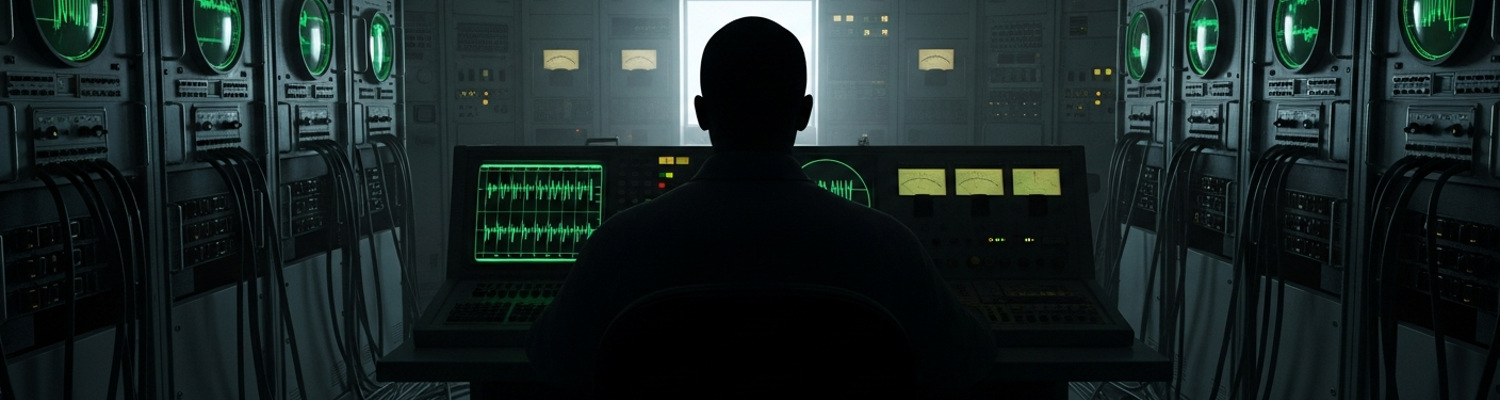

### Initial Encounter: Intelligence Cable
A teletype machine punched out a message. The timestamp was 03 JAN 1965, 02:47Z. Zulu time. For the ground crew and the systems specialist monitoring the U-2's intelligence feed, local time was nearly three hours ahead. They were in the deepest phase of pre-dawn darkness. Archival evidence shows winter missions were selected for their extended hours of night, a perceived cloak for the high-altitude aircraft. This condition also introduced extreme risk. The cold of a Russian January, often plunging to thirty degrees below zero Celsius on the ground, stressed every mechanical component. Hydraulic lines could become sluggish. Fuel gaskets could shrink and leak. For the radio operator in a listening post, 02:47Z was a critical point in a long vigil defined by caffeine and the low hum of equipment. The mission transitioned from transit to action.
The location was 51.2N 37.8E. This designated a patch of earth inside the Soviet Union, within the Kursk Oblast. The region was a flat expanse of agricultural plain, ideal defensive terrain for Soviet Air Defence Forces, the PVO. The absence of mountains made ground-based radar highly effective. A review of operational logs from the period indicates Western intelligence expected this sector to be heavily saturated with PVO assets. Planners briefed the crew to anticipate interlocking fields of fire from SA-2 Guideline surface-to-air missile batteries. The coordinates placed the U-2's flight track directly over a suspected corridor for early-warning and target acquisition radars, including the P-12 "Spoon Rest" and the P-35 "Bar Lock" systems. These were the electronic eyes of the Soviet defensive network. Their activation was a primary intelligence goal.
TARGET ACQUISITION. The phrase denoted success. For the SIGINT specialist, it meant a specific, pre-briefed electronic signal had been intercepted. The operator’s console, an array of frequency displays and audio filters, showed the sudden appearance of a new emission. It possessed a known frequency, a specific pulse repetition interval, and a recognizable modulation identifying it as a Soviet radar. The operator's task was to isolate this signal from background static and other broadcasts. He activated magnetic tape recorders, capturing the raw signal for later analysis. INITIAL ENCOUNTER. This second phrase was more severe. It suggested the signal's nature had changed. Often, it meant a transition from a general search sweep to a dedicated target-tracking mode. The rhythmic pulse of the search radar shifted to the steady, focused hum of a lock-on. This was the moment of maximum sensory and cognitive demand for the radio operator. He had to document the change, log new signal parameters, and relay the information, all while his own physiological response threatened the fine motor control needed to operate his equipment.
SIGINT Operations: The Unglamorous Reality
The work of ground-based Signals Intelligence operators was functionally separate from the high-altitude cockpit of the U-2. A close review of U.S. Army Security Agency (ASA) logs indicates that for every pilot, dozens of soldiers were deployed in a global network of listening posts. These were often in isolated, forward-deployed positions, from the man-made hill at Teufelsberg in West Berlin to other stations along the Iron Curtain. Operators worked in windowless, climate-controlled vans or subterranean bunkers, surrounded by banks of sensitive receivers. The Collins R-390A/URR, an 85-pound electro-mechanical receiver, was a mainstay. It was a highly sensitive piece of equipment, capable of pulling faint high-frequency signals from the ether, but required constant, precise manual operation. These soldiers were linguists, cryptologists, and radio specialists tasked with a 24-hour-a-day mission to monitor, intercept, and interpret the military communications of the Soviet Union and its Warsaw Pact allies.
The primary sensory input was auditory. A dense, layered composition of atmospheric hiss, the crackle of distant lightning, and the wash of commercial broadcast signals filled the operator's headphones for twelve-hour shifts. Within this chaos, the operator had to isolate targets. This included the rhythmic Morse code of a distant naval vessel, the garbled chatter of a Soviet tank unit on maneuvers, and the electronic emissions of the PVO’s air defense network. NSA voice intercept operators would track the entire daily routine of a Soviet air base, from morning radio checks to practice bombing runs. The appearance of a P-12 "Spoon Rest" early-warning radar was a significant event, its VHF signal cutting through the background static. The subsequent hand-off to a P-35 "Bar Lock" target acquisition radar represented a serious escalation. Each signal had to be identified, its frequency and parameters logged, and its raw audio captured on magnetic tape.
This was a search for specific electronic signatures in a global field of electromagnetic noise.
This auditory vigilance produced a sustained state of high alert. Missing a single transmission, such as the subtle shift in a radar’s pulse repetition frequency that indicated a missile lock, could have catastrophic consequences. This was not an abstract fear of war, but an immediate fear of personal failure with strategic implications. Archival medical records and post-service accounts from ASA personnel detail a range of chronic symptoms stemming from this workload. Operators frequently reported debilitating headaches, persistent tinnitus, and significant sleep disturbances. The state of hypervigilance required to distinguish between thousands of similar-sounding electronic signals often led to a heightened startle response and chronic stress that degraded operator performance over time.
Sensory Overload and Operator Isolation
The labor was punishing. For twelve hours, an Army Security Agency operator sat fixed to a chair, headphones channeling a torrent of electronic noise. The primary instrument was often a Collins R-390A/URR receiver, a nearly 30-kilogram box of tubes and electro-mechanical gearing that demanded constant physical manipulation. Its operation was a tactile skill. The operator’s hands were perpetually in motion, dialing heavy knobs to traverse the 0.5 to 32 MHz frequency range, hunting for signals across 32 separate 1-megahertz bands. The auditory environment was a dense chaos. At the base was a wall of atmospheric static, a hiss and crackle that could be intensified by solar flares or distant electrical storms, sometimes rendering entire listening periods useless. Layered over this was the bleed-through of powerful commercial and state broadcasts. Within this cacophony, the operator had to find his target. He was trained to recognize the specific electronic signatures of Soviet military hardware, particularly the air defense radars of the PVO. The appearance of a P-12 "Spoon Rest" early warning radar, operating in the VHF band, would cut through the noise with its distinctive sweeping pulses. This was an aggressive search through noise, a form of attrition that medical records show led to chronic headaches and sleep disorders.
This was a vigil.
The isolation of the radio operator was absolute. While the pilot was alone in the stratosphere, the SIGINT operator was alone in a windowless, shielded room. These listening posts were scattered globally, often in remote locations like Teufelsberg in West Berlin, a station built atop a man-made mountain of rubble. Early operations there were run from mobile vans parked on the summit, where operators worked in parkas against the cold. The operator worked inside a Sensitive Compartmented Information Facility (SCIF), his only connection to the outside world being the antenna feed and a secure line for reporting. He was sworn to secrecy, forbidden from discussing his duties. This psychological sequestration mirrored the pilot’s physical situation. The pilot faced the immediate threat of a surface-to-air missile; the operator faced the persistent pressure of committing a mistake that could lead to that missile being fired. The failure was personal, but the consequences were strategic.
The operational environment was defined by an overwhelming flood of data. The operator was not merely listening for a single sound but monitoring a vast spectrum of electronic activity, presented both audibly and visually on the green phosphor screen of a panoramic frequency display. A review of NSA operational descriptions from the period (such as those found in NARA Record Group 457) shows that a typical mission involved tracking the entire daily routine of a Soviet air base. The operator had to monitor multiple channels simultaneously, discerning the difference between routine training chatter, naval Morse code transmissions, and the electronic intelligence (ELINT) that was the primary objective. When a signal of interest, such as the hand-off from a "Spoon Rest" search radar to a "Bar Lock" target acquisition radar, was detected, a rapid, precise sequence of actions was mandatory. The operator had to fine-tune the receiver, log the exact frequency, use peripheral equipment to measure the pulse repetition interval, activate a tape recorder, and report the intercept up the intelligence chain. This entire process occurred in seconds, often while other new signals were simultaneously appearing on his scope, forcing a constant, high-stakes triage.
Data Overload and Identification Errors
The volume of real-time data from a U-2’s sensors consistently threatened to exceed the processing capacity of a ground-based operator. A single operator was responsible for monitoring a vast electronic spectrum. The operator’s station was designed to intercept Soviet ultra-high frequency communications, which required a direct line of sight that only an aircraft could provide. Within this torrent of raw data, the analyst had to isolate and identify specific, pre-briefed electronic signatures of Soviet Integrated Air Defense System (IADS) radars. This was a process of finding specific signals in an electronic storm, distinguishing military transmissions from civilian broadcasts, atmospheric noise, and other irrelevant signals. The sheer volume of incoming intercepts, especially during periods of high military activity, created a significant demand on an individual's working memory. High demand is directly associated with errors in task performance.
This was not a theoretical problem.
Common errors in identifying IADS emitters were a persistent issue. The Soviet air defense network was a layered system. An operator would first seek the signal of a P-12 "Spoon Rest" early warning radar, a mobile system used for initial detection for SA-2 sites. Upon detecting a target, the "Spoon Rest" would hand it off to a target acquisition radar like the P-35 "Bar Lock." The final, and most dangerous, signal was from the SNR-75 "Fan Song" fire control radar, which guided the SA-2 Guideline missile. While these radars had distinct parameters, their signals could be misattributed under operational stress. Weak or distorted signals, enemy electronic countermeasures, or the simultaneous operation of multiple radars could make positive identification difficult. An operator might mistake the tracking mode of a "Fan Song" for the acquisition sweep of a "Bar Lock," a critical error that understated the immediate threat level. This misidentification stemmed from confusing similar pulse repetition frequencies or scan patterns, a mistake made more likely by the need for rapid analysis.
The consequence of these misattributions was immediate. A flawed signal identification passed up the intelligence chain could lead directly to a revised flight plan for the U-2, often mid-mission. President Eisenhower himself would sometimes alter flight paths based on intelligence regarding potentially dangerous areas. Consider a scenario where an operator erroneously identifies a "Fan Song" fire-control signal as a less threatening "Bar Lock" acquisition radar. The mission controller, believing the U-2 is merely being watched and not actively targeted, allows the pilot to maintain course. Moments later, the operator realizes his mistake and issues a frantic correction. The aircraft is locked by a missile guidance system. This new information would force an instantaneous, high-risk decision. The pilot would be ordered to immediately break from the planned flight track, executing an evasive maneuver and diverting to a pre-planned alternate route. This not only placed the pilot in greater danger but often meant sacrificing the primary intelligence objective of the sortie.
The Psychological Burden and Internal Casualties
A close review of after-action reports (AARs) from the period reveals a clinical accounting of events. These documents were designed for rapid analysis of tactics, not for capturing the human condition. An entry might state: "02:47Z, TARGET ACQUISITION, SA-2 SNR-75 ‘FAN SONG’," followed by logged frequencies and pulse repetition intervals. This language stripped away the operator’s physiological response: the spike of adrenaline, the knowledge that a human pilot was now being actively targeted. The AARs, focused on identifying what happened and how to improve, treated the operator as a component in a machine. The forms lacked fields to document the mental load or the acute stress of making a split-second identification. This was a feature, creating a record of machine-like efficiency that erased the true cost paid by the personnel involved.
The work was a high-stakes intellectual grind.
For twelve-hour shifts, the SIGINT operator was locked in a state of extreme hypervigilance. This was an aggressive mental exercise. The operator had to juggle dozens of signals simultaneously, sorting the electronic chaff of civilian broadcasts and atmospheric noise from the signatures of the Soviet air defense network. The constant mental effort required to maintain this level of focus led to a state of chronic stress and fatigue. This overload is directly linked to performance errors. Sustained high-stakes decision-making and hypervigilance lead to cumulative wear and tear on the body and brain. An operator suffering from this load might experience slower reaction times, indecision, or difficulty prioritizing tasks, any of which could be fatal in the context of a U-2 mission. The fear of failure was a constant professional anxiety.
The internal casualties were widespread. A review of post-service accounts and medical studies of intelligence personnel points to a consistent pattern of symptoms. The constant auditory input and stress often resulted in chronic tinnitus, headaches, and profound sleep disturbances, including insomnia from rotating shift work. The psychological toll was equally severe. Operators reported persistent anxiety, depression, and emotional numbing. These symptoms are consistent with what later analyses identify as the systemic biological and psychological breakdown from sustained, high-performance roles. The intelligence community was often slow to recognize or address these issues, which were frequently compounded by the stigma of seeking mental health support within a culture that demanded emotional suppression. These men were casualties of a war fought with frequencies and sound waves, their injuries invisible but debilitating.
Medical Costs and Performance Deterioration
Post-service accounts and declassified medical analyses from the Cold War era indicate a distinct pattern of stress-related illnesses among Signals Intelligence personnel. The mission demanded unwavering vigilance for up to twelve hours at a time, creating a state of sustained hypervigilance. This condition was not a reaction to direct physical threat but to the responsibility of the task and the fear of personal error with strategic consequences. The cumulative wear from this prolonged chronic stress was generated by the demands of isolating a single Soviet transmission from a dense background of electronic noise. An error in identifying the shift from a P-35 "Bar Lock" search radar to an SNR-75 "Fan Song" fire-control radar was a failure that could cost a pilot his life. This pressure contributed directly to increased rates of chronic anxiety and depression documented in personnel serving at listening posts from West Berlin to Southeast Asia.
These were not abstract complaints.
The physiological consequences were specific. Chronic, tension-type headaches were a frequent complaint, a direct result of the intense concentration required to stare at green phosphor panoramic display scopes. The auditory environment itself was an instrument of damage. Operators wore headphones that funneled a constant stream of static and overlapping signals directly into their ears for entire shifts, leading to widespread reports of tinnitus. The nature of 24/7 operations mandated disruptive shift work that led to profound sleep deprivation and circadian rhythm disorders. An Army study later found that combat effectiveness can drop significantly in soldiers who get only four hours of sleep per night. For the SIGINT operator, fatigue was a direct threat to mission success, degrading the very attention, memory, and processing speed required to perform their duties.
These internal wounds had a direct impact on mission effectiveness. Mental and physical fatigue are linked to errors in judgment. An operator slowed by a migraine or suffering from the fog of sleep deprivation was more likely to misattribute a signal. A tired analyst might confuse the pulse repetition frequency of a benign system with that of an active threat, causing a false alarm that rerouted an aircraft and wasted valuable fuel and time. The reverse was far more dangerous. A failure to detect the subtle change in an enemy radar’s electronic signature could leave a U-2 pilot with no warning of an imminent attack. Operational logs document instances where U-2 flight paths were altered mid-mission based on revised intelligence from ground stations, sometimes correcting an initial, flawed analysis made under pressure. Each of these events represented a moment where an operator’s physical or psychological state directly intersected with the safety of the pilot and the success of the intelligence objective.
The collection of these symptoms reflects the systemic toll of a career in a high-performance, high-stress field. Within the culture of Cold War intelligence services, these issues were rarely seen as an occupational hazard. A deep-seated institutional emphasis on emotional toughness meant that operators were often discouraged from reporting such problems. Seeking help was perceived as a sign of weakness, a potential mark against a soldier’s record that could jeopardize their security clearance and career. Consequently, many personnel suffered in silence, their conditions undocumented and untreated.