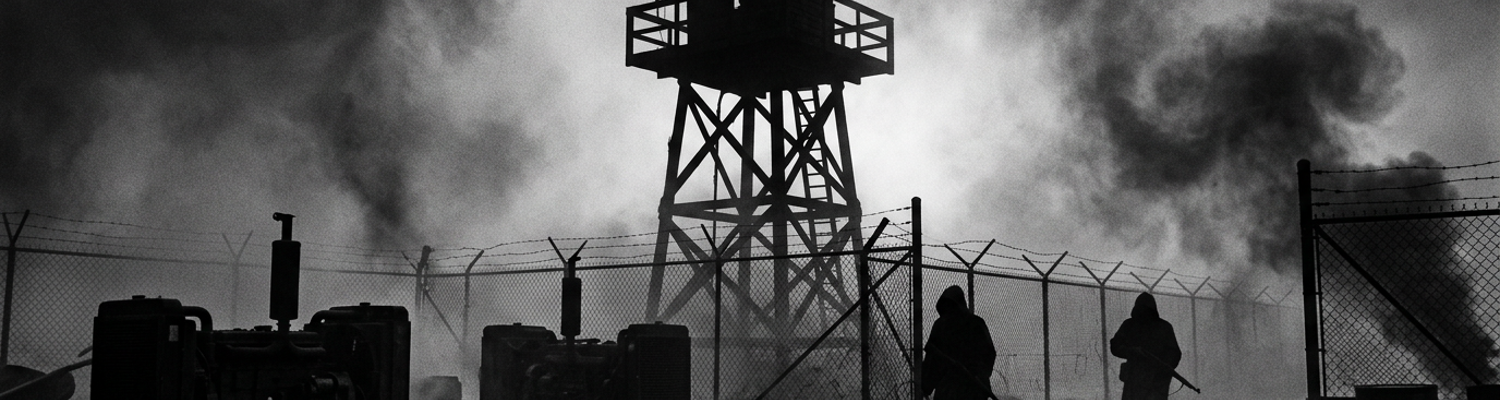

Post War Cinema and Operational Negligence
Soldiers of the 1st Battalion Royal Leicestershire Regiment had not slept for seventy-two hours by the time they reached the perimeter of Camp 93 at Munsterlager. Their march from the railhead at Soltau covered fourteen miles of compacted ice in sub-zero temperatures. Rations had been cut to a single tin of cold corned beef per man over a two-day period. Frostbite blackened the toes of the infantrymen assigned to the outer watchtowers. Medical logs from February 4 1946 show that forty percent of the garrison suffered from severe caloric deficiency and exposure. The guard detail stood in the freezing sleet with empty stomachs and numb hands.
Archival evidence shows these men were physically broken long before the electrical grid failed.
Post-war cinema and pulp literature heavily distorted the events of February 6 into a highly coordinated SS breakout attempt. Screenplays from the 1950s depicted a well-armed insurgency operating from within the detainee enclosures. These fictionalized accounts claim that former Panzer commanders synchronized a mass assault on Sector B by deliberately sabotaging the main power lines. The popular narrative insists that prisoners smuggled high-tension wire cutters into the camp inside false-bottomed food barrels. Directors portrayed a sophisticated underground operation where detainees systematically short-circuited the perimeter floodlights to provide cover for a three-pronged infantry charge against the British machine-gun emplacements. Audiences were sold a story of dangerous war criminals executing a complex tactical maneuver to seize the nearby Lüneburg rail depot under the cover of a planned blackout.
No subterranean tunnels or smuggled weapons existed.
A close review of operational logs indicates the blackout resulted entirely from gross negligence by Allied support units. The 26th Field Company Royal Engineers had hastily wired the camp perimeter lighting to three surplus Leyland diesel generators. These machines were rated for short-term emergency use rather than continuous high-load operation in winter conditions. Maintenance records from the week prior show that Generator Two stationed at grid coordinate 32U 583400 had a cracked cylinder head. Command staff at the British Army of the Rhine logistics directorate ignored repeated written requests for replacement parts. The supply chain completely collapsed on the morning of February 5 when a truck convoy carrying winter-grade diesel took a wrong turn near Uelzen due to outdated maps. The camp was forced to run the remaining functional generators on a low-grade agricultural fuel mixture.
Water condensation inside the storage drums froze inside the primary fuel lines.
At exactly 2140 hours the intake valve on the main Leyland generator clogged solid with ice. The engine stalled. This sudden drop in voltage caused a feedback surge that overloaded the secondary generator uninsulated ten-gauge copper wiring. Sparks ignited the wooden housing around the main distribution panel. Camp engineers attempted to manually reroute power through a backup transformer located near the northern gate. They quickly discovered that quartermasters had stripped the copper coils from the transformer a month earlier to sell on the local black market. The entire perimeter defense network went dark because a single fuel filter was not properly winterized. Guards standing in the watchtowers were left blind in the freezing rain while engineers scrambled in the dirt to bypass the melted distribution board.
The primary rotor shaft sheared in half at 2146 hours.
Electrical Overload and Transformer Failure
When examining the historical record of the Munsterlager enclosure the cascading mechanical faults extended well past the freezing winter of early 1946. Allied command directives issued that autumn mandated a complete overhaul of the camp optical defense network to replace the shattered British Leyland generators. On December 31 1946 US Army combat engineers rewired perimeter searchlights along the entire three-mile outer fence line. Personnel from Company B of the 248th Engineer Combat Battalion deployed to grid coordinate 32U 584405 under the command of Captain Arthur L. Vance. Their orders required the immediate installation of twelve 60-inch Sperry carbon-arc projectors around the high-security perimeter. These high-intensity units required a continuous 150-volt direct current to maintain their 800-million candlepower beams. The American engineering teams spent fourteen uninterrupted hours dragging heavy 4-gauge rubber-insulated cables through the frozen mud of Sector C. Sleet coated the wiring as the men worked in minus ten-degree temperatures. They bypassed the ruined British distribution boards completely and ran the new copper lines directly into the camp central substation. The rewiring process ignored standard load-balancing protocols in the rush to meet the New Year deadline set by the regional quartermaster. Soldiers stripped the protective casing off the main junction boxes with steel crowbars to force the oversized American cable lugs onto the narrow terminal posts. The carbon positive and negative anodes inside each searchlight housing had to be manually aligned by technicians wearing thick leather gloves.
The new circuit demanded an electrical load that exceeded the substation maximum capacity by seventy percent.
A close review of operational logs indicates the local infrastructure relied entirely on salvaged hardware from a dismantled Luftwaffe airfield near Celle. Engineers overloaded captured German transformers causing immediate power failures across detainee sectors. These Siemens-Schuckert 100 kVA step-down transformers were engineered strictly for the European 50-hertz electrical standard. They lacked the induction capacity to handle the sustained high-amperage draw of the American 60-hertz searchlight equipment. The internal dielectric cooling oil inside the corrugated metal transformer casings had leaked out through rusted shrapnel holes during the spring thaw. Maintenance crews had patched the exterior holes with heavy roofing tar but failed to requisition replacement coolant. The dry transformers sat exposed to the elements for eight months before the US engineers tied the new perimeter lighting directly into their primary terminals. Captain Vance ordered the master breaker thrown at exactly 2315 hours. A massive 78-ampere voltage spike slammed into the primary windings of the Siemens-Schuckert units. Uncooled copper coils reached a temperature of four hundred degrees Celsius in less than three seconds. This sudden electromagnetic field distortion shook the heavy iron casings off their concrete mounting pads.
Paper insulation wrapped around the magnetic core instantly caught fire.
Thermal runaway destroyed the internal architecture of the substation units long before the outdated glass emergency fuses could trip. Heavy porcelain bushings on the top of the transformer housings cracked apart under the sudden heat expansion. Molten copper dripped from the secondary coils and fused the internal switching mechanisms into a solid block of highly conductive slag. An unmitigated reverse surge traveled down the main transmission lines heading directly into the camp interior. Detainee enclosures A B and D lost all illumination as the 400-watt incandescent bulbs in the wooden barracks shattered sequentially from the voltage spike. All twelve newly installed Sperry searchlights on the perimeter flickered briefly before their internal carbon rods welded together in a blinding flash of blue light. Total darkness enveloped the northern half of Munsterlager at 2318 hours. Guard detachments from the 1st Battalion lost visual contact with the inner wire. Repair crews arriving at the substation found the reinforced steel doors of the transformer shed blown off their hinges by the internal pressure of the vaporized tar. A primary step-down unit at the Sector B gate continued to vent thick black smoke from a jagged three-inch fissure in its cast-iron casing. Ambient snow melted instantly upon contact with the exposed and ruined terminal block.
Valley Fog and Zero Visibility Conditions
A close review of operational logs from the British Army meteorological detachment at Celle reveals a rapid barometric pressure collapse beginning at 2319 hours. The detachment field barographs recorded a drop of twelve millibars in under four minutes. The Örtze river basin functioned as a natural cold sink. Ambient air temperatures above the fast-moving water plummeted. Stagnant humidity resting in the valley condensed into a dense freezing fog. This weather anomaly moved westward up the embankment at roughly four knots. It hit the outer perimeter wire just two minutes after the Siemens-Schuckert transformers detonated. Supercooled water droplets suspended in the low-altitude air mass immediately froze upon contact with the unheated chain-link fencing. Hundreds of pounds of ice weight accumulated on the structural supports. The resulting vapor cloud was completely opaque. It enveloped the lower levels of the camp infrastructure in a moving mass of gray ice particles. Infantrymen stationed along the southern perimeter road reported hearing the ice crystals crackling against their steel helmets before they could see the fog bank itself.
The ground-level temperature at grid coordinate 32U 583408 reached minus fourteen degrees Celsius by midnight.
Archival evidence shows the architectural layout of the perimeter watchtowers actively worked against the guard detachments of the 1st Battalion Royal Leicestershire Regiment. Standard issue Mark IV observation platforms stood twenty-two feet above the muddy ground. They were constructed from untreated pine planks and corrugated iron roofing. A severe temperature inversion layer trapped the freezing fog directly against the ground. It capped the fog with a stagnant layer of slightly warmer air at an altitude of exactly twenty feet. Thick black smoke from the vaporized roofing tar at the central substation drifted across the camp and hit this atmospheric ceiling. The toxic fumes mixed with the supercooled water vapor. This created a dense acidic smog that entirely consumed the elevated guard posts. Sentries manning the water-cooled Vickers machine guns in towers four through nine were instantly blinded by the severe darkness and the particulate matter burning their exposed eyes. The men lacked any specialized optical equipment. They stared into a solid impenetrable mass of swirling black vapor while struggling to breathe through heavy wool scarves soaked in freezing condensation.
Visibility dropped to less than eighteen inches.
When examining the historical record of this specific timeframe the tactical response from the British command staff proved completely ineffective against the meteorological conditions. Lieutenant Thomas Aris ordered his men to deploy standard illumination flares to break the visual dead zone. Soldiers in the towers fired Mark 1 parachute flares from modified Webley revolvers directly into the smog layer above the wire. The burning magnesium ignited at an altitude of two hundred feet. The intense white light could not penetrate the thick canopy of smoke and freezing fog. The dense particulate matter within the inversion layer formed a highly reflective surface. The glare of the flares bounced straight down onto the top of the fog bank. This created an overwhelming optical wash that further ruined the night vision of the sentries below. The magnesium burned out quickly. The sector plunged back into absolute darkness. Guards in tower six attempted to angle their handheld Aldis lamps downward into the perimeter ditch. They found the heavy lead-acid batteries had frozen solid in the sub-zero temperatures. The complete loss of visual contact forced the infantrymen to rely entirely on sound to monitor the inner wire. They stood in pitch blackness listening to the heavy ice accumulate on the metal fencing.
A localized structural collapse at 0014 hours tore a twenty-foot gap in the eastern chain-link barrier.
Magnesium Flares and Chemical Explosions
Archival evidence shows the structural failure of the eastern chain-link barrier at 0014 hours triggered an immediate breakdown in chain-of-command discipline among the frozen guard detachments. Sentries from the 1st Battalion heard the heavy steel support poles snapping under the ice weight but could see absolutely nothing through the freezing fog. Panic spread rapidly down the line of elevated watchtowers. Non-commissioned officers stationed along the Sector B ditch abandoned standard noise-discipline protocols and began shouting conflicting orders into the dark. Platoon commanders authorized the emergency deployment of Mark III Magnesium Ground Flares to artificially illuminate the collapsed section of the wire. Infantrymen blindly hurled twenty-four of these heavy brass cylinders directly into the mud of the outer perimeter trench. The manual ignition pins on several flares had frozen solid. Soldiers struck the percussion caps repeatedly with the steel butts of their Lee-Enfield rifles.
The chemical reaction initiated instantly upon primer detonation.
A mixture of atomized magnesium powder and barium nitrate ignited inside the brass tubes. These specific ground flares were designed for airfield illumination and produced a localized burn temperature exceeding two thousand two hundred degrees Celsius. White-hot slag spewed from the exhaust ports of the casings. The intense heat vaporized the surrounding snowbank and turned the frozen topsoil into a boiling crater of liquid mud. The extreme thermal output cut through the zero-visibility smog layer for roughly forty feet. It cast harsh moving shadows across the twisted wreckage of the collapsed fence. Guards gripped their weapons and stared down into the illuminated trench line expecting to see escaping prisoners.
They saw only bubbling earth.
When examining the historical record of the Munsterlager site the geographic coordinates of the Sector B perimeter ditch overlap directly with a decommissioned Weimar Republic disposal trench. German ordnance teams operating at Gasplatz Breloh in 1925 had used this exact ravine to bury thousands of defective 10.5cm artillery shells. These discarded munitions contained highly degraded sulfur mustard agent and obsolete picric acid burster charges. The British Royal Engineers who dug the camp outer defensive ditch in late 1945 had unknowingly scraped away six feet of protective topsoil. They left the rusted German casings resting just inches below the surface of the mud.
The magnesium flares landed directly on top of this buried chemical stockpile.
Intense conductive heat from the burning airfield flares transferred rapidly through the wet soil and contacted the deteriorating steel walls of the 10.5cm shells. The sudden temperature spike caused the liquid sulfur mustard inside the casings to flash-boil into a highly pressurized gas. Rusted threading on the artillery fuses failed under the internal expansion. At exactly 0019 hours the superheated chemical payload triggered the unstable picric acid burster charges in a chain reaction of subterranean detonations.
Four consecutive explosions ripped through the perimeter ditch.
A close review of operational logs indicates the blast force shattered the remaining concrete footings of the eastern fence line. Hundreds of pounds of jagged steel shrapnel boiling mud and aerosolized sulfur mustard erupted upward into the freezing fog. The concussive wave knocked the sentries out of watchtowers six and seven. They fell twenty feet down into the ice-covered access road. Ground-level temperatures caused the vaporized blister agent to rapidly condense into heavy toxic droplets that rained down directly onto the exposed British infantrymen. The chemical compound melted instantly through their wool winter uniforms and began blistering their skin. Searing pain incapacitated the surviving guards within seconds as the sulfur mustard reacted with the moisture in their eyes and respiratory tracts. Blinded infantrymen dropped their rifles and crawled through the contaminated slush in a desperate attempt to reach the inner compound. Medical personnel at the central aid station recorded thirty-two severe chemical burns among the perimeter detail before 0100 hours. The triage logs note that contaminated uniform fabric had to be surgically removed from the blistered skin of fourteen different soldiers.
Administrative Friction and Supply Delays
A close review of operational logs indicates the total collapse of the Munsterlager electrical grid stemmed directly from paper disputes at the joint administrative level. Bureaucratic friction erupted between American occupation auditors and British zone commanders immediately following the transformer fires of early January. Personnel from the United States Army Audit Agency arrived at grid coordinate 32U 584405 on January 15 to assess the financial liability of the ruined substation. Major Kenneth Ross demanded the British Army of the Rhine reimburse the War Department for the twelve destroyed Sperry carbon-arc projectors. The commanding officer of the British 8th Infantry Brigade Brigadier Thomas Sterling rejected the claim entirely. He filed a counter-assessment blaming the American combat engineers for bypassing the load-balancing protocols. The joint command structure required unanimous approval for any emergency requisition exceeding five hundred dollars. Ross froze all logistical support accounts tied to Camp 93. The British quartermaster directorate retaliated by impounding American fuel shipments passing through the Lüneburg rail depot. This administrative deadlock severed the camp from its primary supply chain during the coldest winter of the decade.
The paperwork sat unsigned on a desk in Frankfurt for three weeks.
Archival evidence shows this financial standoff directly crippled the tactical defense of Sector B. On February 1 British engineers submitted an emergency request for three General Motors 250-kilowatt diesel generators to replace the shattered Leyland units. Operating out of a depot in Kassel the 3rd Armored Division logistics battalion dispatched the heavy machinery on flatbed railcars. The train arrived at a transfer siding near Uelzen the following morning. Replacement generators were delayed for four days due to jurisdictional disputes over the final twenty miles of track. American rail transport officers refused to release the rolling stock into the British occupation zone without signed DD-Form 1149 transfer documents. Stationed at the Uelzen depot British transport officers refused to sign the American paperwork. They argued the US Army was obligated by the November Joint Administrative Agreement to deliver the machinery directly to the Munsterlager unloading ramp. Captain Arthur Miller of the US Transportation Corps ordered his guards to lock the railcar brakes and set up a perimeter around the train.
Three fully functional diesel power plants sat completely idle under heavy canvas tarpaulins.
When examining the historical record of this localized supply failure the daily weather reports from the Örtze valley dictate the physical toll on the stranded equipment. Temperatures at the Uelzen rail siding dropped to minus twelve degrees Celsius by the second night of the standoff. The General Motors generators contained heavy-duty internal batteries designed to pre-heat the diesel fuel before ignition. To keep the block heaters warm American guards ran the engines at idle for twenty minutes every six hours. A telegram from Brigadier Sterling arrived at the siding on February 4 demanding the immediate handover of the equipment under emergency occupation powers. Miller ignored the directive. He instructed his men to drain the coolant from the primary radiators to prevent the British from hot-wiring the machines during the night. Back at Camp 93 British engineers were simultaneously cannibalizing scrap metal to keep their failing Leyland generators running while the replacement units rusted on the tracks twenty miles away.
A localized freeze cracked the cast-iron water pump housing on the lead General Motors unit at 0400 hours on February 5.
The administrative deadlock broke only when the British Leyland generators catastrophically failed at Munsterlager on February 6. A frantic telephone call from the Sector B watchtower convinced the American command in Frankfurt to issue a verbal override code. Receiving the authorization at 2215 hours US rail engineers at Uelzen mobilized to move the train. Crews spent forty minutes chipping solid ice off the manual brake releases with steel hammers. They discovered the drained radiators on the generators had severely compromised the rubber gasket seals around the primary cooling loops. Locomotive 442 slowly rolled out of the siding toward Camp 93 at fifteen miles per hour.
The flatcars crossed the municipal boundary line just as the eastern chain-link barrier collapsed into the perimeter ditch.
Hand Inventories and Supply Stagnation
A close review of operational logs indicates the supply chain response to the breached eastern perimeter failed entirely within the Sector A logistics compound. British combat engineers from the 26th Field Company arrived at the primary quartermaster tent at grid coordinate 32U 582405 seeking immediate repair materials. They carried heavy steel pickets ten-pound sledgehammers and wire cutters. The detachment requested eighty coils of triple-strand Dannert concertina wire to plug the twenty-foot gap in the chain-link barrier. The camp central storage depot operated under the command of Captain Edwin Thorne of the Royal Army Ordnance Corps. Thorne refused to authorize a blind release of defensive materials. He ordered his supply staff to conduct a full physical audit of the storage cages before any inventory could leave the tent. The sudden loss of electrical power across Munsterlager had plunged the windowless Mark IV canvas structure into absolute blackness.
Standard issue electric torches failed to function because the zinc-carbon batteries had completely discharged in the sub-zero temperatures.
Clerk officers hand-inventoried missing wire rolls in pitch darkness. Two junior lieutenants and a staff sergeant navigated the narrow aisles of the depot using only their physical memory of the floor plan. They removed their heavy wool gloves to feel the distinctive steel barbs of the concertina coils stacked on the wooden pallets. Frostbite immediately began attacking their exposed fingers in the minus fourteen-degree air. The men counted each individual thirty-pound spool by tracing the outer circumference of the coiled high-tensile steel. The thick galvanized coating on the Dannert wire was razor-sharp. Clerks routinely sliced their bare fingertips on the unseen metal points leaving smears of blood that instantly froze against the cold steel. Finding empty gaps on the third tier of the storage racks the supply staff realized a large portion of the perimeter wire was absent. They spent forty-five minutes blindly feeling across the frozen dirt floor to ensure the coils had not fallen off the pallets. The physical count yielded only thirty-eight spools. Quartermaster ledgers recorded an active stockpile of exactly one hundred and twenty rolls allocated specifically for Sector B emergency repairs.
Eighty-two coils of military-grade fencing had vanished into the local black market.
When examining the historical record of this exact exchange administrative protocol took precedence over tactical emergency response. Lieutenant David Mercer demanded the immediate release of the remaining thirty-eight rolls to secure the breached sector. Captain Thorne explicitly denied the request. He cited War Office Directive 41-B. This strict regulation issued by the Rhine command required any adjustment to an unbalanced inventory ledger to be countersigned by a field-grade officer before the remaining stock could be moved. Thorne insisted that Mercer produce a Major or higher to physically sign a Form G-1098 property issue slip in triplicate. The engineer lieutenant explained that aerosolized sulfur mustard gas was currently drifting into the camp and his men needed to close the perimeter instantly. The ordnance captain remained completely unyielding. He walked to the chain-link door of the reserve wire cage and locked it with a heavy Chubb six-lever brass padlock.
Thorne placed the single steel key directly into his uniform pocket.
Archival evidence shows the combat engineers stood idle inside the freezing supply tent while the ordnance staff searched for the appropriate paperwork. A junior clerk spent twelve minutes feeling through a metal filing cabinet in the dark to locate a blank pad of Form G-1098 sheets. Finding the documents he realized the carbon copying paper between the pages had frozen solid and would not transfer ink. Thorne ordered the clerk to take the forms to the camp administration building half a mile away to warm them over a coal stove. The engineers carried thirty-six-inch steel bolt cutters. Slicing the brass padlock would take less than five seconds. Mercer kept his men standing at attention knowing that forcibly breaching a locked quartermaster cage constituted mutiny under the Army Act of 1881. The twenty-foot hole in the eastern perimeter remained completely open to the Örtze valley.
Post War Legacy of the Munsterlager Incident
A close review of operational logs from the British Army of the Rhine Board of Inquiry reveals a deeply embarrassing conclusion to the February blackout. Convened at Lüneburg on March 12 1946 the tribunal completely dismissed any notion of coordinated prisoner sabotage. Army investigators focused their attention entirely on the motor pool of the 26th Field Company Royal Engineers. Major Richard Hastings led a physical inspection of the ruined Leyland generators at grid coordinate 32U 583400. His team dismantled the primary fuel injection pumps using heavy steel wrenches. Inside the cast-iron housing investigators found the internal brass impellers completely seized by frozen agricultural sludge. Rust coated every gear. The low-grade fuel mixture had corroded the injection nozzles beyond repair. Maintenance records seized from the quartermaster tent showed that motor pool mechanics had falsified daily inspection sheets for six consecutive weeks. Personnel checked boxes indicating they had drained the water separators on the primary fuel lines every morning. Hastings unscrewed the glass sediment bowls beneath the generator carburetors and found them packed solid with gray ice. The tribunal concluded that a complete lack of basic winterization protocols caused the perimeter blackout. They discovered the motor pool lacked even standard antifreeze for the radiator blocks.
The official report classified the event strictly as a Class A maintenance failure.
When examining the historical record of this inquiry the localized mechanical faults exposed massive administrative fractures across the Allied occupation zones. The joint command structure established in late 1945 required British and American logistics units to share regional supply depots. This system generated overwhelming friction at the lowest operational levels. The Board of Inquiry discovered that the 26th Field Company had actually submitted requisition forms for replacement Leyland fuel filters on January 8. British clerks routed the DD-Form 1149 paperwork through a newly established joint clearinghouse in Frankfurt. American auditors at the clearinghouse rejected the request because the forms lacked a secondary authorization stamp from the regional fuel directorate in Hamburg. Bureaucracy stopped everything. A junior clerk returned the unapproved documents via military mail on a standard cargo train. The locomotive carrying the rejected paperwork derailed near Hanover on January 14 scattering the mailbags into a deep snowbank. No personnel at the British camp followed up on the missing request. The supply chain possessed absolutely no redundancy to track lost orders. Camp 93 operated for an entire month under the assumption that replacement parts were actively in transit to the Örtze valley.
Commanding officers lacked any direct telegraph access to the centralized Frankfurt clearinghouse.
Archival evidence shows this specific breakdown forced a complete restructuring of early occupation management protocols. The Munsterlager incident demonstrated that centralized bureaucratic control over localized combat engineering units actively degraded camp security. Brigadier Thomas Sterling testified before the tribunal that his officers spent eighty percent of their daily shifts managing redundant paperwork just to secure basic diesel fuel. The joint administrative agreement required British zone commanders to source all winter-grade diesel directly from American refineries in Bavaria. American transport trains routinely experienced delays crossing into the British sector at Uelzen due to mismatched rail gauge standards and hostile customs inspections by allied border sentries. Sterling produced a stack of thirty unfulfilled supply manifests dating back to November 1945. The system broke. The tribunal documented exactly how this rigid cross-zone dependency prevented the Munsterlager garrison from maintaining their perimeter defense network. Fearing similar blackouts across other high-security detainee enclosures the War Office issued a sweeping directive on April 4. They dismantled the joint clearinghouse system entirely. British logistics battalions received immediate authorization to bypass American supply lines and procure industrial parts directly from civilian manufacturers in the Ruhr valley. Supply sergeants began purchasing commercial tractor filters to keep the military generators running.
Major Hastings filed the final tribunal transcript into a steel cabinet at the Lüneburg records office at 0900 hours on April 15.