
Strategic Command Disputes and Pacific Allocation
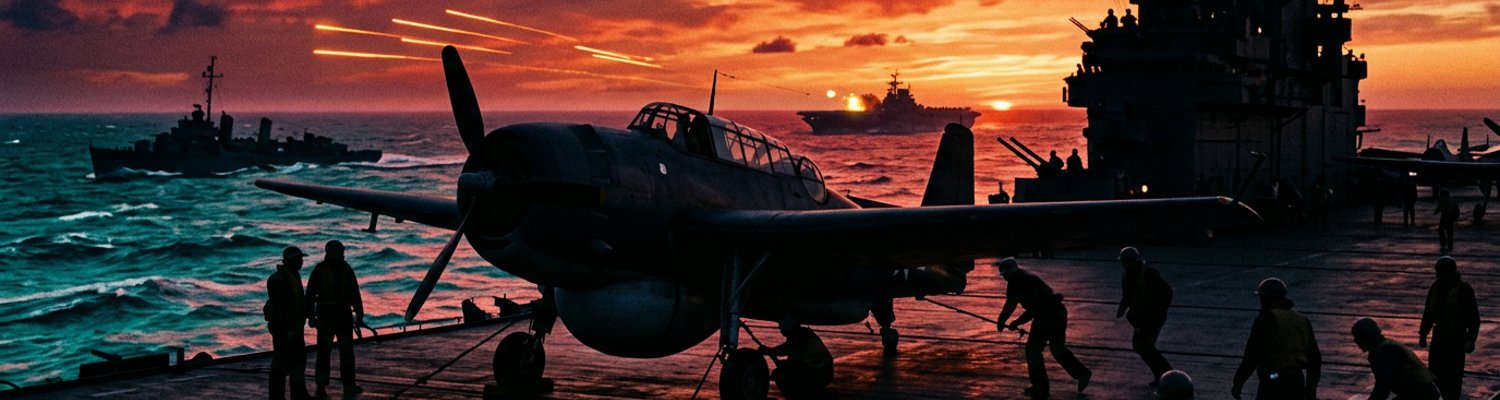
Mechanics aboard USS Yorktown struggled to clear a fouled fuel line on an F6F-3 Hellcat fighter before pre-dawn flight quarters sounded across the darkened waters ninety miles northeast of Truk Lagoon. Humid sea air carried the heavy stench of leaking aviation gasoline and pungent diesel exhaust as armorers hoisted five-hundred-pound bombs onto slick wooden decks beneath wet flight suits. Vice Admiral Marc Mitscher watched the deck handling from the carrier island, knowing that every minute of delay jeopardized the tight operational timetable demanded by Pearl Harbor. Naval planners had staked the entire operation on catching five Japanese airfields unprepared inside the atoll, yet the carrier strike force was sailing into the central Pacific under contentious strategic compromises. State Department Decimal File 740.0011PW recorded inter-service debates between Chester Nimitz and Douglas MacArthur over Pacific theater resource allocations, revealing how bitter arguments over fleet carriers, assault transports, and heavy bombers had nearly derailed this carrier raid.
Douglas MacArthur argued that the Navy should divert its fast carriers toward the Southwest Pacific to cover his landings along northern New Guinea instead of risking precious hulls against fortified coral islands. Chester Nimitz pushed back through official cables to Washington, calculating that a direct thrust across the Central Pacific would break through the outer defensive ring of the Japanese Empire far faster than a jungle campaign. Logistical ledgers in Washington exposed the raw friction between both theaters, as supply officers tallied the exact distribution of aviation fuel, replacement airframes, and repair tenders between the two competing commands. Civilian diplomats and military planners clashed over these inventory sheets, knowing that assigning fleet carriers to one theater starved the other of deep-strike capability. Admiral Ernest King brokered a compromise in Washington that kept Task Force 58 under naval command, ordering Nimitz to prove that carrier aviation could shatter land-based air networks on its own.
Joint Chiefs of Staff leaders authorized Operation Hailstone to test whether carrier task forces could neutralize heavily fortified bases without amphibious invasion. Military strategists had long regarded Truk Lagoon as Japan's premier central Pacific anchorage, a circular coral barrier packed with coastal guns, submarine pens, and five interconnected air bases that guarded the Caroline Islands. Traditional amphibious doctrine dictated that capturing such a redoubt required waves of landing craft, division-strength ground assaults, and weeks of bloody beachhead fighting. Naval planners calculated instead that nine fleet and light carriers, carrying over five hundred warplanes, could isolate the atoll by dropping high explosives directly onto runways, hangars, and anchored transport ships. Success in this high-risk raid would eliminate the need for a costly land invasion, releasing valuable marine divisions and cargo vessels for future strikes against the Mariana Islands.
Carrier crews across Task Force 58 implemented this experimental doctrine as they readied nine fleet and light carriers for the opening fighter sweep. Flight deck armorers aboard the flagship USS Yorktown and her sister ships checked hydraulic pressure gauges and warmed radial engines in the final hour before daybreak. Radio technicians in shipboard radar rooms calibrated their delicate vacuum tubes and tracked faint electronic pulses across glowing scopes, hunting for any early warning patrol launched from Truk. Pilots strapped into tight cockpits adjusted their oxygen regulators and plotted compass headings toward the airstrips on Moen and Eten islands. Catapult officers raised their glowing green batons into the ocean wind, signaling the lead Grumman Hellcats to advance toward the flight deck launching spots.
Task Force 58 Pre-Dawn Launch Logistics
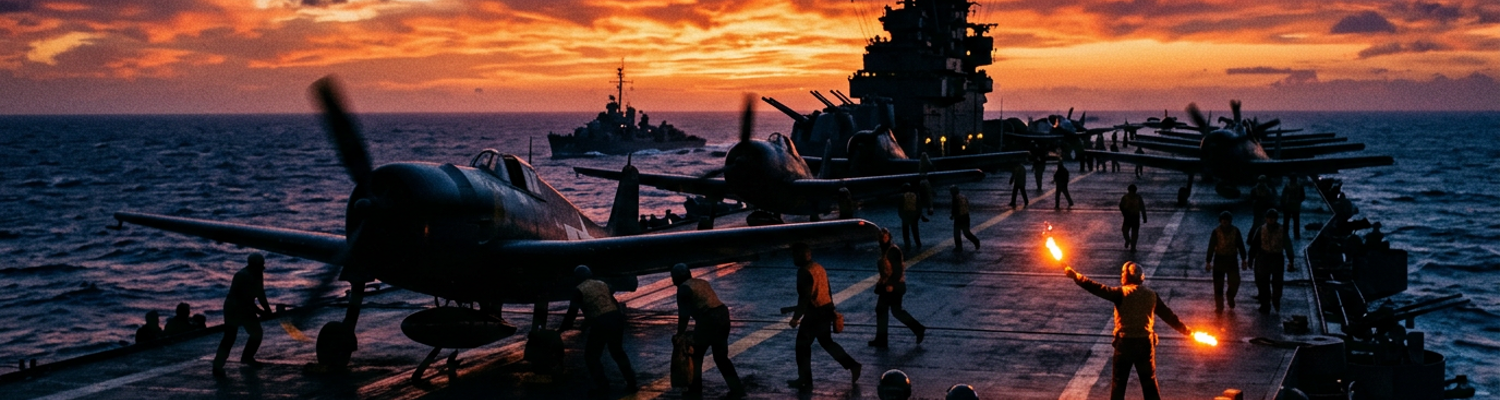
Plane directors guided each Grumman fighter forward as tire treads gripped the damp wooden deck planks. Deck crews managed volatile aviation fuel lines and Pratt and Whitney R-2800 engine warm-ups prior to the dawn launches on February 17, 1944. Mechanics checked rubber hoses, brass couplings, and deck valves with shielded red lenses to spot high-octane gasoline leaks before stray sparks could ignite the crowded flight deck. Aviation machinists leaned against the fuselage frames to listen to the two thousand horsepower Pratt and Whitney R-2800 Double Wasp engines, verifying manifold pressures and spark plug ignitions while the heavy propellers churned the humid sea air. Exhaust gases bathed the forward carrier decks in blue flames as flight officers checked cockpit controls and hydraulic rudder movements. Armorers latched heavy belly drop tanks beneath the fighter fuselages to ensure each aircraft carried enough reserve fuel to reach Truk and return.
Fuel tanks clattered into their release shackles as mechanics secured the breakaway feed lines and safety locking pins. Plane captains tapped cockpit cowlings to signal ready status to pilots who sat waiting with adjusted instrument dials and strapped shoulder harnesses. Vice Admiral Marc Mitscher directed nine fleet and light carriers maneuvering northeast of Truk Lagoon under total night blackout restrictions, holding the strike force in precise tactical formation ninety miles from the target without using radio transmissions or navigational lights. Helmsmen gripped their steering wheels on darkened bridges across the three carrier task groups, matching compass headings to keep thirty-three combat vessels aligned in the black sea. Signalmen passed silent operational orders down the formation lines with directional, hooded infrared lamps aimed directly at neighboring bridge wings. Bridge officers tracked the changing wind velocity across the carrier bows as the flagships turned fifteen degrees into the prevailing easterly trades.
Anemometers spun on the carrier mastheads, confirming thirty knots of relative wind over the wooden flight decks to provide maximum takeoff lift. Launch directors organized the seventy-two Hellcats into two tight deck rows, staggering wingtips to clear catwalk ironwork and gun sponsons along the hull edges. Catapult crews dragged heavy steel bridle cables across the teak decking, hooking the wire loops into the launch lugs under the fighter bellies. Flight deck officers waved their luminescent wands in rapid circles, ordering pilots to advance their throttles to full military combat power against the holdback releases. Radial engines roared at maximum power, blowing stinging spray, hot cylinder exhaust, and unburnt fuel across the ducking catapult teams. Catapult officers dropped their glowing wands toward the darkened forecastle, opening the hydraulic release valves to fire the fighters into the pre-dawn sky.
Fighter aircraft accelerated down the catapult tracks, clearing the carrier bows with only seconds separating each launch. Pilots corrected for sudden engine torque as their landing gear cleared the flight deck edge and their airframes met the open ocean wind. Flight leaders clicked their radio transmitters to confirm group assembly, orbiting into loose diamond formations above the darkened task force without showing formation lights. Compass needles settled onto southwesterly courses as the lead divisions climbed through moist cloud layers to gain cruising altitude. Flight formations closed ranks behind their division commanders, establishing radio silence to preserve tactical surprise before reaching the radar coverage zone around Truk. Squadrons climbed through five thousand feet on a direct bearing for the Japanese airfields on Moen and Eten islands.
Fighter Interceptions Over Moen and Eten
Altimeter needles climbed past twelve thousand feet as seventy-two Grumman F6F-3 Hellcats executed a synchronized suppression sweep targeting Japanese airfields across Moen and Eten islands. Flight leaders adjusted supercharger blowers into high gear while scanning the eastern horizon for the low volcanic silhouettes of Truk Atoll. Japanese radar operators at the Moen island radar station detected the approaching formations forty miles out, sounding air raid sirens across the dispersal revetments. Ground crews on Eten Island cranked hand starters on Mitsubishi A6M Zero fighters and scrambled to clear coral dust from narrow packed runways. Pilots from the 201st and 204th Naval Air Groups ran across open revetments toward their idling machines, hoping to gain operational altitude before the incoming strike arrived over the outer reef. Exhaust smoke billowed from dozens of Sakae engines as Japanese interceptors taxied out in disorganized clusters toward the primary takeoff strips.
Throttle linkages slammed forward as Japanese pilots lifted off the coral runways without forming structured defensive flights. Fighter directors aboard Task Force 58 plotted these scattered takeoffs on plotting boards using SK air search radar returns relayed through radio headsets. Shipboard radar directed an eighty-plane interception between 0610 and 0615 hours that eliminated Japanese defensive scrambles before combat air patrols formed. Hellcat divisions banked sharply into steep dives from twenty thousand feet to trap the climbing Zeros and Nakajima Ki-43 Oscars below ten thousand feet. Armor-piercing incendiary bullets from six wing-mounted Browning machine guns tore through unarmored Japanese fuel tanks and wings. Flaming debris fell into the clear waters of the lagoon as the first wave of scrambling defenders broke apart under concentrated American diving passes.
Hellcat pilots leveled off above the falling wreckage and redirected their guns toward the Moen airfield complex. Lieutenant Commander William R. Kane led his division across the Moen runways, raking twin-engine Betty bombers and transport aircraft parked in open revetments. Hydraulic fluid and burning high-octane gasoline erupted across the dispersal ramps, creating thick black pillars of smoke that blinded antiaircraft gunners stationed along the perimeter hills. Japanese gunners fired twenty-five-millimeter Type 96 automatic cannons at the low-flying fighters, but the heavy volume of American strafing fire cut down gun crews before they could establish effective tracking patterns. Metal fragments and machine gun slugs perforated uncamouflaged aircraft parked wingtip to wingtip along the taxiways, eliminating second-wave replacement planes on the ground.
Eten Island airstrips suffered immediate strafing passes as southern Hellcat divisions shifted their fire directly against surviving fighter dispersal pens. Navy pilots spotted five Zeros attempting to take off across the crosswind runway and dove through the rising harbor smoke to cut them off. Tracers stitched across the lead Zero as its landing gear retracted, sending the fighter cartwheeling into the shallow surf off the southern runway threshold. Ground crews across both Moen and Eten abandoned their repair workshops and fire trucks to seek shelter in concrete bunkers as fuel depots detonated along the flight lines. Strike leaders circled the burning airfields at three thousand feet, transmitting clear radio codes back to Task Force 58 that the skies above Truk were open for the incoming dive bombers and torpedo planes.
Radar-Guided Strike Avionics in Combat Operations
Radio receivers aboard Task Force 58 carriers logged these target clearance signals, enabling flight coordinators to dispatch continuous daylight waves of dive bombers and torpedo planes against Japanese shipping across Truk Lagoon. Dive bombing squadrons battered vessels caught in the open water, forcing surviving freighters, tankers, and naval auxiliaries to seek refuge within the darkened channels and island shadows of the atoll as twilight settled over the Pacific. Enterprise Torpedo Squadron 10 executed the first nocturnal carrier-based radar decapitation strikes against anchored shipping, shifting American carrier doctrine from daylight visual attacks to precision electronic night strikes. Aviation ordnance crews and electronics technicians aboard USS Enterprise labored in the hangar bay to inspect sensitive vacuum tubes, clean coaxial antenna cables, and load four delayed-action five-hundred-pound bombs into each aircraft. Lieutenant Commander William I. Martin assembled his aircrews around navigational charts in the ready room, plotting low-altitude approach corridors through the jagged island passes where unguided flight meant certain destruction in the dark.
Pilots strapped into twelve modified Grumman TBF-1C Avengers started their Wright R-2600 radial engines on the darkened flight deck of USS Enterprise before catapult crews launched the flight into black ocean skies at two in the morning. Radar operators crouched inside cramped fuselage compartments behind the cockpits, warming up their electronic consoles and adjusting sweep controls while the aircraft climbed toward the atoll. Electromagnetic signals bounced off the jagged mountain crests of Dublon and Eten islands, showing up on circular cathode-ray scopes as bright green echoes that clearly defined the narrow waterways from the surrounding land. Flight leaders used these radar images to guide their formations through the reef passes without catching a wingtip on towering volcanic bluffs. Grumman TBF-1C Avengers navigated restricted lagoon waterways using airborne radar altimeters and ASB microwave sets to execute low-altitude bombing runs, keeping their airframes level at three hundred feet above the calm water.
Radar operators watched for distinct target blips to detach from the coastline clutter as each Avenger closed within two miles of the primary Japanese anchorage. Crewmen spoke over intercom wires to feed precise steering corrections to their pilots, centering the luminescent target spikes on the scope grid lines. Pilots aligned their aircraft with these electronic bearings, lowering their noses into shallow gliding approaches and flipping toggle switches to open the ventral bomb bay doors. Release mechanisms dropped clusters of five-hundred-pound bombs across the decks of merchant hulls from an altitude of two hundred and fifty feet, giving the delayed fuses just enough drop time to arm before impact. Armor-piercing casings punched through steel deck plating and cargo holds, detonating deep inside the engine spaces before Japanese lookouts could identify the attacking planes or aim their searchlights into the night sky.
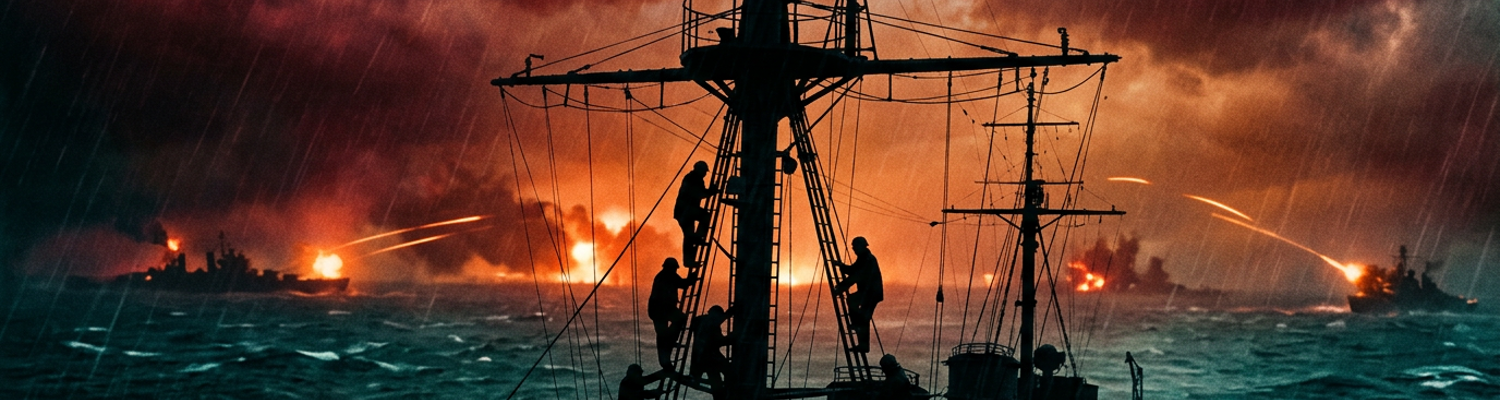
Searchlights snapped on along the perimeter of Dublon Island, casting frantic white beams into empty overcast clouds while Japanese antiaircraft crews pumped twenty-five-millimeter tracer rounds thousands of feet above the skimming bombers. Secondary explosions shattered ammunition ships and oil tankers across the roadstead, throwing towering fireballs into the black sky that exposed burning hulls listing into the coral shallows. Lieutenant Van V. Eason banked his plane into a hard turn above the southern lagoon reef, reading his radar altimeter to clear outer barrier shoals while gathering his flight for the return transit. Flight division leaders confirmed direct bomb hits on eight major vessels and severe damage on several others, losing only a single Avenger during the entire operation. Enterprise landing signal officers waved the surviving bombers onto the illuminated carrier deck before dawn, collecting electronic mission logs that detailed the bomb impacts on anchored transports.
Auxiliary Shipping Losses and Strategic Atoll Isolation
Flight officers aboard Task Force 58 carriers analyzed these electronic mission logs alongside fresh aerial reconnaissance photographs, tracking pillars of black smoke that rose from burning merchant vessels across the lagoon. Morning strike groups followed these smoke columns back into the anchorage to finish off damaged Japanese supply ships before salvage crews could beach them against the islands. Navy dive bombers dropped one-thousand-pound armor-piercing bombs into cargo holds filled with submarine spare parts, coastal artillery shells, and aviation maintenance equipment. Torpedo planes skimmed low over the barrier reef to send Mark 13 torpedoes into the waterlines of commercial freighters that had been drafted into military transport service. Burning bunker fuel spread across the surface of the anchorage, igniting wooden workboats and cutting off escape routes for crews trying to beach listing vessels on the shallows of Dublon and Fefan islands.
Grumman Avengers and Curtiss Helldivers dove through this rising smoke during daylight strikes on February 17 and 18, methodically picking apart the maritime infrastructure that sustained Japanese naval power in the central Pacific. Task Force 58 aircraft destroyed over 250 Imperial Japanese aircraft and sank 200,000 tons of fleet auxiliary and support shipping throughout the two-day operation. Strike leaders concentrated their bombs and torpedoes against irreplaceable auxiliary assets, including three fleet oilers, two specialized submarine tenders, and dozens of heavy transport freighters. Antiaircraft gunners on merchant decks fired their small-caliber machine guns until bomb explosions breached their bulkheads and flooded their boiler rooms. Heavy detonations ripped through ammunition vessels and fuel carriers, sending metal hull fragments raining down on the lagoon floor and leaving thirty-one major support vessels resting on the bottom.
Staff officers at Imperial Japanese Navy headquarters in Tokyo received urgent distress cables reporting the loss of these ships, recognizing that the logistical destruction severed the Combined Fleet supply chain across the central Pacific. The sunken oilers and cargo vessels represented a massive fraction of the specialized merchant fleet under Japanese naval control, wiping out repair tools, replacement engines, and fuel reserves needed to operate warships far from the home islands. Major Japanese fleet units had already withdrawn from Truk to safer bases in Palau and the East Indies, and the loss of these support ships permanently prevented battleships and aircraft carriers from ever staging out of the atoll again. Japanese commanders scattered their surviving transport vessels along secondary island routes, but the lack of repair drydocks and oil bunkers at Truk left frontline garrisons in the Marshall, Gilbert, and Caroline islands without food, ammunition, or aerial reinforcement.
Admiral Chester Nimitz reviewed these damage assessments at Pearl Harbor and formally confirmed the strategy of bypassing fortified anchorages toward the Marianas. Joint planners realized that an expensive amphibious invasion of Truk was entirely unnecessary because the carrier strikes had stripped the atoll of all naval and air power. American commanders canceled planned amphibious operations against the fortified base, deploying submarine patrol rings and land-based bomber squadrons to keep the isolated atoll neutral and cut off from external resupply. Task Force 58 turned eastward to recover its air groups and replenish fuel bunkers, clearing the way for amphibious assault forces to prepare direct invasions of Saipan, Tinian, and Guam.