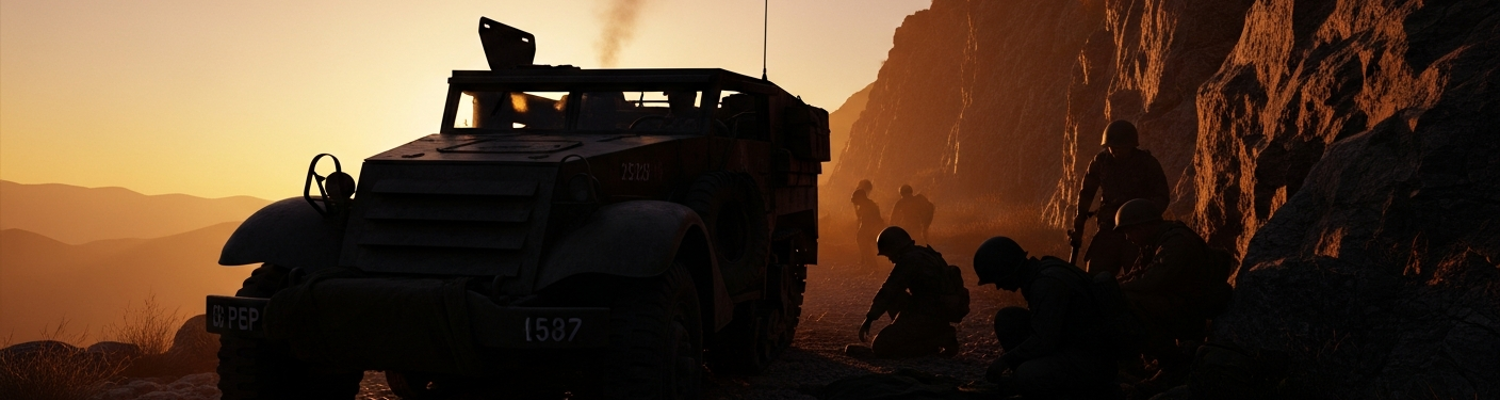

Isolated Patrol Catastrophe: The Nebrodi Highlands
The end of the reconnaissance patrol into the Nebrodi massif did not arrive with the shriek of incoming artillery. It began with a sputter.
In early August 1943, the race to Messina was at its peak. Planners at 3rd Infantry Division headquarters demanded aggressive probing of the German 15th Panzergrenadier Division's flank. The assignment fell to a platoon from the 15th Infantry Regiment. The force consisted of three M3 half-tracks and two Jeeps, tasked with penetrating deep into the unforgiving mountain roads south of the main coastal route, Highway 113. The terrain was a mechanical amplifier of vulnerabilities. These were not roads; they were mule tracks, steep and winding, littered with rockfalls and sharp stones. A close review of operational logs from similar patrols (Record Group 407, Army Adjutant General) indicates that fuel consumption under such conditions could triple the accepted road-march estimates. The White 160AX engines in the half-tracks, already running hot in the 100-degree Sicilian summer, were forced into low-gear, high-RPM climbs for hours.
The lead half-track, its engine laboring up a steep grade near the village of Maniace, was the first to die. A post-operational analysis pointed to a combination of fuel starvation and vapor lock, a condition where gasoline turns to gas in the fuel lines from excessive heat, choking the engine. Within an hour, a second half-track exhausted its sixty-gallon tank. The patrol was stranded. Its remaining fuel was barely sufficient to power the Jeeps for a short-range reconnaissance, let alone a return journey. The M3 half-track, a vehicle designed to offer better off-road performance than a truck, was still critically hampered by its wheeled front axle on the tight, switchback turns. Maintenance records from the campaign show that units were plagued by fuel filters clogged with sediment from hastily handled fuel drums. Its rubber tracks, unlike the replaceable links on a tank, required a complete and unavailable replacement if seriously damaged by the sharp rock. The platoon was now an infantry unit stripped of its mobility, dozens of miles from its supply line.
Isolation proved more lethal than any German machine gun. The patrol’s initial mission had been reconnaissance, not direct combat, but a brief firefight with a German rear-guard element left three men wounded before the enemy withdrew. In their immobilized state, those injuries became critical. Archival medical reports from the Sicilian campaign repeatedly cite the extreme difficulty of evacuating casualties from the mountainous interior. The platoon’s medic quickly exhausted his limited supply of morphine and sulfa powder. Without the ability to transport the wounded, they were stranded. The August heat brought dehydration and heatstroke during the day, while the surprising chill of the mountain nights induced hypothermia. One of the wounded men died from infection, a death directly attributable to the inability to perform a timely evacuation. A second soldier, suffering from severe dysentery, perished from dehydration. When a relief force finally reached the beleaguered platoon 48 hours later, they found a unit defeated not by the enemy, but by its own machinery and the tyranny of distance.
Sicilian Terrain and Vehicle Overheating
A review of operational after-action reports from the U.S. Seventh Army’s push through Sicily in August 1943 reveals a consistent pattern of mechanical failure. Early motorized reconnaissance units, particularly those attached to the 3rd Infantry Division and 2nd Armored Division, were worn down by the island’s conditions. The combination of 100-degree ambient temperatures, fine volcanic dust, and the severe inclines of the Nebrodi and Madonie mountain ranges created an operating environment far beyond the design specifications of their vehicles. Jeeps and M3 half-tracks were forced into grueling, hours-long climbs in low gear at high RPMs, placing their cooling systems under continuous, maximum load. The narrow, winding mule tracks that passed for roads offered no respite, preventing airflow that might have dissipated some of the heat. This environment was a constant source of attrition for patrols tasked with probing the flanks of retreating German formations.
Chronic overheating became a tactical factor, grounding entire columns of vehicles. The Willys Go-Devil engine in the standard Jeep and the White 160AX in the M3 half-track were particularly susceptible. Maintenance logs from the period (NARA Record Group 153) show a dramatic spike in radiator failures, blown head gaskets, and vapor lock. The constant grinding over sharp volcanic rock and shattered pavement from German demolitions led to an epidemic of tire blowouts. Wartime synthetic rubber tires, primarily Government Rubber-Styrene (GR-S) produced without access to natural Malaysian rubber, had notoriously poor heat resistance and durability. A shredded tire on a mountain pass was a mission-ending event, often requiring a heavy wrecker that was itself prone to the same overheating and tire failures. The problem became so pronounced that some reconnaissance units began to unofficially prefer the Jeep for its lighter weight, despite its vulnerability, simply because it was easier to manhandle or repair compared to a disabled half-track.
This wave of mechanical heat casualties created a secondary supply crisis. An unforecasted and massive consumption of water. Quartermaster planning, based on temperate-climate operational data from training in the United States or the UK, had grossly underestimated the amount of water vehicles would require. The estimates accounted for crew drinking water and standard maintenance but failed to budget for the constant replenishment of boiling radiators. A single truck or half-track could lose gallons of coolant in a few hours of climbing. This forced supply convoys, already strained by poor roads and enemy action, to dedicate significant capacity to hauling non-potable water for the machines. Every gallon of water for a radiator was a gallon of fuel, ammunition, or rations that could not be transported.
Morning Reports and Readiness Inaccuracies
An examination of the daily operational summaries from American units in Sicily during August 1943 reveals a systemic and dangerous disconnect. These reports, intended to provide division and corps commanders with a clear, quantitative snapshot of combat power, became instruments of institutional pressure. A detailed analysis of documents from formations like the 3rd Infantry Division and the 2nd Armored Division shows that field commanders were under intense pressure to maintain the pace of the advance on Messina. This translated into a reporting culture where the definition of 'operational' was stretched to its breaking point. In the neat columns of the S-3 and G-3 reports sent up the chain, a vehicle was listed as ready if it could start its engine. This binary system, lacking any nuance for degrees of mechanical soundness, created a paper army that bore little resemblance to the exhausted and faltering formations on the ground.
The numbers were misleading.
The gulf between reported vehicle readiness and actual combat availability was significant. A company in the 15th Infantry Regiment might report ten of its twelve M3 half-tracks as 'mission capable,' a figure that looked solid at II Corps headquarters. The reality was that those ten vehicles were a maintenance officer’s nightmare. A half-track was deemed 'operational' even if its White 160AX engine was guaranteed to overheat on any sustained incline, forcing five-minute halts every fifteen minutes to cool down. It was 'operational' if its fuel lines were prone to vapor lock in the 100-degree heat, a condition that could stall the engine without warning. It was 'operational' despite its tracks, made of wartime synthetic rubber, being so worn that the sharp volcanic rocks of the Nebrodi mountains posed a constant, mission-ending threat. A July 23rd report from the 753rd Tank Battalion, attached in support of the infantry, explicitly warned Second Corps that tanks were beginning to break down continuously for lack of 50 and 100-hour checks. This warning was a symptom of a much wider issue. The relentless push for Messina meant preventative maintenance was abandoned in favor of patchwork repairs designed only to keep a vehicle moving long enough to be counted in the next day’s report.
This strain was mirrored in the underreported human cost. The morning reports, focused on quantitative data like troop numbers and equipment status, effectively masked the qualitative degradation of the fighting force. Cases of heat exhaustion, which incapacitated thousands of soldiers, were frequently downplayed or omitted to avoid the perception of a unit’s weakness. A soldier suffering from the early stages of heatstroke was often simply kept on the duty roster, his condition unrecorded until he collapsed. Medical records, when cross-referenced with unit reports, show a clear disconnect between the number of men officially listed as sick and the far larger number being treated for heat-related illnesses and dysentery at aid stations. The pressure to meet the readiness numbers on the morning reports created a difficult cycle. Commanders, believing they had more functional equipment and healthy soldiers than they actually did, ordered aggressive operations that further exhausted both men and machines.
The Systemic Logistical Strain of Sicily 1943
A deep examination of Seventh Army’s logistical records from the Sicilian Campaign reveals a system strained by its own operational tempo. The rapid advance, particularly General Patton’s aggressive push west to Palermo and then east toward Messina, created a demand for fuel, spare parts, and ammunition that the nascent supply infrastructure could not sustain. The initial landings in July 1943 had been a massive undertaking, depositing 150,000 men and over 14,000 vehicles onto the island’s southern shores. The island’s primitive road network, composed largely of narrow tracks unsuitable for heavy military traffic, immediately became a choke point. German demolition teams compounded the problem, methodically destroying key bridges and mining mountain passes as they conducted a skilled fighting withdrawal. Quartermaster truck companies, the lifeblood of the advance, found their convoys slowed, navigating cratered roads and hastily constructed bypasses, burning fuel at an unsustainable rate just to move supplies forward.
The operational pace had a cumulative effect on vehicle serviceability. A review of Ordnance maintenance reports from units like the 2nd Armored Division shows a spike in engine, transmission, and suspension breakdowns. The problem was so pronounced that a report from C Company of the 753rd Tank Battalion warned II Corps on July 23rd that its tanks were breaking down because mandatory 50 and 100-hour maintenance checks were being skipped to keep up the pace. This practice was widespread. The pressure to advance meant preventative maintenance was abandoned in favor of battlefield expediency. Ordnance crews were forced into a cycle of cannibalization, stripping parts from already disabled vehicles to keep others running. The pool of available spare parts shrank daily, while the number of vehicles needing those same parts grew.
The cascading failures of equipment and supply lines were rendered less visible to higher command by the very reporting systems meant to track them. As detailed in unit morning reports, a vehicle was often listed as 'mission capable' if it could simply start its engine, a fiction that masked a grim state of disrepair. This created a disconnect between the combat power recorded on paper at Seventh Army headquarters and the exhausted reality on the ground. This chasm between perceived and actual strength was deepened by the depletion of essential resources. The constant overheating of vehicle engines in the 100-degree Sicilian heat required enormous quantities of water, a logistical demand that planners had not fully anticipated. By early August, as American forces closed on Messina, the systemic strain was reaching its peak. Fuel and ammunition were being ferried around destroyed sections of the main coastal highway by Navy landing craft, a clear indicator that the army’s own land-based logistics system had been pushed past its breaking point.
Command Paralysis and Its Consequences
A review of Seventh Army's operational records from the Sicilian campaign reveals a high command driven by a single-minded focus on forward momentum. This focus made it incapable of responding to the growing failures within its own formations. The 'race to Messina' became the sole metric of success, a strategic imperative from General George S. Patton’s II Corps that actively discouraged pausing to address logistical decay. This created a difficult situation. Field commanders, pressured to maintain a breakneck pace, submitted morning reports that painted a fictional picture of unit readiness. The command echelons, in turn, accepted these optimistic reports, seeing no official reason to slow the advance for maintenance or logistical consolidation. The result was an operational state where the only possible order was 'advance,' even as the ability to do so was being dismantled by terrain, heat, and mechanical exhaustion. The term 'mission capable' was stretched to include vehicles that could barely move and men on the verge of collapse.
This relentless drive had a direct impact on the mission and corroded troop morale. The aggressive push toward Messina was ironically slowed not by the skilled withdrawal of the German 15th Panzergrenadier Division, but by the Seventh Army’s own internal breakdowns. Columns of the 3rd Infantry Division and 2nd Armored Division ground to a halt on the steep, winding tracks of the Nebrodi mountains, not under fire, but because their vehicles had overheated into submission. For the individual soldier, this was a demoralizing experience. It was one thing to be stopped by the enemy; it was another to be defeated by your own equipment. Men watched precious water, a resource for which they themselves were suffering in the 100-degree heat, being poured into the boiling radiators of Jeeps and half-tracks. The mission became a source of frustration, as the objective remained Messina, but the immediate, all-consuming battle was against overheating engines, shredded tires, and fuel starvation. This created a loss of faith in the machinery of war and, by extension, the leadership that had sent them into this environment so ill-prepared. The high operational tempo directly contributed to Allied casualties, not all from combat, and ultimately allowed over 100,000 Axis personnel and thousands of vehicles to escape to mainland Italy.