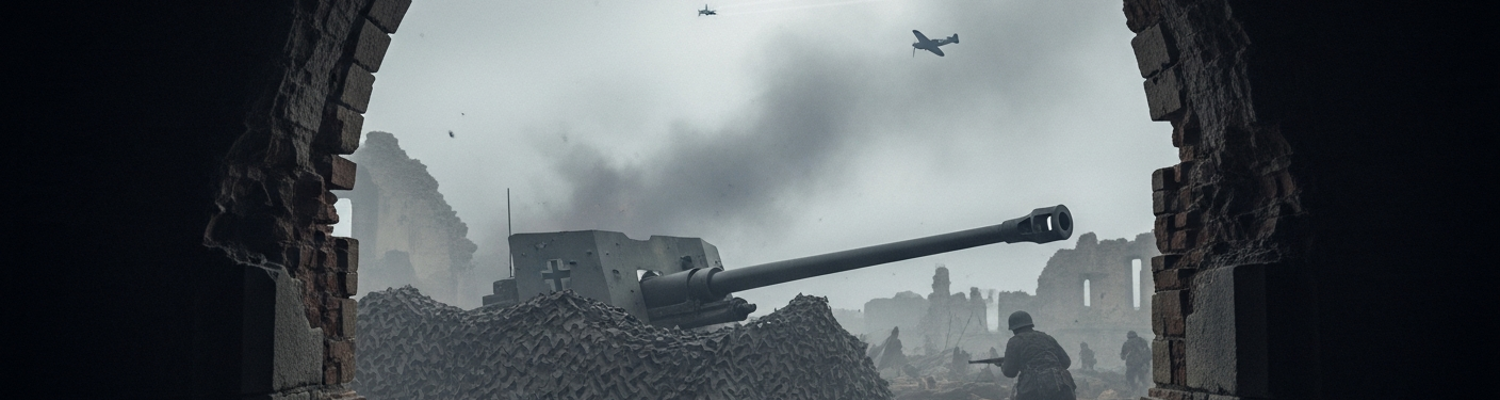

Allied air power over Normandy was an instrument of overwhelming force, yet its application against discrete, hardened targets proved difficult. German anti-tank doctrine depended on ambush and concealment, principles refined across years of combat. A PaK 40 anti-tank gun was not left in an open field. Crews broke through the dense hedgerows of the bocage, embedding the gun within centuries-old earth and root systems. Camouflage netting, interwoven with local foliage, rendered the position nearly invisible to a fighter-bomber pilot moving at several hundred miles per hour.
Operational logs from P-47 Thunderbolt squadrons document the pilot's perspective. They could see the effects of anti-tank fire, the burning Sherman tanks, but could not pinpoint the source. The primary indicator of a gun’s location was its muzzle flash, a split-second event difficult to acquire and attack in a single pass. Experienced German gun crews would fire a few rounds and then cease activity, knowing that continued action would draw aerial retribution. This tactical patience turned the skies from a source of immediate support into a waiting, often unseen, threat that could only be called upon after the damage was done.
In the urban ruins, the challenge was amplified.
The battles for Carentan and Saint-Lô demonstrated that even total air supremacy could be neutralized by rubble and determined defenders. Carentan, an objective required to link the American beachheads, was a labyrinth of narrow streets that funneled armored advances into predictable channels. German Fallschirmjäger positioned single assault guns or towed 7.5 cm PaK 40s to cover key intersections, halting entire columns. Before it was taken, Saint-Lô was subjected to a massive aerial bombardment that left it almost completely destroyed. This destruction, intended to cripple the German defense, instead created an ideal anti-tank landscape. From the perspective of a USAAF pilot, the city was a homogenous field of gray and brown debris. An anti-tank gun firing from the ground floor of a collapsed department store was indistinguishable from the surrounding wreckage.
Forward Air Controllers, or FACs, were the intended solution. These small teams, attached to frontline army units, were meant to provide a direct communication link between infantry and the fighter-bombers circling overhead. The technology of 1944 was fragile. A review of records from the 29th Infantry Division’s push towards Saint-Lô (NARA Record Group 407) details one such failure. A FAC team attached to a rifle company was equipped with a standard SCR-522 VHF radio, powered by a PE-94 dynamotor in their jeep. As the company’s advance was stalled by a well-hidden StuG III assault gun firing from a ruined house, the FAC attempted to vector in a flight of P-47s. The radio was dead. An after-action report indicates the PE-94’s connection had likely sheared from the violent jolting over shell-cratered roads. The P-47s could see the friendly armor burning below but, without specific coordinates from the FAC, were tactically forbidden from engaging. They circled until their fuel ran low, then returned to their advanced landing ground. The infantry company was forced to dislodge the German assault gun with bazookas and satchel charges, a process that cost them more than a dozen casualties.
German armored doctrine in the summer of 1944 was a product of attrition. Facing overwhelming Allied material superiority, panzer crews adapted by turning the ruined cityscapes of Normandy into lethal hunting grounds. The Panther and Tiger tanks, mechanically unreliable in open campaigns, became apex predators in the rubble. Archival evidence from the fighting in Caen shows how units like the 12th SS Panzer Division integrated their heaviest armor into the defense. A single Panther, with its long-barreled 75mm gun and heavily sloped frontal armor, could dominate a long, straight avenue from a prepared position. The tank would be positioned deep within a collapsed building or behind a massive barricade of debris, exposing only its gun and thick mantlet. Allied armored columns, forced into predictable channels by the wreckage, would advance into a pre-sighted kill zone. After destroying the lead vehicles, the German tank would use the smoke and confusion to reverse into its hide, sometimes a garage or a structurally reinforced cellar, completely disappearing from view. The frontal armor of a Panther or the box-like hide of a Tiger was nearly immune to the 75mm guns of the Sherman tanks at anything but point-blank range.
Air power was not the answer.
USAAF IX Tactical Air Command records reveal the limitations of air-delivered ordnance against such targets. From several thousand feet, a city like Saint-Lô was a monochromatic landscape of shattered gray stone. A Panther concealed in the shadow of a ruined cathedral was indistinguishable from the surrounding debris. Even if ground troops managed to mark a target with smoke, a hazardous task under fire, the weapons of the day were imprecise. A standard 500-pound general-purpose bomb required a near-direct hit to guarantee a kill against a heavy tank, and the blast was often absorbed by the very rubble that concealed the target. The 5-inch High Velocity Aircraft Rocket (HVAR) was a powerful psychological tool but a blunt instrument. Post-battle analysis from the Falaise Pocket showed that while pilots claimed hundreds of tank kills, operational research teams on the ground confirmed only a small fraction. A Royal Air Force test using a captured Panther tank revealed that under ideal conditions, with no defensive fire and a stationary target, eight Typhoons firing a total of 64 rockets scored only three hits. For a pilot traveling at over 300 miles per hour, trying to hit a stationary, camouflaged target in a city full of enemy anti-aircraft fire, the probability of a kill was low.
German crews perfected the art of making a 57-ton steel vehicle vanish. Camouflage in the urban environment went beyond simple netting. Tank crews used the battlefield itself as their primary material. They would systematically pile rubble and shattered masonry over and around their vehicles, creating custom-built hides that blended into the destruction. Large tarpaulins were draped over the tank’s chassis to break up its distinctive silhouette. A common factory-applied pattern known as Hinterhalt-Tarnung, or Ambush camouflage, was designed for this warfare, using a base of dark yellow with spots of green and red-brown to simulate the effect of light filtering through shattered structures. Many tanks were also coated with Zimmerit, a rough paste designed to prevent magnetic mines from adhering to the hull. While the Allies never used such weapons, the coarse, concrete-like texture of the paste proved effective at reducing glare and helping mud and brick powder cling to the vehicle, further integrating it into the grimy urban palette.
The procedure for a close air support (CAS) request was a bureaucratic relay race. An infantry company pinned by a concealed anti-tank gun would first radio its battalion headquarters using a man-portable SCR-300, a set with a realistic range of three to five miles. From there, the request was passed up the chain to regimental and then divisional command posts, often over easily severed field telephone lines. At each step, the information was logged, evaluated, and plotted on a map before being forwarded to the IX TAC’s command center. Only then was a mission assigned to a flight of P-47 Thunderbolts or RAF Typhoons, which were often holding in a holding pattern miles away.
This process was fundamentally broken.
The entire sequence could consume anywhere from thirty minutes to several hours. By the time the fighter-bombers arrived on station, the tactical situation had frequently changed. The German anti-tank gun, having already destroyed its initial targets, would have displaced to a new firing position, leaving pilots to circle over a quiet battlefield. A specific after-action report from the 29th Infantry Division’s assault on Saint-Lô details a request for an air strike against a StuG III that had halted an entire company’s advance. The request was submitted at 10:40 hours. A flight of P-47s was finally vectored to the target coordinates at 12:15 hours, but found only the burning wrecks of two Sherman tanks. The StuG was gone. The pilots returned to their Advanced Landing Ground without dropping their ordnance due to strict rules of engagement designed to prevent friendly fire.
For the ground troops, the wait for air support was an exercise in attrition. While the request slowly climbed the command ladder, the German gun crew had a free hand. A single well-sited PaK 40 could methodically eliminate a platoon’s machine gun nests and bazooka teams, leaving the riflemen exposed. The sound of friendly fighter-bombers overhead, unable to intervene, was a source of deep frustration. In the absence of timely air support, infantry commanders were forced into costly frontal assaults against hardened targets. A company from the 35th Infantry Division, fighting for a key crossroads south of Saint-Lô, lost seventeen men in under an hour attempting to neutralize a single Panther tank hidden in a collapsed building. Their request for an air strike went unanswered for ninety minutes. The high-risk alternative was often the only option: small teams of soldiers crawling through rubble under direct fire, armed only with bazookas and satchel charges, to perform a task that a 500-pound bomb could have accomplished in seconds.
Strategic command during Operation Overlord operated with a different perspective. For planners at Supreme Headquarters Allied Expeditionary Force (SHAEF), the air war was an instrument of grand strategy. The primary objectives assigned to the Allied Expeditionary Air Force were broad: achieving air superiority, interdicting German reinforcements by shattering the French railway and road networks, and isolating the Normandy battlefield. This was the “Transportation Plan,” a campaign that saw heavy and medium bombers pulverize rail yards and bridges across France. From the elevation of a command post in England, this was a logical use of air power, intended to prevent entire panzer divisions from reaching the front. The allocation of air assets was heavily weighted toward pre-planned strikes against fixed, strategic targets, not the dynamic opportunities presented by urban anti-tank ambushes.
The intelligence apparatus, while impressive in its strategic scope, often failed at the granular level. Information on a suspected anti-tank gun’s location, gathered by a frontline patrol, began a long journey up the command chain. This intelligence, perhaps a set of coordinates hastily scribbled on a message pad, would be sent to battalion, then divisional G-2 (intelligence) sections. There, it was collated, analyzed against other reports, and plotted on master maps before being passed to the air support command. A report could be delayed by a cut field telephone wire, a courier jeep hit by shellfire, or simply misfiled in a chaotic command post tent. By the time a P-47 Thunderbolt was vectored onto the target coordinates, the German gun crew had often vanished, leaving pilots to find only smoking Allied tank hulls as evidence of their recent activity.
Rigid targeting protocols were unsuited for the chaos of city fighting. The primary tool for preventing friendly fire was the “bomb line,” a geographic line drawn on operational maps that separated friendly and enemy territory. Beyond this line, pilots were generally free to attack targets of opportunity. Inside the bomb line, where Allied troops were operating, air strikes were forbidden without positive identification and control from a qualified Forward Air Controller on the ground. This was a sensible precaution for open country but a severe limitation in the rubble of Caen or Marigny. The front line in an urban battle was not a clear line on a map; it was a fluid, three-dimensional space where friendly and enemy soldiers were often separated by a single wall. A German StuG firing from a collapsed bakery might be only 50 yards from the American infantry it was pinning down. Even if a FAC team was present and their radio was working, the procedures of IX Tactical Air Command often prioritized pre-planned missions or flights circling in a holding pattern miles away, waiting for assignment through the slow, formal request chain.
The sensory environment of urban combat in Normandy was an assault. The sharp, metallic tang of cordite was constant, hanging in the air from the ceaseless expenditure of ammunition and mortar rounds. It clung to the pulverized stone dust that coated every surface in ruined cities like Saint-Lô. Layered over this was the heavy, greasy odor of burning diesel fuel, a byproduct of knocked-out Sherman tanks and supply trucks that became pyres in the narrow streets. The most oppressive smell was the sickly sweetness of decay. It was a compound fragrance of rotting vegetation from the ancient hedgerows, churned into the earth by artillery and mixed with the wreckage of homes. This was combined with the ever-present odor of human and animal remains, often unreachable for days, left to decompose in the humid summer heat. The combination of smells, cordite, diesel, and rot, created an atmosphere of perpetual filth.
For the infantry platoons pinned by a concealed PaK 40, the knowledge that Allied airpower was circling miles overhead was a source of corrosive frustration. The bureaucratic process of requesting close air support was a fatal disconnect from the speed of combat. An infantry company taking casualties could not afford to wait the 30 to 90 minutes the system required. During that time, a disciplined German gun crew could dismantle an American assault. Unit after-action reports from the 29th and 35th Infantry Divisions’ fight for Saint-Lô document this pattern. The German gun would eliminate the American platoon’s own heavy weapons, its machine guns and bazooka teams, first, leaving the riflemen exposed. The sound of friendly P-47 Thunderbolts flying overhead, unable to intervene due to rigid communication protocols, was a recurring feature of these reports.
The result was a spike in attrition for ground forces. The calculus for a company commander was direct. A single Panther tank or StuG III, hidden in the rubble, was largely immune to the 75mm guns of accompanying Sherman tanks. The standard M9 bazooka’s 2.36-inch rocket struggled to penetrate the thick frontal armor of these German vehicles; a successful kill required a flanking shot to the thinner side or rear armor, an improbable feat in a pre-sighted kill zone. In the absence of a timely 500-pound bomb, the only remaining option was an infantry assault. Casualty figures from the battle for Saint-Lô are stark; the 29th Infantry Division alone suffered over 3,700 casualties between July 7th and 22nd. A significant portion of these losses can be attributed to small-unit actions against fortified positions and concealed armor. Sending two or three-man teams armed with bazookas and satchel charges across open, rubble-strewn ground under direct fire was often the only course of action. The first team was almost always lost, their attempt serving only to confirm the enemy’s exact location for the teams that followed.
Moving a single wounded soldier from a contested street in Saint-Lô to a field hospital was a multi-stage ordeal. It began with a company aid man crawling through debris to administer basic first aid. These aid men, assigned at the platoon level, were the first link in a long evacuation chain. Their job was to stabilize the patient, often with nothing more than morphine and sulfa powder, and get them to a battalion aid station located in a cellar a few hundred yards to the rear. This initial movement was the most hazardous. Four-man stretcher-bearer teams had to navigate shattered landscapes where streets were impassable to vehicles. A standard four-man litter carry was often impossible in alleys choked with collapsed masonry, forcing bearers to use two-man carries or fireman’s carries, all while exposed to sniper and mortar fire.
Evacuation was a tactical possibility, not a right.
This journey was made more difficult by the realities of urban anti-tank warfare. An enemy PaK 40 that had already halted an armored column did not cease firing. These gun crews would then shift their attention to secondary targets, including supply trucks and any moving vehicle, a category that included ambulances. Medical vehicles like the ¾-ton Dodge WC54 ambulance or jury-rigged jeeps, though marked with large Red Cross emblems, were frequent targets. Some reports from the 1st Infantry Division state that the red cross markings drew fire rather than repelled it. The effect was twofold. First, it created a high attrition rate among the ambulance drivers and medics of the medical battalion’s Collecting Companies. Second, the wreckage of a single destroyed ambulance could block a critical evacuation route for hours, creating a backlog of wounded men waiting in cellars with dwindling medical supplies.
The final hurdle was the bureaucracy of extraction. A battalion surgeon could not simply call for an ambulance. The request had to follow a strict chain of communication, relayed from the battalion medical section to the regimental level, and then to the divisional medical battalion headquarters which controlled the ambulance assets. This process, reliant on fragile field telephone lines or radio channels cluttered with competing tactical traffic, could take hours. A request for air evacuation for a priority case was even more complex, requiring coordination with IX Tactical Air Command and the establishment of a secure landing zone, an impossibility in a contested city. Medical planners had established a system with tens of thousands of hospital beds in England, but the connection between this system and the man bleeding in a Norman cellar was tenuous. The triplicate tags filled out for each patient, detailing their injuries and treatments, were part of a system designed for order in the midst of chaos.