Full Calendar
THIS DAY IN U.S. MILITARY HISTORY • DECEMBER 10 1941 U.S. Navy World War II

Enterprise Dive Bombers Destroy Japanese Submarine I-70

Scouting Squadron Six tracked and destroyed the first Japanese fleet warship sunk by American forces in World War II northeast of Oahu.
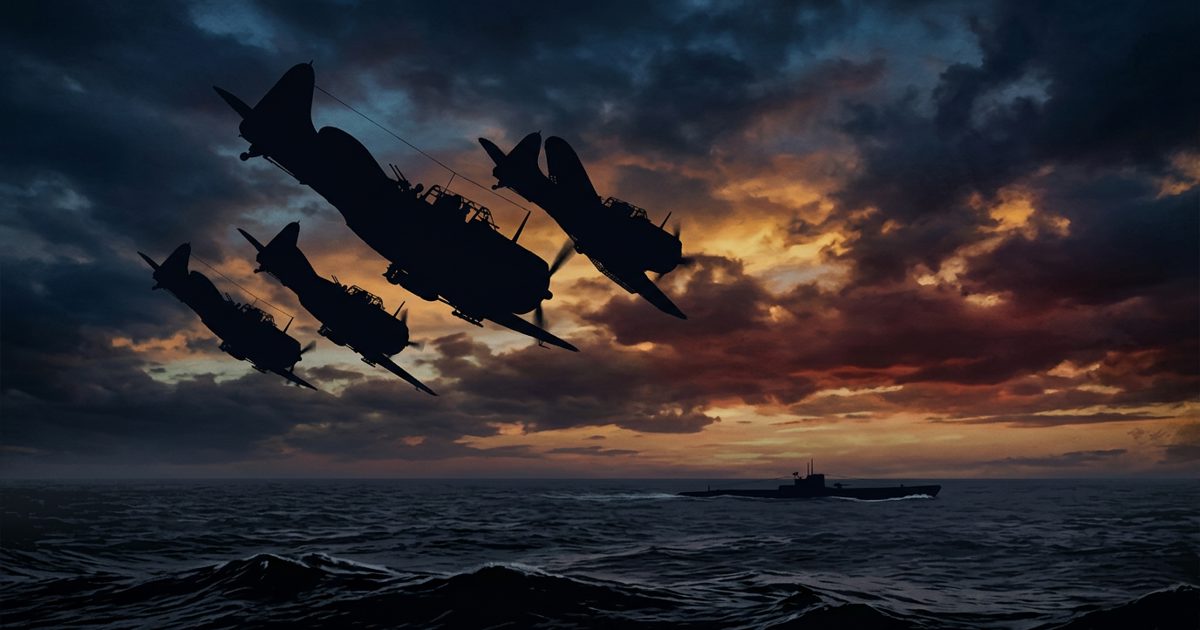
Enterprise Dive Bombers Destroy Japanese Submarine I-70

Patrol planes from the aircraft carrier USS Enterprise swept the Pacific waters northeast of the Hawaiian Islands looking for enemy naval forces three days after the attack on Pearl Harbor. Lieutenant James S. Gray led a flight of Douglas SBD-2 Dauntless dive bombers from Scouting Squadron Six across the search sector when his aircrews spotted the surfaced Japanese fleet submarine I-70 approximately 120 miles from Molokai. Captain Michitaka Sano commanded the 1,400-ton Kaidai-class submarine, which had operated as part of the advanced reconnaissance screen for the Japanese carrier strike force. Lieutenant Gray tipped his Dauntless into a steep bombing run and released a 1,000-pound demolition bomb that detonated close to the submarine pressure hull, rupturing ballast tanks and leaving the vessel crippled on the surface.

Lieutenant Clarence E. Dickinson Jr. arrived over the coordinates several hours later leading a second section of Dauntless dive bombers from Enterprise to finish the strike. Dickinson had survived being shot down over Oahu on December 7 and immediately resumed combat flight operations from the carrier deck. Gun crews on the crippled submarine opened fire with their 13.2-millimeter deck gun as the American bombers pushed over from 5,000 feet into vertical dives. Dickinson held his aircraft steady through the tracer fire and released his heavy bomb directly over the submarine midsection.

Shockwaves from the direct explosion tore through the deck plating and blew several Japanese crewmen into the sea. Observers in the trailing Dauntless watched I-70 stop dead in the water before settling rapidly by the stern and plunging beneath the waves within forty-five seconds. All Japanese officers and crewmen perished in the sinking, leaving behind a widening slick of fuel oil and wreckage. Admiral Husband E. Kimmel and naval headquarters received confirmation of the kill, marking the first Japanese combatant warship destroyed by the United States military during the Pacific War.

CHRONOLOGICAL RECORD

December 10 Across U.S. Military History

8 Verified Events
1864 U.S. Army Landmark Event • American Civil War

Sherman Reaches Outer Defenses of Savannah

Major General William Tecumseh Sherman led sixty thousand Union soldiers to the perimeter of Savannah, Georgia, completing the March to the Sea. Confederate Lieutenant General William J. Hardee entrenched ten thousand defenders behind flooded rice fields to block the narrow causeways into the city. Union engineers immediately surveyed supply routes south toward the Ogeechee River to establish communications with the federal fleet.

1898 Joint Service Landmark Event • Spanish-American War

Treaty of Paris Concludes Spanish-American War

Diplomats representing the United States and the Kingdom of Spain signed the Treaty of Paris, formally ending overseas hostilities. Spain surrendered sovereignty over Cuba and ceded Guam and Puerto Rico to the United States while accepting a twenty-million-dollar payment for the Philippine Islands. The agreement established American military administration across the Caribbean and Western Pacific, creating an expanded overseas perimeter for the armed forces.

1941 U.S. Marine Corps Landmark Event • World War II

Japanese Landing Forces Overwhelm American Defenses on Guam

Soldiers from the Japanese South Seas Detachment and naval landing units assaulted Dungcas Beach and advanced on Agana before dawn. Captain George J. McMillin coordinated resistance with 153 U.S. Marines and eighty local Insular Force Guards armed with rifles and light machine guns. Overwhelming enemy numbers forced McMillin to surrender the garrison at the Plaza de Espana, marking the first American territory lost in the Pacific War.

1941 U.S. Navy • World War II

Japanese Bombers Obliterate Cavite Navy Yard

Waves of Japanese twin-engine bombers struck the Cavite Navy Yard in Manila Bay, demolishing repair shops, ammunition depots, and power facilities. Heavy bomb detonations sank the submarine USS Sealion and the minesweeper USS Bittern at their berths. Chief Boatswain Earl D. Payne manned a machine gun aboard a moored PBY-4 Catalina and shot down an attacking Zero, scoring the Navy's first aerial victory of the war.

1941 U.S. Army Air Forces • World War II

Captain Colin Kelly Attacks Japanese Invasion Fleet

Captain Colin P. Kelly Jr. piloted a Boeing B-17C Flying Fortress from the 14th Bombardment Squadron against Japanese warships off northern Luzon. Bombardier Meyer Levin dropped three 600-pound demolition bombs, scoring damaging near-misses on the light cruiser Natori. Japanese Zero fighters intercepted the bomber on its return flight, prompting Kelly to hold the controls of the burning aircraft so his crew could parachute to safety.

1950 U.S. Navy Landmark Event • Korean War

Task Force Ninety Initiates Hungnam Sealift Operations

Transports of Task Force Ninety completed the withdrawal of Allied forces from Wonsan and commenced perimeter loading at Hungnam, North Korea. Rear Admiral James H. Doyle deployed transport vessels and naval gunfire support ships to extract the 1st Marine Division and the Army 7th Infantry Division. Naval beachmasters began loading heavy cargo and staging soldiers for redeployment south to Pusan.

1963 U.S. Air Force • Cold War

Pentagon Cancels Dyna-Soar and Approves Military Space Station

Secretary of Defense Robert S. McNamara terminated the Air Force X-20 Dyna-Soar hypersonic spaceplane program during a Pentagon press conference. McNamara redirected sixty million dollars in development funding toward the newly designated Manned Orbiting Laboratory project. Air Force leadership assumed management of the orbital reconnaissance laboratory, which utilized modified Gemini capsules launched atop Titan III boosters to conduct military surveillance missions.

1982 U.S. Navy • Cold War

USS Ohio Completes First Trident Ballistic Missile Patrol

Submariners aboard USS Ohio returned to port after concluding the submarine's inaugural strategic deterrent patrol in the Pacific Ocean. Captain A.K. Thompson commanded the Blue Crew during the seventy-day deployment armed with twenty-four Trident I C4 ballistic missiles. Completion of the voyage verified the operational readiness of the Ohio-class submarine platform as the new backbone of the nation's sea-based nuclear deterrent triad.

MEDAL OF HONOR ACTION 1965

First Lieutenant Harvey C. Barnum Jr. Takes Command at Ky Phu

Riflemen from Company H, 2nd Battalion, 9th Marines, found themselves cut off and ambushed by intense North Vietnamese and Viet Cong mortar, machine gun, and rifle fire near the village of Ky Phu in Quang Tin Province. First Lieutenant Harvey C. Barnum Jr. accompanied the unit as an artillery forward observer from the 12th Marines when enemy fire mortally wounded the rifle company commander and severed radio communications with the battalion command post. Barnum sprinted across fifty yards of open, bullet-swept terrain to retrieve the wounded captain, moved him to cover, and immediately assumed tactical command of the disorganized company. Radio operators under his direction reestablished contact with supporting units as Barnum quickly reorganized the defensive perimeter and directed devastating retaliatory fire into fortified enemy positions.

Barnum then exposed himself to continuous hostile fire while guiding two armed UH-1E helicopters into close-support rocket runs against the surrounding enemy tree lines. His precise target markings suppressed the hostile machine-gun nests and cleared an extraction zone for casualty evacuation helicopters. Barnum led a counterattack that drove the remaining ambush force from the field, allowing his Marines to evacuate all dead and wounded personnel without leaving a single casualty behind. President Lyndon B. Johnson presented the Medal of Honor to Barnum at the Pentagon in February 1967 for his decisive battlefield leadership.