CHRONOLOGICAL RECORD
December 14 Across U.S. Military History
9 Verified Events
1774
Continental Militia
Landmark Event
• American Revolutionary War
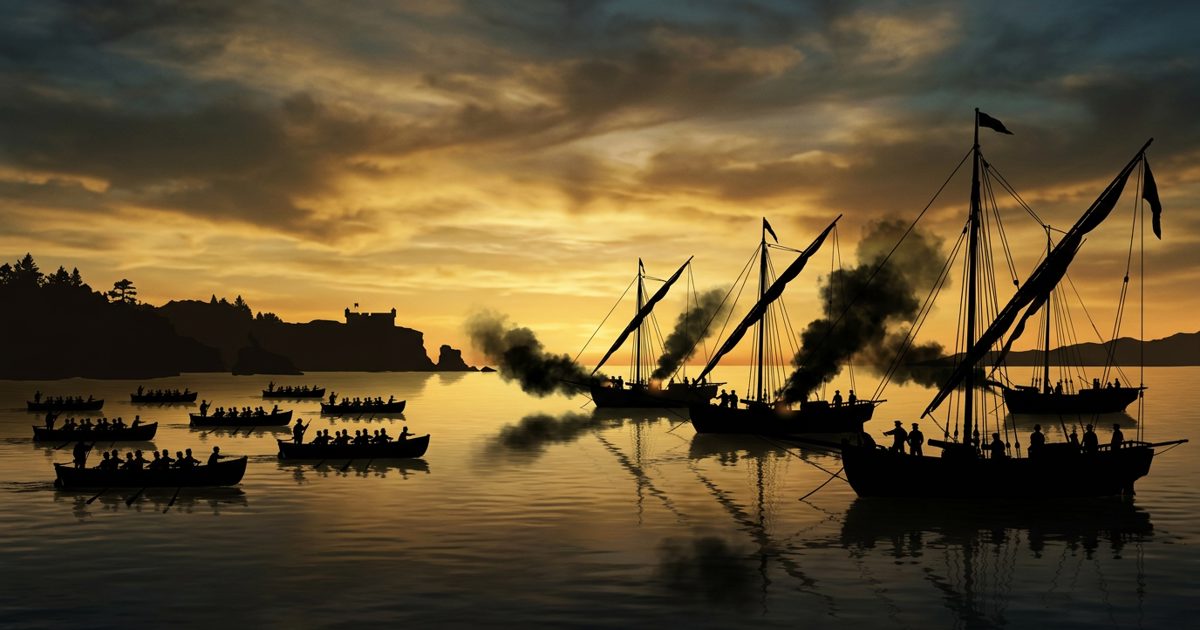
Patriot Militia Raids Fort William and Mary
Major John Langdon led 400 New Hampshire provincial militiamen to storm Fort William and Mary in New Castle on December 14, 1774. The raiders overpowered the six-man British garrison after exchanging gunfire and seized 100 barrels of gunpowder. Colonial authorities later distributed this vital ammunition to provincial troops who fought at the Battle of Bunker Hill.
1782
Continental Army
Landmark Event
• American Revolutionary War
Continental Troops Liberate Charleston Following British Evacuation
Brigadier General Anthony Wayne led Continental light infantry and cavalry into Charleston, South Carolina, on December 14, 1782, as the British rear guard embarked onto Royal Navy transport ships. Major General Nathanael Greene established American military control over the city after two and a half years of British occupation. This orderly handover effectively terminated major military operations across the southern theater.
1862
U.S. Army
• American Civil War
Union Forces Carry the Bridge at Kinston
Major General John G. Foster directed 10,000 Union soldiers in an assault against Confederate defenders guarding the Neuse River bridge near Kinston, North Carolina, on December 14, 1862. Union regiments pushed across Harriet's Chapel, capturing 400 Confederate troops and seizing eleven artillery pieces. Foster advanced rapidly toward the Wilmington and Weldon Railroad to disrupt critical Southern supply routes.
1863
U.S. Army
• American Civil War
Union Cavalry Fights at Beans Station
Brigadier General James M. Shackelford deployed Union cavalry divisions to defend Bean's Station, Tennessee, against an aggressive counterattack by Confederate Lieutenant General James Longstreet on December 14, 1863. Dismounted federal troopers fought from hotel buildings and fence lines before conducting a fighting withdrawal toward Rutledge. This sharp engagement concluded the Knoxville Campaign, leaving Union forces in firm control of East Tennessee.
1927
U.S. Navy
Landmark Event
• Interwar Era
Aircraft Carrier USS Lexington Enters Naval Service
Captain Albert W. Marshall accepted command as the aircraft carrier USS Lexington was commissioned at Quincy, Massachusetts, on December 14, 1927. Converted from a battlecruiser hull, the 33,000-ton warship provided the fleet with high speed, an expansive flight deck, and long operational range. The carrier served as an essential operational testbed for developing carrier air wing doctrine prior to World War II.
1941
U.S. Army Air Forces
• World War II
Lieutenant Hewitt Wheless Defends Bomber Over Legaspi
Lieutenant Hewitt T. Wheless piloted a B-17 Flying Fortress through relentless attacks by 18 Japanese fighter aircraft during a bombing run over Legaspi, Philippines, on December 14, 1941. His gunners destroyed several enemy aircraft while Wheless navigated back to Mindanao with shattered control surfaces and flat tires. Wheless received the Distinguished Service Cross for saving his bomber and surviving crew.
1944
U.S. Armed Forces
Landmark Event
• World War II
Congress Creates Five-Star General and Admiral Ranks
President Franklin D. Roosevelt signed Public Law 78-482 on December 14, 1944, establishing the five-star grades of General of the Army and Fleet Admiral. Congress created these ranks to ensure American theater commanders held equal military protocol alongside Allied field marshals. Leaders like George Marshall and Chester Nimitz soon received fifth stars to coordinate massive global Allied coalitions.
1944
U.S. Army
• World War II
Sergeant Ralph Neppel Breaks German Counterattack at Birgel
Sergeant Ralph G. Neppel defended an approach to Birgel, Germany, on December 14, 1944, with Company M of the 329th Infantry Regiment. A point-blank shell from an advancing German tank severed Neppel's leg and wounded his entire machine-gun squad. Neppel dragged himself back to his weapon on his elbows and killed the remaining enemy infantry, forcing the tank to withdraw.
1964
U.S. Air Force
Landmark Event
• Vietnam War
Operation Barrel Roll Commences Over Laos
Aircrews initiated Operation Barrel Roll on December 14, 1964, bombing North Vietnamese infiltration targets across northern Laos. U.S. Air Force fighter-bombers flying from bases in Thailand joined Navy aircraft from Task Force 77 to disrupt enemy logistics along the Ho Chi Minh Trail. This interdiction mission evolved into a sustained air campaign that lasted until the 1973 ceasefire.