CHRONOLOGICAL RECORD
December 15 Across U.S. Military History
9 Verified Events
1862
U.S. Army
Landmark Event
• American Civil War
Burnside Withdraws Across the Rappahannock River
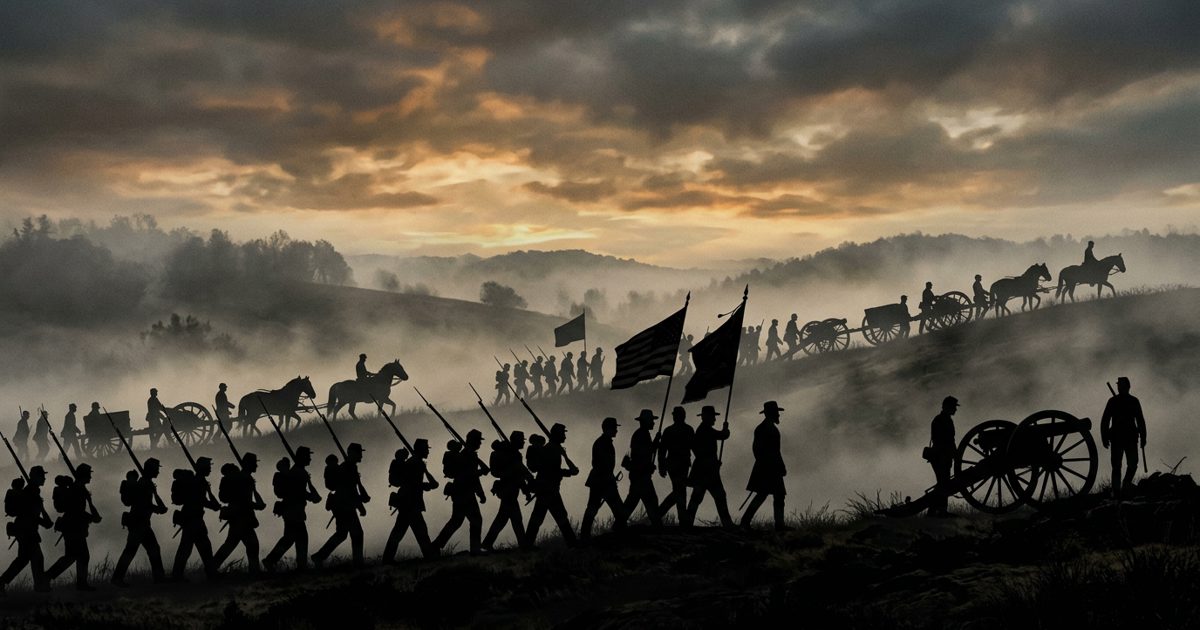
Major General Ambrose Burnside ordered the Army of the Potomac to evacuate Fredericksburg, Virginia, on the night of December 15, 1862. Union engineers muffled the wooden pontoon bridges with dirt and pine boughs so tens of thousands of soldiers could withdraw quietly across the Rappahannock River. Heavy rain and darkness masked the retreat from Confederate observers, ending the Fredericksburg campaign.
1943
U.S. Army
• World War II
Cavalry Troops Land at Arawe in New Britain
Troops from the 112th Cavalry Regimental Combat Team stormed ashore at the Arawe Peninsula on southwestern New Britain on December 15, 1943. Soldiers met heavy Japanese fire during initial rubber-boat landings before naval gunfire and tank landing craft secured the beachhead. The landing diverted enemy troops from Cape Gloucester and severed regional coastal supply routes.
1944
U.S. Navy
Landmark Event
• World War II
William Leahy Promoted as First Fleet Admiral
President Franklin D. Roosevelt promoted Admiral William D. Leahy to the rank of Fleet Admiral on December 15, 1944, making him the senior five-star officer in American military history. Leahy served as Chief of Staff to the Commander in Chief and presided over the Joint Chiefs of Staff throughout the war. His promotion established rank parity with Allied commanders.
1944
U.S. Army
Landmark Event
• World War II
Allied Amphibious Forces Invade Mindoro Island
Brigadier General William C. Dunckel landed combat teams of the 24th Infantry Division and 503rd Parachute Infantry on Mindoro Island on December 15, 1944. Naval vessels under Rear Admiral Arthur Struble delivered over 16,000 assault troops to establish forward fighter airfields south of Manila. Combat engineers cleared airfields within thirteen days to directly support the subsequent invasion of Luzon.
1944
U.S. Army Air Forces
• World War II
Major Glenn Miller Disappears Over English Channel
Major Glenn Miller boarded a single-engine Noorduyn UC-64A Norseman aircraft at Royal Air Force Twinwood Farm on December 15, 1944, bound for newly liberated Paris. Bad weather obscured the flight path, and the plane vanished over the freezing English Channel without sending a distress signal. Miller had enlisted to direct the Army Air Forces Band and bolster Allied troop morale.
1945
U.S. Navy
• World War II
Chester Nimitz Relieves Ernest King as Chief of Naval Operations
Fleet Admiral Chester W. Nimitz assumed office as Chief of Naval Operations at the Navy Department in Washington on December 15, 1945, relieving Fleet Admiral Ernest J. King. Nimitz oversaw the massive postwar demobilization while initiating naval nuclear propulsion programs and early guided-missile research. His administration maintained fleet readiness to counter emerging Cold War threats worldwide.
1948
U.S. Marine Corps
Landmark Event
• Cold War
Navy and State Department Establish Marine Security Guard Program
Secretary of the Navy John L. Sullivan signed a formal Memorandum of Agreement with the Department of State on December 15, 1948, establishing the modern Marine Security Guard program. The charter authorized active-duty Marines to provide internal security and safeguard classified documents at diplomatic missions across the globe. Selected detachments commenced specialized training before deploying to embassies in early 1949.
1967
U.S. Army
• Vietnam War
Specialist Allen Lynch Rescues Comrades Under Fire
Specialist Fourth Class Allen J. Lynch risked his life near My An in Binh Dinh Province on December 15, 1967, while serving with the 1st Cavalry Division. Lynch carried wounded soldiers through intense crossfire into an isolated defensive ditch and defended them against repeated enemy charges for two hours. President Richard Nixon awarded him the Medal of Honor for his valor.
2011
Joint
Landmark Event
• Post-9/11 Era
United States Forces Iraq Cases Colors in Baghdad
General Lloyd Austin and Command Sergeant Major Joseph Allen cased the colors of United States Forces Iraq during an official ceremony in Baghdad on December 15, 2011. Defense Secretary Leon Panetta attended the ceremony, which marked the formal conclusion of the eight-year American military mission in Iraq. American combat forces completed their orderly withdrawal across the border into Kuwait days later.