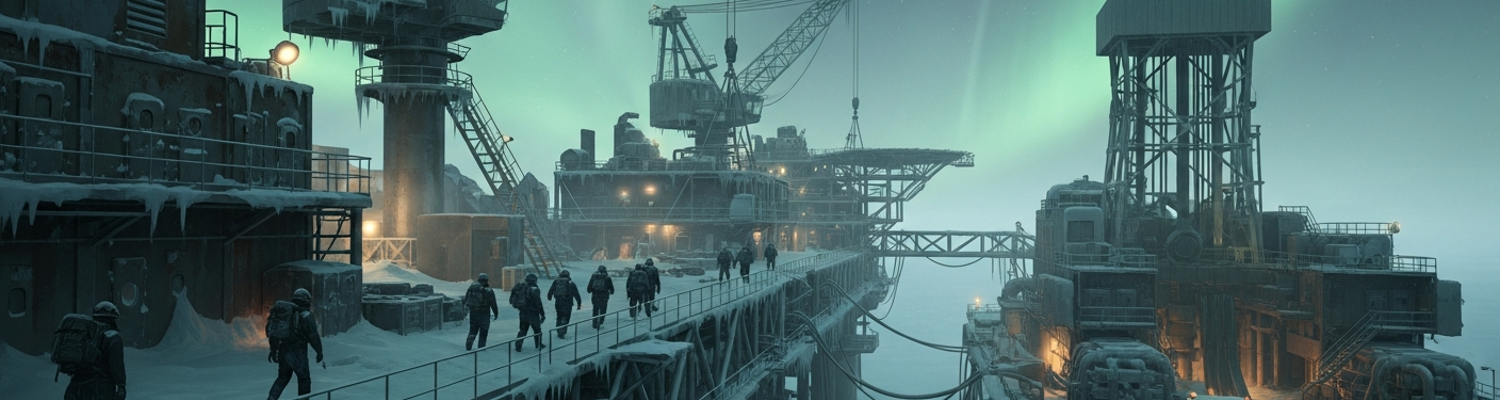

03:47 ZULU, 14 November 1967. Position 82°15'N 62°25'W. On the Ward Hunt Ice Shelf, a sound not native to the natural world cut through the polar silence. It was the high-frequency whine of a hydraulic pump under extreme duress. A review of operational logs (AAR-ICY-GAUNTLET-001) from the U.S. Army Polar Engineering Battalion’s forward element shows the event occurred seventy-five hours into their mission.
D+3.
The central fluid power system for the clandestine drilling platform, designated POKER FLAT, had completely seized. This platform was the core of an ambitious strategic effort to embed a deep-ice sonar array. Its purpose was tracking Soviet submarine traffic under the polar cap. The system, comprising three main derrick-lift actuators and a network of high-pressure lines, was designed to maneuver a multi-ton thermal drilling rig into position. Archival evidence shows initial telemetry from the platform’s control habitat reported a gradual but persistent pressure drop in the primary hydraulic circuit beginning around 01:00 ZULU. The engineering team on site, a specialized detachment from Fort Belvoir, followed standard cold-weather protocols. They attempted to isolate the leak. Their efforts were ineffective. The ambient temperature held at a sustained -48° Celsius before wind chill. This was far below the system’s tested tolerance thresholds. By 03:40 ZULU, the hydraulic fluid, a standard MIL-H-5606 mineral oil, had begun to gel within the lines. Its viscosity increased exponentially until it was no longer a fluid. The pump’s whine was its final protest before the electric motor’s circuit breaker tripped, plunging the ice shelf back into silence. The main derrick was frozen, locked at a useless 15-degree angle.
The mission’s primary objective was now inert.
With the hydraulic system disabled, the entire suite of primary mission equipment was rendered non-operational. The POKER FLAT platform was an integrated system, not just a drill. The thermal drilling unit, a 2.5-megawatt device intended to melt a borehole 1,000 meters into the ice, could not be deployed. It remained fixed in its transport cradle, inaccessible and immobile without the hydraulic derrick to lift and position it. The acoustic sensor package, a delicate string of hydrophones and transmitters, was designed to be lowered down the completed borehole. It sat secured in its climate-controlled container, its sophisticated electronics serving no purpose. A post-operation analysis of command decisions (NARA Record Group 338) indicates the on-site officer, Major C.W. Albright, correctly assessed that any attempt to manually move the derrick or the drill package would risk structural damage to the platform. Such an attempt would also likely result in severe injury to his men. Radio transcripts from the subsequent 48 hours detail exchanges with the main support base at Thule. Albright requested technical guidance that did not exist. The field manuals provided no contingency for a total hydraulic failure in such extreme, sustained cold. The platform’s integrated diesel generators continued to function, but they were now only powering the lights and heaters of a static, failed outpost.
The root cause was later identified as unanticipated material brittleness. Subsequent forensic analysis conducted by the Army’s Cold Regions Research and Engineering Laboratory (CRREL) in Hanover, New Hampshire, revealed a cascade failure. The point of origin was the atomic level of the materials themselves. The primary culprit was the specific grade of steel alloy, AISI 4140, used in the fabrication of the main hydraulic actuator casings. While known for high tensile strength in normal temperatures, its ductile-to-brittle transition temperature was dangerously close to the conditions encountered. Army procurement specifications had certified the system for operation down to -40° Celsius. These certifications were based on laboratory tests that involved cyclical exposure, cooling the equipment for several hours before returning it to a warmer state. The engineers of Operation ICY GAUNTLET had not accounted for the effects of a sustained, 72-hour cold soak under full operational load. At the molecular level, the steel’s crystalline structure had shifted. It lost its ability to deform under pressure and instead became fragile. The initial failure was a micro-fracture in a high-pressure manifold fitting. This was followed by the shattering of a series of synthetic polymer O-rings within the main actuator seals, which had also lost their elasticity in the deep cold. The design specifications were simply wrong, based on flawed testing parameters that did not match the operational environment.
A post-operation analysis of the POKER FLAT drilling platform’s design reveals a flaw in its mission sequencing. The operational plan called for a two-stage process. First, the thermal drill would create the borehole. Second, a delicate acoustic sensor array would be lowered into the resulting shaft. While the seizure of the main hydraulic derrick is well-documented, less attention has been paid to the secondary system designed for the actual sensor placement. This subsystem, designated the Model 7B Failsafe Deployment Winch, was an entirely separate mechanical assembly. It consisted of a precision-machined, variable-speed hydraulic motor connected to a cable drum wound with 1,200 meters of armored co-axial signal cable. An articulated tensioning arm, also hydraulically actuated, was designed to maintain constant pressure on the cable spool. This was to prevent birds-nesting or slack during the slow, multi-hour descent of the sensor package. Engineering logs show this system was intended to be the mission’s final, delicate touch.
This secondary system was even more vulnerable to the cold.
The failure of the deployment winch was not a gradual seizure but an explosive event. The main derrick’s failure was due to gelling fluid and pump strain. The winch system, however, experienced a catastrophic material integrity breakdown. The system utilized a series of smaller-diameter, flexible high-pressure hoses (Aeroquip 2651-6) to connect its motor and tensioning arm to the main hydraulic manifold. These hoses were constructed of a synthetic chloroprene rubber tube, reinforced with a double-braided steel wire mesh, and covered by an outer layer of neoprene-impregnated fabric. Procurement testing had certified these hoses for operation down to -40 degrees Celsius. Like the rest of the platform, the tests did not account for the molecular changes from a multi-day cold soak. At -48 Celsius, the chloroprene and neoprene layers lost all elasticity, reaching their glass transition point and becoming exceptionally brittle. Archival incident reports from Major Albright’s team state that at approximately 04:15 ZULU, a technician attempted a low-pressure diagnostic on the winch motor. The mere actuation of the valve sent a low-pressure pulse into a hose that could no longer flex. It shattered. A fine mist of MIL-H-5606 hydraulic fluid instantly atomized and froze in the arctic air, coating the side of the drilling platform in a pink, icy film. The sound was reported not as a bang, but as a sharp crack.
The impact of this secondary failure was absolute. It confirmed that even if the engineering team had found a way to manually deploy the massive thermal drill, the mission’s core objective was unattainable. The very tool designed to place the expensive sonar package into the ice was now permanently destroyed. A close review of the POKER FLAT platform’s integrated systems by CRREL after the incident uncovered the foundational design error. To save weight and reduce complexity, both the high-torque derrick lift system and the low-torque, high-precision winch system were plumbed into the same hydraulic pump and reservoir. This design choice, while efficient on paper, created a cascading, single point of failure. The initial pressure drop caused by the failing derrick actuators had starved the entire network. The subsequent hose rupture on the winch system guaranteed that even if the main pump could be restarted, it could never build operational pressure again. The platform was not just disabled; it was mechanically unsalvageable in the field.
The failure of the primary and secondary drilling systems was only the prelude. While the engineering team on the ice shelf grappled with the inert POKER FLAT platform, a more insidious crisis was developing within their only shelter. This was a Jamesway-style subterranean observation bunker located approximately 200 meters from the drill site. A close review of operational logs shows that at 05:30 ZULU, the bunker’s primary heat source, a military-grade 60,000 BTU Improved Environmental Control Unit (IECU), sputtered and went silent. The unit, designed for maintaining positive pressure and a habitable temperature in rigid-wall shelters, was the detachment’s lifeline. Post-incident analysis determined the failure point was the main blower motor. The extreme, sustained cold had degraded the bearing lubricant to a near-solid state. This caused the motor to overheat and trip a non-resettable thermal cutoff switch. The ECU was not broken, but it was permanently disabled without replacement parts that did not exist in the field. The loss of the heater was immediate. The loss of forced air circulation proved to be the more destructive failure.
Warm air became the enemy.
The true point of failure was not the ECU, but the bunker’s structural seals. The shelter was constructed from prefabricated insulated panels joined together with heavy-duty neoprene gaskets. Procurement specifications had certified these seals for temperatures down to -40° Celsius. They had never been subjected to the prolonged -48° Celsius of the Ward Hunt Ice Shelf. At this temperature, the neoprene lost its elasticity, becoming brittle and shrinking. This created microscopic gaps in the panel joints, allowing the punishing arctic air to infiltrate the structure. While the ECU was running, its positive pressure and high-volume airflow had negated this flaw. Once the blower stopped, the physics of the situation inverted disastrously. The still, warm air inside the bunker, saturated with moisture from the men’s breath, began to convect. As it touched the super-chilled interior surfaces of the shelter walls, the moisture flash-froze. This process of rapid and aggressive ice accretion meant that within an hour, a thick layer of crystalline frost coated every interior surface, including the delicate electronics of their primary radio set.
This cascading failure of environment and equipment had a severe human cost. The men of the 55th Engineer Company detachment found themselves in a rapidly freezing tomb. With the internal temperature plummeting, the primary mission of survival superseded all other objectives. A secondary AN/GRC-109 radio, a rugged CW-only set favored by Special Forces, was brought online. Attempts to establish a stable connection with Thule were hampered by both the atmospheric conditions of the high arctic and the deteriorating state of the operators. Condensation from their breath froze on the radio’s vacuum tube sockets and tuning controls, causing intermittent shorts. A more dire problem was the rapid onset of cold injuries. Medics’ logs (filed under MED-LOG-IG-7) indicate three engineering specialists suffered severe, deep frostbite to their hands and faces while attempting to diagnose and repair the failing equipment. Army cold-weather doctrine of the period was clear: gentle, slow rewarming was paramount. This was impossible in an environment where the ambient temperature was now well below freezing and falling fast. The last coherent message received at Thule, logged at 08:12 ZULU, reported the complete failure of the primary radio, multiple casualties, and an internal bunker temperature of -25° Celsius.
The equipment failures of Operation ICY GAUNTLET had consequences that extended far beyond the Ward Hunt Ice Shelf. Archival evidence shows the POKER FLAT drilling platform was intended as the prototype and first node of a much larger strategic project: the Forward Area Seismic & Acoustic Relay, or FASAR network. This plan called for the clandestine installation of at least a dozen similar subterranean sensor stations across the high arctic, from the Canadian archipelago to northern Greenland. Each node was designed to house a deep-ice or permafrost-penetrating sensor package containing GS/A-29 geophone arrays and wide-spectrum acoustic receivers. Data from each node was to be transmitted via buried cable to a hardened AN/TRC-145 burst-transmission radio relay. This would create a wide-aperture listening post aimed squarely at the Soviet Union’s northern flank. The failure of ICY GAUNTLET within the Army engineering community halted the FASAR program before it ever truly began. The specialized drilling equipment was now proven unreliable, the deployment methods flawed, and the entire concept was sent back to CRREL for a years-long post-mortem that sapped all momentum and funding.
The blind spot was total.
This inability to establish the planned monitoring network created a critical and unmitigated intelligence gap. Strategic planners in the late 1960s had been anticipating the flow of real-time seismic and acoustic data from the FASAR network. Its cancellation forced a reversion to existing and far less effective methods. These were primarily periodic and predictable high-altitude aerial reconnaissance and the still-nascent satellite imaging programs. A close review of operational logs from this period reveals deep frustration among intelligence analysts. Where FASAR was meant to provide a constant stream of data, satellite passes provided only fleeting snapshots. These were often obscured by the persistent cloud cover or the complete darkness of the polar winter. The intelligence void was not a lack of data; it was the complete absence of a specific type of data that no other asset could provide. There was no Plan B. The CRREL investigation into the material and engineering failures of ICY GAUNTLET dragged on for years. By the time its findings were complete, the strategic landscape and technological priorities had shifted, leaving the FASAR concept permanently on the shelf.
The most damaging effect of this intelligence failure was its direct impact on the assessment of Soviet mobile ballistic missile deployments. By the late 1960s, intelligence reports indicated the Soviet Union was actively deploying second-generation, road-mobile ICBMs, such as the SS-13 SAVAGE, mounted on heavy, multi-axle transporter-erector-launchers (TELs). These units posed a unique threat. They could be hidden in hardened shelters and then dispersed to pre-surveyed launch sites with little warning. The FASAR network's geophones were specifically calibrated to detect and classify the unique, low-frequency seismic signature generated by these massive TEL convoys moving over frozen ground. Triangulation of these signatures from multiple FASAR nodes would have allowed Strategic Air Command to track the movement of mobile ICBM units in near-real-time, even under heavy cloud cover or during blizzards. Without this capability, the United States was almost wholly dependent on satellite imagery. A declassified 1968 National Intelligence Estimate highlights a specific incident where a suspected mobile ICBM regiment operating east of the Ural Mountains disappeared from satellite surveillance for 72 hours. This created a high-level alert. Analysts could see the empty bases, but they had no way of knowing if the missiles were on a routine training exercise under forest canopy or had been moved into launch-ready positions. It was a scenario of maximum strategic uncertainty that the FASAR network was expressly designed to prevent.
The intelligence void left by the cancellation of the FASAR program occurred during a period of exceptionally high global instability. A review of declassified assessments from 1967 to 1969 reveals a deep and growing anxiety within the strategic community over the pace of the Soviet military buildup. This was a tangible expansion of offensive capability across every branch of the Soviet armed forces. The U.S. was heavily committed to the war in Vietnam, a conflict that strained resources and attention. Simultaneously, the Soviet Union had reached a rough strategic parity with the United States in nuclear arms for the first time, altering the fundamental calculus of deterrence. The summer of 1968 saw Warsaw Pact tanks crush the Prague Spring, a demonstration of Moscow’s willingness to use overwhelming force to maintain control of its satellite states. A year later, in March 1969, tensions between the USSR and the People’s Republic of China erupted into violent border clashes along the Ussuri River. U.S. intelligence officials watched these events with apprehension. It was within this environment of proxy wars, direct invasions, and inter-communist conflict that the need for reliable, persistent intelligence on Soviet military movements was at its absolute peak.
The intelligence was anything but reliable.
The failure to field the FASAR network had a specific and debilitating effect on the United States' ability to understand and track a new and destabilizing class of Soviet weapon systems. Archival evidence from the National Reconnaissance Office shows that by the late 1960s, a primary concern for intelligence analysts was the deployment of the first generation of Soviet mobile intercontinental ballistic missiles. The RT-2, designated the SS-13 SAVAGE by NATO, was a three-stage, solid-propellant ICBM that became operational in 1969. While early deployments were in fixed silos, intelligence pointed toward the development of a road-mobile version mounted on a massive Transporter-Erector-Launcher, or TEL. A TEL is an integrated vehicle capable of transporting a missile, raising it to a vertical launch position, and firing. This allows a nuclear-armed unit to disperse from a known base and hide in the vast forests and frozen expanses of the Soviet interior. It presented a nightmare scenario for strategic planners. The seismic and acoustic sensors of the FASAR network were specifically designed to counter this threat, calibrated to detect the unique low-frequency ground vibrations produced by heavy TEL convoys. Without FASAR, the ability to track these mobile systems in near-real-time was lost. The intelligence community was forced to depend almost exclusively on imagery from reconnaissance satellites like the KH-8 GAMBIT.
This dependence on satellite imagery created dangerous periods of strategic uncertainty. The KH-8 satellite provided remarkable high-resolution photographs, but it had limitations. Its operational success depended on predictable orbits, clear weather, and daylight, conditions rarely guaranteed over the Soviet arctic. The KH-8 was a film-return system. Canisters had to be physically ejected, retrieved in mid-air by aircraft, and the film processed. This cycle could introduce significant delays between image capture and analysis. A review of Strategic Air Command alert posture logs from 1969 details multiple instances where suspected SS-13 mobile units, tracked to a specific garrison by satellite, would subsequently disappear from surveillance for days at a time. Planners in Omaha could see the empty shelters. They had no way of confirming if the missiles were on a routine training dispersal under heavy tree cover or had been moved to forward-deployed, pre-surveyed launch positions in a heightened state of readiness. This forced military leaders into a reactive posture based on worst-case assumptions. The inability to independently verify the disposition of a significant portion of the Soviet nuclear arsenal created a gap in the doctrine of Mutually Assured Destruction, a doctrine which depended on a clear and certain understanding of the opponent’s capabilities and intent.