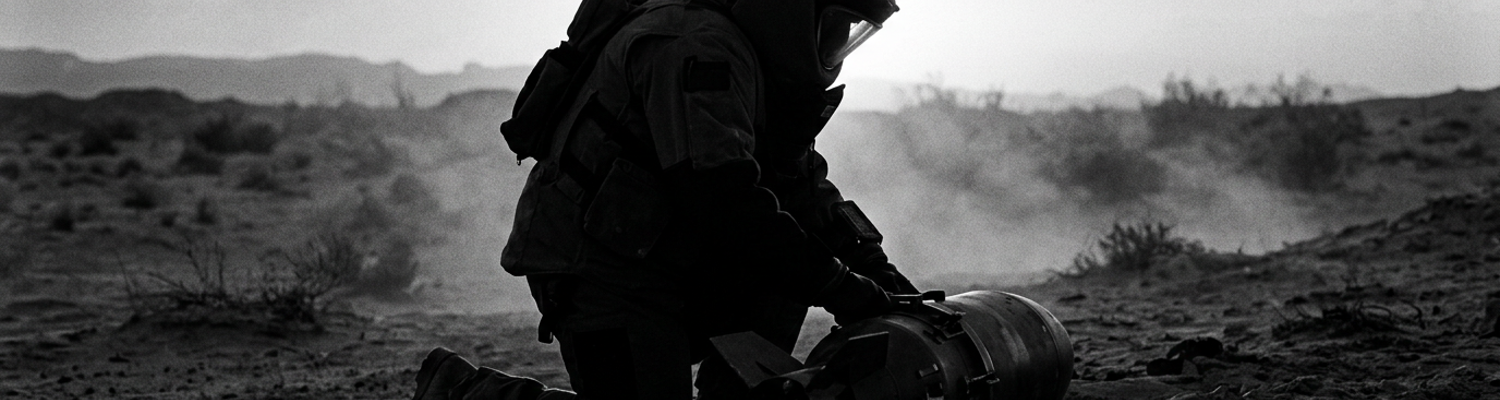

Operation Teapot and Shot Apple Two Planning
Department of the Army training doctrine promised field personnel that standard impregnated cotton fatigues and vigorous brush-downs would neutralize radioactive contamination. In the forward triage bunkers at Yucca Flat, medical orderlies spent the morning of May 5, 1955, using surgical shears to cut away rubberized protective suits. The synthetic material had melted directly into the skin of convulsing soldiers. Archival evidence shows that planners at the Armed Forces Special Weapons Project built their troop exposure doctrines on laboratory calculations. Those calculations failed immediately under field conditions. High desert heat reached past ninety degrees Fahrenheit by mid-morning. The rising temperature transformed protective masks into airless traps filled with regurgitated bile and caustic dust.
The test protocols treated lethal fission byproducts as basic sand.
A close review of operational logs indicates that Shot Apple-2 detonated at precisely 05:10 Pacific Standard Time. The device sat atop a five-hundred-foot steel tower in Area 1 of the Nevada Test Site. Engineers armed the weapon after nineteen days of weather delays caused by shifting upper-altitude winds. The experimental uranium-plutonium composite core produced an explosive yield of twenty-nine kilotons. This yield exceeded earlier planning estimates by nearly five kilotons. The detonation generated an overpressure shock wave that raced outward across Yucca Dry Lake at speeds surpassing eleven hundred feet per second.
Steel mooring cables sheared instantly.
Thermal radiation baked the surrounding desert basin at temperatures exceeding two thousand degrees Fahrenheit within the first five hundred milliseconds. The heat vaporized the tower and set ablaze hundreds of acres of sparse sagebrush. Instruments positioned on the valley floor recorded peak blast pressures of six pounds per square inch at distances exceeding one mile. The shockwave shredded coaxial telemetry lines and blew open blast baffles. Cobalt-activated dust scattered into the rising convective column.
Operation Cue turned the dry lakebed into an open firing range for nuclear blast dynamics.
Federal Civil Defense Administration officials arranged an elaborate civil defense complex known as Doom Town less than two thousand yards south of the tower site. Contractors built multi-story brick residences and reinforced cinderblock homes. They erected electrical transmission towers and industrial fuel storage tanks. Technicians stocked these structures with commercial canned goods and radiation-monitoring instruments. High-explosive ordnance and aircraft components sat parked in designated peripheral rows to measure secondary projectile hazards. Blast overpressure struck the closest residential structures at 05:10:04. The force fractured concrete load-bearing slabs and stripped wood framing down to splintered skeletons within two-tenths of a second.
Fuel tanks ruptured and ignited.
Unreinforced masonry walls collapsed inward, burying hundreds of instrument packages beneath tons of contaminated rubble. Ground commanders ordered thousands of infantrymen from the 3rd Marine Provisional Atomic Exercise Brigade directly into forward staging trenches. These earthworks sat between thirty-five hundred and four thousand yards from ground zero. Enlisted men crouched in six-foot-deep dirt trenches cut directly into the alkaline alluvium. Ground shock rolled through the trench lines forty-eight frames after flash illumination. The seismic wave collapsed peripheral revetments and snapped wood shoring timbers. Tons of calcified dust dumped directly onto the soldiers. Army Explosive Ordnance Disposal teams attached to Task Force Razor stood positioned in secondary reserve trenches just behind the main infantry line. These five-man EOD elements carried specialized brass-shanked tool kits and early-generation AN/PDR-27 survey meters.
Heereswaffenamt Munition Vulnerability Tables and Modeling Failures
Archival evidence shows that planners within the Armed Forces Special Weapons Project derived their primary vulnerability models from captured German military records. These documents sat stored at the federal records repository in Alexandria, Virginia. Allied technical intelligence teams impounded shelf miles of ballistics documentation compiled by the Heereswaffenamt during late 1944. The Third Reich weapons agency originally calculated ammunition cook-off thresholds and sympathetic detonation distances under heavy artillery bombardment. Defense Department analysts spent years translating these German ballistic indexes. They transposed tables calculated for cast-iron Krupp artillery shells directly into American weapon effects handbooks.
Weapons planners believed that conventional blast overpressure equations would scale directly against nuclear shock waves.
Project engineers applied these decades-old foreign calculations to map out expected ordnance survival zones across the northern sectors of Area 1. A close review of operational logs indicates that this reliance produced severe predictive errors across the Yucca Flat target grid. Conventional high-explosive payloads sat positioned on open wooden cradles between fifteen hundred and thirty-five hundred feet southwest of the Apple-2 shot tower. The test array included standard AN-M64 five-hundred-pound bombs and AN-M65 one-thousand-pound general-purpose munitions. The Heereswaffenamt tables assumed that munition casings would encounter only singular kinetic impulses delivered through air shock.
Shot Apple-2 subjected the forward munitions array to a dual-stage thermal and dynamic assault.
An immediate thermal pulse radiated across the desert floor when the composite core detonated. This energy heated munition casings to temperatures exceeding eight hundred degrees Fahrenheit within three hundred milliseconds. Radiant energy flash-melted lead solder joints and blistered protective lacquer coats. The heat liquefied the wax binding inside internal explosive booster charges before the blast front even arrived. Liquid TNT and molten composition-B seeped directly past rubber gaskets into empty internal threads. Radiant heat softened the tempered steel striker springs in tail-fuze cavities housing mechanical M100 and M115 fuzes. The thermal flux decomposed heat-sensitive lead styphnate primers.
The firing assemblies became mechanically hair-triggered.
Peak blast overpressures of nine pounds per square inch slammed into the softened ordnance arrays four seconds later. The shock front warped steel bomb casings out of round and snapped internal arming pins. Arming vanes drove backward into deformed booster cups. Every safety mechanism on the test line failed simultaneously. Technical reports reveal that field disposal personnel encountered unexploded bombs that defied every standard disarming procedure. Technicians entering the target grid found that the chemical stabilizers within the tetryl booster pellets had begun thermal off-gassing. This process coated external fuze threads in crystalline crusts sensitive to micro-friction.
Standard brass spanner wrenches threatened to detonate the friction-sensitized explosive crystals upon the slightest torque.
The safe distances calculated by the Armed Forces Special Weapons Project assumed that intact fuzes required heavy mechanical blows to trip their striker pins. This assumption left disposal teams kneeling over five-hundred-pound bomb casings that a gust of grit-laden desert wind could trigger. Radiation survey personnel measured ambient readings of thirty-two roentgens per hour directly above the warped M115 fuze wells at Sector 1-B.
Unexpected Thermal Updrafts and Prompt Fallout Hazards
Weapon meteorologists at the Atomic Energy Commission forecast a stable north-northeasterly dispersion vector across the unpopulated expanses of the Nevada test range. Events in the lower troposphere over Area 1 directly contradicted those pre-shot wind soundings. The twenty-nine-kiloton fireball breached its maximum expansion diameter of six hundred yards. The superheated core generated extreme vertical thermal updrafts rising at speeds in excess of two hundred and fifty miles per hour. This violent column acted as a localized low-pressure vacuum. The updraft pulled hundreds of thousands of tons of pulverized desert surface material straight up into the stem.
A previously unrecorded layer of sharp wind shear sliced into the rising thermal plume at three thousand feet above ground level.
This thermal shear tilted the convective mushroom stem thirty-five degrees south toward the populated staging corridors. A close review of operational logs indicates that the United States Weather Bureau observation post at Yucca Lake missed this localized boundary layer inversion entirely. Surface anemometers had recorded light southwesterly breezes of five to seven knots at ground level during the arming sequence. Cold air draining off the surrounding Pintwater and Belted mountain ranges clashed directly with the thermal shock front above four thousand feet. This collision generated unpredictable multi-directional vortex turbulence.
Heavy silicate particulates separated prematurely from the main cloud cap.
Weapon temperatures fused these particulates into jagged vitreous beads between fifty and four hundred microns in size. They dropped out of the convective column before reaching stabilization altitude. Dense radioactive slag began falling back down into the lower air layers over Yucca basin. Ground monitoring data confirms that this early deposition pattern landed squarely on Trench Area Bravo. This position sat thirty-five hundred yards south of ground zero. Thirty-two Explosive Ordnance Disposal technicians and radiological safety monitors sat crouched in unroofed dirt earthworks waiting for clearance to advance.
A rain of hot calcified alluvium and irradiated slag struck the forward trench lines at 05:14 PST.
Forward observers recorded dense grit pinging audibly against canvas webbing and steel helmets. Ground-level gamma radiation levels inside the open staging trenches surged from background readings to twenty-eight roentgens per hour within ninety seconds. Readings climbed past seventy-five roentgens per hour on unshielded trench parapets ten minutes later. Technicians wearing standard M9A1 protective field masks found their external canister filters rapidly choked by dense alkaline dust. This dust was saturated with short-lived fission products including iodine-131 and barium-140.
Respirator intake valves gummed up within three minutes of exposure.
Soldiers labored against severe airflow resistance as ambient temperatures inside the trench climbed past ninety-five degrees. AN/PDR-27 survey meters carried by Team 3 pegged immediately at their maximum scale limit of five hundred milliroentgens per hour. This equipment failure blinded the team to the true radiation field. High-range AN/PDR-39 instruments registered contact readings of one hundred and ten roentgens per hour directly on the shoulders of the men's impregnated herringbone twill fatigues. Company command radios at the trench lip shorted out when conductive ionized grit fouled external antenna jacks. This severed direct communication with the main decontamination station at Camp Desert Rock.
Protective Gear Limitations and Extreme Heat Stress
Chemical Corps directives mandated the use of heavy non-porous butyl rubber overgarments and sealed rubber boots for all forward ordnance survey personnel. Solar radiation beating down on the barren caliche surface of Area 1 drove local ambient air temperatures to 105 degrees Fahrenheit by 09:30 PST. Surface sand temperatures across the blast path approached 140 degrees. Evaporative cooling ceased entirely inside the two-piece impermeable suits issued to the five-man EOD teams of Task Force Razor. Sweat could not dissipate through the vulcanized synthetic rubber.
Moisture collected inside the boots and gloves at rates exceeding one quart per man per hour.
Body temperatures among technicians humping twenty-pound tool satchels across the crater lip spiked past 103 degrees within twenty minutes of dismounting their M59 armored personnel carriers. Human skin softened and detached under the trapped moisture. Medical field debriefs show that command staff treated these suits as universal shields while disregarding the physical limits of the human body. Standing test orders required ordnance specialists to kneel directly on superheated radioactive alluvium to probe fractured ground-shock gauges. Direct contact with the baking soil degraded the lower seams of the rubber trousers.
Pressurized exterior heat and pulverized fission grit worked past taped ankle cuffs.
Disorientation and severe muscle cramping took hold before the technicians could reach the second line of target cradles. Two disposal specialists assigned to Sector 1-B collapsed face down into the dirt from circulatory shock. Their internal suit temperatures exceeded the operating limits of the field thermometer equipment. A close review of operational logs indicates that the respiratory gear issued to filter prompt fission particles produced a second mechanical failure. Disposal teams wore experimental protective respirators modified with thin lead-foil shielding sheets integrated into the rubber facepieces.
These masks paired with external canister assemblies designed to stop fine aerosolized particulates.
Boots kicked up thick plumes of alkaline Yucca Flat lakebed dust as soldiers moved along the crater perimeter. This fine compound consisted of pulverized calcium carbonate and volcanic ash. The blast wave pulverized these particles to diameters under five microns. The dust bypassed the outer intake baffles. Dry mineral dust caked the internal rubber inhalation discs and mushroom-style exhalation flutter valves within eight minutes of foot movement through Sector 1-C. The moisture from the soldiers' heavy breathing mixed with the calcified powder.
This formed an adhesive alkaline paste that cemented the flexible rubber flappers to their valve seats.
Inhalation resistance climbed to levels that collapsed the thin rubber intake tubes. Soldiers drew unfiltered desert air straight through the valve housing rims when the exhaust valves jammed partially open. The caustic alkaline dust entered their mouths and bronchial tracts. The material reacted with salivary fluids to produce chemical burns across mucosal membranes. Several technicians attempted to clear their sticky flutter valves by blowing outward with excessive force. This action dislodged the internal rubber retaining rings and broke the airtight seal around their jaws.
Men began vomiting violently into their mask bowls.
Regurgitated gastric fluids blocked the remaining intake ports. Technicians broke protocol and stripped their facepieces off by hand inside sectors registering forty-five roentgens per hour of active gamma radiation. Medics at the forward trench triage station received six technicians within an hour. All exhibited second-degree contact burns across their inner thighs and severe respiratory trauma from aspirated lakebed dust. Field logs at the triage station recorded rectal temperatures of 106.2 degrees Fahrenheit for the first EOD sergeant brought back from the shot line.
Manual Clearance of Sensitized High Explosives
Disposal technicians from the 63rd Ordnance Detachment received orders to advance on Sector 1-B at 07:15 PST. This target zone sat eighteen hundred feet southwest of ground zero. The two-man teams crawled flat on their stomachs across caliche gravel and jagged fragments of structural steel. They entered the perimeter of an open wooden munition rack destroyed during the initial blast wave. Five hundred-pound AN-M64A1 general-purpose bombs lay thrown across forty yards of scorched desert floor.
Direct thermal flux from the twenty-nine-kiloton fireball had carbonized the exterior olive drab paint.
The heat fused bomb casings directly to molten steel mounting bands. Radiative heat reaching twelve hundred degrees Fahrenheit welded the base plugs into the internal casing threads. Disposal specialists dragged themselves through radioactive silt measuring twenty-two roentgens per hour. They used non-sparking beryllium-copper scrapers to chip away carbonized rubber gaskets bonded to bomb lug brackets. Every inch of forward movement kicked up alkaline dust that settled into the exposed cooling fins of their respirator check valves.
The test directorate prohibited demolition in place.
A close review of operational logs indicates that ground commanders rejected counter-charging the ordnance. Secondary detonations would obliterate nearby underground soil-strain gauges and coaxial diagnostic lines. That command choice forced technicians to execute manual disarming operations directly within the sympathetic detonation threshold of the munition cluster. The three-hundred-pound high-explosive fill consisting of Composition B inside each AN-M64A1 casing had experienced severe thermal shock followed by violent kinetic deceleration. Radiant energy liquefied the external layer of the cast explosive matrix.
Molten TNT separated from suspended RDX granules before recrystallizing into an unstable porous sponge.
The impact shock wave from Shot Apple-2 subsequently deformed the nose and tail fuze cavities by up to six degrees out of round. Mechanical M100A2 tail fuzes sat jammed against crushed internal booster sleeves. Thread friction generated during manual extraction risked producing localized shear heating above the critical detonation threshold of three hundred and sixty degrees Fahrenheit. The explosive blast wave would transmit across the six-foot spacing to initiate the entire battery of twelve five-hundred-pound bombs simultaneously if a single sensitized casing detonated from mechanical shock. Shock waves from adjacent munitions would travel through the calcified soil at four thousand meters per second.
Technical reports describe the mechanical breakdown of standard EOD extraction tools under the extreme thermal warping found at Area 1.
Technicians attempting to thread M18 fuze extractors onto the distorted striker heads discovered that thermal expansion had galled the steel threads into solid blocks. Lead disposal personnel knelt directly over the exposed tail assemblies. They applied thirty foot-pounds of manual torque through brass spanner wrenches while saturated in sweat that filled their rubber gloves. Grit particles measuring fifty microns lodged between the wrench jaws and the distorted locking rings. This created sudden slips that stripped wrench pins and jarred the sensitized internal firing pins.
The specialists held their breath during each rotational turn.
They listened for the internal crunch of fractured striker springs or the scrape of friction-sensitive tetryl booster crystals along the casing walls. Team Two extracted the first distorted tail fuze assembly from bomb casing serial number 43-11882 at 08:42 PST. The open cavity revealed molten explosive residue pooled directly behind the booster cup.
Battlefield Triage and Improvised Skin Decontamination
The subterranean aid station established in Trench Bunker Charlie was overwhelmed by forty-eight casualties by 10:00 PST. The corrugated-steel shelter was engineered for sixteen men. Medical orderlies assigned to the 63rd Ordnance Detachment faced a total diagnostic collapse. The clinical presentations of thermal shock, blunt trauma, and acute radiation exposure appeared indistinguishable. Men dragged from the Sector 1 crater line collapsed across the dirt floor. They vomited uncontrollably while shaking with violent systemic chills.
Core body temperatures among the collapsed EOD technicians hovered near 106 degrees Fahrenheit.
Their skin presented as mottled, pale, and covered in cold sweat. Medics attempting to sort the arriving litters could not determine the root cause of the intractable projectile vomiting. It could stem from heat-induced circulatory failure or severe concussive shock from the initial twenty-nine-kiloton blast wave. It could also indicate early prodromal radiation syndrome triggered by whole-body penetrating gamma doses exceeding three hundred rads. Blast trauma complicated every assessment. Ruptured tympanic membranes and compound fractures from collapsed trench earthworks obscured neurological signs.
Orderlies could not separate the irradiated dying from the heat-stricken.
A close review of operational logs indicates that the physical infrastructure of the forward medical bunker actively worsened the crisis. The unventilated dugout sat thirty-four hundred yards south of the Apple-2 ground zero. It trapped ambient desert heat alongside the body heat of dozens of retching soldiers. The station quickly exhausted its sixty-gallon emergency potable water bladder. Orderlies lacked the basic fluids required to administer oral rehydration salts or maintain intravenous lines for patients entering hypovolemic shock. Contaminated herringbone twill uniforms and melted butyl rubber garments piled up in the narrow entry trench.
The shelter doorway became a secondary radiation emitter.
The pile registered four roentgens per hour on AN/PDR-27 survey dials. Orderlies worked on hands and knees across dust-caked groundsheets. They stepped over soldiers who drifted into comas while others tore at their own throats in oxygen-starved delirium. Official chemical wash trucks never arrived from the rear depot at Camp Desert Rock. Field reports document that medical staff had to invent decontamination protocols from salvaged domestic supplies. Technicians who had stripped off damaged respirators arrived with severe localized beta radiation burns across their necks and wrists.
Irradiated calcium silicate dust had settled into sweat channels.
The fine lakebed dust carried volatile fission isotopes of iodine-131 and strontium-89. These isotopes produced rapid epidermal reddening and caustic chemical necrosis. Standard water washdowns were impossible due to severe water rationing. Wiping the skin with dry sponges only drove the jagged fifty-micron glass particles deeper into raw dermis. The station surgeon dispatched runners to rummage through the blast-damaged mobile field kitchens and intact residential pantries inside the Doom Town civil defense display. Medics returned with commercial glass jugs of five-percent acetic acid household vinegar and cardboard cases of standard zero-point-nine-percent sodium chloride irrigation flasks.
Vinegar broke the chemical bond between the alkaline lakebed fallout and human flesh.
Orderlies poured raw vinegar directly across the inflamed blistering skin of the ordnance technicians. The mild acid reacted with the basic calcium carbonate alluvium. This dissolved the calcified matrix and freed the trapped beta-emitting particles without causing deep chemical trauma to the exposed subcutaneous tissue. Medical assistants followed each acid application with pressurized flushes of sterile saline solution. They jetted the loosened radioactive slurry into cut-open five-gallon ration cans. Medics used standard surgical shears to peel away outer layers of sloughing contaminated epidermis when the saline ran out. They scraped radioactive matter off bleeding tissue before dusting the open flesh with sulfanilamide powder. The station log recorded thirty-two EOD and infantry casualties treated with the improvised wash by 11:30 PST. Residual beta contact readings across their scrubbed skin dropped from twenty-five roentgens per hour to three hundred milliroentgens per hour.
Institutional Divergence in Nuclear Testing Doctrine
Test directors at the Armed Forces Special Weapons Project structured clearance timetables around theoretical radiological models that failed completely in the field. Laboratory simulations executed at Los Alamos assumed prompt radiation would decay along predictable mathematical curves. This assumption allowed clearance squads from the 63rd Ordnance Detachment to begin surface inspections ninety minutes after detonation. Test directorate staff established an operational exposure ceiling of 3.9 roentgens for Exercise Desert Rock VI personnel. They projected that sweep teams would encounter minimal residual contamination beyond the immediate crater rim.
Ground monitors moving into Sector 1 discovered a different environment.
The five-hundred-foot tower burst had pulverized hundreds of tons of mineral-rich desert surface. The blast scattered short-lived beta and gamma emitters across all forward approach corridors. Low-range AN/PDR-27 survey instruments issued to clearance personnel pegged their needles at five hundred milliroentgens per hour within seconds of deployment. Team leaders could not map the true intensity of the radiological field. High-range AN/PDR-39 meters subsequently registered ambient fields exceeding seventy-five roentgens per hour across the central target arrays. Desk planners had calculated human radiation budgets assuming uniform particulate dispersion across clean ground.
A close review of operational logs indicates that high-level command decisions widened this institutional breach.
Test controllers situated at the Control Point refused to adjust recovery timelines. They denied clearance teams discretion to bypass forward equipment cradles. Ground commanders prioritized the recovery of high-speed diagnostic film canisters and subsurface soil-strain gauges over the physical limits of the ordnance technicians. Clearance squads received explicit directives forbidding the use of counter-charges to neutralize unexploded munitions. Secondary detonations would sever buried telemetry runs and ruin physical soil-displacement data needed by weapon physicists. Technicians crawled into areas reading over one hundred roentgens per hour.
They manually disarmed warped AN-M64 general-purpose bombs.
Internal Composition B fills had softened under direct thermal flux. Disarming crews worked with hand wrenches on distorted fuze bodies while radioactive calcium silicate dust packed into their respiratory valves. Theoretical safety guidelines existed only in administrative handbooks. The near-disaster at Area 1 prompted an emergency review of ordnance clearance doctrine in irradiated environments. Technical debriefs compiled after Exercise Desert Rock VI exposed the failure of standard disarming techniques on munitions altered by combined nuclear blast and thermal radiation.
Ordnance Corps commanders at Aberdeen Proving Ground initiated direct revisions to technical manuals.
Revised doctrine stripped test directors of the authority to mandate manual disarming operations in contaminated forward zones. New protocols barred technicians from approaching unexploded ordnance on foot when ambient radiation fields exceeded two roentgens per hour. The Army established a mandatory forty-eight-hour radiological cooldown window for non-essential targets. Disposal units received authorization to employ remote-fired shaped charges to destroy sensitized ordnance in place. This applied regardless of adjacent test instrumentation or scientific diagnostic wiring. Field teams were equipped with long-line cable pull assemblies and vehicle-mounted extraction winches. Personnel could apply mechanical torque to damaged fuze rings from behind shielded earth berms five hundred feet away. Standard issue low-range detectors were permanently replaced by AN/PDR-39 survey meters featuring telescoping probe mounts.