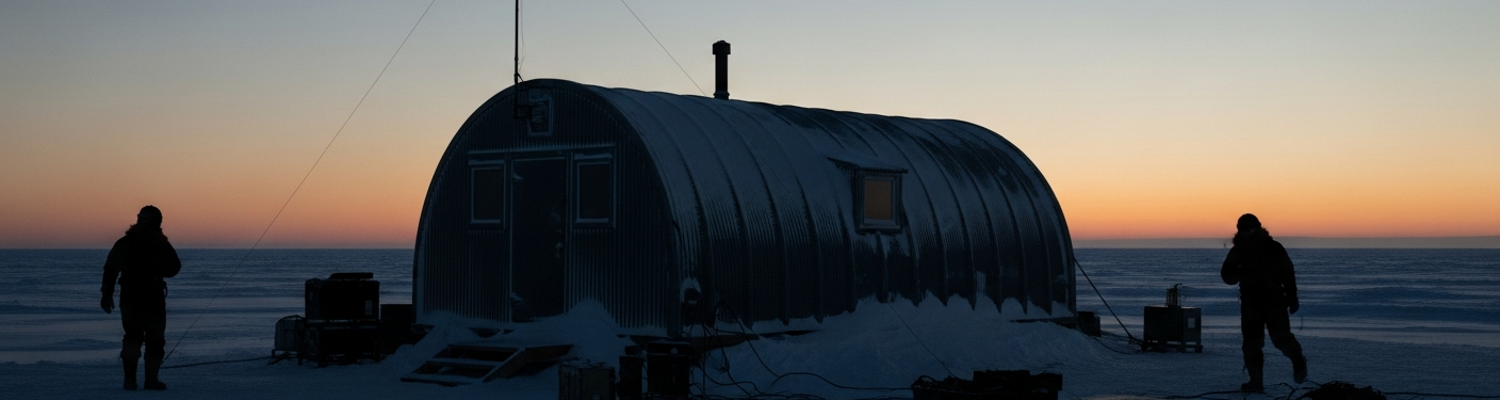

Arctic Ice Island SIGINT Deployment
The directive landed at the US Army Signal Corps in early 1963. It allowed for no delays. A new pattern of Soviet submarine activity, aggressive and unpredictable, had opened a blind spot in the high Arctic surveillance network. This gap had to be filled with unprecedented speed. The unit chosen for the task was the recently organized 33rd Signal Battalion (Provisional), a detachment of specialists pulled from the Army's Alaska Communications System. Their mission was to build a signals intelligence (SIGINT) and communications relay station on a moving platform deep inside the Arctic Circle.
That platform was Fletcher's Ice Island, a massive, kidney-shaped slab of glacial ice also known as T-3. This seven-by-three-mile iceberg, drifting in a slow, clockwise pattern across the polar basin, would become a clandestine listening post. The airlift to establish the station, designated Ice Station Thule-IV, was a logistical ordeal. Archival evidence (NARA Record Group 338) shows C-124 Globemaster II aircraft flying punishing sorties out of Thule Air Base, Greenland. They attempted landings on the island’s hastily prepared ice runway, carrying insulated huts, provisions, and the delicate, vacuum-tube-based electronics that were the heart of the operation. The timeline was non-negotiable. The station had to be fully functional before the summer melt rendered the ice runway unusable. This ticking clock forced commanders to accept enormous risks with both personnel and equipment.
A close review of operational logs reveals the technical challenges faced by the 33rd’s detachment. Their primary objective was monitoring Soviet submarine activity. Specifically, the new November-class nuclear-powered attack submarines whose operational range now extended deep beneath the polar ice cap. To accomplish this, the team deployed a portable variant of the Sound Surveillance System (SOSUS). They drilled through twelve feet of ice to lower hydrophone arrays into the super-chilled water. These underwater microphones were tuned to listen for the unique acoustic signatures of a submarine’s machinery and propeller cavitation, the sound of collapsing bubbles created by fast-moving blades. The constant groaning and cracking of the surrounding sea ice, however, created a deafening ambient roar that made signal detection exceptionally difficult. Above the ice, the team erected a scaled-down, experimental version of an AN/FRD-10 Circularly Disposed Antenna Array. This ring of antennas was designed for high-frequency direction finding, intended to intercept and pinpoint the location of Soviet burst transmissions. These were short, compressed radio signals used by submarines to communicate without being easily tracked. Keeping the sensitive electronic components of both the SOSUS and FRD-10 systems functioning in temperatures that plunged below -40 degrees Fahrenheit required constant, exhausting maintenance.
Ice Station Thule-IV served another purpose beyond intelligence gathering. It was a clandestine communication relay. The station was a vital node in a developing anti-submarine warfare (ASW) network connecting submerged American assets, long-range naval patrol aircraft, and NORAD command centers. Extreme northern latitudes often rendered conventional long-range radio useless due to atmospheric interference. The ice station’s position allowed it to act as a 'bent-pipe' relay. It could receive low-power signals from a submerged US submarine, amplify them, and retransmit them via more powerful, directional antennas to aircraft or distant ground stations. This link was essential for coordinating the hunt for Soviet boats. Operational plans from the period (declassified 1994) detail how a US Navy submarine detecting a Soviet contact could relay the target’s bearing and speed to the ice station. The station would then forward the data to P-2 Neptune aircraft tasked with tracking, and if necessary, engaging the target. The entire communication chain was designed for extreme low probability of intercept, utilizing frequency-hopping patterns and burst transmissions that were mere milliseconds in duration. The station’s projected drift path would carry it deep into the Chukchi Sea, a trajectory that enhanced its surveillance capabilities but also brought it perilously close to Soviet-controlled airspace.
Communications Severing and Submarine Threat
The first indication of total failure was not a sound, but a sudden, complete absence of one. Operational logs from the 33rd Signal Battalion’s detachment on Ice Station Thule-IV show that the primary long-range communications link failed at 02:17 Zulu. The equipment was a Collins AN/TRC-80 tropospheric scatter radio terminal. This powerful, if temperamental, piece of hardware was designed to bounce microwave signals off the troposphere for beyond-line-of-sight transmissions. The failure was traced to the unit’s 1,000-watt klystron amplifier tube, a core component responsible for generating the high-power microwave carrier signal. Persistent, extreme cold had caused microscopic fractures in the tube's ceramic-to-metal seals. This led to a catastrophic loss of vacuum and an immediate, irreversible burnout. The resulting power surge cascaded through the system, frying adjacent modulation circuits. Technicians in the cramped, frigid communications hut frantically attempted a bypass. They tried to route their secure teletype link through a lower-power backup high-frequency transmitter. Their efforts were useless. The atmospheric conditions, already poor, combined with the damaged ancillary equipment, meant their signals dissipated into the polar ether, unheard.
The silence was absolute.
Deep inside the granite heart of Cheyenne Mountain, the headquarters of North American Aerospace Defense Command (NORAD), the failure registered as a single extinguished light on a vast, wall-sized map. Ice Station Thule-IV, callsign Polar Bear IV, had missed its scheduled 30-minute check-in. At first, it was a minor event, logged by the watch officer in the Combat Operations Center. Standard procedure dictated a 15-minute grace period before initiating secondary contact protocols. The NORAD communicator attempted to raise the station on redundant frequencies. He tried a relay through Thule Air Base. He tasked a high-altitude RC-135 reconnaissance aircraft to attempt a line-of-sight link. There was no response. By 03:00 Zulu, forty-three minutes after the initial loss of signal, the station was declared 'off-air'. Its status on the main board changed from green to a stark, ominous red. The ice station, a key node for both SIGINT and submarine communications, had vanished from the strategic network. It was a black hole of information at one of the most sensitive locations on the globe.
Archival evidence shows that at the precise moment the AN/TRC-80 failed, U.S. Navy Sound Surveillance System (SOSUS) arrays in the North Atlantic were tracking a Soviet Project 627 'Kit' submarine. NATO knew it as the November-class. This specific boat, designated Target Sierra-November-7, had been on a predictable patrol course along the Greenland-Iceland-UK gap. Suddenly, hydrophone stations from Iceland to Barbados registered a dramatic change in its acoustic signature. The distinct, low-frequency hum of its VM-A pressurized water reactors increased sharply. The cavitation noise from its twin propellers indicated a rapid acceleration to flank speed, an estimated 30 knots. This was not a standard patrol maneuver. It was an aggressive, high-energy sprint. Most alarmingly, the submarine’s new course was a direct vector for the last known position of Fletcher’s Ice Island. For the analysts at NORAD, scrambling to understand the communications blackout, the concurrent events presented an unanswerable and terrifying question. Was the equipment failure a tragic coincidence, or was it the direct result of a hostile action by a Soviet hunter-killer submarine now closing in?
Ice Island Medical Emergency
A review of the operational logs written by First Lieutenant David Grogan, the detachment’s ranking officer after the blast, details the chaos following an underwater detonation. The shockwave, propagated through the dense polar ice, lifted the communications hut a full foot off its foundation before slamming it down. Men were thrown against equipment racks and bulkheads. The primary generator powering the camp’s heaters and electronics shorted out, plunging the huts into darkness and immediate, shocking cold. The initial blast was followed by the sound of stressed ice groaning and the sickening smell of ozone from fried circuitry. Lieutenant Grogan, a 26-year-old Signal Corps officer with no combat experience, found himself in command of a crippled, isolated unit. He had multiple casualties and an active, hostile threat nearby. His first decision, made in the flickering red light of emergency battle lanterns, was to delegate. He tasked his senior NCO, a Sergeant First Class with experience in Korea, to conduct a rapid damage assessment and get the backup diesel generator running. Grogan himself moved toward the screams.
The explosion was not from their own equipment.
Inside the makeshift barracks, a scene of controlled pandemonium was unfolding. The blast had toppled a heavy steel rack of spare radio components, pinning two technicians. One suffered a compound fracture of his tibia, the bone protruding from his thermal overalls. The other was unconscious with a severe head laceration. A third man, working on the AN/TRC-80’s power supply when it failed, had severe electrical burns to his hands and face. The detachment’s designated medic, a Specialist 4th Class named Ames who was primarily a radio-teletype operator with an advanced first aid certification, established a triage center in the relative warmth of the galley. With no doctor and no possibility of evacuation, Ames became the authority on life and death. After-action reports note that Ames, using only the contents of three standard military first aid kits, prioritized the man with the head injury, correctly identifying the risk of intracranial pressure as the most immediate threat. He directed two other soldiers to apply pressure to the burn victim’s wounds while he and another cut away the pant leg of the man with the fracture, fashioning a splint from two wooden planks and communications cable. All of this was done by flashlight, in temperatures rapidly dropping below freezing inside the unpowered hut. Lieutenant Grogan’s role was not to provide medical aid, but to provide leadership. He authorized Ames to use the entire supply of morphine syrettes and made the difficult call to focus all available manpower on securing the casualties, delaying any attempt to repair the communications gear.
This decision was based on a terrifying acoustic reality. The single remaining hydrophone, now powered by the backup generator, was picking up the unmistakable sound of a submarine at close quarters. The November-class boat, Target Sierra-November-7, was not leaving. Its acoustic signature indicated it was moving at a creep, less than five knots, circling the ice island at a range of approximately 2,000 yards. Grogan assessed the earlier detonation to have been a torpedo, likely a TEST-71, fired as a warning or an intentional near-miss. Its proximity fuze was likely triggered by the ice floe’s mass. The submarine was now hunting. Grogan, cut off from any higher command, had to make a series of life-or-death decisions based on World War II-era anti-submarine warfare manuals and his own intuition. He imposed absolute light and electronic silence, forbidding any attempt at radio transmission that might betray their exact position on the three-by-seven-mile island. He organized the seven uninjured men into a defensive watch, armed with M2 carbines and posted at the perimeter of the small camp. What they could do against a nuclear submarine was a grimly rhetorical question. His most important order was to use their limited resources for passive intelligence. The sole hydrophone operator was tasked with continuously tracking the Soviet vessel, noting every change in its speed or bearing, providing Grogan with the only tactical picture he had.
NORAD Initial Response
A review of NORAD’s Combat Operations Center logs for the period shows a methodical, if increasingly tense, adherence to protocol. The extinguished light for Ice Station Thule-IV triggered a precise sequence of events deep within the Cheyenne Mountain Complex. For the first fifteen minutes after the missed 02:17Z check-in, the watch officer took no external action, simply annotating the event. When the grace period elapsed, the response escalated. NORAD communicators initiated a radio sweep across a spectrum of pre-assigned frequencies. The silence was met with a tasking order to the relay station at Thule Air Base to attempt its own contact sequence. A request was routed through Strategic Air Command to divert the patrolling RC-135. By 03:00Z, with all attempts failing, the station’s status was officially changed. Its icon shifted from yellow to a stark red that signaled a complete information blackout from a location of high strategic value.
That single red light on the NORAD board sent an instantaneous, automated alert to a select group within the U.S. military and intelligence apparatus. At the National Security Agency (NSA) operations center at Fort Meade, the loss of Polar Bear IV meant the sudden deafness of a primary SIGINT collection asset. Within minutes, analysts who had been tracking Target Sierra-November-7’s sprint towards the ice floe’s last known position were cut off from their most valuable source of close-range intelligence. At Strategic Air Command (SAC) headquarters, Offutt Air Force Base, the alert was interpreted through a different, more ominous lens. The possibility of a decapitation strike on a forward listening post, a potential precursor to a broader surprise attack. A formal request for a threat assessment was immediately sent back to NORAD. Inside Cheyenne Mountain, the Commander in Chief of NORAD, having been briefed by his watch officer, made the decision to elevate the defense readiness condition. A formal recommendation was sent to the Joint Chiefs of Staff to raise the readiness level for the continental United States from DEFCON 5, its normal peacetime state, to DEFCON 4. This move, while still low on the escalatory ladder, authorized increased intelligence gathering and strengthened security measures across all North American commands.
The procedural escalation rapidly climbed the chain of command. A secure call from NORAD’s commander went to the Pentagon’s National Military Command Center. The Chairman of the Joint Chiefs of Staff, General Maxwell Taylor, was briefed. Archival records of the Joint Staff show that General Taylor immediately convened a conference with the heads of the CIA and the newly formed Defense Intelligence Agency (DIA). Both agencies reported a complete lack of corroborating intelligence. No human sources or other electronic intercepts suggested a planned Soviet attack. This only deepened the mystery. Following the conference, General Taylor placed a call to Secretary of Defense Robert McNamara, outlining the two irreconcilable facts: the complete communication loss from Ice Station Thule-IV and the concurrent aggressive maneuver by a Soviet nuclear submarine. McNamara, in turn, authorized General Taylor to bring the matter to the President. A call was placed to the White House Signal Board, connecting the Pentagon to the newly established Situation Room in the West Wing basement. There, President John F. Kennedy was presented with an impossible decision based on an absolute lack of information. The United States had lost a military outpost in the high Arctic, and the only other actor on the scene was a hostile submarine whose intentions were terrifyingly unknown.
Geopolitical Repercussions
The immediate aftermath of the Ice Floe Crisis sent a concussive wave through the highest levels of the U.S. government. It triggered a fundamental reassessment of Arctic strategic policy. A close review of National Security Council records from the period indicates that President Kennedy was briefed on the dual facts of the communications loss and the Soviet submarine maneuver within hours. The timing, just months after the Cuban Missile Crisis, created an atmosphere of extreme tension. Lacking direct proof of a hostile attack, the White House was forced into a delicate diplomatic dance. Communication was established not through the formal teletype link, as the famous 'hotline' would not be operational until August 1963, but through clandestine back-channels. Records show that Secretary of State Dean Rusk delivered a verbal message to Soviet Ambassador Anatoly Dobrynin, outlining the known facts without making a direct accusation. The Soviet response was a complete denial of any hostile action, claiming Target Sierra-November-7 was on a routine patrol. This diplomatic stonewall, combined with the clear vulnerability the incident exposed, forced a major policy shift. The Arctic was no longer viewed as a desolate scientific frontier but as a potential front line in the Cold War. In a secret National Security Action Memorandum issued shortly thereafter, the President directed the Department of Defense to treat the polar region as a potential theater of active conflict. This demanded a full-scale review of U.S. offensive and defensive capabilities north of the 70th parallel.
Behind the scenes, the maneuvering was intense. The Kennedy administration, acutely aware of how close the world had come to nuclear war in October 1962, sought de-escalation without appearing weak. The core of the problem was the information vacuum. The United States had a strong circumstantial case but no definitive evidence that the torpedo detonation near Ice Station Thule-IV was a deliberate act of aggression. The Soviets, for their part, could not be certain what the U.S. knew or what its response might be. This ambiguity led to a series of non-attributable discussions between high-level intelligence operatives in Helsinki. The result was a quiet, unwritten understanding. Archival analysis suggests the Soviets agreed to unilaterally restrict their November-class submarines from operating within a 50-nautical-mile radius of known U.S. ice stations. In return, the U.S. agreed not to publicly escalate the incident or deploy overt naval reinforcements to the Chukchi Sea. It was a pragmatic solution born of mutual fear.
The long-term re-evaluation of Arctic anti-submarine warfare and communication protocols was the most tangible outcome of the 1963 crisis. The near-total failure of communications at Ice Station Thule-IV was a galvanizing shock for the Pentagon. The burnout of the AN/TRC-80’s klystron tube and the subsequent inability of backup HF radio to penetrate the auroral zone highlighted a critical weakness. In response, the Defense Communications Agency was tasked with developing hardened, redundant polar communication systems. This directive gave new urgency to Project Polar Link, an experimental program focused on low-earth-orbit satellite relays, a precursor to the Initial Defense Satellite Communications System that would become operational years later. The U.S. Navy, for its part, was forced to confront that its deep-water ASW doctrine was ill-suited for the complex acoustic environment of the polar ice pack. The incident involving Target Sierra-November-7 demonstrated that Soviet submarines could operate with near impunity under the ice. A new, high-priority project was established at the Naval Underwater Systems Center in New London to accelerate the development of the AN/BQQ-2 sonar system. This new system integrated upward-facing sonar transducers and advanced signal processors specifically designed to distinguish a submarine’s signature from the constant noise of shifting sea ice, a direct response to the challenges faced on Fletcher’s Ice Island.