
Initial Marine Air Mobility in I Corps
In the summer of 1965, the western fringe of South Vietnam’s coastal plains was a contested frontier. Here, the rice paddies gave way to the Annamite Mountain Range, a rugged chain of jungle-covered mountains forming a border with Laos and Cambodia. Archival evidence (NARA Record Group 127) shows this terrain was the primary physical channel for the Ho Chi Minh Trail. This was not a single road but a complex network of paths and river crossings hidden beneath a triple-canopy jungle. It was the main supply route for moving personnel and materiel from North Vietnam into the south. Intelligence estimates from the period calculated that over 12,000 soldiers had passed through this network in the previous year, alongside a daily flow of up to 30 tons of supplies.
Controlling this highland region was paramount.
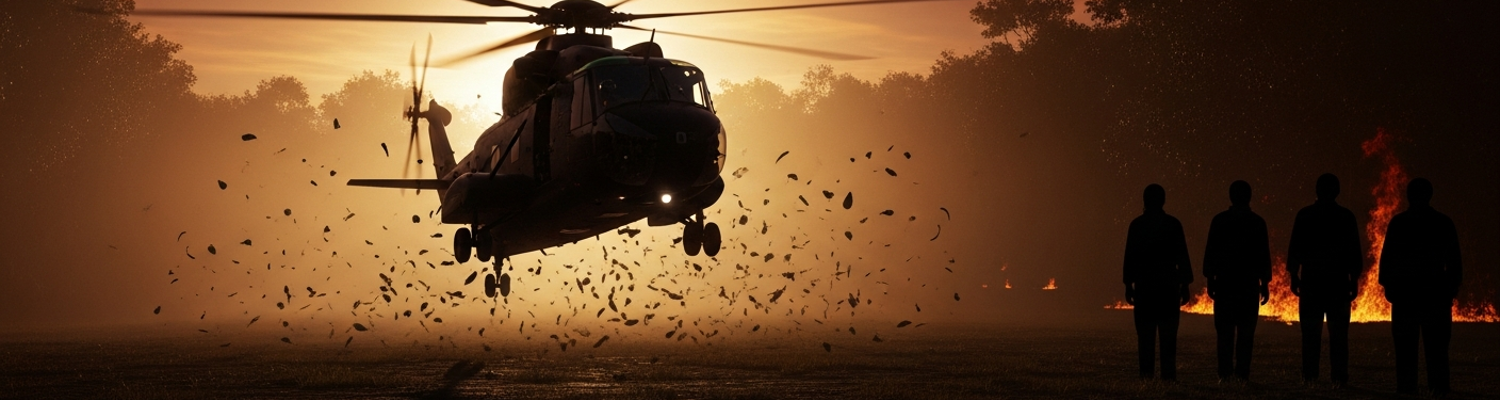
Providing the airborne mobility for this effort were units like Marine Medium Helicopter Squadron 365 (HMM-365). Operational logs indicate that by June 1965, the squadron was deep into its combat deployment at Da Nang, having moved ashore from the USS Princeton (LPH-5) in May. The primary aircraft for HMM-365 was the Sikorsky UH-34D Seahorse. It was a piston-engine machine with a distinctive nose and a high, exposed cockpit. Crews respected its power, which made it more capable in the hot, thin air of the mountains than some other contemporary helicopters. It could also absorb significant battle damage and return to base. Yet, it carried known deficiencies. The magnesium alloys in its airframe, used for weight reduction, caused it to burn intensely when struck by ground fire. The high cockpit, while offering excellent visibility, made pilots a clear target. Mechanical failure was a constant threat.
Despite these dangers, the men of HMM-365 flew continuously. They accumulated over 12,000 flight hours in a single tour, a reflection of the relentless operational tempo. The mission was to provide mobility in terrain that was otherwise impassable. Initial tactical objectives were not large, set-piece battles. They were designed to insert Army of the Republic of Vietnam (ARVN) soldiers to interdict enemy forces moving out of the mountains. A developing tactic known as the "Eagle Flight" involved a flight of four troop-carrying UH-34s orbiting a battle, ready to land and cut off any enemy soldiers attempting to escape. This was an application of Marine counter-insurgency doctrine, using the helicopter to deliver precise force.
UH-34D Seahorse High-Altitude Performance Degradation
The engine of the UH-34D was its Wright R-1820-84 Cyclone, a nine-cylinder, air-cooled radial engine that produced 1,525 horsepower. This was a powerful but dated piston engine. Its placement low in the helicopter’s nose offered a degree of protection for the crew. The engine and airframe, however, were not designed for the operational environment of the Annamite foothills. The combination of high ambient temperatures and high humidity created a condition known as high-density altitude. The hot, wet air was less dense. This offered the 56-foot main rotor less purchase and reduced the oxygen available for combustion. Archival evidence shows this directly translated into a severe degradation of the aircraft’s lift capability. A Seahorse could carry between 12 and 16 troops in ideal conditions. Flight crews in Vietnam discovered this number was often theoretical. On a hot day in the highlands, a UH-34D might struggle to lift off with just eight combat-equipped Marines. Mission planners had to choose between reducing the number of troops per helicopter, thereby increasing the number of sorties required and extending time in the landing zone, or off-loading fuel, which drastically shortened the aircraft’s range.
Every mission was a race against the fuel gauge.
Operational profiles for HMM-365 reveal the mathematics of the Seahorse's fuel consumption. The Wright R-1820 engine was not fuel-efficient. Specific fuel consumption data for the engine family indicates a burn rate of approximately 0.6 pounds per horsepower per hour. At full power, this meant a consumption rate approaching 100 gallons per hour. A standard tactical profile, transiting from Da Nang to a landing zone, executing a high-power insertion, and returning, placed enormous demands on the engine. The helicopter’s main fuel tanks held around 218 gallons. This gave the aircraft a maximum range of roughly 245 miles under ideal cruise conditions. Combat was not ideal. The high-power demands of hovering in hot air, maneuvering to avoid ground fire, and climbing out of the mountains meant that effective combat radius was often less than 100 miles. Mission time could be as short as 90 minutes. This was particularly problematic for "Eagle Flight" missions, where helicopters orbited a contact zone. The Seahorse’s endurance was so limited that the window of opportunity was brief.
The Trans-Pacific JP-4 Naval Supply Chain
The high fuel consumption of the UH-34D Seahorse fleet created a massive demand for JP-4 aviation fuel. This demand stretched a new and underdeveloped logistical chain. The air war in the northern provinces of South Vietnam depended on a naval pipeline that began far out at sea. This chain originated with large, civilian-crewed tankers of the Military Sea Transportation Service (MSTS) that steamed across the Pacific. These vessels were floating depots, carrying millions of gallons of JP-4. The first point of transfer, and a significant chokepoint, was moving this fuel to the Navy’s amphibious assault ships. Vessels like the USS Princeton (LPH-5) served as the mobile sea base for helicopter squadrons like HMM-365 before they moved ashore. This transfer happened at sea using a method called underway replenishment. The massive tanker and the smaller LPH would steam in close formation, connected by heavy fueling hoses. The success of this operation depended entirely on calm seas and functional equipment. Any disruption, from a tropical squall to a malfunctioning pump, could halt the flow of fuel for hours or days. The limited number of MSTS oilers available to service the entire fleet in the region meant that any delay had cascading effects.
Shore-Based Fuel Distribution Failures at Da Nang
Once JP-4 was aboard the LPH, the next challenge was moving it to the depots at Da Nang. In the initial phases of the Marine buildup in 1965, Da Nang’s port facilities were primitive and overwhelmed. A review of operational logs from the period details a process filled with inefficiency. Fuel was often pumped from the ships through long, flexible hose lines to collapsible rubber fuel bladders set up in temporary tank farms near the beach. These bladders were exposed to the elements and susceptible to leaks. The process was slow, and the few available pumps were a constant maintenance issue. The port itself was congested, with ships waiting offshore for days for a chance to offload their cargo. This created a second major chokepoint. Every step of this ship-to-shore transfer introduced a risk of contamination. Seawater, sand, and sediment could easily enter the fuel stream through leaky connections or compromised bladders. This could render entire batches of JP-4 useless until they could be re-filtered, a time-consuming process that further strained supplies.
The final leg of the journey was distribution from the shore-based depots to the HMM-365 flight line at Da Nang Air Base. This task fell to ground crews and Marine motor transport units. They used M49A2C fuel tanker trucks, each capable of carrying 1,200 gallons, to ferry the JP-4 from the main depots to the squadron’s refueling pits. The route was short but ran over poor roads, thick with the traffic of a rapidly expanding military base. Vehicle breakdowns were common. A more sinister risk was enemy action. While the Da Nang base itself was relatively secure, the supply lines feeding it were considered targets. A single sapper attack or a well-placed mortar could destroy a fuel convoy, vaporizing thousands of gallons of needed fuel. A single broken fuel pump could ground an entire squadron.
Radio Silence and Rules of Engagement Ambiguity
The success of a mission to extract civilians depended entirely on coordination with the ground element. After-action reports from this period frequently highlight the breakdown of tactical radio links as a primary source of operational friction. In the mountainous terrain of the Annamite foothills, line-of-sight FM radio was unreliable. The standard man-portable radio for ground troops, the AN/PRC-25, and the aircraft-mounted sets in the UH-34Ds operated on similar frequencies. The dense jungle canopy and intervening ridgelines, however, could render them useless. A flight of four Seahorses arriving over a pre-designated landing zone could find itself unable to raise the Special Forces or Marine advisory team they were sent to support. The pilots could see the village and the people gathering, but could hear only static.
This communication blackout created an immediate crisis in the cockpit. Without a voice on the ground to confirm the security of the landing zone, every decision became a high-stakes gamble. The Rules of Engagement (ROE) for operations in 1965 were a complex set of directives designed in Washington to limit escalation. Pilots and crews were instructed to fire only when fired upon. The interpretation of this rule became dangerously ambiguous in the absence of communication. A flight leader looking down at a village clearing designated as friendly might see dozens of people moving near the tree line. In the silence of a dead radio, he was forced to make an assessment based purely on visual cues. Were those villagers fleeing toward the helicopters, or were they Viet Cong fighters maneuvering for an ambush? Was a flash of light from the trees the glint of the sun, or a muzzle flash? The ROE, intended to provide clarity, instead created a dilemma. Firing into the tree line risked killing civilians. Hesitation, however, could mean losing multiple aircraft and their crews.
A Sầu Valley Evacuation and Collateral Damage
The potential for these overlapping failures was realized during an evacuation near the A Sầu Valley. A flight of four UH-34Ds from HMM-365 arrived over a designated clearing to extract several dozen Montagnard families threatened by an advancing Pathet Lao and North Vietnamese Army unit. The lead aircraft, already struggling with the thin air, experienced a partial loss of hydraulic pressure on its final approach, a common failure point (per Maintenance Action Form 781-A) in the overworked airframes. The pilot fought the controls, but the landing was hard. Its port-side oleo strut buckled on impact, sending the Seahorse slewing sideways and blocking a significant portion of the landing zone. In the ensuing chaos, a second UH-34D, its crew unable to establish radio contact with the ground team, began its approach. Its door gunner, scanning the tree line, observed a group of figures breaking from the jungle canopy and running towards the downed aircraft. Lacking any confirmation of their identity and operating under the standing order to suppress potential threats, he fired a three-second burst from his M60 machine gun. The 7.62mm rounds struck the running figures. They were not enemy soldiers. They were a group of village elders and children who had been hiding in a separate location, now running for the perceived safety of the Marines.
The tactical incident became a strategic weapon almost instantly.
Hanoi's Diplomatic Exploitation and US Policy Impact
North Vietnamese political strategy included a sophisticated system for exploiting such events. On the ground, Viet Cong political cadres were trained to document the aftermath of any engagement involving civilians. Within hours of the HMM-365 incident, a cadre was on site with notebooks and witnesses. They gathered names of the dead, collected shell casings, and coached survivors on a specific narrative. This information was hand-carried by courier along the Ho Chi Minh trail to command elements in the North. There, the Propaganda and Training Department of the People’s Army of Vietnam took control. The raw details of the event, the hydraulic failure, the communication breakdown, the gunner’s split-second decision, were stripped away. The story was repackaged for political impact. The Vietnam News Agency and Radio Hanoi began broadcasting reports, in English and French, describing a deliberate aerial massacre of unarmed civilians by American forces. They presented the dead elders and children as proof of an American policy of extermination against ethnic minorities.
This version of events sent shockwaves through the international community. In European capitals like Paris and Stockholm, the reports from Hanoi were accepted largely without question. This put the Johnson administration and the State Department in a difficult position. Official military spokesmen in Saigon could issue denials or state that the incident was under investigation, but their statements were viewed with skepticism and came days after the initial North Vietnamese accusations had shaped global opinion. The collateral damage, born from a confluence of mechanical stress and environmental limitations, had inflicted a political cost on Washington that far outweighed the tactical significance of the event. The incident spurred a formal State Department inquiry, creating friction between civilian policymakers and military commanders. The operational limitations of the UH-34D, made plain by such incidents, accelerated the procurement and deployment of turbine-powered helicopters. By 1966, the Bell UH-1 Huey and the Boeing CH-46 Sea Knight began to replace the older Seahorse airframes in front-line Marine squadrons.