
Mission Abrogated
The order arrived not as a crackle over a radio, but as a quiet string of characters printed by a teletype machine in the radio room of the USCGC Northwind. The directive, classified TOP SECRET and designated COMNAVEASTLANT R 142230Z MAR 61, was simple. All interdiction operations were terminated. The primary mission of the Arctic Interdiction Group was now search and rescue. The target, a suspected Soviet resupply convoy, was no longer the priority. Surviving indigenous hunters were.
For weeks, the AIG, a composite unit of two Navy frigates and the Coast Guard icebreaker Northwind, had been fighting a losing battle against the Arctic. Their task was to enforce an embargo on a disputed island outpost near the hypothetical Kolyma Passage. Now, that mission was over. A review of after-action reports (AAR 61-04B) confirms the shift in focus was absolute. Targeting solutions on Soviet contacts were deleted. The frigates USS Glover and USS Sample were ordered to use their surface-search radars not to find enemy warships, but to scan for small, non-metallic returns that might be the remaining hunting vessels.
The strategic failure was total. While the AIG diverted its remaining operational capacity to a humanitarian crisis of its own making, Soviet convoy 17-Delta, consisting of three transports and a light icebreaker escort, slipped through the passage unobserved. Their transit was later confirmed by signals intelligence intercepts from a listening post in the Aleutians. The blockade had failed to stop its target. It had, however, created a new disaster.
The Civilian Toll
The operational area was not an empty expanse on a map. It was the ancestral hunting grounds of the Siberian Yupik people. The deployment of the AIG in late winter directly intersected the seasonal sealing and whaling routes between the mainland and the hunting areas around Wrangel Island. The American task force, operating under strict electronic and visual concealment, was a ghost to its adversaries but a physical impediment to the local inhabitants.
The blockade inadvertently funneled a dozen indigenous hunting vessels, small outboard-powered boats, into a trap. As the AIG patrolled the southern edge of the ice pack, the hunters were pushed further north than usual. Then the weather turned. An anomalous pressure system drove multi-year ice floes south, blocking their return path to the permanent coastal settlements.
Catastrophe followed quickly. Shifting ice, moving with the force of a geological event, crushed two of the boats. The impacts were sudden, leaving no time for escape. Fourteen hunters were lost to the freezing water. Their bodies were never recovered. The incident is noted only in a heavily redacted addendum to the main mission log.
The remaining ten crews endured an ordeal that lasted for weeks. Their small vessels, designed for day trips, were low on fuel and provisions. A review of survivor debriefings conducted after their rescue details the extreme hardship. Fuel for heat and melting water ran out within days. Frostbite and starvation became constant threats. They were cut off, their low-power radios unable to reach help. The AIG, the only asset in the region capable of rendering aid, was at that time still focused on its primary mission, completely unaware of the unfolding tragedy just over the horizon. The rescue effort, when it finally came, was a desperate race against time, consuming the last of the task force's fuel and supplies.
Crippled by the Arctic
The mission began to unravel long before the political order to stand down. The Arctic itself was the primary antagonist. The winter of 1961 was unusually severe, and the environmental intelligence provided to the AIG's planners was deeply flawed.
The first major casualty was the frigate USS Glover. While maneuvering to avoid a large ice floe, the ship struck a submerged, unchartable pressure ridge of multi-year ice. This older, harder ice behaved like rock. The impact did not breach the hull but transmitted a violent shock through the ship's propulsion system. The starboard propeller shaft suffered a catastrophic failure. The main reduction gear was damaged, sending metal fragments into the lubrication system. The captain had no choice but to lock the starboard shaft. The Glover's top speed was reduced by seventy percent, making it unable to keep pace with the other ships. It became a liability, a slow-moving target burning excess fuel.
Soon after, the AIG's primary sensor platform was neutralized. The USCGC Northwind was not just an icebreaker; it carried an advanced, experimental sonar array intended for under-ice detection. Sustained impact with smaller ice floes, a constant feature of operating in the passage, systematically destroyed the array's external transducers. The system was rendered inoperable. A post-mission analysis (NAVSEA Report 22-C-789) found that the array's housing was simply not designed for the kinetic stresses of the environment. The AIG was now partially blind.
The two failures created a cascade. With one frigate slowed and the primary sonar down, the remaining frigate, USS Sample, was forced into a series of high-consumption maneuvers to cover the resulting gaps in their patrol screen. Fuel consumption across the task force skyrocketed. They were burning through their reserves just to maintain station, long before the mission was officially called off. The ships were becoming trapped, not just by the ice, but by the simple arithmetic of their own fuel gauges.
The Arctic Interdiction Group
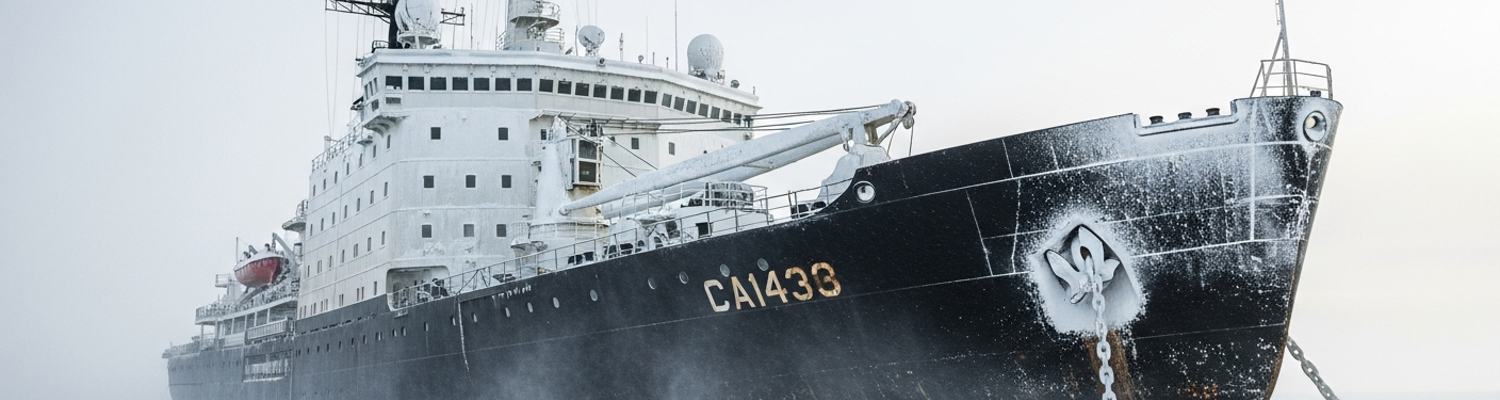
The unit's very existence was a secret. Assembled in late 1960 under the codename Operation Cold Fence, the Arctic Interdiction Group was a specialized, purpose-built tool for a very specific task. Its composition reflected this. The core was the Coast Guard's heavy icebreaker USCGC Northwind (WAGB-282), one of the few vessels in the American inventory capable of sustained operations in polar ice. It was supported by two ice-strengthened Dealey-class destroyer escorts, USS Glover (DE-1098) and USS Sample (DE-1048), chosen for their endurance and relatively simple, reliable engineering plants.
Their mission was to establish and enforce a naval embargo in the Kolyma Passage. The objective, based on fragmented intelligence, was to prevent the Soviet Union from using a suspected late-winter channel to resupply a clandestine outpost on a disputed island. The AIG was to deploy, confirm the route's existence, and interdict any Soviet naval or transport vessels attempting to use it.
The deployment plan was aggressive. The group departed from Adak, Alaska, in late February 1961, maintaining strict radio silence. Their route took them on a sweeping arc through the Bering Strait and into the Chukchi Sea, timing their arrival at the Kolyma Passage for the period of maximum ice instability.
This is where the first, critical error was made. Planners in Norfolk and Washington viewed the operational area as a blank space, a featureless white void on the map defined only by longitude, latitude, and ice concentration charts. They completely failed to account for its human geography. The AIG's patrol box was drawn directly over the centuries-old transit routes used by Yupik hunters. The mission plan contained no mention of indigenous populations, no procedures for contact, and no contingency for civilian interaction. From the moment the AIG entered the Arctic, it was sailing toward a disaster of its own making.
Foundational Intelligence Failure
The ultimate cause of the Kolyma Passage incident was not a single equipment failure or a bad command decision. A close review of the operational planning documents reveals the entire mission was built on a foundation of deeply flawed intelligence.
First, the environmental assessment was wrong. Naval Oceanographic Office forecasts predicted a standard season of first-year pack ice, which the Northwind could handle with relative ease. They failed to predict the anomalous cold snap that resulted in the widespread presence of much harder, more dangerous multi-year ice. The pressure ridges that crippled the Glover were not on their charts. The sustained blizzards that grounded all potential air support were dismissed as a low-probability risk.
Second, the assessment of American capabilities was overly optimistic. The ice-strengthening modifications made to the frigates were insufficient for the conditions they actually encountered. The experimental sonar array on the Northwind had never been tested in a high-contact ice field. The technology was not ready. The mission's planners pushed the ships and their systems past their known design limits.
The most significant error was the complete absence of human intelligence. There was no understanding of the region's inhabitants. The concept of established, seasonal hunting routes was entirely foreign to the planners. The operational area was treated as an empty battlefield, a void to be contested by state actors. This oversight turned a naval operation into a humanitarian crisis. The presence of the hunters was not a surprise that could have been avoided; it was a certainty that was simply ignored. The fourteen deaths and the subsequent rescue mission were not an unforeseen accident, but a direct consequence of this initial, foundational failure in intelligence.