
Ongjin Peninsula Interdiction Aftermath
Forty eight hours without hot rations had degraded the crews before their craft slipped into the chop off Haeju Bay. Infantry detachments assigned to reinforce coastal patrols had spent two days marching across rutted dirt tracks south of the 38th parallel. They hauled field gear and heavy ammunition crates through driving rain. The rain soaked wool uniforms down to the skin. Salt sores spread across their necks and wrists. Men vomited bile as sea swells slammed the flat bottoms of their vessels against the water.
Exhaustion had already broken their operational readiness.
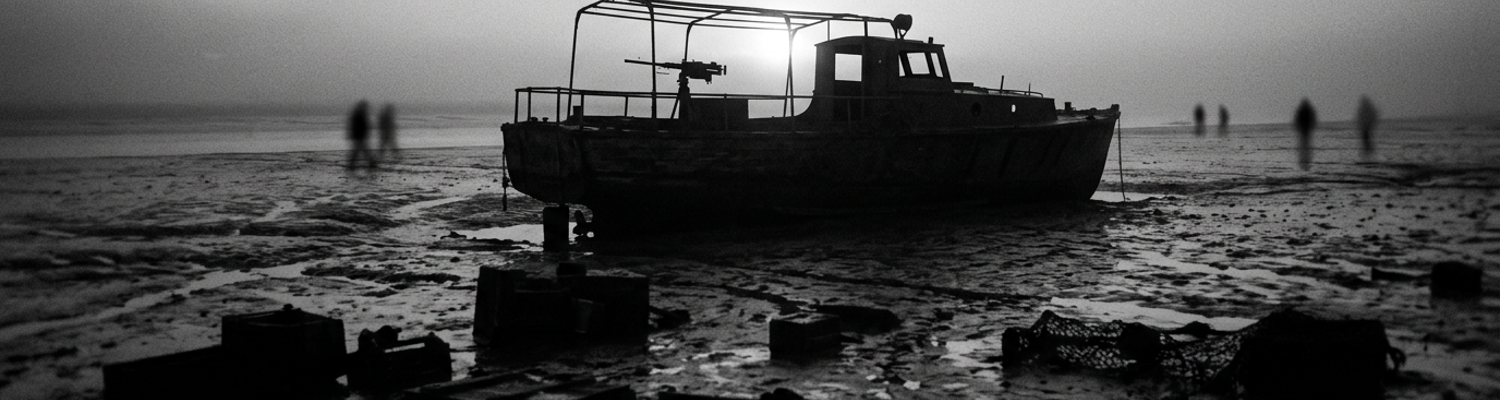
Archival evidence shows that the recovery operation began at 0240 hours. Two converted wooden picket craft drifted dead in the water south of the Ongjin coastline. Assigned to intercept northern contraband junks slipping across the maritime boundary line, the patrol element had botched the midnight ambush. The lead vessel ran hard onto an uncharted granite shelf near Taedong Bay. Screws sheared off instantly. Hull timbers splintered along the keel. Freezing brine entered the forward bilge before crewmen could deploy collision mats.
The second vessel fouled its rudder on submerged wooden fishing stakes.
It attempted to pass a towline in pitch darkness. This left both craft wallowing helplessly as the ebbing tide drained out of the shallows. Local salvage sampans and an auxiliary yard tug spent nearly four hours securing steel wire hawsers around the damaged hulls. They dragged the battered craft backward off the rocks under the imminent threat of northern shore battery fire.
The receding sea left them defenseless.
A close review of operational logs indicates that the first after action reports were compiled inside an unheated port warehouse at Incheon Pier 2 at 0415 hours. Technical officers scribbled on damp mimeograph sheets by the light of gasoline lanterns. They documented widespread radio silence and equipment breakdowns. Tactical SCR 300 radio sets had cut out entirely within thirty minutes of departure. Salt encrustation shorted the antenna bases. Heavy coastal humidity ruined the dry cell batteries. Mechanical failures were equally severe across the entire patrol section. Raw water intake strainers on the converted marine engines had ingested heavy concentrations of suspended bottom sediment. This blocked cooling passages. Cast iron blocks seized from overheating.
Mechanics counted six disabled engines by dawn.
Each was fouled with silt and stripped of water pump impellers. The immediate post mission debriefings lacked any strategic overview. Officers focused entirely on cataloging the destroyed hardware. Supply clerks tallied the lost carbines and ruined radio handsets. They noted that the saltwater immersion had rendered the weapons completely inoperable. The infantrymen sat on wooden crates in the warehouse. They stripped off their wet boots and attempted to restore circulation to their feet. Medical personnel arrived at 0530 hours to evaluate the crews.
They diagnosed twelve cases of severe hypothermia.
The medical logs recorded that standard issue wool blankets provided insufficient insulation against the damp cold. Quartermaster detachments had failed to issue waterproof gear before the patrol. This administrative oversight directly caused the high casualty rate from environmental exposure. The officers in charge of the debriefing submitted their preliminary findings to the United States Army Military Government in Korea headquarters in Seoul. Their report detailed the complete failure of the interception attempt. It emphasized the unsuitability of the current patrol craft for shallow water operations.
The report was filed under designation USAMGIK 46 112 (NARA Record Group 338, Box 412).
The file contained sixty two pages of typed mechanical failure logs. It included hand drawn diagrams of the shattered hull timbers. The inspecting officers noted that the fir planks had splintered longitudinally along the grain. This indicated a complete structural failure of the keel assembly upon impact with the granite shelf. The salvage operation had further stressed the remaining intact frames. The steel wire hawsers had cut deeply into the softened wood during the towing process.
Mediterranean Contraband Doctrine in Korean Littorals
Administrators inside the USAMGIK Department of Transportation relied on obsolete European operational handbooks when organizing naval security patrols along the 38th parallel littoral zone. Bureau of Marine Transportation planners instituted Standard Operating Procedure 14 without adjusting for regional hydrology. These tactical instructions mandated high speed intercept vectors and paired craft search formations. They included rigid boarding protocols originally drafted to capture Italian coastal lighters across the Tyrrhenian Sea. Staff assumed coastal security could loiter three to five miles offshore in converted 63 foot aircraft rescue boats and wood hulled 83 foot cutters. They planned to vector motorized boarding launches toward target vessels across predictable water tables.
Under these European boarding doctrines, search teams were ordered to run alongside suspect craft at three knots.
They were expected to secure grappling hooks over low gunwales before sending six man teams armed with carbines directly into target holds. Staff officers treated the mud choked archipelagoes of the Yellow Sea as if they were charting the volcanic drop offs of the Gulf of Salerno. Theater mandates forced detached Army infantry units into hazardous maritime interdiction roles without adequate training. XXIV Corps directives compelled company grade elements of the 7th Infantry Division to suppress extensive black market shipping networks operating across the maritime boundary. Detachments drawn from Company B and Company C of the 31st Infantry Regiment stationed in Incheon received these orders.
Northern and southern syndicates moved coordinated shipments of northern ammonium sulfate fertilizer and refined motor kerosene.
They also transported scrap brass and raw tungsten past military checkpoints at night. Soldiers were shoved aboard commandeered Japanese wood hull tugs and thirty six foot LCVP landing craft. They were forced to patrol jagged coastal channels in rough seas. Infantry personnel lacked maritime search training and boarding ladders. They had no translators capable of deciphering commercial manifests written in mixed Hanja script. Salt encrustation quickly corroded receiver mechanisms on standard issue M1 Garand rifles. It jammed water cooled Browning machine guns mounted on makeshift pipe tripods.
Riflemen slipped repeatedly into freezing harbor chop.
The 31st Infantry Regiment had arrived in Korea equipped for standard ground combat. Their supply manifests listed M1 Garand rifles, M1 carbines, and Browning Automatic Rifles. None of these weapons were treated with maritime anti corrosion compounds. The salt air oxidized the parkerized finishes within forty eight hours. Operating rods on the M1 Garands seized inside their gas cylinders. The wooden stocks swelled from the constant moisture. This altered the zero of the weapons and made them difficult to handle in close quarters. The soldiers attempted to improvise waterproof covers using shelter halves and canvas tarpaulins. The freezing spray penetrated these makeshift barriers easily.
The operational mismatch between Mediterranean deep water tactics and Yellow Sea macro tidal regimes produced immediate mechanical disasters.
Mediterranean operational doctrine assumed reliable 200 fathom operating depths and clear water. It expected tidal fluctuations that rarely exceeded twelve inches throughout an entire lunar cycle. Along the Korean coast near Ganghwa Island and the Yesong River mouth, Allied patrols encountered thirty two foot macro tidal swings. These reversed with violent eight knot currents.
Ebbing waters drained over two miles of coastal channels in less than eighty minutes.
This exposed sprawling mudflats that immobilized deep draft military hulls. Smugglers operated flat bottomed wooden sampans steered by sculling oars. They slid over surface slicks in mere inches of water to slip over the boundary line. Chasing patrol craft slammed hard into uncharted silt bars. These vessels were powered by Hall Scott Invader gasoline engines and Gray Marine diesels drawing over four feet of draft. Raw water intake scoops ingested high concentrations of suspended bottom sediment. This stripped water pump impellers and baked fine river clay into internal cooling jackets within minutes.
At 0515 hours, four patrol craft sat stranded completely upright on dry mud banks off Kyodong Island.
Their cooling systems were ruined. Their drive shafts were bent out of alignment. The crews had to wait twelve hours for the next high tide to float them free. During this time, they were exposed to freezing winds and potential hostile fire from the northern shore. The Mediterranean doctrine had proven completely incompatible with the local geography.
Incheon Quartermaster Winter Depot Ledger Deficiencies
Supply ledgers maintained at the Incheon Quartermaster Depot throughout the winter of 1946 to 1947 recorded an absolute exhaustion of low temperature engine lubricants across all maritime sectors. Base logistics personnel had requisitioned standard high viscosity SAE 30 and SAE 50 mineral oils from surplus Pacific stockpiles in Manila and Subic Bay. They expected mild maritime conditions along the mid peninsula. Sub zero temperatures dropping below five degrees Fahrenheit congealed these heavy oils into unpumpable paste inside cold crankcases and oil galleries.
Mechanics attempting to crank Gray Marine 6 71 diesels and Chrysler Crown marine engines stripped starter motor pinions.
They sheared drive splines and burned out 24 volt electrical starters. Depot repair teams lacked chemical thinners or zero pour point Arctic synthetic blends. This forced them to position open charcoal braziers and gasoline blowtorches directly beneath aluminum oil pans to heat the solidified lubricant. Crankcase vapors ignited during three separate pre heating attempts at Pier 3. This destroyed two motorized repair barges and sixty lead acid battery banks. Requisitions submitted to the Eighth Army supply center in Yokohama for Arctic grade petroleum went unfilled for ninety six consecutive days.
This grounded critical patrol elements at their berths.
Depot storehouses held fourteen thousand drums of heavy petroleum formulated strictly for equatorial operations. Sub zero seawater conditions in Incheon harbor caused catastrophic mechanical breakdowns across active coastal picket craft. Surface water temperatures in the harbor dropped to twenty eight degrees Fahrenheit. This turned raw water cooling circuits into solid ice plugs during low speed interdiction patrols along the outer approaches. Suspended silt and ice crystals packed tightly into raw water intake strainers.
This starved engine heat exchangers and warped cast iron cylinder heads on converted 36 foot LCVPs and 63 foot rescue craft.
Copper cooling pipes split lengthwise along their brazed seams when trapped seawater expanded during dead in the water boardings. This dumped corrosive brine into internal bilges as soon as engines restarted. Rubber impregnated canvas drive belts lost all frictional grip against drive pulleys. They were hardened by freezing spray and continuous exposure to sub zero winds. Belts snapped within seconds of throttles being pushed forward to intercept northern junk traffic. This disabled circulating water pumps and generators simultaneously.
Machinists stationed at the Wolmido repair slips recorded thirty eight cracked engine blocks.
They noted seventy four severed auxiliary drive belts between December 1946 and January 1947 alone. This reduced the available patrol fleet by sixty percent. Ice sheared the water pump impellers before patrol craft could clear the harbor breakwater. Operational documents show that boarding parties conducted winter interdiction missions without adequate wet weather protective clothing. Soldiers detached from Company C of the 31st Infantry Regiment manned open deck wooden launches. They wore standard cotton herringbone twill work trousers and water permeable M 1943 field jackets over standard wool flannel shirts.
Quartermaster supply points in Incheon held no inventory of waterproof foul weather oilskins.
They lacked rubberized deck parkas and insulated maritime boots. Freezing spray continuously broke over low gunwales in eight foot swells. This soaked uniforms that stiffened into rigid sheets of ice within fifteen minutes of exposure to thirty knot winds. Wool gloves saturated with brine froze directly to cold weapon receivers. This stripped skin from soldiers fingers whenever riflemen pulled charging handles on M1 Garands. Standard issue leather combat boots became waterlogged and froze rigid.
Dozens of men slipped off ice glazed gunwales into freezing water while attempting to clamber aboard intercepted junks.
The medical logs at Pier 2 (Document ID: MED-47-09) documented ninety one cases of third degree frostbite. They recorded severe trench foot and systemic hypothermia among coastal patrol personnel before the end of January 1947. The depot ledgers reflected a complete disconnect between the requisitioned materials and the environmental conditions of the Yellow Sea winter. Quartermaster officers at the Bupyeong storage yards attempted to source local cold weather gear. They contacted civilian textile mills in Seoul. The mills lacked the raw materials to produce heavy wool or rubberized canvas. The occupation forces were left reliant on the frozen supply lines stretching back to Japan.
Operational Autopsy of Maritime Quarantine Mandates
Army inspectors visiting the port of Incheon uncovered an unbridgeable operational gap between theater level sanitary directives and physical supply stocks. General Douglas MacArthur had issued sweeping maritime quarantine mandates from his Far East Command in Tokyo. These orders aimed to stop cholera and epidemic typhus outbreaks along the Yellow Sea coast. Every watercraft crossing the 38th parallel was ordered to undergo complete pesticide dusting and sulfur fumigation. The mandates also required a mandatory five day offshore detention.
Inspector General teams dispatched by XXIV Corps found that local quartermaster facilities possessed almost none of the required equipment.
Warehouses at the Incheon supply depot and the nearby Bupyeong storage yards held zero mechanical pesticide sprayers. They contained no chloropicrin canisters and zero functional sulfur burning pots. Quartermasters had stockpiled forty four tons of dry calcium hypochlorite bleach in unventilated wooden sheds at Pier 1. Humid sea air penetrated rusted steel drums and converted the chemical into inert rock. Medics assigned to boarding parties had to dilute veterinary carbolic acid with icy bay water in five gallon paint cans. They applied the corrosive mixture to wooden hulls with handheld deck brushes.
Paper directives issued from Tokyo outpaced chemical stocks in Korea by five months.
Exhaustive maintenance audits conducted across the Incheon tidal basin cataloged a near total collapse of the harbor patrol craft. Technical evaluation teams examined forty nine requisitioned Japanese and Korean wooden launches tied along the Wolmido boat slips. They found only eight vessels capable of clearing the outer breakwater under their own engine power. Teredo naval shipworms (Teredo navalis) had tunneled through untreated fir strakes below the waterlines. This softened hull timbers until oak frames cracked under ordinary docking impacts. Salt encrustation and hull strain had worked horsehair and tar caulking free from the seams.
This allowed water to flood forward bilge wells at rates exceeding five gallons per minute.
Mechanics attempting to pump out the holds discovered that the brass bilge pumps had seized. They had ingested coal dust and harbor mud. Replacement diaphragms were entirely absent from depot shelves. The supply catalog (Quartermaster Form 41) listed the diaphragms as backordered since October 1945. Twisted propeller shafts and stripped transmission gears forced auditors to classify forty one patrol boats as scrap timber before year end. Split garboard planks rendered the remaining vessels structurally unsound.
Rotting fir hulls sat immobilized across the low tide mudflats.
Official testimony preserved from military government inquiries details a state of crippling administrative inertia between Far East Command and regional occupation detachments. Officers from the USAMGIK Department of Transportation testified under oath that requisition chits for boat parts were systematically discarded by staff planners in Japan. Tokyo logistics coordinators categorized maritime interdiction in the Yellow Sea as an internal civil policing matter. They ruled that coastal patrol units had to purchase lumber and bronze fasteners using local Korean currency on commercial civilian markets. Marine replacement engines were subject to the same procurement restrictions.
Field commanders in Seoul argued that decades of colonial exploitation and wartime bombing had left Korean industry without functional foundries.
The region lacked copper wire and dry docks. Priority transport allocations went entirely to occupation forces in Honshu and Kyushu. This stranded XXIV Corps requests in administrative dead ends for months. Requisition 46 B 1088 requested forty marine engine rebuild kits and two thousand feet of cured white oak planking. It passed through nineteen separate military government offices over 132 days. Theater headquarters in Tokyo returned the file without action.
Structural Revisions to Early Cold War Littoral Patrols
XXIV Corps logistics officers in Bupyeong drafted priority emergency requisitions to bypass standard Far East Command supply channels by late January 1947. Dispatched directly to the Army Port of Embarkation in San Francisco and the Eighth Army depot in Yokohama, these manifest requests demanded specialized sub zero maritime service kits. Staff cataloged urgent requirements for closed loop freshwater heat exchangers and thermostatically controlled immersion heaters. They requested low pour point sub zero synthetic oils to replace the congealed SAE 50 lubricants. The heavy oils had cracked dozens of Gray Marine 6 71 engine blocks.
Simultaneously, technical evaluators demanded the complete substitution of existing patrol assets.
The deep draft 63 foot wooden aircraft rescue hulls and 83 foot patrol cutters were deemed mechanically unviable inside the Yellow Sea tidal basin. They drew up to five feet of water. In their place, operational commanders requisitioned sixty flat bottomed plywood assault craft and shallow draft utility hulls. These were engineered to draft less than twenty two inches of water at full load displacement. Mechanics planned to fit these modified hulls with enclosed surface keel coolers. This would prevent mud and suspended silt from entering internal water jackets.
Heavy displacement hulls had proved useless against thirty foot tides.
XXIV Corps issued Tactical Instruction 4 A on January 18. This order ended all unsupportable nighttime boat patrols across the Haeju Bight and the southern Ongjin approaches. Deep water interception doctrine was abandoned in favor of static shore based surveillance networks. These were positioned along the mainland headlands and elevated promontories on Kyodong and Ganghwa Islands. Military government engineers set up fortified observation posts at coordinates 37 degrees 48 minutes North, 126 degrees 16 minutes East. They anchored high magnification Japanese 20x120 naval spotting binoculars and long range optical rangefinders directly into concrete foundation blocks.
Battery powered carbon arc searchlights and SCR 284 radio sets linked these coastal lookouts directly to artillery observation posts inland.
The equipment was protected from sea salt fog by greased canvas jackets. Infantry squads no longer blind searched shallow coastal waters in freezing darkness. Spotters logged northern skiffs traversing boundary mudflats from clifftop perches. They relayed azimuth bearings by land line telephone back to harbor picket stations. Intercept launches stayed tied to Wolmido wharves with engines preheated. They deployed into navigation channels only after land based spotters confirmed a target position and speed.
Clifftop telephone lines replaced nocturnal boat sweeps.
Administrative dockets show that American military authorities accelerated the complete transfer of coastal interdiction duties to the fledgling South Korean Coast Guard. XXIV Corps officers recognized that soldiers from the 31st Infantry Regiment could not navigate the macro tidal channels. This forced the Department of Transportation to hand over interdiction responsibilities to Korean personnel operating under Lieutenant Commander Sohn Won yil. South Korean crews possessed intimate knowledge of regional bathymetry. They understood the seasonal ice packs and tidal currents.
They were drawn from merchant marine academies and local sailing syndicates.
Beginning in February 1947, US authorities transferred twelve salvaged Japanese wooden picket launches to the newly designated Coast Guard base at Incheon Pier 1. They also provided four auxiliary motor minesweepers and stockpiles of captured 7.7mm machine guns. Korean crews stripped the failed American raw water intake scoops. They reinstalled local copper pipe assemblies and manual bilge sweeps that functioned without electrical power. On March 3, 1947, American infantry detachments stood down entirely from waterborne interdiction along the maritime demarcation line. They handed all tactical control of harbor boardings and shoal sweeps to South Korean maritime units. The transfer documents (Transfer Order 47-C) listed the exact inventory handed over to Lieutenant Commander Sohn Won yil. The list included the twelve modified launches and the four minesweepers. It also detailed the transfer of three hundred captured Arisaka rifles and fifty cases of 7.7mm ammunition. The American personnel returned to their barracks in Incheon. They relinquished all harbor patrol duties at 1800 hours.