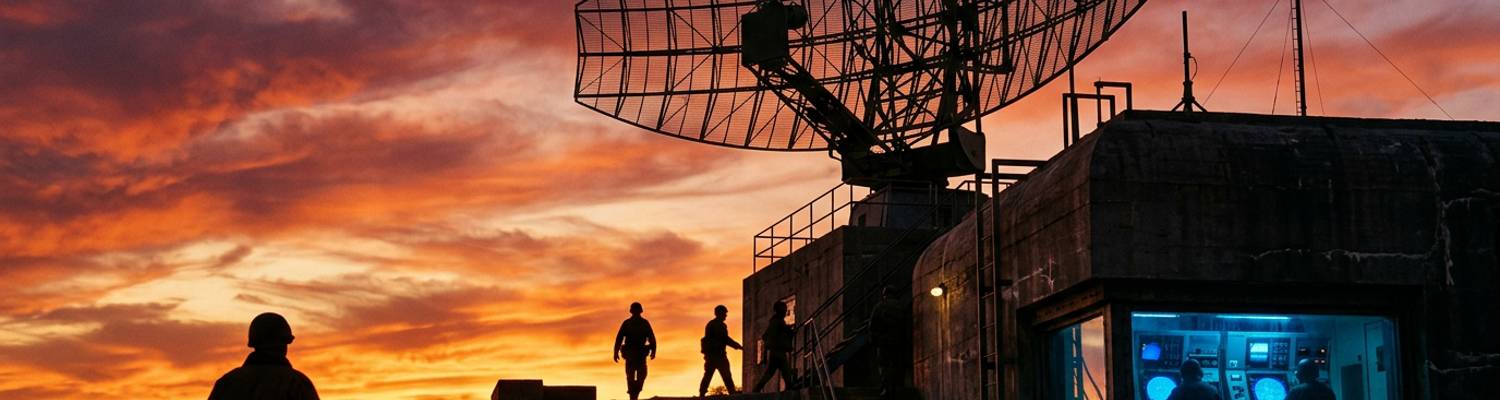

Strategic Standoff Over the Sary Shagan Range
Oscilloscope screens flashed an erratic cluster of signal spikes across the reconnaissance station. The sensor operator saw that a critical receiver bank had begun to overheat and desynchronize. Staff Sergeant Miller flagged the mission commander over the internal flight intercom to report that the primary signal processor was losing its frequency lock on the target sector. Tactical officers in the cabin faced an urgent choice between aborting the intelligence sortie or running the electronics until they burned out. The mission commander ordered the technical crew to hold the orbit and open the maintenance access panels while instructing the cockpit pilots to maintain a steady altitude along the perimeter. Missing this collection window would leave American defense analysts blind to high-priority Soviet missile developments taking place deep within the arid basin of Lake Balkhash.
Lake Balkhash basin activity required constant monitoring from the edge of Soviet airspace. Strategic Air Command positioned RC-135V/W Rivet Joint and RC-135S Cobra Ball reconnaissance aircraft on standoff flight tracks along peripheral airspace near Soviet Central Asia to capture those exact weapons signatures. These heavily modified jet transports flew long, grueling patrols over international airspace, relying on banks of sensitive electronic sensors to record Soviet military transmissions from hundreds of miles away. High internal heat loads constantly threatened the delicate vacuum tubes, circuit boards, and tape drives packed tightly inside the converted fuselage. Cooling blowers struggled against the rising temperatures inside the lower equipment racks, filling the workspace with the smell of scorched wire coating. A blown transformer inside the signal distribution rack now threatened to silence the very receivers tasked with mapping the new Soviet phased-array radars before the Soviet test launch could occur.
Receivers required immediate repair to capture the impending radar emissions. Technicians scrambled into the cramped equipment aisle and unbolted aluminum casing covers to pull the smoking junction box from its rack. Flight maintenance specialists stripped away thermal insulation tape with pocket knives, discovering that intense electrical current had melted the primary relay contacts inside the power inverter. Spare factory components were stored thousands of miles away at home bases, leaving the crew with no replacement modules for the fried hardware. The lead avionics technician grabbed a spool of copper patch wire and a pair of insulated alligator clips to bypass the melted relay entirely. Soldering irons shook in crewmen hands as clear-air turbulence buffeted the aircraft along the international boundary track.
Turbulence made the delicate repair work extremely difficult. Solder smoke filled the narrow corridor between the electronics racks as the technician clamped the spliced wires onto the receiver terminal lugs. Power surged back through the receiver conduits, illuminating the row of amber and green channel lights across the operator console with only minutes to spare. Intercept operators re-engaged the magnetic tape recorders and fine-tuned their radio frequency monitors across the radar bands directed at the Sary Shagan test complex. Raw electronic telemetry began spilling across the green displays, confirming that the makeshift bypass handled the electrical load required to record the incoming Soviet tracking transmissions. The mission director instructed the pilots to execute another racetrack turn along the patrol line to keep the collection antennas aligned squarely toward the remote Soviet testing ground.
Sensor Architectures and Inflight Signal Interception
Antennas mounted inside the fuselage cheek fairings locked their beam patterns onto the horizon as the RC-135 completed its banking turn toward the desert basin. Specialized superheterodyne receivers and cryogenically cooled radio frequency tuners were tuned to harvest Soviet millimeter-wave tracking emissions radiating from radar sites near Lake Balkhash. Engine vibrations along the patrol line loosened a threaded brass connector on the liquid nitrogen distribution manifold, draining coolant away from the tuner chassis. Technicians dropped onto the cabin floor with an adjustable wrench and Teflon sealant tape to stem the escaping gas before receiver sensitivity degraded. Staff Sergeant Miller wrapped the leaking junction with sealing tape and torqued the retention nut firmly against the equipment rack frame. Pressure gauges on the cryogenic control panel stabilized at their proper operating markers, allowing the chilled tuners to process the incoming radar emissions without thermal noise distortion.
Tuners regained their operational efficiency as the temperature dropped. Coolant circulated steadily through the vacuum-jacketed lines, restoring the superheterodyne converters to their peak reception threshold. Crews relied on high-density multi-track analog magnetic tape drives to record ultra-dense pulse trains, radio frequency modulations, and pulse repetition intervals. Friction inside the primary recorder suddenly stalled the motorized capstan, threatening to stretch and ruin the thin magnetic tape stock as the telemetry flooded in. Airborne technicians dismantled the front faceplate of the transport assembly to inspect the binding drive belt and gummed roller bearings, scrubbing the drive pulleys clean with cotton swabs dipped in alcohol. Miller guided the delicate recording ribbon back through the magnetic pickup heads and engaged the tension rollers to resume tracking.
Tracking resumed as the steel drive reels spun smoothly across the recorder face. The mechanism drew the magnetic tape over fourteen active channels at one hundred twenty inches per second, registering the incoming pulse trains on oscilloscope screens as tall, synchronized green spikes that matched the predicted frequencies of the new Soviet tracking arrays. Rising heat from the closely packed amplifier modules soon caused individual signal channels to drift off their baseline calibrations. Technicians uncoupled a flexible canvas air hose from an overhead ventilation duct and secured it over the overheated amplifier housing with aluminum foil tape. Cold cabin air rushed directly across the electronic circuits, driving internal chassis temperatures down within safe operating limits. Intercept operators watched the drifting signal baselines snap back into alignment on their monitoring scopes, confirming that all fourteen recording channels were capturing clean data.
Data collection required constant vigilance from the electronic warfare officers. Operators worked the manual tuner controls to track subtle shifts in the target radar pulse repetition intervals as Soviet ground crews stepped up their transmission power. Copper patch cables rigged earlier in the flight held firm under the steady electrical load, feeding stable power into the demodulation units without sparking or dropping voltage. Electronic warfare officers marked the precise start and stop points of each transmission block on their physical log sheets while cross-checking the audio tones through their headsets. Tape counter wheels ticked past thousands of feet of magnetic tape as the collection bank absorbed the full electronic profile of the Soviet millimeter-wave tracking radar. Mission supervisors verified that the improvised repairs had preserved the entire signal intercept without losing a single data channel, radioing the cockpit crew to lock in the heading for the next collection orbit.
Sub-Zero Cabins and Sensor Cooling Loop Failures
Orbits at high altitudes exposed the aircraft to extreme environmental conditions. Pilots swung the modified airframe onto the high-altitude collection heading, leveling the wings as outside air temperatures plunged past fifty degrees below zero. Extended standoff orbits at high altitudes caused interior avionics bay temperatures to plummet, developing thermal stress and brittle fractures across plumbing lines. Thick frost coated the uninsulated aluminum ribs and stringers behind the main receiver racks, turning rubber seals brittle and causing dissimilar metals to shrink at different rates. Severe cold soaked through the skin panels and structural ribs, overcoming the electric heaters mounted along the lower equipment deck. Thin stainless steel coolant tubes feeding the forward receiver chassis snapped near a rigid bulkhead bracket under the intense cold, spraying white clouds of vaporized gas from the fractured line into the lower equipment bay and venting system pressure to zero.
Gauges on the environmental monitoring console bottomed out instantly. The escaping gas was draining the entire liquid nitrogen supply into the unpressurized aircraft belly, forcing Air Force electronic warfare officers to execute emergency inflight pressure bleeds and bypass cracked liquid nitrogen cooling lines to keep high-frequency sensors from overheating. Staff Sergeant Miller grabbed a portable pressure-relief wrench and crawled into the freezing access space beneath the floor to vent the line before back-pressure could rupture the primary storage container. Escaping vapor hissed out through the opened release ports as crew members dumped high-pressure gas through an auxiliary exhaust port in the aircraft skin. Technicians clamped an insulated flexible bypass hose around the fractured metal segment, tightening double worm-drive screw clamps to redirect the remaining coolant directly into the tuner core. Frost bit into their heavy leather gloves as they worked in the dark crawlway to seat the bypass line into place.
Placement of the bypass line restored the critical thermal management system. Nitrogen coolant flowed through the makeshift rubber bypass line, chilling the receiver baseplates moments before internal safety switches tripped the power. Needles on the temperature gauges swung back into their normal green zones as the steady flow of chilled liquid stopped the heat buildup inside the chassis. Intercept operators re-engaged the main receiver switches, watching the green traces on their signal analyzers steady as electrical noise inside the circuits dropped away. Clear telemetry pulses from the Soviet radar installation returned to the cathode-ray tubes, confirming that the high-frequency tuners were processing raw millimeter-wave tracking emissions without distortion. Flight engineers adjusted the primary environmental control valves, sending auxiliary heating through lower vents to stop the ambient air around the electronics racks from freezing over completely.
Temperatures inside the equipment bay slowly receded. Ducts along the cabin floor discharged warm engine bleed air into the lower electronics bay, stabilizing the compartment temperature and preventing the patched plumbing joints from contracting again. Maintenance specialists inspected the bypass clamps every five minutes with heavy-duty flashlights, feeling along the braided line for frost buildup or fresh hairline cracks. Intercept operators leaned over their control dials, logging frequency changes as Soviet radar crews at the Sary Shagan test center transmitted another pulse group across the arid desert basin. Magnetic tape reels continued spinning across all fourteen collection tracks, pulling thousands of feet of recording ribbon over the magnetized heads without dropping signal data. Mission controllers recorded the stabilized coolant levels in the official flight log, keeping the reconnaissance jet firmly on station as the Soviet missile test window approached.
Improvised Mechanical Repairs on Magnetic Tape Transports
Radar transmitters at the Sary Shagan test complex surged to full operational power. Dense bursts of tracking pulses traveled toward the peripheral patrol route just as the collection orbit stabilized, prompting electronic intelligence systems inside the RC-135 to route the incoming radio frequency telemetry directly into the high-density analog tape banks to preserve the pulse shapes. Crews manually adjusted capstan motors, tension arms, and guide rollers to prevent tape stretching and jamming during continuous collection of Soviet tracking radars. Staff Sergeant Miller hovered over the main recording deck with a handheld adjustment tool, fine-tuning the spring tension on each swinging arm as the reels pulled hundreds of feet of magnetic ribbon past the recording heads every minute. Sudden mechanical stress rippled through the transport chassis when the reconnaissance jet plunged into a violent pocket of clear-air turbulence at high altitude. The severe jolt knocked Miller against the equipment rack, throwing the spinning reels off their rotational balance and snapping the fast-moving magnetic tape across the center transport guide.
Guides and rollers scattered loose tape fragments across the recording deck. Tape fragments whipped violently around the motorized capstan until Miller slammed the emergency drive cutoff button to stop the spools. Reconnaissance technicians performed delicate tape splices using razor blades and isopropyl wipes inside freezing cabins while navigating severe clear-air turbulence. Miller stabilized his arms against the vibrating equipment frame, using small steel clamps to lock both severed ends onto an aluminum splicing block. Sub-zero drafts from the lower airframe chilled the cabin air, making his bare fingers stiff and clumsy as he carefully cleaned the broken tape edges with isopropyl wipes to remove dust and oil deposits. A single clean stroke of a razor blade squared the torn ends at a precise forty-five-degree angle without nicking the microscopic oxide layer, allowing Miller to press a strip of specialized adhesive backing across the seam to join the severed halves together before the loose ribbon could wrap around the internal drive belts.
Belts and pulleys engaged as technicians threaded the spliced ribbon back through the roller assembly. Capstan drive motors groaned under the strain as electrical power returned to the transport bay, struggling against the synthetic grease inside the drive bearings that bitter cold had hardened. Technicians loosened the motor mounting bolts with an Allen wrench, adjusting the drive alignment by hand while checking the tape speed against an internal electronic strobe light. Tension arms required repeated manual adjustments to keep the fragile mylar ribbon centered between the polished guide rollers as the aircraft continued to shake in the rough air. Miller monitored the spinning hubs until the drive mechanism achieved a steady velocity of one hundred twenty inches per second, allowing the magnetic ribbon to glide smoothly over the pickup heads without binding. Tape counters resumed their forward spin across all channels, confirming that the repaired transport resumed recording the active radar tracking emissions coming out of the Sary Shagan test range.
Range telemetry flooded back into the recording system. Oscilloscope displays immediately registered the incoming telemetry streams, showing solid pulse traces across every active channel of the multi-track system. Intercept operators tracked the shifting pulse repetition frequencies of the Soviet radar installations, confirming that the spliced tape captured clean telemetry without dropouts or magnetic phase errors. Technicians stayed stationed on the freezing cabin floor beside the recorder rack, periodically wiping frost off the metal transport faceplates with dry cotton rags to stop ice crystals from contaminating the tape path. Flight engineers continued to monitor cabin environmental readings while keeping a close watch on the mechanical tension arms to catch any fresh drag on the drive motors. Mission commanders confirmed that the recording bank was operating at full capacity, directing the flight crew to maintain the collection orbit across the high-altitude patrol track.
Analytical Fractures Over National Intelligence Estimate 11-12-80
Couriers unloaded the completed magnetic tape reels from the aircraft recording decks immediately after landing. They hand-carried the data straight into secure processing rooms where technical specialists fed the spliced analog ribbons through laboratory signal analyzers, struggling to reconcile irregular pulse trains that had suffered minor magnetic distortion during the turbulent flight. Air Force Foreign Technology Division analysts at Wright-Patterson Air Force Base directly clashed with Central Intelligence Agency analysts over telemetry data recovered from these airborne intercepts. Air Force specialists at Wright-Patterson argued that strange power spikes and sudden shifts in pulse repetition frequency proved that the Soviets were testing high-energy combat lasers against target warheads over Lake Balkhash. Central Intelligence Agency processing teams countered by pointing to the mechanical splices and thermal noise on the tape, insisting that electrical fluctuations from ground equipment could easily mimic weapon discharges. Analysts on both sides spent weeks hand-measuring individual pulse shapes with drafting calipers across miles of paper strip charts to verify the true amplitude of the Soviet signals.
Signals traced on paper highlighted sharp variations in the recorded target reflections. Calipers aligned across the paper traces showed distinct anomalies, creating a methodological rift centered on whether radar cross-section anomalies and pulse signatures signaled imminent Soviet operational directed-energy weapons or defensive tracking upgrades. Foreign Technology Division engineers insisted that sudden, sharp drops in target radar cross-sections occurred because high-powered ground beams were blinding or physically vaporizing reentry vehicle surfaces during descent. Civilian analysts at Langley re-examined the same pulse trains and demonstrated that atmospheric turbulence, ionospheric ducting, or simple radar beam jitter could produce identical signal drops. Technical teams built analog filter circuits inside their test benches to simulate the tape flutter caused by the RC-135 capstan motor, attempting to isolate aircraft mechanical noise from genuine Soviet transmitter modulations. Every filter adjustment changed the calculated power levels of the Balkhash emitters, leaving the two agencies deadlocked over the physical threat.
Threat assessments required consensus for the upcoming intelligence reports. Analysts from Wright-Patterson Air Force Base brought their signal plots directly into interagency drafting sessions to challenge the Central Intelligence Agency position on National Intelligence Estimate 11-12-80. Foreign Technology Division officers pointed to the millimeter-wave pulse signatures as direct evidence of fire-control radars linked to operational laser batteries at the Terra-3 complex. Agency representatives pushed back by presenting telemetry from past Soviet missile tests, showing that the unusual pulse intervals matched routine phased-array tracking radar modifications designed for standard anti-ballistic missile batteries. Technicians from both departments replayed the digitized tapes through oscilloscope banks late into the night, adjusting threshold voltages by fractions of a millivolt to prove their rival interpretations. Divergent signal readings forced the drafting committee to write conflicting footnotes into National Intelligence Estimate 11-12-80, recording the fundamental technical split over Soviet laser readiness.
Readiness estimates left military planners with sharply divided intelligence conclusions. Officers reading the completed estimate found conflicting Air Force and CIA assessments, forcing senior defense officials reviewing the report to face contradictory forecasts. Air Force analysts warned of an immediate laser threat to American spy satellites, while CIA analysts described conventional radar modernization. Strategic Air Command responded by ordering additional reconnaissance patrols along the Soviet Central Asian border to harvest cleaner, uncorrupted telemetry from the Balkhash radar stations. Maintenance teams at peripheral staging bases restocked their spare parts lockers with fresh cryogenic fittings, heavy-duty tape guides, and specialized patch cables for the next collection sortie. Electronic warfare officers loaded fresh reels of magnetic tape into the RC-135 recorder banks, preparing their receiver racks for another high-altitude mission over the desert test range.
Phased-Array Telemetry and Directed-Energy Ambiguities
Recorders spun the fresh reels of magnetic tape into forward motion as the RC-135 leveled out along the peripheral collection track. Intercept operators leaned over their green phosphor monitors, watching the signal traces spike with sudden, violent amplitude bursts as Soviet radar transmitters came alive across the Balkhash basin. Electronic intelligence collectors captured unusual electrical load fluctuations associated with Hen House and Pechora-class radar prototypes at the test range, as massive electromagnetic pulses radiated out from the remote test site. The energy surged through the aircraft receiver antennas and severely overloaded the front-end mixer diodes inside the main equipment rack, sounding warning buzzers across the cabin intercom as receiver bay temperatures climbed rapidly from the unexpected incoming power surge. Staff Sergeant Miller pulled a set of ceramic attenuator pads from his pocket, squeezed into the narrow gangway behind the equipment bay, and manually screwed the protective blocks into the coaxial feed lines to bleed off the excess radio frequency energy before the sensitive diodes burned out completely. Steel mounting brackets rattled against the bulkhead as Miller used an open-ended wrench to secure the heat sinks firmly against the cooling frame.
Brackets held the modified attenuator assembly in place while the receiver banks stabilized. Clean high-frequency data streams fed into the multi-track analog recording units, registering bizarre electrical signatures pulsing from the ground on the cabin displays. The giant radar emitters were drawing colossal surges of current directly from the regional Central Asian power grid, leading Foreign Technology Division specialists to interpret massive energy discharges as evidence of active ground-based laser or particle-beam anti-satellite weapon tests. Analysts on board the aircraft scrambled to determine whether these power draws were feeding beam directors aimed at American spacecraft or simply charging the enormous phased-array faces of experimental missile tracking radars. Intense electrical interference began leaking into the aircraft internal communications system, creating static hums that threatened to drown out the voice coordination between the sensor operators and the pilots. Miller grabbed a length of braided copper wire from a maintenance drawer, stripped the ends with his pocket knife, and clamped the bare strands across the receiver rack frame and an unpainted structural rib to route the static noise harmlessly into the fuselage skin.
Straps of copper grounding wire carried the crackling static charge away from the equipment chassis. The audio channels cleared immediately, sharpening the pulse images on the oscilloscope screens as intercept operators tracked each pulse train through their headsets. Every massive drop in Hen House radar signal strength coincided directly with an immense discharge of broadband electromagnetic energy across adjacent bands, showing Air Force technicians that the extreme electrical strain on the ground was causing power grids around Lake Balkhash to buckle. Transmitter frequency drift made accurate signal interception exceptionally difficult, cracking solder joints inside the primary signal demodulator under the severe thermal cycling and cutting off the audio feed to the frequency tracking bench midway through the Soviet transmission cycle. Miller wedged a pair of insulated test probes across the fractured solder bridge, holding the tiny brass contacts together with his bare fingers while an operator dialed in the tracking receivers to capture the fading telemetry. Mission directors verified that the recording reels were capturing the full modulation profile of the weapon test and ordered the flight crew to reset their frequency scanners for the next test sequence.
The Narrowing Soviet Microelectronics Gap
Scanners locked onto a new set of frequencies emanating from the Sary Shagan test range. Operators watched in disbelief as the telemetry revealed complex digital processing signatures previously thought impossible for Soviet engineering, confirming that Soviet military research and development had rapidly closed the microelectronics gap. The intercepted signals displayed rapid frequency agility and digital beam steering characteristic of advanced solid-state circuitry, allowing analysts on board the RC-135 to record distinct pulse patterns matching look-down shoot-down radars. These systems were designed to track low-flying cruise missiles and bombers through heavy ground clutter. Western intelligence estimates had projected that the Soviet Union remained at least a decade away from fielding such compact, high-speed processing capabilities. The raw data spilling onto the magnetic tapes proved those estimates completely wrong.
Tapes captured the unmistakable electronic footprint of a fully integrated, digitally controlled air defense network. The Soviet S-300P surface-to-air missile system was conducting live tracking drills against simulated low-altitude targets, allowing sensor operators to analyze the pulse repetition intervals and identify multiple simultaneous target tracking channels. This capability required advanced microprocessors and miniaturized electronic components that the Soviet defense industry had secretly mastered. The RC-135 crew documented the radar systems seamlessly handing off tracking data between different phased-array sectors without dropping the signal lock. Technicians monitored the data flow and realized the Soviet engineers had successfully reverse-engineered or independently developed high-density integrated circuits. The sheer speed of the radar beam positioning indicated a massive leap in Soviet computational power.
Power and precision defined the new Soviet radar emissions. The intercepted telemetry showed that the S-300P guidance systems could calculate intercept trajectories in milliseconds, prompting electronic warfare officers on the reconnaissance aircraft to cross-reference the incoming signals against known Soviet capabilities. They found no match in their threat libraries for the sophisticated track-via-missile guidance links they were recording, realizing the Soviet microelectronics breakthrough allowed their surface-to-air missile batteries to guide weapons with unprecedented accuracy. The RC-135 collection systems strained to process the sheer volume of digital data transmitted by the ground stations, forcing technicians to constantly adjust their receiver bandwidths to capture the wide-spectrum frequency hopping employed by the new Soviet radars. The recording reels captured definitive proof that the technological advantage held by Western air forces was rapidly evaporating.
Proof of the Soviet microelectronics advancement demanded immediate transmission to the Pentagon. Mission commanders ordered the communications officers to prepare a priority encrypted data burst, compiling the most critical segments of the intercepted telemetry into a compressed digital format. They routed the data through the secure satellite uplink, bypassing standard post-flight processing protocols to beam the encrypted transmission directly to National Security Agency listening posts and Strategic Air Command headquarters. Analysts on the ground began decoding the telemetry before the RC-135 even completed its patrol orbit, confirming the existence of advanced Soviet look-down shoot-down radars and surface-to-air missile guidance systems years ahead of Western estimates. The data burst triggered an immediate reevaluation of American strategic bomber penetration tactics.
Strategic Shock Across Pentagon Air Defense Planning
Engineers in the subterranean vaults of the Pentagon fed the recovered Sary Shagan tape reels directly into digital pulse analyzers. They deciphered the incoming radar transmissions as signal processors filtered out background atmospheric noise, revealing the precise frequency-hopping patterns and tracking telemetry generated by Soviet ground batteries. Confirmed advancements in Soviet S-300P surface-to-air missile guidance systems forced Strategic Air Command to rethink low-altitude B-52 bomber penetration routes. Laboratory readouts proved that the solid-state phased-array radar of the S-300P could lock onto targets flying beneath radar coverage while simultaneously guiding high-speed interceptor missiles through heavy ground clutter. Flight profiles that depended on masking heavy bombers behind ridgelines and hills suddenly lost their tactical value against a computerized radar that updated beam positions in fractions of a second. General Richard Ellis ordered tactical teams to recalculate radar detection thresholds for every B-52 unit assigned to the Single Integrated Operational Plan.
Teams at Strategic Air Command reviewed these revised radar detection thresholds. Planners recognized that existing electronic jamming pods could not blind the automated multi-channel guidance radars of the S-300P, as flight crews flying low-altitude test sorties over mock radar ranges reported that analog noise jammers failed to break the tracking locks of the new Soviet phased-array emitters. Electronic warfare officers reported that older analog frequency repeaters on the B-52 fleet lacked the speed required to counter digital beam steering and track-via-missile downlinks. Command staff abandoned several primary northern penetration corridors over the Soviet Arctic and relocated planned ingress lines to wider peripheral corridors over open ocean waters. Officers recalculated fuel reserves and increased the deployment of aerial refueling tankers across northern staging bases. They pushed urgent technical warnings up the chain of command to the Office of the Secretary of Defense.
Warnings reached the Office of the Secretary of Defense. Officials absorbed the technical data and diverted emergency funding into specialized defense initiatives, using the Sary Shagan intercepts to drive accelerated Pentagon budget shifts toward advanced electronic countermeasures and stealth aircraft development. Bureaucrats stripped millions of dollars away from legacy surface ship maintenance and conventional artillery accounts to channel immediate cash reserves into high-priority Air Force research accounts. Engineers at electronics manufacturers received rapid contracts to develop digital radio frequency memory pods capable of recording, altering, and returning radar pulses before Soviet engagement computers could compute a firing solution. Congressional appropriations committees met in closed session to authorize secret reprogramming requests, clearing the way for major capital commitments to secure aerospace design facilities.
Facilities at Lockheed development centers received these diverted appropriations to expand prototype testing for the Have Blue and Senior Trend stealth programs. Designers used the Sary Shagan radar pulse measurements to calculate the exact radar cross-section reductions necessary for the F-117A Nighthawk to survive inside Soviet air defense sectors. Technicians shaped faceted radar-absorbent panels and applied dielectric coatings to test airframes, designing these materials to scatter the specific frequency bands detected over Lake Balkhash. Flight test crews conducted night radar evaluation runs against simulated Soviet tracking beams at the Tonopah Test Range in Nevada. Air Force technicians adjusted the radar-absorbent tiles on prototype airframes and recorded the reflected pulse signatures to prepare the first production stealth aircraft for operational deployment.