
By 1978, the Qara-Khan mountain range was a sharpening point of geopolitical conflict. American strategic planners, according to operational logs from the period, viewed the arid, knife-edge peaks as a potential flashpoint in the contest against the Soviet Union. The range formed a porous border between a neutral, Western-leaning regional power and a new client state of Moscow. For years, the primary concern had been political subversion. Archival evidence shows this changed in the spring of 1978.
A long-range patrol from the U.S. Army’s 10th Special Forces Group, operating under clandestine orders, documented advanced Soviet survey teams deep inside neutral territory. They were accompanied by Spetsnaz elements. Satellite imagery soon confirmed the construction of hardened signals intelligence sites and meteorological stations, precursors for establishing air-control dominance. The Soviet Union’s Turkestan Military District, with its mass of armor and motor rifle divisions, sat just across the border. The intelligence assessment was grim. Moscow was preparing the ground for a potential armored thrust through the mountain passes to secure a warm-water port.
The threat in the Qara-Khan validated a doctrinal shift gaining momentum within the Pentagon. The post-Vietnam U.S. Army, under direction from the Training and Doctrine Command (TRADOC), was pivoting away from counter-insurgency and back towards high-intensity conflict with the Warsaw Pact. Doctrines like Active Defense and its successor, AirLand Battle, were developed to counter Soviet numerical superiority. AirLand Battle called for deep, violent attacks to disrupt an enemy’s rear echelons and seize the initiative. This concept was not limited to Europe. A Presidential Directive signed in August 1977 had already laid the groundwork for a new Rapid Deployment Force (RDF). The doctrine demanded that heavy American units, tanks, artillery, and mechanized infantry, arrive in a theater before a crisis could escalate.
The Ares V directive, issued in late 1978, was the operationalization of this need. It was not a weapon system but a capability requirement. The directive mandated that the Military Airlift Command (MAC) must be able to deploy a full heavy armor battalion task force from the United States to a high-altitude, unimproved airfield anywhere in the world, with wheels on the ground within 96 hours. The test case was the M60A1 main battle tank. Weighing over 50 tons, the M60 was the backbone of American armored power. Ares V stipulated that a minimum of twelve M60A1s, along with their accompanying M113 armored personnel carriers, ammunition, fuel, and maintenance crews, had to be deliverable. This presented an engineering challenge. The C-5 Galaxy, the only aircraft capable of carrying the load, faced significant performance degradation at high-altitude airfields. Its engines struggled in thin air, and its weight required landing strips with a strength that did not exist in the remote passes. The entire concept of rapid deployment hinged on solving the physics of lifting a 53-ton tank and putting it down on a dirt strip at 8,000 feet.
The Ares V directive was a concept at war with physical and bureaucratic limits. The document itself was a product of the Army’s AirLand Battle doctrine. Planners at TRADOC, focused on the vision of American armor appearing from the sky, translated this need into engineering requirements that bordered on the impossible. A review of operational logs shows the directive’s core mandate, landing a dozen M60A1 main battle tanks on an unimproved airstrip at 8,000 feet, was deeply flawed. The C-5 Galaxy's General Electric TF39 engines suffered thrust degradation in the thin, hot air of high-altitude environments, reducing payload capacity and increasing required landing distances. The C-5’s 28-wheel landing gear required a surface with a minimum California Bearing Ratio (CBR) of 9 to operate from an unimproved field. The alluvial fans and dry lake beds of the Qara-Khan mountains, composed of sand, clay, and gravel, offered CBR values as low as 2. Landing a fully loaded C-5, weighing over 300 tons, on such a surface risked the landing gear sinking and catastrophic structural failure.
These technical impossibilities fueled a bitter conflict between the services. The U.S. Air Force’s Military Airlift Command (MAC), operators of the C-5 fleet, viewed the Ares V directive as reckless. Archival evidence shows MAC leadership argued that risking their most valuable strategic airlifters on unprepared landing zones was tactically unsound. Those same aircraft were central to the primary war plan: reinforcing NATO against a Warsaw Pact invasion of Europe. The loss of even a few C-5s in a Qara-Khan operation would impair America’s ability to fight its main anticipated war. The Army saw things differently. For the architects of the new Rapid Deployment Force, Ares V was a doctrinal necessity. It was the only way to project heavy armored power into a theater without established bases and prove the global reach of AirLand Battle. The disagreement was fundamental. The Air Force saw the C-5 as a strategic asset to be preserved for the decisive battle in Europe. The Army saw it as a tactical delivery system for expeditionary warfare. The U.S. Marine Corps, with its established doctrine of amphibious assault and maritime prepositioning, largely viewed the Army’s high-risk airlift scheme with institutional skepticism.
The pressure of the 96-hour delivery timeline, combined with the directive’s top-down focus on airlift mechanics, created the plan’s most dangerous flaw. It bypassed critical ground reconnaissance. Standard procedure for any air-land operation would involve the prior insertion of a Special Forces team. Units like the 10th Special Forces Group were trained for these missions: clandestine infiltration, surveillance of proposed landing zones, conducting topographic surveys, and providing real-time intelligence on enemy presence and soil conditions. Their reports would determine if a landing was possible. The Ares V timeline rendered this methodical process obsolete. There was no time. Planners in distant command centers relied almost exclusively on satellite imagery and high-altitude photo reconnaissance. This data could show if a potential landing strip looked flat, but it could not reveal a thin crust of dry earth hiding soft mud, the load-bearing capacity of that soil, or the presence of anti-tank mines buried just beneath the surface.
The Dragon’s Tooth Pass was a geographic problem. A review of logs from the 10th Special Forces Group, which had surveyed the area a year prior, designated the primary transit route as a narrow defile at an average altitude of 8,200 feet. Flanked by knife-edge ridges and unstable scree slopes, the pass was a natural funnel. At several points, such as the choke point designated The Grinder at grid coordinate 45.67, the usable floor of the canyon narrowed to less than 25 meters. The ground itself was a hazardous mixture of alluvial gravel and fine, powdered gypsum. This abrasive dust, kicked up by the tracked vehicles of Task Force 1-68 Armor, proved to be a persistent mechanical threat. Maintenance records from the task force show a spike in failures of road wheel bearings and track pin connectors on the M60s and M113s. The Continental AVDS-1790-2 air-cooled diesel engine of the M60 tank was particularly vulnerable. Its large cooling fans pulled the abrasive dust deep into the engine bay, clogging cooling fins and leading to overheating under load. The terrain offered perfect defensive advantages to any entrenched enemy, with high ground like the Vulture’s Perch rock formation providing unobstructed observation for miles down the canyon.
Extreme and rapid thermal shifts defined the operational environment. Meteorological data from the period shows daytime temperatures on the valley floor regularly exceeding 105°F, then plummeting to near freezing after sunset. This violent temperature swing created havoc on metal components. The hydraulic seals on the M60’s turret traverse and gun elevation systems became brittle in the cold and then lost integrity in the heat, resulting in widespread fluid leaks that deadlined several tanks. The perpetual wind carried not just sand but a fine, electrostatically charged silicate dust. This dust clung to every surface and penetrated supposedly sealed equipment. It was damaging to the rotor blades of the AH-1 Cobra attack helicopters providing air cover. Maintenance logs from the supporting aviation battalion reveal that the abrasive particles eroded the leading edges of the blades, creating a distinctive glowing corona at night known as the Kopp-Etchells effect and forcing blade replacements at triple the normal rate. This same dust severely degraded the optical sights on the tanks, scratching lenses and making accurate gunnery difficult, while also infiltrating the cooling fans of the task force’s AN/VRC-46 radio sets, causing them to overheat.
Enemy harassment exploited these environmental and geographic weaknesses. The opposition, identified in intelligence summaries as Soviet-backed irregulars and Spetsnaz reconnaissance elements, avoided direct confrontation. Their strategy was attrition. Small, mobile teams armed with Soviet-made 9K111 Fagot or older 9M14 Malyutka anti-tank guided missiles used the high ground to engage the American column at maximum range. An after-action report from Charlie Company, 1-68 Armor, details a typical engagement: a single 9M111 missile, fired from a concealed position over 2,000 meters away, struck an M60A1 on its rear engine deck. The tank was not destroyed but was disabled. The disabled tank blocked the narrow pass for 18 hours while recovery crews worked under sporadic 82mm mortar fire. This single event threw the operational timeline into chaos. This pattern of hit-and-run attacks made effective counter-battery fire nearly impossible. The psychological toll of this constant threat was significant. Medical logs show a sharp increase in combat stress-related casualties. The command of Task Force 1-68 was forced to adopt a new protocol: all movement was restricted to the hours of darkness, and every advance was preceded by dismounted infantry sweeps of the high ground, slowing progress to a crawl.
U.S. Army bridging doctrine in the late 1970s reflected its strategic focus on a mechanized war in Central Europe. Field manuals from the era, such as FM 5-34, show the doctrine was built around two assets designed for prepared surfaces and protected operations. The first was the M60A1 Armored Vehicle-Launched Bridge (AVLB), a 55-ton chassis that could deploy a 60-foot scissor bridge in minutes. This system was intended to move with armored columns, rapidly crossing narrow gaps. The second asset was the Medium Girder Bridge (MGB), a man-portable, modular system that could span larger gaps but required a large engineering crew and hours to assemble on a prepared site. The entire philosophy assumed flat terrain, stable soil, and a degree of air and fire superiority.
The realities of Dragon’s Tooth Pass rendered this doctrine useless. The M60A1 AVLB was limited by its own design. Its 60-foot span was insufficient for ravines exceeding 80 to 100 feet across. The AVLB required stable, level ground on both sides of the gap to launch and rest its bridge. The steep, crumbling canyon walls offered no such purchase. Attempts to deploy the AVLB were thwarted by extreme launch angles, which exceeded the hydraulic system’s 15% operational slope limit, and soft ground that could not support the bridge’s end connectors. The heavier Medium Girder Bridge presented different problems. A standard MGB set consisted of dozens of aluminum components that had to be hand-assembled. In the high altitude of the pass, the physical performance of the engineer crews was degraded by hypoxia, turning a six-hour assembly task into a multi-day ordeal. The lack of level, open ground adjacent to the gaps meant there was often no place to lay out the components and build the bridge before pushing it across the chasm.
Every engineering effort was conducted under the threat of enemy action. Soviet-backed forces had turned the high ground into a weapon. Their tactics were not designed to destroy the American task force, but to bleed it through small cuts, with combat engineers as a primary target. An after-action report from the 652nd Engineer Battalion details the results. During an attempt to construct a Medium Girder Bridge across a 90-foot washout, the 34-man assembly party was targeted by a single 82mm mortar team hidden on a reverse slope over a mile away. The sporadic but accurate fire inflicted casualties and forced the engineers to abandon the exposed construction site. The deployment of an M60A1 AVLB to bridge a smaller ditch became a magnet for anti-tank guided missiles. The vehicle’s high, slow-moving deployment sequence made it an unmissable target. One AVLB from Charlie Company was struck by a 9K111 Fagot missile during its deployment, the resulting fire destroying the asset and blocking the main axis of advance for 36 hours. The enemy understood that by targeting the engineers, they could halt the entire armored column.
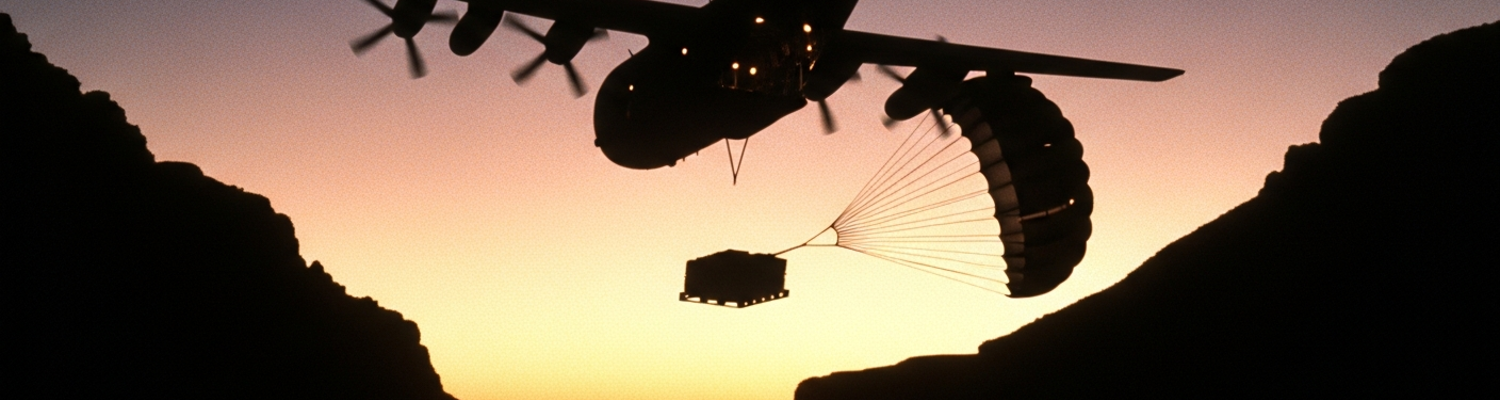
The breakdown of bridging doctrine forced a desperate improvisation. With both AVLBs and MGBs proving unworkable, engineers from the 652nd Engineer Battalion devised a plan to span the 90-foot chasm at The Grinder with a custom-fabricated structure. This required the airdrop of heavy components, specifically four 22-foot steel I-beams and prefabricated concrete abutment forms. The only delivery method was a C-130 Hercules performing a Low-Altitude Parachute Extraction System (LAPES) drop, a maneuver where the aircraft flies feet above the ground and a parachute pulls the heavy pallet out the rear cargo door. This decision shifted the operation’s center of gravity from the digital chain of command.
A review of operational logs reveals the catastrophic flaw in the plan: the incompatibility between U.S. Army and U.S. Air Force data systems of the era. The Army in the field, including the 652nd Engineers, relied on the AN/GSG-10 Tactical Fire Direction System, or TACFIRE. Developed for artillery, TACFIRE had become the de facto system for transmitting logistics requests and precise targeting information. It operated using the Military Grid Reference System (MGRS), an alphanumeric code for ground combat. The Air Force’s Military Airlift Command (MAC) planned its global sorties using a separate mainframe-based system designed for managing aircraft and cargo. MAC’s system used latitude and longitude for navigation and drop zone designation. There was no direct digital interface between the two. A request from the engineers for an airdrop at MGRS coordinate 45G YU 8534 9812, the small, flat area adjacent to the chasm, had to be relayed by voice or teletype to a liaison officer. That officer would then manually convert the MGRS coordinate to latitude and longitude before entering it into the MAC flight planning system.
This manual conversion process was a designated point of failure. Under the pressure of the Ares V timeline, the potential for a single digit to be transposed or a conversion calculation to be botched was high. The request for the bridging components was approved. A C-130H from the 317th Tactical Airlift Wing was tasked with the mission. The flight crew received their mission packet, which included the drop zone coordinates as transcribed and converted hours earlier. Flying a nap-of-the-earth profile through the treacherous valleys, the pilots had a window of only a few seconds to execute the drop. At the designated point, the aircraft slowed to 130 knots and descended to less than ten feet above the terrain. The drogue chute was released, the extraction parachutes deployed, and a multi-ton pallet containing the I-beams was ripped from the cargo bay. From the crew’s perspective, the drop was a perfect execution.
The pallet landed with pinpoint accuracy in the wrong location. It sat nearly three kilometers northeast of The Grinder, at the bottom of an inaccessible box canyon. An investigation traced the error back to a single point of data entry. During the manual MGRS to lat/long conversion at the rear-echelon command post, two numbers in the easting value had been transposed. The digital request sent by the Army was perfect. The physical execution by the Air Force was flawless. The human bridge between the two incompatible systems had failed.
The mission in Dragon’s Tooth Pass inflicted a devastating wasting of the 652nd Engineer Battalion. A review of operational logs shows the unit’s primary function devolved into a cycle of vehicle recovery. The M88 Recovery Vehicle, designed to retrieve disabled M60 tanks, became the most over-tasked asset in the task force. Its Continental AVDS-1790-2DR diesel engine was strained to its limits, with crews often rigging two M88s in tandem to winch a single 53-ton M60 that had thrown a track or sunk its hull in soft gypsum. The high altitude reduced the physical work capacity of unacclimatized soldiers by as much as 30 percent, turning the act of hauling heavy tow bars and winch cables into an exhausting ordeal. Medical records from the task force aid station show a sharp uptick in non-combat injuries among the engineers, sprains, hernias, and stress fractures, attributable to this repetitive, heavy labor.
Each recovery operation was a tactical gamble. The Spetsnaz and irregular forces understood the American column was only as fast as its slowest element. After-action reports detail a consistent pattern: an M60 tank would be disabled by a long-range missile, and as the M88 recovery crew moved forward, they would be engaged by 82mm mortar fire. The engineers were caught in a choice. They could rush the recovery, risking a failure of the rigging that could permanently damage both vehicles, or they could perform the procedure by the book, a process that could take hours, all while exposed to enemy fire. The psychological toll of being hunted was severe. A review of debriefings from the 652nd reveals a pervasive sense of being used as bait. The enemy knew that by disabling a tank, they could force the engineers into a prepared kill zone.
This grinding attrition created deep fissures in morale. From the perspective of the soldiers on the ground, the catastrophic failure of the C-130 LAPES airdrop was not an abstract logistical error. It was a direct betrayal. To the exhausted crews of the 652nd Engineers, the Air Force was an aloof entity that had failed at its one task, leaving the Army to bleed in the pass. Unofficial unit surveys conducted after the operation recorded a near-universal feeling of abandonment. They perceived a disconnect between their reality, working for days under fire to move the column a few hundred meters, and the world of the Air Force pilots who, in their view, botched a single drop and returned to a secure base. This friction was the human consequence of the deeper doctrinal schism within the Pentagon. The Army’s Rapid Deployment Force concept demanded that Air Force assets be risked in hazardous, tactical scenarios. The Air Force’s Military Airlift Command prioritized the preservation of those same assets for a strategic war in Europe.
The systemic failures of Operation Ares V reverberated through the Pentagon. The after-action reports became a case study in how expeditionary doctrine shatters against physical constraints. The Europe-focused bridging and recovery assets of the 652nd Engineer Battalion were not just inadequate; they were liabilities. This forced a re-evaluation of engineering strategy within the Army. Planners at TRADOC, humbled by the reports from Dragon’s Tooth Pass, initiated programs to develop lighter, air-transportable engineering systems for the new Rapid Deployment Joint Task Force (RDJTF). The experience directly influenced the development of the Maritime Prepositioning Ship program, which gained favor in the early 1980s as a more reliable alternative to high-risk strategic airlift. It was better to have heavy equipment already floating in a region than to gamble on landing it under fire on an unprepared airstrip.
The raw, human friction documented in post-operation psychological surveys became evidence in a larger debate about inter-service structure. The resentment felt by Army engineers was quantified and presented by reformers as a direct consequence of services operating with conflicting priorities. The Ares V failure was used internally as an example of why the command structure needed to be reworked, adding momentum to a legislative push that would culminate in the Goldwater-Nichols Act of 1986. That act fundamentally restructured the military, streamlining the chain of command and forcing the services into a joint operational framework.
The most immediate reform came in data sharing. The catastrophic LAPES airdrop was traced to a single human error. An investigation revealed that a liaison officer, under time pressure, had transposed two digits while manually converting the Army’s drop zone request from the Military Grid Reference System to the latitude-and-longitude format used by the Air Force. The Army’s AN/GSG-10 TACFIRE system could not speak to the Air Force’s global flight planning mainframe. In the aftermath, a post-1978 directive mandated the creation of a joint program office to develop a common data interface for all air support and logistical requests. This effort forced the services to create digital gateways and standardized protocols, ensuring an MGRS coordinate entered by a forward observer would be translated automatically and flawlessly into navigational data for a flight crew. The transposed coordinate that doomed the bridging effort became the specific justification for ending the practice of manual data conversion between the services.