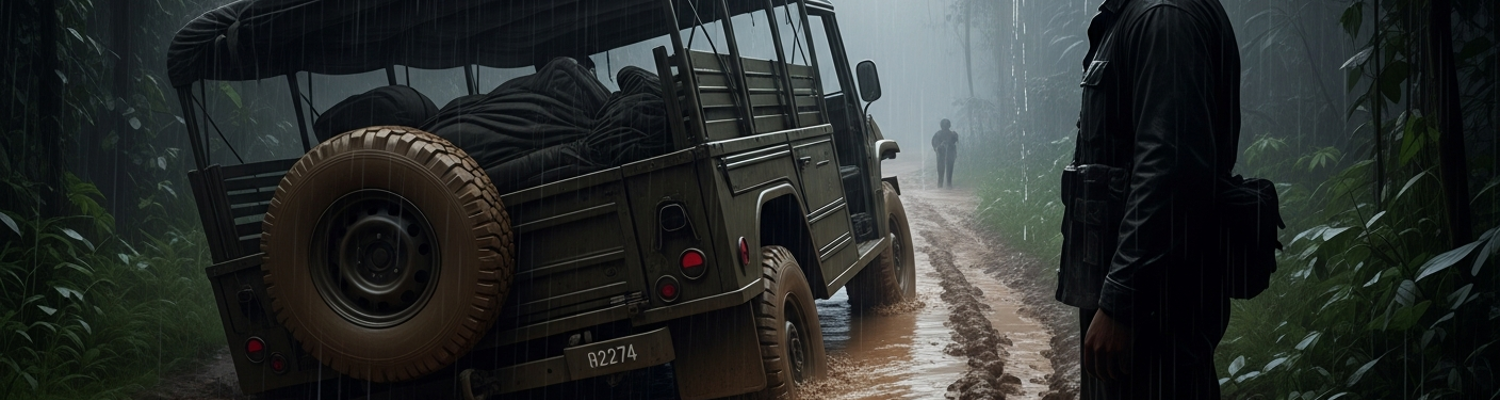

M274 Mule Mechanical Failures
Operational logs from the I Corps Tactical Zone circa 1970 document a persistent pattern of mechanical failure involving the M274 utility vehicle, known as the Mule. Designed as a simple, lightweight platform to ferry supplies over terrain inaccessible to larger trucks, the Mule was intended to solve the last-mile problem. It could carry loads greater than its own weight and mount various weapons, from machine guns to recoilless rifles. Yet in the mud-choked hills and rain-lashed firebases manned by units like the 2nd Battalion, 9th Marines (2/9), the vehicle frequently became a stationary liability. Maintenance reports from the Force Logistics Command in Da Nang show a disproportionate number of Mules were often non-operational. They sat awaiting parts or field-expedient repairs, creating their own set of supply bottlenecks that dictated the tempo of frontline engagements.
The steering mechanism was a notorious point of failure.
Archival evidence points to frequent breakdowns within the steering gearbox and connecting rods on models prior to the A5 variant. The complex four-wheel steering system was acutely vulnerable to the conditions of northern South Vietnam. Constant exposure to water and fine grit would seize the bell crank levers and universal joints, making steering sluggish and eventually impossible. The support bracket for the steering column, bolted directly to the vehicle’s deck, could rip out under the strain of navigating rough terrain, leaving the operator with a detached and useless steering wheel. The two-cylinder, air-cooled engine used in later models (M274A2 through A5) presented its own issues. The engine was susceptible to fuel pump diaphragm failures, which could thin the engine’s oil with gasoline and lead to catastrophic seizure. Spark plugs fouled easily, and the magneto ignition system was prone to failure in the damp, humid environment.
These specific, recurring mechanical issues meant that a Mule loaded with ammunition or C-rations could grind to a halt miles from its destination, not from enemy action, but from its own fragility. For the forward-deployed rifle companies of 2/9 operating from remote combat bases in Quang Tri Province, a non-functional Mule was a direct threat. A single disabled vehicle could stall the delivery of water, mortar rounds, medical supplies, and mail for an entire platoon. Supplies had to be manually humped the rest of the way by Marines already tasked with combat patrols. This diverted manpower and energy. The unreliability of the M274 forced company commanders to postpone patrols or conserve ammunition because a scheduled resupply was stranded on a muddy trail with a seized steering box.
This unreliability forced a culture of improvisation. Marines became part-time mechanics, developing a working knowledge of the Mule's many weaknesses. They learned to diagnose fuel pump issues, clean spark plugs, and attempt to un-seize steering components with whatever tools were available. Cannibalization became standard practice. Parts were stripped from already disabled Mules to keep others running, creating a cascading effect of non-repairable platforms. This constant state of mechanical triage, far from strategic planning centers, represented the grinding routine of logistics in I Corps. The pace of the war for the infantryman was often set not by grand strategy, but by the sputtering death of a two-cylinder engine.
I Corps Maintenance Deficiencies
Force Logistics Command (FLC) inventories from 1970 show a systemic shortage of components for both the M274 Mule and the M54-series 5-ton truck. The supply depot at Da Nang, the nerve center for Marine logistics in I Corps, was supposed to be a vast reservoir of materiel. In practice, it was a study in scarcity for vehicle parts. The global nature of the American military commitment and a procurement system that prioritized aviation assets meant that ground vehicle components were often a secondary concern. For the M54 truck, the workhorse of every major convoy, the FLC supply battalion consistently lacked fuel injector pumps for its multi-fuel engine, transmission synchronizer assemblies, and even basic leaf spring packs. A single M54 disabled with a failed injector pump could sit for weeks awaiting a replacement from Okinawa or the United States.
For the smaller M274 Mule, the problem was even more acute. A seemingly endless list of non-mission-capable vehicles awaited simple parts. Steering gearboxes, engine magnetos, and fuel pump diaphragms were perpetually on backorder. The computerized requisition system, which used hundreds of programs to track inventory, often failed to accurately predict the high failure rate of these specific items in Vietnam’s uniquely corrosive environment. The result was a shadow economy of cannibalization, where parts were stripped from one damaged vehicle to restore another, creating an ever-growing graveyard of skeletal frames that could never be returned to service.
A deficit of skilled mechanics compounded the scarcity of parts. A 19-year-old Marine assigned to a Motor Transport maintenance section may have completed training in the United States, but that schooling rarely prepared him for the realities of I Corps. Stateside training focused on standard procedures in well-lit, well-equipped depot workshops. In the field, a mechanic might be forced to diagnose a sophisticated transmission problem on an M54A2 truck in ankle-deep mud, under a poncho during a monsoon, with only a standard-issue toolkit. The Continental multi-fuel engines used in many trucks were notoriously complex, and a misdiagnosis could lead to catastrophic failure. Many junior mechanics, facing a complicated internal engine or transmission issue, lacked the specialized knowledge to do anything other than replace the entire component, an impossible task without the part in stock.
The few highly experienced Staff Non-Commissioned Officers with the requisite diagnostic skills were stretched thin. They became a human bottleneck in the repair chain, constantly moving between firebases to triage the most critical breakdowns. An after-action report from the 7th Motor Transport Battalion could detail a convoy of thirty M54 trucks departing Da Nang with ammunition for 1st Marine Division elements. Twenty miles out, the lead truck’s transmission seizes. The entire column, stretching over a mile on a narrow road like Highway 1, grinds to a halt. The organic maintenance element cannot perform the repair. A radio call back to FLC at Red Beach confirms the necessary transmission assembly is not in stock. A high-priority requisition is sent to Okinawa. For the next 48 to 72 hours, the convoy is a static, vulnerable target. The supplies it carries remain out of reach of the frontline units who had planned their operations around its timely arrival.
Treacherous Riverine Supply Lines
Naval Support Activity Da Nang operational logs from 1970 highlight a fundamental logistical challenge. The massive deep-draft cargo ships and amphibious assault vessels of the Seventh Fleet, loaded with thousands of tons of materiel, were forced to anchor miles off the coast of I Corps. Their size rendered them incapable of navigating the shallow, sand-choked coastlines. The transfer of supplies was a dangerous, weather-dependent evolution. A Landing Ship, Dock (LSD), like the USS Thomaston (LSD-28), would ballast its stern, flooding a massive internal bay and allowing a smaller Landing Craft, Utility (LCU) to motor into the churning water inside. In anything above a moderate sea state, the LCU would surge violently, threatening to slam its steel frame against the well-deck walls as cranes attempted the delicate work of moving pallets of ammunition or fuel drums from one vessel to the other. A snapped cable or a rogue wave could send a multi-ton container crashing onto the deck or into the sea.
From the offshore transfer points, the burden fell to a fleet of slow, unwieldy workhorses. The Landing Craft, Mechanized (LCM), particularly the LCM-8 or "Mike Boat," and the larger LCU formed the backbone of this tactical logistics fleet. Operated by units like Naval Support Activity Da Nang, these flat-bottomed, steel-hulled vessels with their characteristic bow ramps were designed to move heavy things onto hostile shores. An LCU could carry over 150 tons of cargo, several M54 trucks, a pair of 105mm howitzers, or dozens of pallets of C-rations, but its top speed was a mere eight knots. Every journey from the deep-water anchorages into the mouths of rivers like the Cua Dai or the Thu Bon was a slow, grinding, multi-hour trip. Their loud diesel engines announced their arrival from miles away, and their predictable routes made them easy to track.
Once inside the river systems of Quang Nam Province, the threat changed from meteorological to man-made. The wide expanse of the South China Sea gave way to narrow, winding waterways flanked by dense foliage. Viet Cong sappers and North Vietnamese Army regulars used the rivers as their own highways and seeded them with a lethal array of traps. Command-detonated mines, fashioned from unexploded American bombs, were buried in the silt of the riverbed. Swimmers would slip into the water at night to attach limpet mines to the hulls of craft moored at advance bases. Ambushes were a constant danger. A concealed machine gun nest or a team armed with rocket-propelled grenades could wait for days for the perfect moment to strike. The slow speed and loud engine noise of an LCU loaded with ammunition made it a priority target.
A single well-placed RPG could disable the vessel, turning it into a floating, often burning, roadblock that choked the artery it was meant to supply. Operational reports detail the cascading effects. A single LCM-8 hit by a B-40 rocket on the Thu Bon River, its engines disabled and its cargo of mortar rounds burning, represented far more than the loss of one boat. Its failure to arrive meant an infantry company in the hills west of Hoi An would not receive its scheduled fire support munitions. Patrols would be curtailed. Defensive fire plans would be altered. The loss of the craft would trigger a rescue and recovery mission, pulling armed helicopters and security elements from other planned operations to protect the disabled vessel and its crew.
Underway Replenishment Bottlenecks
Records from the Seventh Fleet and Naval Support Activity Da Nang in 1970 expose friction in the sea-to-shore supply system. The logistical architecture for I Corps depended on a "push" system. Massive shipments of supplies were dispatched from depots in Okinawa or the United States based on strategic forecasts, not on immediate requests from field units. This method created a supply pattern of feast or famine. Materiel arrived in enormous, discrete, and often untimely chunks. An Amphibious Cargo Ship (LKA), like one from the Tulare class, might arrive off the coast carrying thousands of tons of a single commodity, such as 155mm artillery shells. The arrival of this bulk supply would trigger a frantic, short-term burst of activity that overwhelmed the system, followed by long periods where that specific item was critically scarce. This cycle made consistent operational planning for units like the 1st Marine Division exceptionally difficult.
This friction began miles from shore with the open-ocean transfer. The process, often called a "well-deck marriage," involved a Landing Ship, Dock (LSD) taking on ballast to partially flood its massive internal bay. A smaller, flat-bottomed Landing Craft, Utility (LCU) would then motor into this churning, enclosed space. In anything but the calmest seas, the 189-ton LCU would surge violently against the steel walls of the LSD’s well-deck as cranes attempted to move multi-ton pallets between the vessels. A snapped cable or a moment of misjudgment by a crane operator could send a container of ammunition or medical supplies into the sea, a total loss. This transfer was the first major bottleneck, entirely dependent on weather and the precise ship handling of crews from Naval Beach Group One.
Once a load was transferred, the inefficiency shifted to the shoreward transit and offload. An LCU-1610 class vessel, though capable of carrying over 150 tons, had a top speed of only eight knots. Upon arrival at facilities like the Bridge Cargo Ramp or the Museum Ramp in Da Nang, the craft faced the next bottleneck. A lack of adequate hardstand space, a shortage of working cargo-handling equipment like forklifts, and disorganized pallet staging meant that offloading was a chaotic, grinding process. An LCU might wait for hours just to get a spot on the ramp. On February 27, 1969, an LCU loading at the Bridge Cargo Ramp was struck by a rocket, killing 13 crewmen, an illustration of how these logistical logjams created static targets. The pressure to clear the ramp for the next incoming craft often led to pallets of supplies being dumped wherever space could be found, creating vast, disorganized fields of materiel exposed to weather, pilferage, and enemy fire.
Exhausted Logistics Personnel Strain
Archival evidence from Force Logistics Command (FLC) units at Da Nang reveals the weight carried by support personnel. The work was a relentless cycle. For the mechanics of the 7th Motor Transport Battalion or the supply clerks at the Red Beach depots, a twelve-hour workday was standard, often stretching to sixteen hours, seven days a week, under the oppressive humidity and heat of I Corps. The air was a thick mixture of diesel exhaust, red dust, and the constant drone of generators. Sleep was frequently interrupted by distant artillery or the sudden alert of an incoming rocket attack.
This environment bred a unique form of exhaustion. It was the mental grind of thankless, repetitive labor, compounded by the knowledge that their efforts were perpetually undermined by forces beyond their control. A study of personnel records indicates a pervasive sense of being forgotten, a feeling that their war of busted knuckles and inventory sheets was invisible to the larger command structure. While combat units experienced the acute stress of firefights, logistics personnel endured a chronic, low-grade anxiety, a constant pressure of impending deadlines and equipment failures.
The frustration was a palpable force inside the maintenance bays and supply depots. A motor transport mechanic with the 1st Service Battalion faced the same failed M54 transmission or seized M274 steering box day after day. He would fill out the same requisition forms for parts he knew were not available in-country, creating a paper trail of futility. This led directly to the sanctioned, yet demoralizing, practice of cannibalization. To get one five-ton truck back on the road, a mechanic would be ordered to strip a magneto or a fuel pump from another disabled vehicle, guaranteeing the scavenged truck would never run again. It was a zero-sum game that created an ever-expanding boneyard of skeletal frames, a visible monument to the supply chain’s dysfunction.
A review of FLC manning documents from 1970 shows a consistent shortage of experienced mechanics and technicians. The Marine Corps had expanded too quickly, and stateside training could not replicate the specific challenges of Vietnam. A young private, trained in a pristine workshop at Camp Lejeune, was wholly unprepared to diagnose a complex multi-fuel engine while kneeling in mud during a monsoon. The few highly skilled Staff NCOs, men with years of diagnostic experience, were stretched impossibly thin. Their absence brought all other complex repairs to a standstill. An entire convoy’s departure could be held for hours, not for parts, but for the arrival of the one gunnery sergeant who knew how to properly time the injector pump on an M54.
Unsung Supply Chain Realities
Photographic archives from the Force Logistics Command (FLC) in Da Nang reveal a war documented separately from the one of firefights and patrols. Marine combat photographers, many with an MOS code of 4631, were tasked with creating a comprehensive visual record of the American commitment in I Corps. While a selection of their images depicting dramatic action would find its way into newspapers and official histories, the bulk of their work documented something far more mundane. Thousands of negatives and prints filed away in records centers captured the unglamorous processes of the supply chain. At the FLC photo lab near Da Nang, photographers like Staff Sergeant R.D. Lucas and his Vietnamese counterparts processed roll after roll of film showing not heroism, but entropy. Their mission was to record everything.
The photographic record from 1970 is not one of streamlined efficiency, but of chaotic effort. Pictures taken at the sprawling Red Beach Base Area show not orderly rows of supplies, but vast, open-air dumps where pallets of ammunition boxes and fuel drums sink into the red mud. A series of images from the cargo ramps operated by Naval Support Activity Da Nang documents M54 five-ton trucks disabled with flat tires or mired to their axles in muck. Combat photographers captured images of exhausted Marines from service battalions manually humping crates from a grounded LCU, the designated forklift sitting idle in the background with its engine cowling open. These were not images of enemy action. They were portraits of breakdown, showing equipment defeated by the environment and a supply system overwhelmed by its own volume.
Press releases and command chronologies from Military Assistance Command, Vietnam (MACV) and FLC presented a narrative of overwhelming logistical power. Reports from Naval Support Activity Da Nang hailed its own history as one of impressiveness in both size and service, celebrating milestones like the offloading of the millionth ton of cargo. The FLC touted its Automated Services Center, a data processing unit that used over 500 separate computer programs to track and manage the flow of materiel. These reports, built on statistics and broad overviews, were a curated version of the truth. They measured the flow of the river but ignored the eddies where everything got stuck. The story of the millionth ton moved did not include the visual record of the ten thousand tons sitting in the mud at Red Beach or the critical parts for an M274 Mule that were listed in a computer database but were nowhere to be found in the actual depot.
Vietnam War Supply Chain Impact
Operational records from III Marine Amphibious Force circa 1970 reveal that materiel shortages were a chronic condition that dictated the rhythm of daily combat. For a rifle company of the 1st Marines dug in on a remote firebase south of Da Nang, this meant a constant anxiety over dwindling supplies. Official histories speak of temporary shortages of items like radio batteries and vehicle parts, but for the men on the line, these were persistent deficits. A platoon might enter a multi-day patrol with only one or two full batteries for its PRC-25 radios, forcing strict radio silence to conserve power and leaving them isolated. Stocks of 81mm mortar rounds, particularly illumination and white phosphorus, were frequently depleted, stripping company commanders of the ability to light up a perimeter during a nighttime probe or screen a medevac with smoke.
This scarcity directly translated into a loss of combat effectiveness.
A close review of battalion after-action reports shows a clear pattern. Planned company-sized sweeps were frequently downgraded to platoon-sized patrols or postponed entirely, with the reason cited as logistical constraints. A mission to clear a suspected enemy base area twelve miles away might be cancelled because the M54 five-ton trucks needed to transport the unit were non-operational, awaiting transmission parts that were not available in-country. This forced inactivity ceded the initiative to North Vietnamese Army and Viet Cong forces. They gained time to emplace mines, prepare ambushes, and fortify their positions, often in close proximity to American bases. The tactical tempo was set not by the aggressive plans of a Marine captain, but by the systemic failure of the supply chain hundreds of miles away.
A road like Highway 1 or a river like the Cua Viet was meant to be a fluid artery, pumping the materiel of war to the front. When a lead truck in a 30-vehicle convoy had its transmission fail, or a single landing craft was disabled by a mine in a narrow channel, that artery instantly hardened. The entire column would grind to a halt, sometimes for days. What was once a logistical asset in motion became a static target stretching for over a mile. This transformation had severe strategic implications. Enemy forces did not need to confront the full strength of a Marine battalion; they only needed to find and exploit the single weakest point in its supply line. A stalled convoy became a magnet for ambushes, forcing commanders to divert infantry and air assets away from planned combat operations to provide security for a line of broken-down trucks. A review of operational summaries shows that a substantial portion of combat power in I Corps was consistently tied up in this defensive mission, guarding its own paralyzed supply lines.