
Allied Diplomacy and Expanded Leaflet Dispersion Mandates
Archival evidence shows that a severe local airfield crisis in late 1964 originated during high-level diplomatic talks in Washington. British Prime Minister Harold Wilson met President Lyndon B. Johnson at the White House between December 7 and December 9 to negotiate Western commitments across Southeast Asia. Johnson pressed for British combat battalions under the multilateral More Flags campaign. Wilson rejected sending British troops into active combat. He cited British military entanglements in the Borneo Confrontation. Diplomatic compromise shifted toward expanding non-combat technical expertise. British advisors from the British Advisory Mission in Saigon had established counterinsurgency protocols during the Malayan Emergency. These protocols emphasized population registration and saturation psychological operations. Specific commitments emerged around British advisory roles in Southeast Asian psychological warfare techniques. American military planners then had to rely on massive airborne leaflet dispersion programs across contested rural sectors.
Washington demanded immediate physical execution of that advisory mandate.
A close review of operational logs indicates that Military Assistance Command Vietnam reacted to the White House directive by issuing urgent orders. General William Westmoreland ordered the expansion of psychological dispersion runs. These runs targeted Communist infiltration paths through the Truong Son mountains into Laos and eastern Cambodia. Central Highlands forward staging bases became the primary network for this campaign. Long-distance flights from coastal hubs like Tan Son Nhut burned excessive fuel over the high mountain ridges. Air Force commanders placed heavy flight demands on rudimentary fields like Dak To. They converted dirt strips into turnaround points for Fairchild C-123 Providers of the 315th Troop Carrier Group. Flight schedules doubled. Aircraft cycled through these austere highland clearings every forty-five minutes. Crews loaded heavy wooden pallets stacked five feet high with unbundled newsprint into cargo bays.
Paper cargo shut down the airfield.
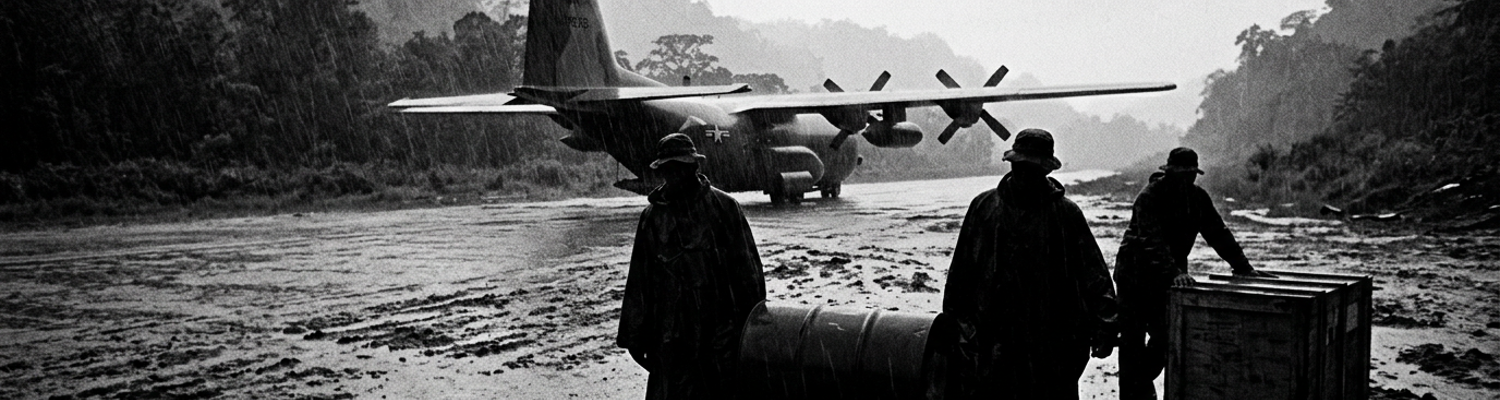
Heavy cargo demands collided directly with the poor soil bearing strength of the Dak To valley. Runway subgrades composed of decomposed granite and wet volcanic clay could not absorb the kinetic impact of twenty-ton transport planes. These aircraft landed on rough pierced-steel planking at eight-minute intervals. Hydraulic shock waves from locking brakes snapped the interlocking steel lugs. Metal planks drove straight into the saturated subbase. Each heavy C-123 touchdown gouged trenches eighteen inches deep through the surface. Subsequent transports became trapped in thick mud. Thousands of waterlogged propaganda boxes scattered across the active perimeter. Combat engineers from the 8th Engineer Battalion arrived on site with three Caterpillar D4 dozers. They brought sixty barrels of rapid-curing liquid asphalt to patch the central braking zone.
The damage required immediate manual intervention.
Dak To Airstrip Role in Border Psychological Operations
When examining the historical record of northern Kontum Province, Dak To functioned as a primary forward operating location. The airfield provided direct flight access to Communist transit points inside the Tri-Border sector. South Vietnam, Laos, and Cambodia converge in this specific area. MACV air planners selected the outpost because tactical transports operating from coastal bases burned twenty percent of their fuel load climbing across the Annamite Range. Staging twin-engine Fairchild C-123B Providers directly out of Dak To reduced round-trip transit times. The transit to the border dropped from hours to under fifteen minutes. Mountain topography dictated unforgiving flight profiles. Transports lifting off the short 3,200-foot strip had to clear jagged volcanic ridgelines. These ridges rose to fifteen hundred meters. Pilots banked sharply through tight mountain saddles to evade automatic weapons fire. They descended into narrow river canyons under low cloud ceilings.
Proximity to the border transformed the remote valley into an air hub.
Maintaining this high sortie rate required stocking massive amounts of psychological warfare cargo beside the runway. Tons of psychological warfare leaflets sat prepositioned at the outpost for rapid loading. The active flightline became an open-air supply depot. Between twenty and thirty-five tons of paper cargo sat stacked inside reinforced earth revetments. Open-sided timber sheds shielded the material with weathered canvas tarpaulins. The 7th Psychological Operations Group in Okinawa printed the payloads. Trucks transported them overland via Route 14 from coastal depots. These payloads consisted of Chieu Hoi safe-conduct passes and civilian relocation warnings. Workers packed them into forty-pound corrugated cartons strapped to wooden warehouse pallets. Four-man loading teams composed of 5th Special Forces Group Detachment A-24 personnel and indigenous Montagnard workers manually shoved these pallets. They pushed them across aluminum roller conveyors into the aircraft cargo bays. Flight directives mandated twenty-minute ground turns. Ground crews muscled sixteen thousand pounds of boxed print material into position. Transport pilots kept their Pratt and Whitney R-2800 radial engines idling to avoid starter motor burnouts.
Paper stock proved mechanically destructive to airframes.
Operational logs indicate that the physical properties of palletized newsprint generated severe technical failures. Monsoonal dampness penetrated the canvas-covered revetments. Boxed leaflets absorbed groundwater. Cargo pallet weights expanded by fifteen percent beyond documented weight-and-balance charts. Hydraulic actuators on C-123 rear cargo ramps bent under the concentrated weight of rolling pallets. Loading doors froze in half-open positions. Snapping winch cables and failed floor tie-down rings occurred routinely. Pilots accelerated hard down the damaged runway planking. Unsecured paper boxes crashed toward the rear tail assembly. Loadmasters discarded damaged shipping containers into roadside ditches. They secured the surviving paper stacks with heavy chains wrapped directly around internal fuselage ring frames. Ground crews from the 8th Engineer Battalion improvised notched timber wedges to shore up buckled loading ramps. They used hydraulic jacks borrowed from artillery maintenance sheds. The jacks forced jammed ramp doors back into flight-locked positions before the next mortar volley hit the runway.
The equipment degradation accelerated rapidly.
Monsoon Liquefaction of the Laterite Tactical Strip
When examining the historical record of northern Kontum Province in late 1964, continuous rainfall dismantled the geotechnical stability of the Dak To airstrip. An unyielding northeast monsoon deposited over twenty-five inches of precipitation onto the Dak Poko river basin within three weeks. The water completely overwhelmed the rudimentary earthen drainage ditches flanking the runway edges. Dak To surface material consisted of untreated tropical laterite. This iron-rich clay soil formed a crust during dry months. It dissolved into suspension under constant moisture. Infiltration of surface runoff saturated the porous subbase beneath the runway crown. Soil moisture content passed the plastic limit toward full liquefaction. Hydrostatic pore pressure mounted within the underlying gravel bed. The California Bearing Ratio of the subgrade plunged from an acceptable rating of twelve down to less than three. Aircraft weighing in excess of thirty-five thousand pounds exerted ground pressures that the fluid soil mixture could no longer absorb.
Static weight alone caused main landing tire footprints to sink four inches into the unpaved surface.
Archival evidence shows that this subgrade softening caused severe rutting and massive surface shear. Transports attempted rollout maneuvers under these conditions. C-123Bs touched down at ninety knots. The dual main landing gear tires broke through the thin upper crust of compacted laterite. The wheels carved longitudinal furrows eighteen inches deep along the first thousand feet of the strip. Violent soil displacement created asymmetrical drag forces. These forces overwhelmed the pilots and compromised all differential braking action. Wet clay coated the multi-disc brake assemblies inside the wheel hubs. Brake friction linings slipped. Hydraulic line temperatures spiked under futile foot-pedal application. Friction coefficients between the rubber tires and the saturated surface dropped to near zero. Transport planes went into uncontrolled forty-degree skids toward roadside drainage ditches.
The compacted earth strip converted into viscous red mud.
Ground crews from the 5th Special Forces Group Detachment A-24 observed severe hazards. Incoming aircraft had to steer through irregular ridges of displaced mud. These ridges piled two feet high along the runway centerline. The mud caught landing gear wheel fairings and ripped away hydraulic brake lines. The primary danger centered on catastrophic nose-gear collapse during rollout deceleration. The Fairchild C-123B forward gear assembly relied on a nitrogen-charged oleo-pneumatic cylinder. This cylinder cushioned vertical impacts. It lacked the structural bracing to survive high-energy horizontal shear. A thirty-two-inch nosewheel dropped into an eighteen-inch-deep mud trench at fifty knots. The abrupt deceleration generated extreme bending moments across the lower torque links. Shear pins within the forward wheel fork fractured under the sudden resistance. The nose tires twisted ninety degrees against the runway heading. The aircraft chin dug directly into the mud. Flight mechanics from the 311th Troop Carrier Squadron recorded repeated structural fatigue cracks. These cracks developed in the forward fuselage ring frames at Station 120. Internal nose-gear mounts anchored into the aluminum airframe at this exact location. Field engineers repeatedly rigged steel recovery cables around main landing gear trunnions. Caterpillar D4 bulldozers dragged bogged transport planes clear. They completed this task before the nose struts sheared completely beneath the forward fuselage.
Recovery operations required heavy machinery.
Collapse of Timber Revetments and Cargo Waterlogging
Continuous rainfall across the Dak Poko basin caused saturated soils to compromise structural retainers. These retainers protected northern flightline revetments at coordinate ZB175225. Runoff descended from surrounding granite hillsides and pooled behind the earthwork berms. The berms stood eight feet high to shield field equipment from incoming 82mm mortar fragmentation. The retaining walls consisted of untreated eight-by-eight-inch pine timbers. Steel drift pins and horizontal deadmen anchored the wood six feet into the backfill. Hydrostatic pressure built rapidly as water permeated the backfilled laterite. Soil weight rose from ninety to more than one hundred and twenty pounds per cubic foot. Saturated subsoil weakened the friction holding the buried deadmen anchors in place. Timber retainers bowed outward along an eighty-yard front beside the supply apron. Shear pins fractured along the joints. Two hundred tons of red earth poured across the primary staging pad. Detachment A-24 personnel stored crated equipment in this exact area. Supporting uprights snapped at ground level with loud cracking sounds. Protective parapets dropped directly onto palletized radio components and aircraft spare assemblies.
The wooden revetments caved within seconds.
Combat engineers from the 8th Engineer Battalion struggled to shore up the remaining revetment bays. Progressive slope failure threatened adjacent fuel bladders. Saturated soils liquefied beneath the timber sill plates. This eliminated foundation bearing capacity and pushed four-inch retaining planks into sharp angles. Soil friction along the revetment backsides dropped to zero. Water-filled voids replaced compacted aggregate. Bulldozer operators attempted to cut diversion channels with Caterpillar D4 blades. Blade pressure caused surrounding slope shoulders to slough away beneath the tracks. Mud avalanches tore away the stacked timber bulkheads. Three feet of saturated laterite buried two rubber fuel cells and thirty drums of aviation gasoline. Ground crews dug drainage trenches with hand shovels. Perimeter automatic rifle fire peppered the southern boundary wire simultaneously. Water pushed loosened gravel straight through the fractured timber gaps. The supply pad filled with knee-deep slurry. The mud blocked forklift movements entirely. Detachment mechanics abandoned two stuck Clark rough-terrain forklifts. Laterite mud engulfed their wheel hubs.
Cargo pallets sank into the mire.
A close review of operational logs indicates that thousands of pounds of paper propaganda leaflets absorbed runoff water. Bundled print material reduced into dense pulp. MACV psychological operations directives had concentrated over thirty tons of boxed leaflets beside the flightline. Workers stacked them five feet high across raw timber skids. Rain penetrated the frayed vinyl tarpaulins. The uncoated forty-pound newsprint sheets soaked through within hours. Capillary action drew moisture upward through the stacked paper. Water content reached eighty percent of total mass. Expanding paper fibers ripped through steel packing bands. Double-walled corrugated shipping cartons burst open. Millions of Chieu Hoi passes spilled into muddy pools. Pallet weights doubled from one ton to more than four thousand pounds. The pine transport skids shattered beneath them. Cellulose breakdown left a dense slurry. Ground crews could neither shovel nor burn the ruined paper. Detachment A-24 mechanics used backhoes to drag the saturated masses toward airfield drainage gullies. This cleared the aircraft parking slots. Flight crews tried to lift intact bundles. The sodden paper pulled apart in wet stringy clumps. The debris fouled winch gears.
Five tons of ruined cellulose clogged the primary culvert.
Severed Wire Communications and Command Isolation
Northern Kontum Province experienced sudden mudslides in December 1964. These slides tore through the primary signal corridors between the airstrip at coordinate ZB175225 and the sector tactical command post. Torrential water sheets poured off the western slopes of Hill 828. The water gouged out deep drainage channels along the perimeter road. Stable roadside shoulders turned into fluid red mud. Tactical communications between the 8th Engineer Battalion work site and Detachment A-24 headquarters depended on surface-laid WD-1/TT twin-conductor infantry field telephone wire. Each WD-1 cable consisted of four tinned-copper strands twisted with three galvanized-steel tensile strands. A thin vulcanized polyethylene jacket protected the internal wires. The wire possessed a nominal breaking strength of two hundred pounds. Thousands of cubic feet of waterlogged laterite gave way along the road cut. Heavy debris caught the unburied lines. Tensile loads exceeded manufacturer tolerances within minutes. Steel strands snapped at field splices. The break disconnected the central SB-22 switchboard.
The airstrip lost all contact with sector command.
Archival evidence shows that rapid hydraulic erosion stripped away the remaining backup telephone links. This occurred within two hours of the primary slope failure. Runoff from the Dak Poko basin cut four-foot-deep gullies across the perimeter ditch. The water exposed the secondary WD-1 trunks. Ground crews had strung these wires hastily through low brush. Fast-moving mud carried dislodged roots and fractured granite. The debris submerged the lines and split the insulation along the copper conductors. Direct electrical grounding in the waterlogged soil dropped line resistance to zero. The short circuits destroyed the battery components inside every TA-312/PT telephone set on the airfield apron. Maintenance personnel attempted to run replacement lines across open ground using DR-8 hand reels. Incoming 82mm mortar fragmentation cut each fresh strand. Technicians unspooled the wire and watched it sever immediately. Linemen from the 5th Special Forces Group detachment could not leave protective revetments. Tracing line breaks across the exposed apron drew direct fire from surrounding high ground.
Every wired handset at the airstrip went dead.
Engineers and airfield support personnel managed runway stabilization with limited tactical coordination. They relied entirely on degraded radio nets. Ground teams switched to portable AN/PRC-25 and legacy AN/PRC-10 tactical FM transceivers. Local terrain blocked high-frequency transmission paths. Steep volcanic ridgelines rose one thousand meters above the valley floor. The mountains produced severe knife-edge signal attenuation. This prevented line-of-sight very-high-frequency contact with sector headquarters at Kontum City. Monsoonal cloud cover descended into the tree line. The weather absorbed radio wave propagation. The effective ten-mile range of the whip antennas dropped to less than eight hundred yards. High humidity caused terminal condensation inside the unsealed radio chassis. The moisture shorted the circuitry of the BA-386 dry batteries. Operators manually dried internal radio components over open kerosene lanterns inside sandbagged shelters. This process regained momentary battery output.
Radio operators broadcast blindly into howling squalls.
Heavy equipment crews from the 8th Engineer Battalion executed recovery tasks on their own initiative. They operated without centralized command direction while under mortar fire. Bulldozer operators leveled runway craters without advance warning of incoming transport aircraft. They lacked coordinated fire support from base artillery batteries. Spotters with signal mirrors attempted visual signaling toward the central watchtower. Heavy rain and mortar smoke obscured line-of-sight contact across the 3,200-foot strip. Three Fairchild C-123Bs arrived over the valley on low-fuel reserves. Mechanics on the ground waved yellow signal flags from the trench line. They warned incoming pilots away from the liquefied touchdown zones. Flight crews aborted approaches without ground guidance. The planes climbed out through mountain passes. Mechanics shoveled laterite mud by hand to clear landing lanes before nightfall.
The work continued under total radio silence.
Improvised Drainage Engineering Under Harassing Fire
Standing water along the western flank of the runway reached depths of eighteen inches. The water threatened complete washouts beneath the interlocking pierced-steel planking. Standard corrugated metal drainage pipes had never been requisitioned for the forward outpost. Company B of the 8th Engineer Battalion possessed zero factory-built conduit. They needed to relieve the hydraulic pressure undermining the strip. Saturated runoff continued backing up behind the collapsed northern revetments near coordinate ZB175225. Dissolved laterite subbase threatened to sweep directly across the central touchdown zone. Captain Thomas Vance commanded the engineering detachment on site. He ordered maintenance personnel to scrounge the airfield perimeter dump for raw scrap metal. The engineers needed to repurpose the metal into artificial drainage systems. Another transport touchdown would trigger a complete subgrade failure without immediate drainage.
Empty fuel drums offered the only functional substitute.
Combat engineers met this supply deficit by converting discarded 55-gallon steel aviation fuel drums into makeshift drainage culverts. Welders from the 8th Engineer Battalion worked beneath sandbagged maintenance lean-tos. The covers obscured the flare of oxyacetylene torches. The men cut both the top and bottom lids out of one hundred cold-rolled 18-gauge steel drums. Residual aviation gasoline fumes presented an immediate explosive hazard inside the unvented cylinders. Mechanics flushed each drum with water hauled in five-gallon cans from the Dak Poko riverbed. They scrubbed the inner seams with solvent before applying open flame. Technicians used portable Hobart 300-amp gasoline-driven arc welders mounted on the bed of an M37 utility truck. They aligned the open-ended cylinders rim-to-rim along wooden alignment jigs. Continuous circumferential fillet welds joined the metal pieces. Each completed assembly formed a rigid twenty-four-inch-diameter pipe string measuring forty feet in length. The internal cross-sectional area could move over eight hundred gallons of liquid runoff per minute. The water flowed away from vulnerable runway shoulders.
Getting those steel assemblies into the mud meant working without cover.
A close review of operational logs indicates that sappers faced continuous hostile fire. They attempted to carve collection channels and seat the welded conduits along the runway shoulders. Sniper teams from the North Vietnamese Army 325th Division occupied elevated firing positions. They hid across the bamboo-covered slopes of Hill 828. The snipers zeroed in on the open runway with 7.62x54mmR Mosin-Nagant carbines. Mechanics stepped outside the sandbag line and immediately took fire. Earth-moving equipment drew direct 82mm mortar barrages from the surrounding jungle margins. Five-man sapper squads from the 8th Engineer Battalion and local Montagnard strike forces abandoned the heavy machinery. They dug drainage ditches entirely by hand with entrenching tools and pick mattocks. Sappers crawled on their bellies through knee-deep slurry. They gouged out three-foot-deep trenches angled at a five-percent grade. The channels pointed down toward the natural river drainage basin.
Mortar fragments punctured the newly welded pipes.
Combat engineers hauled the forty-foot drum sections across the exposed runway shoulders by hand. They used rope bridles and steel recovery cables. The men slid the heavy assemblies across the saturated laterite while under fire. Incoming 82mm rounds burst within thirty yards of the ditch line. Shrapnel tore through the thin sheet-metal cylinder walls. Red mud sprayed across the open pipe inlets. Sappers sealed the shrapnel perforations. They clamped split metal patches and scrap burlap over the punctures with mechanical steel banding tools. High-velocity surface runoff threatened to erode the soil around the pipe jackets. The teams backfilled the trenches with crushed granite aggregate shovelled from nearby perimeter bunkers. They pinned the joints down with sandbags loaded with damp river sand. Four continuous culvert lines discharged pooled runoff away from the strip by dusk. Subgrade hydrostatic pressure dropped by forty percent. An evening mortar barrage then severed the southern boundary wire.
The drainage system held its ground.
Manual River Ballast Stabilization of the Runway
The immediate structural collapse of the subgrade along the 3,200-foot strip left field officers with limited options. No industrial quarries or heavy crushing plants existed within sixty miles of coordinate ZB175225. Company B of the 8th Engineer Battalion and Montagnard work details organized an emergency stone-hauling operation. They harvested natural ballast from the Dak Poko riverbed. The extraction site sat three hundred yards west of the western perimeter wire. Work parties waded waist-deep into the fast-moving river currents. Intermittent 82mm mortar harassment bracketed the water. The men used entrenching spades and steel pry bars. They filled five-gallon canvas buckets with fist-sized basalt cobbles and rounded river gravel. Soldiers stacked the dense volcanic rock into the beds of two M35 two-and-a-half-ton cargo trucks. Montagnard laborers carried seventy-pound wicker basket loads directly up the muddy embankment on foot. Saturated river silt had to be washed from the angular basalt fragments. Fine clay particles would re-contaminate the fill zones without this cleaning process. Dump drivers backed the six-wheel-drive trucks across unstable perimeter taxiways. They discharged twelve cubic yards of raw stone per hour straight into liquefied depressions. The holes measured three feet deep along the central 1,000-foot braking zone.
Hand labor replaced mechanized equipment.
Archival evidence shows that combat engineers faced continuous subgrade pumping along the centerline. Heavy transport wheels had carved longitudinal trenches twenty inches deep through the wet laterite. The detachment lacked functional pneumatic sheepfoot rollers or mechanical vibrating compactors. Captain Thomas Vance directed his twenty-man engineer detachment to compact the river stones into the wheel ruts. They used hand-fabricated tamper plates. Technicians welded heavy eight-inch square steel plates to five-foot lengths of two-inch galvanized iron water pipe. This created forty-pound manual tampers. Crews dropped the tools repeatedly onto the stone-packed trenches from waist height. Squads of four sappers moved shoulder-to-shoulder along the length of each furrow. They drove the angular basalt cobbles downward into the saturated subbase. The pressure forced water upward to the surface drainage channels. Every three-inch lift of river ballast received approximately forty manual impacts per square foot. Additional aggregate was then raked across the surface. This mechanical displacement forced aggregate interlock within the fluid clay matrix. The California Bearing Ratio rating of the rutted tracks moved upward from an unusable value of two to an operational rating of nine.
Two heavy wooden tampers shattered under the impact.
Engineers continuously monitored compaction density across the patched sectors. They used portable soil penetrometers and airfield cone penetrometer rigs. The 5th Special Forces Group maintenance locker provided the testing gear. Field testing conducted every thirty feet along the touchdown mark revealed specific data. Manual tamping achieved localized compaction densities exceeding eighty-five percent of modified Proctor standards. Mortar fragments from 82mm rounds exploding along the runway verge repeatedly chipped away surface stone. Work details re-tamped dislodged ballast sections between inbound flight windows. Ground crews spread two inches of coarse river sand over the wedged basalt rocks. The sand choked the surface voids and formed a binding friction layer beneath the punctured pierced-steel planking. Continuous hand compaction across twelve hundred linear feet of wheel ruts raised the subgrade California Bearing Ratio rating to eight point five. An empty Fairchild C-123B from the 311th Troop Carrier Squadron initiated engine startup at coordinates ZB175228.
The stone foundation supported the static weight.
Leaflet Drying Methods and Resumed Flight Sorties
Ground crews at the Dak To airstrip confronted a rapid biological threat on December 15, 1964. Damp paper cargo began festering inside the high heat of the valley floor. Ambient temperatures climbed past eighty-five degrees Fahrenheit. The heat combined with saturated mud to produce extreme humidity. These conditions allowed fungal spores to colonize the waterlogged paper pulp. Support teams rigged canvas tarpaulins. They used hot-air engine blowers to dry salvageable leaflet bundles before mold set in. Mechanics from the 311th Troop Carrier Squadron pulled three Herman Nelson BT-400 gasoline-powered ground heaters from aircraft maintenance lockers. Manufacturers originally designed these machines to preheat radial engine cowlings in arctic staging zones. Personnel built makeshift drying tunnels along the southern apron. They draped heavy rubberized canvas covers over wooden frames salvaged from broken ammo crates. Blowers pushed dry air heated to one hundred and thirty degrees through flexible twelve-inch ducting. The air entered the enclosed shelters. Detachment A-24 soldiers and indigenous Montagnard workers manually sliced open damp shipping cartons. They spread individual ten-thousand-sheet reams across raised timber pallets to allow continuous airflow.
Mildew threatened to destroy millions of propaganda sheets.
Flight mechanics maintained strict fire watches around the drying shelters. Paper dust and aviation gasoline exhaust collected in the confined spaces. Air velocities inside the ductwork tore loose paper corners into flying debris. The fragments threatened to ignite against the hot combustion chambers of the blower units. Crews stationed three 50-pound carbon dioxide fire extinguishers beside each duct inlet. Operators rotated every two hours to clear intake screens. Shredded cellulose clogged the metal mesh constantly. Hand-held moisture meters borrowed from the 8th Engineer Battalion soil-testing kit provided exact readings. The meters verified when paper bundles fell below fifteen percent relative water weight. Workers bound the loose leaflets with baling wire once the paper dried. They used steel strapping bands taken from artillery ammunition pallets. The crews repacked sixty thousand pounds of printed material into serviceable drop cartons.
Heat tunnels operated without pause through the monsoon night.
The simultaneous completion of the river-ballast subgrade repairs allowed the runway to support gross transport weights of thirty-five thousand pounds. Combat engineers pulled the last Caterpillar D4 dozer off the stabilized centerline at 0630 hours on December 16. Twelve hundred feet of compacted basalt aggregate and re-seated pierced-steel planking sat ready for rollouts. Restoration of the runway allowed tactical transports to resume takeoffs. Time-sensitive psychological operations along the border required immediate air support. Two Fairchild C-123B Providers from the 315th Troop Carrier Group taxied toward the northern turnaround under clear skies. These planes had been stranded on the taxiway since the subgrade collapse. Loadmasters filled the cargo bays with four-ton payloads of dried Chieu Hoi passes. They loaded defectors letters and warnings targeted at People Army of Vietnam regiments operating along the Laotian frontier.
The tactical strip returned to service.
Psychological warfare planners in Saigon designated the mid-December window as an essential phase. They needed to interdict dry-season troop movements across the Tri-Border region. Infiltration intelligence confirmed that the 325th Division was moving two fresh infantry regiments through mountain passes west of Ben Het. This required immediate dissemination of safe-conduct passes before units crossed the Cambodian border. Provider three-three locked its brakes at the southern threshold of the patched runway at 0715 hours. The pilot spooled both Pratt and Whitney R-2800 radial engines to full combat thrust. The aircraft accelerated across the hand-laid basalt subbase. The plane reached eighty-five knots over the stabilized stone section without subgrade deformation. The cargo aircraft rotated twenty yards before the end of the pierced-steel planking. It cleared the jungle ridge line at coordinate ZB182230. The crew released the first pallet of dried paper over Route 110 forty minutes later.