
The Scale of Abandoned US Military Equipment
The policy of Vietnamization had supplied the Army of the Republic of Vietnam (ARVN) with a material arsenal comparable to many North Atlantic Treaty Organization members. By March 1975, this vast provision of hardware became the basis for a massive transfer of military technology to an opposing force. As ARVN divisions in the I Corps Tactical Zone disintegrated, they left behind equipment with an estimated original cost approaching one billion dollars. This figure was part of a wider loss of nearly five billion dollars in U.S. equipment by the final fall of Saigon. The failure was not one of technology, but of the structure meant to support it. Weapons were present, but the logistical chains, command discipline, and national morale required to wield them evaporated under the pressure of the North Vietnamese Army’s (PAVN) Spring Offensive.
A close review of operational logs from March 1975 reveals a near-total collapse of ARVN armored and artillery formations. In the chaos surrounding the fall of Danang, entire divisions effectively ceased to exist as organized fighting forces. North Vietnamese sources claimed the capture of 179 tanks and armored vehicles and 327 artillery pieces just from the fall of I Corps. This included large numbers of M48 Patton main battle tanks, M41 Walker Bulldog light tanks, and M113 armored personnel carriers. Many of these vehicles were not destroyed in combat. They were found parked and intact, abandoned by crews who had run out of fuel, ammunition, or orders. Roads clogged with hundreds of thousands of panicked refugees made tactical movement impossible. Tank crews abandoned perfectly functional vehicles. In the city of Huế, before the fall of Danang, 140 tanks and armored vehicles were surrendered in place. The PAVN inherited a mechanized army, acquiring more armor in a few weeks than they had possessed in total at the start of the offensive.
Danang Air Base, once one of the busiest airfields in the world, became the single greatest prize. As PAVN forces encircled the city, discipline at the air base dissolved. Desperate civilians and deserting ARVN soldiers swarmed the runways, mobbing any aircraft attempting to leave. While Republic of Vietnam Air Force (RVNAF) pilots managed to fly some assets south, a huge quantity of aircraft was left for the advancing PAVN. A final accounting by North Vietnamese authorities after the I Corps collapse listed 129 captured aircraft of various types. This inventory included dozens of the RVNAF’s front-line Northrop F-5 Freedom Fighters and Cessna A-37 Dragonfly attack jets. It also included numerous Bell UH-1 helicopters and several large C-130 Hercules transport planes. Some departing personnel attempted to sabotage the equipment, but many aircraft were captured in flyable condition. For the North Vietnamese, who had fought for years under the threat of American airpower, it was an unbelievable acquisition that instantly modernized their own air force.
The captured hardware was not left to rust. The PAVN demonstrated remarkable speed in turning the ARVN’s weapons against their former owners. Captured 105mm and 155mm artillery pieces were immediately integrated into PAVN firebases, shelling retreating South Vietnamese forces and civilian evacuation points. M48 tanks, repainted with North Vietnamese markings, were organized into new units and pointed south toward Saigon. The psychological impact of seeing American-made tanks and jets operated by the enemy was profound for the remaining ARVN soldiers' morale. This cache of weaponry, abandoned in the panic of late March 1975, directly fueled the final PAVN drive that would end the war less than five weeks later.
Strategic Impact of Equipment Abandonment
The chaotic abandonment of military hardware during the collapse of I Corps in March 1975 established a ruinous pattern for the final fall of South Vietnam. While the loss of Ban Me Thuot had initiated the strategic crisis, the disintegration of I Corps, a region containing some of the most battle-hardened and well-equipped ARVN units, demonstrated that no part of the nation was secure. The decision to conduct a strategic withdrawal and concentrate forces further south turned into an uncontrollable rout. Roads clogged with hundreds of thousands of panicked civilians made organized military movement impossible, forcing troops to abandon perfectly functional equipment. A review of operational logs shows that entire divisions, like the ARVN 2nd Infantry Division, simply dissolved as fighting units, with thousands of soldiers deserting their posts. This was a systemic collapse. The failure was one of command, discipline, and national will, creating a blueprint for disaster that would be replicated with terrifying speed across the country. The military and political leadership in Saigon was left baffled and unable to issue clear orders as its northernmost corps ceased to exist as a coherent fighting force.
The psychological effect was immediate. For the soldiers and civilians who remained in the south, the scenes from Danang were a terrifying spectacle of societal breakdown. ARVN soldiers, many of whom had dependents in the area, deserted their units en masse to find and save their families, leading to a total collapse of military discipline. Archival accounts describe the city descending into anarchy, with hunger and looting becoming widespread. At Danang Air Base and along the beaches, the very soldiers meant to provide security fought desperately against civilians for a place on the last flights and vessels. This spectacle of troops turning on their own people, broadcast through panicked reports, shattered what little morale remained within the ARVN and the civilian populace. The sight of elite marine and airborne units, previously the core of the army, dissolving into a desperate mob signaled that the government had lost control. This loss of confidence created a wave of panic that spread south, convincing many that further resistance was futile and directly contributing to the rapid collapse that culminated in the fall of Saigon.
For the People’s Army of Vietnam, the collapse of I Corps was a strategic windfall. North Vietnamese commanders, who had initially planned for a two-year campaign, were themselves surprised by the speed of the ARVN’s disintegration. In the span of a few weeks, they acquired a modern combined-arms force without having to fight for it. The haul included at least 179 tanks and armored vehicles, 327 artillery pieces, and 129 aircraft of various types left behind in the I Corps region. Among the captured assets were dozens of front-line Northrop F-5 jet fighters and A-37 Dragonfly attack jets at Danang and Phu Cat air bases, some of which were in flyable condition. The inventory of abandoned ground hardware was equally significant, featuring large numbers of M48 Patton tanks, M41 light tanks, and thousands of M113 armored personnel carriers.
The PAVN demonstrated efficiency in turning these captured weapons against their former owners. Captured 105mm and 155mm artillery pieces were immediately integrated into North Vietnamese firebases, where they were used to shell retreating ARVN columns and evacuation points along the coast. Within days, captured M48 tanks were repainted with PAVN markings, organized into new armored units, and directed south towards the next objectives. For the remaining ARVN soldiers, the psychological impact of seeing American-made tanks and aircraft operated by their enemy was profoundly demoralizing. This transfer of military technology, abandoned in the chaos of late March, directly armed the final PAVN offensive, providing the fuel, ammunition, and firepower for the Ho Chi Minh campaign that would end the war in less than five weeks.
The C-130 Evacuation Frenzy
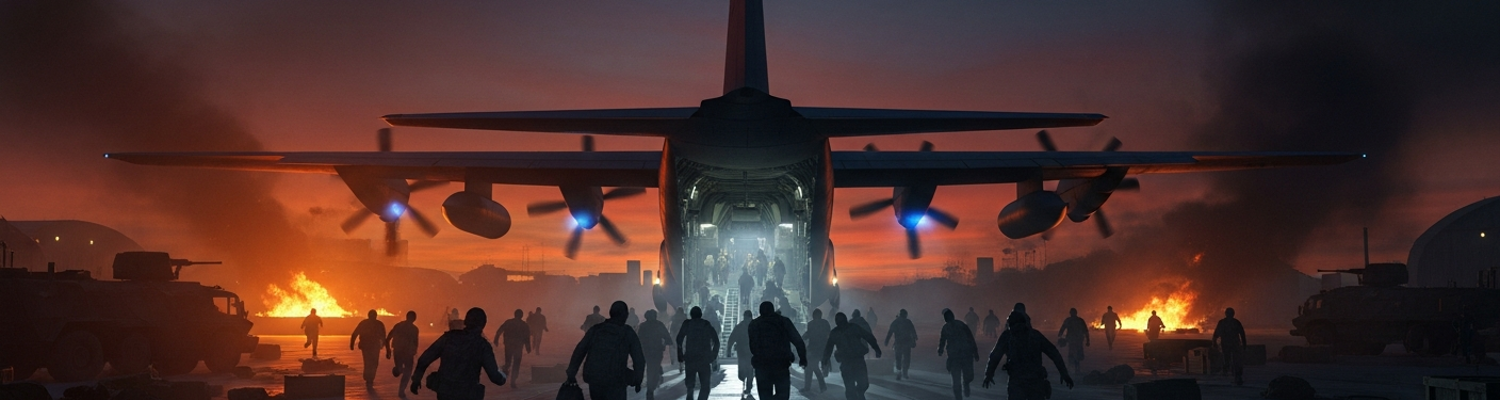
The fixed-wing airlift from Danang Air Base, intended by the Defense Attaché Office as an orderly extraction, disintegrated into mass hysteria on March 28 and 29, 1975. The operational plan relied on C-130 Hercules and civilian-chartered jets, like those from World Airways, to methodically move American personnel and approved Vietnamese refugees south to Saigon. Archival evidence shows the initial flights on March 26 and 27, while tense, proceeded with a semblance of order. That evaporated completely as PAVN artillery began to shell the city’s perimeter and the command structure of the ARVN in I Corps ceased to exist. The airfield became the only point of escape from a city cut off by land and sea, a magnet for tens of thousands of terrified civilians and leaderless, deserting soldiers.
Discipline had vanished.
After-action reports and news accounts from the scene describe a total breakdown of security at the air base. A mass of desperate South Vietnamese, including a large number of armed and panicked ARVN soldiers, overwhelmed the gates and fences, pouring onto the runways and taxiways. The troops who were supposed to be providing security instead fought for their own places on the aircraft. One World Airways Boeing 727 that attempted to land was immediately swarmed by a mob of soldiers who jammed the rear airstair, pushing aside women and children. The pilots of the C-130s faced a difficult task. The sheer weight of people clinging to the aircraft’s ramp and fuselage made normal operations impossible. In one documented instance involving the last C-130 to escape Tan Son Nhut days later, the pilot had to taxi forward and brake sharply just to jolt the mass of people far enough inside to raise the ramp.
The flights operated under a constant and direct threat of violence. The chaos was not just that of a panicked crowd; it was an armed mob. Desperate soldiers, having abandoned their units and officers, used their M16 rifles and pistols to intimidate and force their way aboard the departing planes. Pilots reported gunfire being directed at their aircraft by those left on the tarmac. During the mobbing of the World Airways 727, a grenade exploded under the wing, damaging the flight control surfaces. The crew was forced to take off not from the runway, which was blocked by vehicles and people, but from a parallel taxiway, swerving violently to avoid the crowds. Several individuals clinging to the landing gear fell to their deaths after the aircraft became airborne. The American flight crews of the C-130s faced the same lethal conditions, executing takeoffs while dangerously overloaded and under fire from the very soldiers they were trying to save.
The official capacity of a C-130 was 75 passengers with seatbelts, a regulation put in place following the earlier Operation Babylift C-5A crash. The final flights out of Danang and, later, Saigon defied these limits to a degree that strained the structural integrity of the airframes. The World Airways 727, designed for 131 passengers, took off from Danang with 268 people crammed inside, the majority of whom were male soldiers. A South Vietnamese C-130 crew that escaped Tan Son Nhut in the final hours landed in Thailand with 452 people on board, including 32 in the cockpit alone. This aircraft was overloaded by an estimated 10,000 pounds, requiring the entire length of the runway to achieve flight. These numbers paint a stark, technical picture of the human desperation that had consumed Danang, turning a military air base into a crucible of survival.
Improvised Airlift Doctrine
Standard military doctrine for non-combatant evacuation operations (NEO) proved insufficient for the conditions at Danang in late March 1975. A review of established protocols shows they were built upon the assumption of a secure or at least semi-permissive environment, where evacuees could be screened, manifested, and boarded in an orderly fashion. The situation at Danang Air Base represented the complete inversion of this model. The primary threat to the evacuation was not the advancing PAVN, but the very South Vietnamese soldiers who were supposed to provide security. These troops, having abandoned their units, were now a desperate, armed, and leaderless mob focused solely on self-preservation. There were no established procedures for an airlift conducted in the middle of a full-scale military and societal collapse. The established airlift control system was not equipped to handle a scenario where the airport itself was the epicenter of anarchy.
The physical integrity of the airfield collapsed. Archival reports and news footage from March 29th paint a picture of a runway and taxiway system that had ceased to be a functional aviation facility. It was instead a sea of tens of thousands of people, interspersed with jeeps, trucks, and abandoned military vehicles, making conventional takeoff and landing runs impossible. Pilots on approach saw a human carpet covering the concrete. The last civilian flight to escape, a World Airways Boeing 727, was forced to land and then take off from a parallel taxiway, swerving violently to avoid the crowds and abandoned equipment. During the chaos on the ground, a hand grenade exploded under the 727’s wing and damaged the flaps. This damage, combined with the extreme overloading, directly impacted the aircraft’s flight characteristics and made a normal takeoff more perilous. For the military C-130 crews, the ramp was the point of greatest danger; it was mobbed by soldiers who would fight and shoot to gain a foothold, preventing the ramp from being raised and secured for flight.
The flight manual had no procedure for this.
In this doctrinal absence, aircrews made improvised decisions that defied every standard operating procedure for their aircraft. Pilots and loadmasters operated on a moral imperative to save lives, consciously and repeatedly violating regulations on weight, balance, and performance. The World Airways 727, contractually intended for government use and certified for 131 passengers, took off with 268 people crammed inside. The majority were soldiers who had fought their way aboard. Several others who clung to the landing gear fell to their deaths after takeoff. In one of the final C-130 flights out of the region, this one from Tan Son Nhut under similar conditions, the pilot could not raise the cargo ramp because of the mass of people standing on it. His solution was to taxi the Hercules forward and brake sharply, using the aircraft’s momentum to jolt the crowd far enough inside for the loadmaster to close the door. That specific South Vietnamese Air Force C-130, piloted by a Major Phuong, eventually landed at a base in Thailand carrying 452 people, including 32 in the cockpit alone. The load exceeded the aircraft’s maximum takeoff weight by an estimated 10,000 pounds and required the entire length of the runway to become airborne. These were not decisions found in any checklist; they were acts of extreme airmanship born from necessity.
Ford's Aid Request and Congressional Rejection
As the last vestiges of South Vietnamese control dissolved in I and II Corps, President Gerald Ford made a final appeal to the United States Congress. A close examination of the historical record of April 10, 1975, reveals the President addressing a joint session. His purpose was not to rally the nation for war but to request funds he believed were necessary to stave off a complete humanitarian and strategic disaster. The proposal was for $972 million in emergency aid. Of this total, the administration designated $722 million specifically for military assistance, a sum intended to re-equip and stabilize the rapidly disintegrating ARVN. The remaining $250 million was earmarked for humanitarian relief and to facilitate the evacuation of American citizens and threatened South Vietnamese nationals. Ford’s argument was built on the foundations of American credibility and moral responsibility. He argued that without this immediate infusion of material support, there could be no hope of an orderly withdrawal or of the ARVN establishing a defensible line around Saigon.
The political atmosphere in Washington was hostile to any such renewed commitment. The 94th Congress, heavily populated by a new class of anti-war Democrats elected in the wake of the Watergate scandal, viewed any further aid as prolonging an unwinnable conflict. The prevailing sentiment was that the Vietnam War was a sunk cost. The congressional debate was sharp and dismissive of the administration’s position. Opponents, led by figures in the Senate Foreign Relations Committee, pointed directly to the recent collapse of Danang as their primary evidence. They argued that the ARVN’s failure was not one of material but of morale and leadership. The spectacle of billions of dollars in American-made tanks, artillery, and aircraft being abandoned intact to the advancing PAVN proved to them that sending more equipment would be futile. On April 17, 1975, the Senate Armed Services Committee voted decisively against the military aid component of the package. The full Senate quickly ratified this position, formally rejecting the $722 million request while signaling it would consider funds strictly for humanitarian purposes.
For the government in Saigon, the news from Washington was the definitive end. The rejection of Ford’s military aid request extinguished the last glimmer of hope that the United States would intervene to save the republic. South Vietnamese President Nguyễn Văn Thiệu, who had structured his entire strategy around the assumption of continued American support, saw his political and military position become untenable overnight. His belief that the U.S. would ultimately be forced to act to protect its investment and credibility was proven false. On April 21, just four days after the Senate vote, Thiệu announced his resignation in a televised address, delivering a furious condemnation of the United States for what he described as an unforgivable act of abandonment.
The diplomatic break was complete.
For the leadership in Hanoi, the American congressional vote was the final signal. It removed any lingering ambiguity about the potential for a last-minute American military reaction, such as the B-52 strikes that had halted their 1972 offensive. North Vietnamese commanders, who had initially planned for a more protracted campaign, now understood that the path to Saigon was clear of its most significant strategic obstacle. Archival evidence from the PAVN high command shows an immediate acceleration of their operational timetable following the news from Washington. The final offensive, the Ho Chi Minh Campaign, was pushed forward with maximum speed, confident that the Ford administration was now politically powerless to intervene. The rejection forced an immediate pivot in American policy, shifting all focus from stabilizing South Vietnam to executing an emergency evacuation. The objective was no longer to save an ally but to manage the speed of its collapse and extract personnel before the final PAVN tanks reached the presidential palace.
The Geopolitical Shift After Withdrawal
The fall of Danang and the subsequent American political paralysis sent shockwaves far beyond Southeast Asia, fundamentally altering geopolitical perceptions of American power and resolve. The episode gave birth to the 'Vietnam Syndrome,' a deep-seated reluctance within the American public and political establishment to commit U.S. military forces to overseas interventions. This political constraint would dominate and complicate U.S. foreign policy for over a decade, making administrations hesitant to act decisively in foreign crises for fear of another protracted quagmire. For American allies, particularly those in frontline Cold War states like South Korea, Taiwan, and West Germany, the abandonment of South Vietnam raised alarming questions about the reliability of U.S. security guarantees. Diplomatic records from the period reflect a growing anxiety and a corresponding push toward greater military self-reliance. For the Soviet Union and its clients, the event was a major propaganda victory, presented as evidence of declining American influence and a lack of will. This perception directly emboldened Soviet-backed interventions in other parts of the world, from Angola to Central America, as adversaries calculated that the United States was too internally divided and psychologically scarred to respond effectively. The American objective was no longer to save its ally, but simply to manage the speed of its disintegration.