
The I Corps Tactical Zone
The I Corps Tactical Zone was the absolute northern front of the war in South Vietnam. Its strategic importance, as shown in archival records, was geographical and absolute. A buffer. A barrier. A point of violent contact. The zone encompassed the five northernmost provinces, pressed hard against the Demilitararized Zone (DMZ) and the tangled, mountainous border with Laos. This geography made I Corps the direct recipient of men and materiel flowing from North Vietnam. For the 1st Marine Division, assigned a vast and hostile Area of Responsibility centered around Da Nang, the operational challenge was immense. Key installations like the Da Nang Air Base, the deep-water port, and the command-and-control hub at Marble Mountain were not rear-area facilities. They were objectives under perpetual threat. The defense of I Corps was synonymous with the defense of these assets, and by extension, the viability of the entire American military effort in the northern provinces. The terrain itself, a complex of coastal plains, river valleys like the Que Son, and rugged jungle-covered highlands, channeled North Vietnamese Army infiltration directly toward the division’s main population centers and logistical hubs.
Marine Corps doctrine dictated a defense-in-depth, a layered system of mutually supporting positions designed to absorb and destroy enemy attacks. The theory was sound. This was not a static line but a web of strongpoints, combat outposts, and fire support bases intended to provide interlocking fields of fire. A close review of operational logs indicates that a platoon defending an isolated hill was, in principle, connected to a vast network of power. Its security depended on the 105mm and 155mm howitzers of a nearby fire support base having pre-plotted fire missions covering its perimeter. Its survival hinged on the M2 heavy machine guns of an adjacent outpost being able to rake its flanks with grazing fire. This defensive concept demanded that no position fight alone. Reinforcement and relief were built into the very architecture of the defense, with larger combat bases acting as anchors for strings of smaller outposts that screened the approaches. The entire system was designed to attrit an attacking force, breaking it up against a series of hard points before mobile reaction forces could be inserted to finish it.
The enemy determined the specific, material-intensive nature of these fortifications. The threat in I Corps was not an irregular guerrilla force but organized, well-equipped, and highly motivated main-force units of the North Vietnamese Army and Viet Cong. NVA divisions and independent regiments, armed with Soviet and Chinese heavy weapons, were the primary adversaries. Their tactics were methodical. A typical assault began with a barrage of 122mm rockets and 82mm mortars, intended to suppress defensive fire and drive marines deep into their bunkers. Under the cover of this bombardment, elite sapper teams would move forward to methodically cut through concertina wire and clear paths through minefields. The goal was to punch a hole in the perimeter for a massed infantry assault to exploit. This tactical model dictated that fortifications had to be exceptionally robust. Bunkers required deep overhead cover, often constructed from layers of heavy timbers, sandbags, and pierced steel planking, to survive direct rocket or mortar impacts. Fighting positions needed to be dug deep and reinforced to protect riflemen during the initial barrage. Extensive, multi-layered wire obstacles and minefields were not optional additions but the essential first line of defense, designed specifically to slow the infantry assault and break its momentum under the punishing storm of defensive artillery and mortar fire.
Defensive Doctrine Versus NVA Tactics
The construction of every defensive position in I Corps was a direct reflection of field manuals that codified the hard-won lessons of previous wars, adapted for the unique threats of Vietnam. Archival evidence shows that documents like the Army’s FM 5-15, Field Fortifications, were not theoretical guides but essential blueprints for survival. These manuals provided exacting specifications. A standard one-man fighting hole was to be dug deep enough for the occupant’s shoulders to be below ground level, offering protection from the flat trajectory of small arms fire and the lethal fragmentation of air-bursting artillery. For two men, the position was often an L-shaped excavation, a simple geometric innovation designed to prevent a single grenade or mortar round from incapacitating both occupants. Trench lines were not mere ditches; they were engineered systems. The doctrine specified depths of at least five feet and a width that allowed two men to pass, with sharp traverses every 30 feet to localize the blast effect of a direct hit and prevent an enemy who gained entry from firing straight down the line. Fire steps were cut into the forward-facing wall to allow riflemen to fire over the parapet, while grenade sumps, small, deeper holes dug into the trench floor, were intended to safely contain enemy grenades kicked into them. These designs were a direct counter to the NVA tactic of hugging the belt, where attackers would try to get so close to the defensive line that artillery and air support could not be used. The interlocking fields of fire prescribed by doctrine, drawn on paper as perfect geometric patterns, became a desperate, life-or-death calculation of angles and distances on the red clay hills of places like Firebase Cunningham or Con Thien.
The physical components of this doctrine were a short list of heavy materials. The foundational element was the simple sandbag, a jute or plastic-weave sack which, when filled, weighed over 30 pounds. Firebases and outposts consumed them by the tens of thousands, forming the cellular structure of every wall, parapet, and protective revetment. Timber, often 12-by-12 inch beams of rough-hewn wood, formed the skeletal strength of bunkers and overhead cover. The modern equivalent might be a Hesco barrier, but the 1969 version was a more primitive and labor-intensive affair, often involving empty ammunition boxes or steel drums filled with earth and sand. The most ubiquitous barrier material was barbed wire, particularly concertina wire, which arrived in dense, collapsible coils. Engineers would stake out complex barriers, sometimes 100 meters deep, layering the concertina wire into tangled, impassable fences designed to slow sapper teams and channel attacking formations into pre-registered fields of fire. A seemingly minor but significant item on the supply list was drainage pipe. Archival logs show that corrugated metal culverts were prized materials, not just for preventing trenches from turning into impassable canals during the monsoon, but also for constructing makeshift bunkers when split in half and covered with sandbags. The constant battle against water was as tactically significant as the fight against the NVA.
Ultimate protection relied on the careful science of overhead cover, a direct response to the NVA’s proficiency with indirect fire weapons like the 122mm rocket and the 120mm mortar. A direct hit from one of these munitions could pulverize an improperly constructed shelter. To counter this, combat engineers perfected a layered bunker sandwich approach. A close review of after-action reports and construction logs (NARA Record Group 127) reveals a common formula. The first, lowest layer of the roof would be heavy timbers or repurposed steel culvert halves. On top of this went a thick, compacted layer of sandbags, often two or three deep. This was followed by a critical component: a layer of pierced steel planking (PSP). Originally designed for the rapid construction of expeditionary airfields, these heavy, perforated steel panels, each weighing over 60 pounds, were repurposed as a blast-distribution plate. Another dense layer of sandbags was piled on top of the PSP. Finally, a burster course, often a loose layer of earth, rock, or another sheet of metal, was added on the very top. This final layer was designed to detonate incoming rounds prematurely, causing the main blast and fragmentation to expend its energy before reaching the main structural elements of the bunker. The entire structure was then surrounded by blast walls, particularly at entrances, to prevent shockwaves and shrapnel from entering laterally. The failure to adhere to this doctrine, often due to a lack of materials or the need for speed, had catastrophic consequences.
The Unwritten Rule of Class V Priority
Archival evidence from the Force Logistic Command (FLC) at Da Nang reveals a brutal and unwritten rule of supply in I Corps: the immediate needs of combat always superseded the future requirements of construction. The war of attrition demanded to be fed first. In the daily triage of limited airlift and convoy capacity, Class V items, ammunition, held an absolute, non-negotiable priority over Class IV materials for fortification. A CH-46 Sea Knight helicopter pilot with room for a single pallet would invariably be tasked to carry 105mm artillery rounds to a fire support base engaged in a duel with NVA gunners, not the pierced steel planking or 12-by-12 timbers needed to strengthen that base’s command bunker. This was not a policy failure but a systemic condition dictated by the tempo of the war. Logistical commanders at hubs like Da Nang and Dong Ha faced a perpetual crisis of allocation. Every request for concertina wire or sandbags was weighed against an active request for M16 cartridges, 81mm mortar illumination rounds, or white phosphorus grenades. The result was a constant, gnawing deficit of the very materials needed to execute the defense-in-depth doctrine that command theoretically demanded.
This prioritization had immediate, physical consequences on the ground. A close review of operational logs shows that truck convoys laden with construction materials were frequently halted, their cargo unceremoniously dumped at temporary depots, so the vehicles could be re-tasked for emergency ammunition runs. Convoys moving west from Dong Ha on Route 9, a road so dangerous it was known as the Gauntlet, were particularly susceptible. A convoy of M54 trucks from the 7th Motor Transport Battalion might set out with a manifest of culvert pipes and lumber destined for a firebase like Vandergrift Combat Base, only to be diverted. An NVA probe against a neighboring position or an emergency request from an artillery battery running low on shells would trigger an immediate re-tasking order from III MAF. The trucks carrying the construction supplies would be ordered to a staging area, offload their cargo into the mud, and rush back to the Dong Ha Ammunition Supply Point to load pallets of high explosives. The crucial engineering supplies might sit for days or weeks, exposed to the elements, before another convoy could be spared to retrieve and finally deliver them.
The end of this broken supply chain was the forward firebases themselves, where chronic shortages of basic construction items became a matter of life and death. At remote outposts in the Que Son Valley or along the DMZ, the scarcity of lumber, corrugated steel sheeting, and gabions was a constant state of affairs. Gabions, wire mesh baskets filled with rocks to create sturdy, quick-build revetments, were particularly prized but rarely available in sufficient quantities. Marines were forced to rely almost exclusively on sandbags, which degraded quickly in the monsoon rains and offered inferior protection against rocket and mortar shrapnel. The prescribed bunker sandwich of heavy timbers and pierced steel planking was often an engineering fantasy. Instead, marines improvised with whatever they could scavenge: empty ammunition crates filled with clay, steel drums, and even sections of destroyed enemy equipment. This improvisation directly compromised the structural integrity of their defenses. A bunker roof lacking the critical PSP blast-distribution layer was dangerously vulnerable to a direct hit from a 122mm rocket, a signature weapon of NVA sapper attacks. The lack of materials created a vicious cycle: weakened fortifications invited enemy assaults, which in turn expended vast quantities of ammunition, further cementing its priority in the supply chain and ensuring the next shipment of lumber would once again be pushed aside.
The War Against Water and Rot
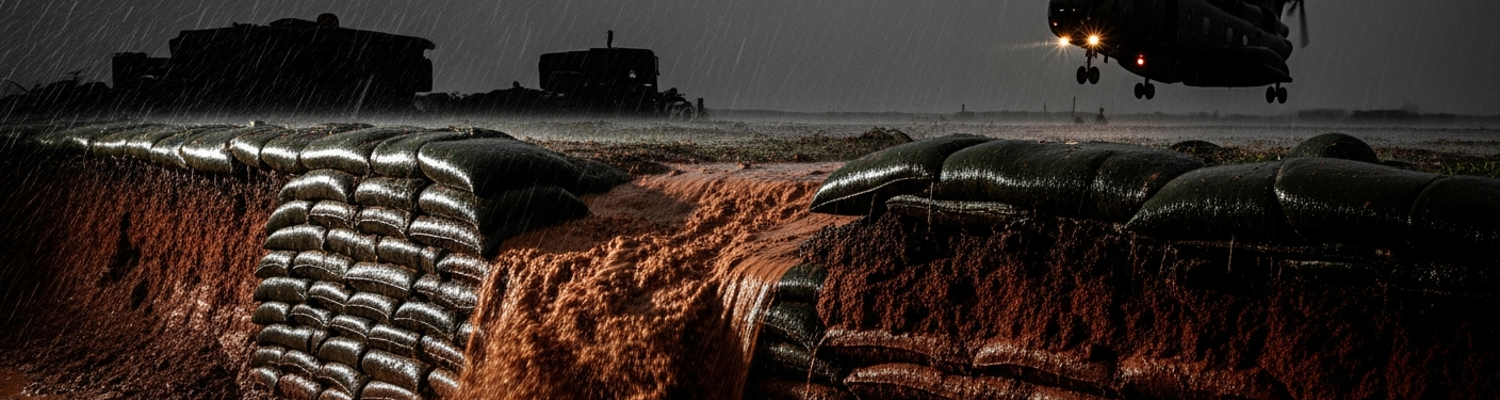
The northeast monsoon did not just bring rain. It unleashed a separate and implacable enemy against every fortification in I Corps. Meteorological records for the Da Nang area show that during the peak of the rainy season, from September through November, monthly rainfall totals frequently exceeded 20 inches, with some months seeing nearly 40 inches. October alone could bring over 650 mm of precipitation, falling on 21 of the month’s 31 days. This was not a steady drizzle. It was a deluge, a vertical wall of water that turned the baked red clay of the firebases into a viscous, unstable slurry. The sheer volume of water overwhelmed all rudimentary drainage efforts. Instead of running off, the rain saturated the earthworks, increasing their weight exponentially. A standard 30-pound sandbag, when waterlogged, could more than double in weight. A parapet wall made of thousands of such sandbags would begin to slump and deform under its own immense, water-filled mass. The laterite soil, stripped of its natural vegetation by constant artillery fire and the clearing of fire lanes, had no root systems to hold it in place. The rain transformed it into a liquid, flowing mud that dissolved trench walls, filled fighting holes, and turned carefully constructed defensive perimeters into shapeless, indefensible mounds of earth.
This constant saturation, coupled with the region’s oppressive humidity that averaged over 80 percent, created a perfect incubator for decay. The two primary construction materials, timber and jute sandbags, were both organic and exceptionally vulnerable. Heavy 12-by-12 inch timbers, used as the primary structural support for bunker roofs and trench revetments, would absorb moisture and become colonized by aggressive tropical fungi. A close examination of engineering reports from the period reveals a constant battle against wood rot that turned load-bearing beams into soft, spongy masses with no remaining structural integrity. The process was insidious and rapid. Fungi would break down the cellulose in the wood, hollowing it out from the inside. A beam that appeared solid could be completely compromised, ready to fail under the slightest new pressure. The effect on the tens of thousands of sandbags that formed the bulk of every defensive position was even more immediate. Standard-issue jute sandbags, when in constant contact with moist soil, would rot and disintegrate completely within two to three months. Even in dry conditions, their lifespan was only a few months. Marines on remote firebases watched as the walls of their protection literally dissolved around them, the rotting jute splitting open and spilling the sand fill onto the bunker floor. This forced a constant, Sisyphean cycle of labor, replacing thousands of bags only to have them begin rotting again almost immediately.
The final, catastrophic result of this systemic degradation was the collapse of the fortifications themselves. The combination of liquefied soil and rotted support structures made mudslides and structural failures a constant threat. A trench line dug into a hillside would become a collection point for tons of water. The immense hydrostatic pressure would press against the shoring timbers, which were already weakened by fungal decay. After-action reports describe the sudden, violent collapse of entire trench sections, burying fighting positions and their occupants under tons of liquid earth. Bunkers faced a different, but equally lethal, threat. As the ground beneath them turned to a slurry, their foundations would be undermined. The immense weight of the overhead cover, layers of rotted timber, waterlogged sandbags, and steel planking, would cause the entire structure to tilt, sink, or pancake. A defensive perimeter could be breached not by a sapper’s charge, but by a mudslide that simply erased a 50-meter section of the line, taking bunkers and trenchworks with it. These collapses were not slow subsidences. They were sudden, violent events, often triggered by the percussive shock of incoming artillery, that could destroy a command bunker or a key machine gun position in an instant.
The Rifleman as Day Laborer
A close review of company-level records from I Corps in 1969 reveals that a Marine rifle company rarely, if ever, functioned at its full combat strength. The relentless war against decay and gravity consumed its personnel. On any given day, it was standard operating procedure for at least one of a company’s three rifle platoons to be designated as the working party, its combat mission supplanted by construction duties. At firebases like Russell or Neville, this meant that up to a third of the infantrymen were not running patrols, setting up ambushes, or conducting security sweeps. Instead, they were engaged in the back-breaking, repetitive labor of filling sandbags, hauling 60-pound steel planks, and replacing the thousands of rotted jute bags that had dissolved during the last monsoon downpour. This was not a temporary diversion. It was a permanent operational condition. The company commander’s morning briefing was less about enemy movements and more about allocating his dwindling manpower between the essential tasks of fighting and building. The tactical cost of this arrangement was absolute. It stripped the company of its ability to project power and saturated its area of operations.
This constant diversion of manpower from offensive and security tasks created a vacuum that the North Vietnamese Army was quick to exploit. The primary mission of an infantry battalion, to find, fix, and destroy the enemy, was severely hampered. A significant portion of its fighting force was perpetually tied to the firebases, unable to perform the very patrolling that was essential for locating NVA units and preventing them from preparing the battlefield. Archival evidence shows a direct correlation between the hours spent on fortification maintenance and a decrease in the number of long-range reconnaissance patrols and platoon-sized sweeps. This allowed NVA and Viet Cong forces to operate with greater freedom, often just outside the wire. They could emplace mines and booby traps on trails, cache weapons and supplies, and conduct detailed reconnaissance of the firebases for future sapper attacks. The degradation of combat skills was another direct consequence. Time that should have been dedicated to live-fire training, rehearsing immediate action drills for ambushes, or maintaining weapons was instead spent on construction. A Marine squad that spent its days digging and its nights on watch had little opportunity to maintain the perishable skills that were critical for survival in a firefight.
The physical and mental toll of this unending labor was profound, directly impacting unit readiness and morale. A Marine’s day often consisted of hours of hard physical work in extreme heat and humidity, followed immediately by a night of standing watch on the perimeter, a cycle that offered little to no respite. The Department of War recognized that sleep deprivation and sustained fatigue could impair a soldier as much as alcohol, yet for the Marines in I Corps, it was a daily state of being. The result was a steady increase in heat casualties, immersion foot from waterlogged trenches, and other non-battle injuries that further depleted unit strength. The psychological impact was just as severe. The fight was not just against a visible enemy but against a seemingly endless cycle of decay. This grinding routine eroded the offensive spirit of the infantry. A unit whose primary daily function was manual labor, and whose members were chronically exhausted, could not be expected to maintain peak alertness or aggression. Operational records from the period note command-level concerns over rising fatigue, which manifested in slower reaction times, reduced vigilance on guard duty, and a general degradation of the unit’s ability to respond decisively when attacked.
An Engineered Solution by III MAF
A close review of logistical orders from III Marine Amphibious Force and the Force Logistic Command in Da Nang reveals a significant shift in engineering strategy in 1969. The catastrophic failure of field-expedient fortifications under monsoon rains and NVA rocket attacks prompted a high-level directive to seek a more durable and rapid construction method. The result was the Standardized Pre-Fabricated Bunker Initiative, a program designed to replace the ad-hoc, labor-intensive world of timber and sandbags with engineered, mass-produced components. The core of the initiative revolved around introducing heavy-duty metal and, in some cases, concrete elements that could be shipped in kits to forward locations. The most common of these were pre-formed, curved sections of heavy-gauge corrugated steel, similar to oversized culvert pipes, designed to be bolted together to form arched roofs for bunkers and trench lines. These steel sections were intended to replace the 12-by-12 inch timbers that were perpetually in short supply and highly susceptible to rot. For larger command posts and medical aid stations, entire prefabricated steel building kits, often referred to as Butler buildings, were also procured.
The program’s objective was to impose industrial uniformity on the chaotic landscape of firebase construction. By providing standardized, interlocking parts, command hoped to eliminate the dangerous variable of improvisation and guarantee a baseline level of structural integrity for every fighting position. The designs were a direct answer to the failures of the bunker sandwich approach. A corrugated steel arch, when properly backfilled with sandbags and earth, offered superior protection against plunging indirect fire compared to a timber-and-planking roof that could rot from within. The steel was impervious to the tropical fungi that consumed wood beams, and its engineered shape was calculated to deflect the blast from a near-miss or prematurely detonate a direct hit from a 122mm rocket. The initiative aimed to create a system where the protective value of a bunker on Hill 119 was not dependent on the scavenging skills of its occupants but on a set of assembly instructions and a pallet of numbered steel plates.
The designs were explicitly created for rapid assembly with minimal skilled labor. The theory was that a squad of infantrymen, equipped with little more than wrenches and brute force, could erect a hardened fighting position in a fraction of the time it took to build a traditional timber-and-sandbag bunker. The steel arch sections were manufactured with pre-drilled holes and were intended to be fastened together with heavy-duty bolts. Larger concrete elements, such as T-walls, were also introduced for revetments and blast walls, able to be placed by cranes or heavy equipment to form instant protective barriers. The entire concept was championed by the Navy Seabees, whose construction battalions were instrumental in fabricating and delivering many of these components. Seabee teams pre-cut and bundled timber kits for bunkers to be shipped to Marine and Army divisions and developed methods for airlifting construction materials to remote sites using Marine helicopters. The ideal scenario envisioned a CH-46 or CH-53 helicopter delivering a palletized kit of steel bunker components directly to a hilltop outpost, with the Marines on site assembling it that same day, drastically reducing their exposure and the man-hours lost to construction. The initiative was a direct attempt to engineer a solution to the manpower drain and the relentless decay that had crippled the defense of I Corps.
System Collapse and Desperate Improvisation
The Standardized Pre-Fabricated Bunker Initiative was defeated not by enemy action, but by the tyranny of distance and prioritization. A close review of Force Logistic Command (FLC) manifests from Da Nang reveals a supply chain fracturing under its own weight. The journey of a single prefabricated steel culvert section, the backbone of the new bunker design, was a case study in systemic failure. A kit, containing several tons of curved steel plates, would be loaded onto an M54 truck of the 7th Motor Transport Battalion at the sprawling Red Beach support complex. Its destination might be a remote firebase in the Que Son Valley or a hilltop overlooking the A Shau. The truck convoy would first have to navigate the treacherous Route 9 to reach a forward staging area like Vandergrift Combat Base. Here, the kit was offloaded to await the final and most unreliable leg of its journey: airlift by a CH-46 Sea Knight or CH-53 Sea Stallion helicopter. This is where the system collapsed. Helicopter availability was a zero-sum game, and the immediate demands of combat held absolute authority. A call for an emergency medevac, a platoon in contact needing ammunition, or an artillery battery running low on 105mm shells would invariably divert the helicopter tasked with carrying the bunker components. The pallets of steel would sit for days, sometimes weeks, sinking into the red clay of the airstrip.
When a kit did finally arrive at a Marine outpost, it often created a new and dangerous form of vulnerability. After-action reports from units in the 1st Marine Division describe the arrival of heavy steel plates without the corresponding crates of specialized fasteners needed to assemble them. An entire pre-fabricated bunker, designed by engineers to withstand a direct hit from a 122mm rocket, was rendered useless by a shortage of high-tensile strength bolts and connecting panels. These were not standard hardware; they were specific components engineered to bear the load and shear stress of a blast wave. A Marine platoon on a hill, having spent hours hauling the multi-ton steel sections into position, would discover they had no means of connecting them. The separate pallet containing the bolts and fasteners, weighing only a fraction of the main kit, was often lost in the logistical chaos at Dong Ha or left behind at a crowded staging area. The result was a firebase cluttered with useless, heavy metal shapes that provided no protection. They had received an industrial puzzle with no way to join the pieces, forcing them to continue relying on the very timber-and-sandbag structures the new system was meant to replace.
This failure cascaded directly into a period of desperate and dangerous improvisation. With the promised supply of engineered components proving illusory, Marines on the ground were forced to build and repair fortifications with whatever they could scavenge. This led to the widespread use of materials that had no ballistic-resistant properties. A common sight on firebases was revetments and bunker roofs incorporating salvaged parts from downed aircraft. Aluminum skin, structural ribs, and floor plates from crashed CH-46 helicopters or battle-damaged C-130s were prized for being lightweight and easy to cut, but they offered almost no protection from shrapnel. A direct hit from an 82mm mortar, let alone a rocket, would tear through such materials. Another ubiquitous feature was walls made from 55-gallon fuel drums filled with sand or local mud. While they could stop small arms fire, they were dangerously susceptible to being split open by the concussion of nearby explosions, spilling their contents and leaving a gaping hole in the defensive line. These expedient structures stood in stark contrast to the robust, layered defenses dictated by doctrine, creating a false sense of security and inviting NVA sapper teams to probe for the inevitable weak points.
The unintended consequence was a strategic crisis. The initiative, born from a desire for efficiency and safety, had created a new, permanent state of vulnerability. Instead of hardened, uniform defenses, the firebases of I Corps became a patchwork of compromised structures. NVA intelligence quickly adapted, learning to identify the tell-tale signs of improvised fortifications. The logistical failure to deliver a few crates of bolts had handed the enemy a tactical roadmap, highlighting the weakest points in the American defensive line. This self-inflicted wound would not heal. For the remainder of their time in these positions, Marine units were forced to expend even more manpower defending known flaws, a direct result of a well-intentioned plan that collapsed under the simple, unyielding pressures of war.