
Sixth Fleet Mobilization and Command Strain
Searing ambient temperatures exceeding 105 degrees Fahrenheit radiate off the Eastern Mediterranean water. This creates a blinding thermal haze. High-altitude atmospheric fronts unexpectedly dump sheets of freezing rain onto the flight paths above the Levant. Aircraft toss violently through severe turbulence. Down at sea level, the coastal humidity combines with the arid topsoil. The shoreline turns into a morass of sticky alkaline mud. Stagnant salt-heavy seawater offers zero cooling effect for shipboard intake valves.
Archival evidence shows this hostile microclimate systematically dismantled machinery and human endurance.
President Dwight D. Eisenhower ordered Operation Blue Bat on July 15, 1958. The objective was to stabilize Lebanon following the violent assassination of the Hashemite royal family in Iraq just twenty-four hours earlier. A close review of operational logs indicates that the Joint Chiefs of Staff transmitted flash-override messages to Admiral Charles R. Brown. Brown served as Commander of the Sixth Fleet. The transmission bypassed standard cryptographic protocols to save time (NARA Record Group 218). Planners in Washington and London worked for seventy-two consecutive hours.
They survived entirely on black coffee and prescription amphetamines.
Sustained sleep deprivation led to severe neurological degradation and localized paranoia among the strategic command staff. Eisenhower directed the immediate deployment of the 2nd Provisional Marine Force directly into Beirut at coordinates 33.8938 N, 35.5018 E. The speed of this mobilization fractured standard supply chains across the European theater. Quartermasters frantically loaded amphibious assault ships with unpalletized rations and mismatched 81mm mortar ammunition crates. Officers experienced acute psychological strain attempting to decipher contradictory orders regarding rules of engagement. They feared triggering a wider regional conflict with Soviet-backed factions.
Command staffs operated in windowless plotting rooms aboard the command ship USS Taconic.
Ventilation in these compartments failed repeatedly. The air grew thick with cigarette smoke and toxic levels of carbon dioxide. Staff officers began experiencing auditory hallucinations and severe hand tremors by the third day of continuous planning. Exhaustion rapidly eroded the tactical judgment of junior officers coordinating the beachmaster units on the sand.
The US Sixth Fleet deployed three carrier strike forces off the coast of Beirut. Task Force 60 established a continuous patrol box exactly twenty miles offshore. This formation centered around the Forrestal-class supercarrier USS Saratoga and the Essex-class carriers USS Essex and USS Wasp. Sustaining this high-visibility show of force required continuous round-the-clock flight operations. Boiler technicians worked in engine rooms where temperatures routinely spiked to 135 degrees. Medical personnel recorded mass casualties from heatstroke, severe dehydration, and acute sodium depletion.
Aviation boatswains mates suffered permanent auditory damage.
They managed constant launch and recovery cycles on the steel flight deck. Steam catapult accumulators began to leak highly flammable hydraulic fluid under the relentless operational tempo. Pilots sat strapped into Douglas A-1 Skyraiders and North American FJ-3 Furys for four-hour alert shifts on the blistering tarmac. Sweat pooled in their oxygen masks and soaked through their G-suits. The psychological pressure of maintaining absolute combat readiness without engaging an enemy produced rampant anxiety among the aviators.
Radar operators staring at cathode-ray tube displays for eighteen hours straight in the Combat Information Center began reporting phantom submarine contacts.
Their nervous systems failed under the sustained adrenaline requirement of waiting for a Soviet preemptive strike. Mechanics stripped screws and installed replacement parts backward due to blurred vision and shaking hands. Logbooks from the USS Saratoga recorded a forty percent failure rate in the Mark 7 arresting gear engines by the end of the second week.
Continuous Underway Replenishment Operations
A close review of deck logs from July 1958 reveals the grueling mechanical requirements of sustaining a blockade in the Levantine basin. Auxiliary vessels executed non-stop fuel and ordnance transfers amid volatile eastern Mediterranean waters. The Neosho-class fleet oiler USS Mississinewa and the store ship USS Rigel carried the primary load. Surface conditions in this specific geographic zone featured unpredictable three-to-five-foot cross-swells. Localized thermal depressions off the Lebanese mountains generated these erratic wave patterns.
Operating roughly twenty-five miles offshore at coordinates 33.7 N, 35.1 E pushed crews to their physical limits.
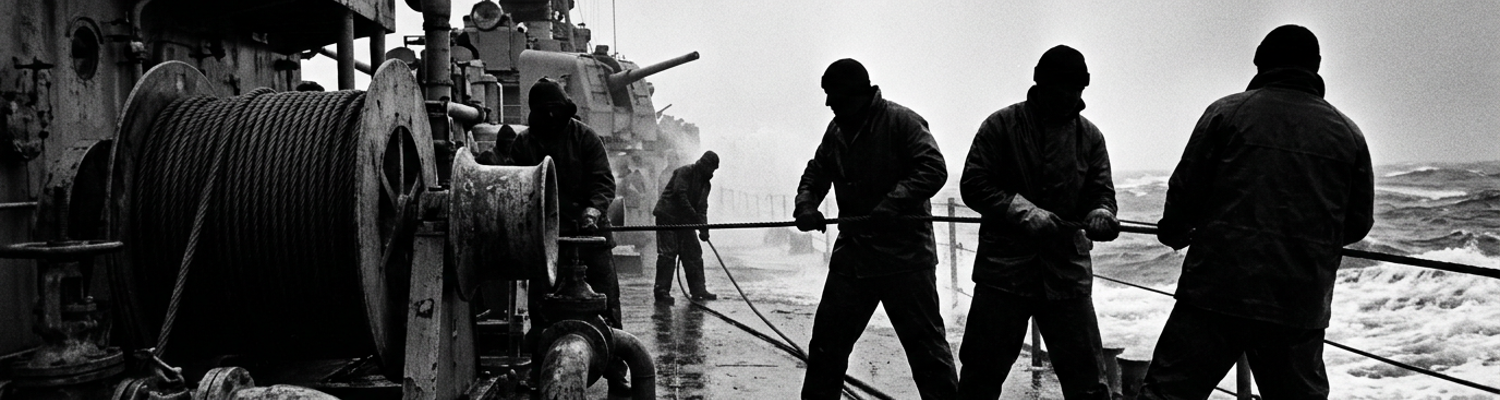
Deck crews wrestled with heavy seven-inch black oil hoses and aviation fuel lines. These lines spanned the sixty-foot gulf between surging hulls. Winch operators maintained tension on the heavy steel span wires. They experienced severe muscle spasms and localized nerve damage in their forearms after twelve-hour shifts at the manual controls. Pumping hundreds of thousands of gallons of highly combustible aviation gasoline required absolute concentration. Both ships pitched violently during the transfer.
The sailors were already suffering from acute sleep deprivation.
A constant spray of saltwater mixed with leaking marine diesel created a frictionless slurry on the steel decks. Boatswains mates frequently lost their footing. They suffered fractured tibias and severe concussions when slammed against steel bulkheads by unexpected wave impacts. Nighttime replenishments forced crews to work under dim red battle lanterns. This amplified the psychological terror of slipping overboard into the crushing gap between the two converging ship hulls.
Medical logs recorded a sharp spike in prescriptions for heavy barbiturates.
High-speed replenishment maneuvers directly kept the strike aircraft carriers operational on station. They did not have to return to regional ports in Naples or Souda Bay. Task Force 60 commanders demanded underway replenishments at speeds between twelve and fifteen knots. This maintained steerageway and complicated firing solutions for suspected Soviet Romeo-class submarines tracking the fleet. The USS Essex and USS Saratoga consumed JP-5 jet fuel at unprecedented rates. The fuel supported continuous A-1 Skyraider and FJ-3 Fury combat air patrols.
Helmsmen on the carrier bridges stared intensely at the churning water.
They watched the gap separating the 60,000-ton warships from the unarmored oilers for up to six continuous hours. This hyper-focused station-keeping induced severe optical strain, blurred vision, and debilitating migraines among the navigation teams. Quartermasters gripping the brass steering wheels developed deep friction blisters. They reported a complete loss of tactile sensation in their hands due to the intense sustained grip pressure. Engine room machinists manually overrode safety governors on the main steam turbines. They answered erratic split-second speed changes from the bridge.
The men inhaled aerosolized asbestos dust and atomized lubricating oil in the confined spaces.
The deafening mechanical noise of the reduction gears caused temporary deafness among the throttlemen. Archival evidence shows that eliminating port calls entirely severed the fleet personnel from any psychological decompression. Seamen trapped in the sweltering windowless hull compartments of the USS Severn began exhibiting symptoms of severe claustrophobia. Night terrors and acute paranoia set in by the fourth week of continuous fuel transfers. The mechanical systems mirrored this rapid human degradation.
Tension-measurement dials on the replenishment winches shattered under the constant shock loads of the plunging ships.
Supply clerks documented a total depletion of replacement rubber O-rings and gaskets for the fueling probes (Naval Supply Systems Command File 44-A). Sailors resorted to wrapping the leaking hose joints with canvas rags and friction tape. They stood directly in the spray of toxic jet fuel. The men manually held the heavy brass connections together during transfer operations. Exposure to the raw JP-5 caused chemical burns and severe contact dermatitis across their exposed faces, hands, and necks.
Overwhelmed pharmacists mates exhausted their onboard supplies of hydrocortisone cream and basic bandages within forty-eight hours of the rationing order.
Technical Strain on Auxiliary Vessel Propulsion Systems
The engineering logs of dual-use auxiliary ships reveal a rapid degradation of both machinery and crew. Converted civilian C3 cargo hulls relied entirely on high-pressure steam propulsion running at maximum continuous rating. The Maritime Commission originally built these hulls for commercial freight. The store ship USS Altair and the ammunition ship USS Diamond Head are primary examples. They had to maintain formation with the fast carrier task forces.
Operating continuously near coordinates 34.0 N, 35.2 E destroyed their mechanical baselines.
These vessels generated power using twin Babcock and Wilcox two-drum express boilers operating at 600 pounds per square inch. Admiral Charles R. Brown ordered the entire supply train to maintain a base speed of fifteen knots. The goal was evading suspected Soviet submarine patrols. This directive forced the auxiliary fleet to push their single-screw propulsion systems past safe redline limits for twenty-three consecutive days. The main reduction gears inside the engine rooms of these converted freighters were never designed for sustained high-speed combat maneuvering without regular port maintenance.
Superheater tubes warped under the constant thermal load of producing 850-degree steam.
Watchstanders in the fireroom manually cranked forced-draft blowers to maximum capacity. They attempted to feed enough oxygen into the combustion chambers to prevent a total loss of steam pressure. A ruptured main steam line in these confined spaces would instantly boil all biological matter within a forty-foot radius. Archival evidence shows the psychological toll of this unrelenting mechanical demand completely broke the engineering divisions.
Boiler technicians stood four-hour watches in unventilated compartments.
Ambient temperatures held steady at 128 degrees Fahrenheit. Sweat instantly vaporized off their skin. Chief engineers restricted water intake to prevent heat cramps. This unintentionally accelerated severe dehydration among the black gang. Machinists mates began exhibiting signs of severe clinical psychosis by the end of July. Men reported hearing distinct human voices screaming from inside the high-speed turbine casings.
The sustained adrenaline requirement of waiting for a catastrophic boiler explosion caused acute adrenal fatigue.
Firemen stared at the brass steam pressure gauges until their vision blurred. They were terrified that a single stuck valve would trigger a chain reaction. Pharmacists mates dispensed heavy doses of dextroamphetamine to keep the engineering chiefs awake. This only fueled their mounting paranoia. Medical officers aboard the USS Diamond Head documented instances of sailors attempting to claw their way up the steel escape ladders during panic attacks.
Their fingernails tore off against the anti-skid grating.
The constant high-frequency whine of the steam turbines degraded the inner ear fluid of the watchstanders. This caused severe vertigo and localized disorientation. Mechanical reliability depended entirely on constant maintenance while underway under severe operational strain. Standard naval engineering doctrine required ships to secure their boilers in port to perform deep maintenance on the refractory brickwork and fuel atomizers. The absolute denial of port calls meant engineering crews had to conduct these dangerous repairs while the ships pitched violently in the Mediterranean swells.
Firemen clad in heavy asbestos suits crawled directly into the still-hot boiler fireboxes.
They chiseled out shattered firebricks. They worked in three-minute shifts to avoid fatal heatstroke. Mechanics manually blew soot from the economizer tubes using 150-psi steam lances. The men inhaled thick clouds of pulverized carbon and aerosolized vanadium. Fuel oil strainers required manual cleaning every twenty minutes to prevent the thick Bunker C fuel oil from clogging the burner barrels. Sailors removed the heavy steel strainer baskets bare-handed.
They blistered their palms on the 200-degree metal.
The USS Altair suffered a forced-draft blower failure on August 4. Captain Richard L. Smith refused to drop out of formation. He ordered his engineering officer to bypass the automatic safety interlocks. They rigged a manual override using heavy chains and steel turnbuckles. Exhausted sailors with third-degree burns on their forearms stood next to the spinning blower shafts. They manually adjusted the air intake valves based solely on the color of the exhaust smoke escaping the ship funnel.
Medical logs from the third week of August list fourteen engineering sailors permanently relieved of duty due to acute nervous system collapse.
Thermal Stress and Engineering Crew Fatigue
A close review of operational logs indicates the Eastern Mediterranean climate rapidly turned naval engineering spaces into lethal environments by early August 1958. The ambient air temperature directly above the Sixth Fleet patrol box at coordinates 33.8 N, 35.4 E held at an unrelenting 104 degrees Fahrenheit. Surface seawater temperatures reached 85 degrees. This unusually warm water stripped the main condensers of their cooling efficiency aboard heavy cruisers like the USS Des Moines.
Admiral Charles R. Brown ordered Task Force 60 to maintain a continuous fifteen-knot patrol speed.
This deterred suspected Soviet Romeo-class submarines from establishing firing solutions. This specific mandate forced engineering departments to operate high-pressure steam plants at near-maximum continuous rating for weeks on end without port maintenance. Deep inside the unarmored lower decks, shipboard machinery spaces reached extreme temperatures during prolonged Mediterranean summer operations. Firemen standing watch in the forward boiler rooms recorded ambient compartment temperatures peaking at 138 degrees.
The thermal radiation emanating from the 600-psi main steam lines completely overwhelmed the shipboard mechanical ventilation systems.
Supply fans merely pushed stagnant superheated air down through the narrow steel ventilation trunks. Steel bulkheads grew too hot to touch with bare hands. Operating these propulsion plants required intense manual labor in a highly toxic micro-environment. Machinists mates regularly climbed narrow vertical ladders to manually adjust superheater steam valves located near the compartment overheads. Sweat instantly evaporated off their skin.
Thick crusts of white mineral salt formed on their dungaree shirts.
The constant vibration of the heavy reduction gears loosened the protective asbestos lagging around the main steam stops. Aerosolized asbestos fibers mixed directly with atomized lubricating oil in the confined space. This toxic suspension coated the watchstanders lungs with a heavy frictionless film that restricted oxygen absorption. Mechanics frequently stripped the threading on bronze gate valves. Their hands shook uncontrollably from severe muscle fatigue.
A total loss of tactile sensation became common among the throttlemen.
Archival medical records from the carrier USS Saratoga detail the rapid physical breakdown of the black gang. Engineering watches faced severe heat exhaustion and physical depletion from relentless high-tempo duties. The standard four-hours-on, eight-hours-off watch rotation collapsed completely by the second week of the crisis. Boiler technicians began dropping out of the duty roster at alarming rates due to acute sodium depletion and clinical heatstroke.
Chief engineers forced the remaining healthy men into a grueling six-on, six-off schedule.
This kept the four main propulsion engines online. Sailors consumed up to thirty sodium chloride tablets per shift to replace lost electrolytes. Their empty stomachs frequently rejected the heavy mineral load. This led to violent bouts of vomiting directly into metal bilge buckets. Pharmacists mates rushed down to the lower levels carrying canvas bags full of intravenous saline solution.
They administered fluids directly into the arms of machinists lying flat on the anti-skid floor plates.
Medical officers documented severe auditory hallucinations among the engineering crews. Exhausted firemen reported hearing distinct orders being shouted through the deafening noise of the forced-draft blowers when no one was speaking. Command staffs refused to rotate the fleet out of the patrol box for rest. The port forced-draft blower on boiler number three failed aboard the destroyer USS Laffey. The engineering officer ordered an immediate manual override.
Four sailors stripped to their undershorts and crawled into the twenty-inch gap between the hot boiler casing and the ship outer hull.
They used heavy steel wrenches to manually crank the heavy air intake louvers open. The ambient temperature in that specific void space exceeded 145 degrees. Two of the men lost consciousness within four minutes and had to be dragged out by their ankles. The ship doctor recorded their core body temperatures at 106.2 degrees. Medical personnel packed both sailors in crushed ice sourced from the wardroom galley to prevent permanent brain damage.
Rigging Rigors and Deck Crew Exhaustion
A close review of operational logs from late July 1958 exposes the severe mechanical and physical friction points aboard Task Force 60 supply vessels. Deck crews managed heavy fuel hoses and tensioned span wires during continuous day and night underway transfers near coordinates 33.9 N, 35.3 E. Sailors aboard the Cimarron-class fleet oiler USS Severn wrestled with seven-inch vulcanized rubber aviation fuel lines. They maintained a fourteen-knot transfer speed alongside the USS Saratoga.
Standard naval replenishment doctrine required helmsmen to maintain exactly sixty feet of open water separation between the plunging steel hulls.
They transferred JP-5 jet fuel at a rate of 3,000 gallons per minute. Winch operators manually controlled the primary 7/8-inch steel span wires using heavy brass brake levers. Constant-tension automatic winches frequently failed due to the erratic shock loads generated by localized thermal depressions and three-foot Mediterranean cross-swells. This mechanical deficit forced boatswains mates into unbroken twelve-hour shifts at the manual controls. They stared directly at the high-tensile steel cables.
They adjusted the brake tension every few seconds to prevent the heavy lines from snapping under the strain of the erratic ship movements.
Friction from the slipping wire ropes heated the winch drums to over 400 degrees Fahrenheit. Sustaining this supply chain bypassed standard peacetime safety protocols. Admiral Charles R. Brown ordered round-the-clock fuel transfers to ensure the carrier air wings could launch immediate strikes against suspected Soviet-backed forces in the Levant. Deck divisions executed these complex rigging operations under total blackout conditions between 2200 and 0400 hours. Men relied exclusively on dim red battle lanterns mounted to the superstructure to navigate the hazardous weather decks.
Rigging teams hauled hundreds of pounds of brass probe fittings and heavy canvas messenger lines across the ship.
A continuous mist of saltwater and spilled hydraulic fluid coated the steel plates. This destroyed the grip of the sailors rubber-soled boots. A sudden fifteen-degree roll of the hull frequently sent entire teams crashing into the outboard lifelines. The sheer physical output required to manually pull the fuel hoses across the open water gulf tore rotator cuffs. It caused severe spinal compression injuries among the junior enlisted sailors.
The heavy brass refueling probes frequently failed to seat properly in the carrier receiving bell.
Sailors had to physically strike the locking cams with heavy lead mallets while suspended over the churning water in canvas boatswains chairs. Supply clerks documented a total depletion of replacement leather rigging gloves within fourteen days. Sustained high-tempo operations pushed sailors past normal operational endurance limits. This caused chronic combat fatigue. Archival medical records from the USS Rigel detail the rapid neurological collapse of the deck divisions by the first week of August.
Men worked forty-eight-hour continuous shifts with only brief interruptions to consume unheated canned rations directly on the weather decks.
The total denial of port calls meant these sailors experienced zero psychological decompression from the constant threat of being crushed between colliding ships or swept overboard. Pharmacists mates recorded rampant cases of acute paranoia, severe hand tremors, and localized muscle spasms among the winch operators. Sailors standing watch on the unshielded decks began exhibiting intense auditory hallucinations. Watchstanders reported hearing the distinct high-pitched ping of parting steel cables when the winches were completely secured.
Command staffs aboard the USS Taconic refused to authorize medical evacuations for exhaustion.
The psychological erosion accelerated as the continuous patrol pattern entered its third week. Chief petty officers on the USS Rigel resorted to dispensing unauthorized doses of dextroamphetamine to keep their rigging teams awake during the early morning transfers. This chemical intervention artificially suppressed the sailors need for sleep but rapidly depleted their central nervous systems. Watchstanders experienced severe tunnel vision and delayed reaction times. A fatigued deckhand aboard the ammunition ship USS Diamond Head failed to release a tensioned messenger line during a sudden break-away maneuver.
The heavy manila rope snapped taut against a steel cleat.
It instantly crushed three of his fingers. Prolonged exposure to atomized marine diesel and raw JP-5 jet fuel caused severe contact dermatitis across the sailors exposed faces and forearms. The shipboard doctor aboard the USS Severn logged nine separate instances of deckhands collapsing into catatonic states directly on the fuel manifolds.
Psychological Erosion and Cold War Naval Logistics
Operational logs expose the rapid neurological degradation of American sailors trapped in a high-tempo deployment during the 1958 Levant Crisis. Admiral Charles R. Brown issued a direct order on July 18 for Task Force 60 to maintain a continuous defensive patrol box off the Lebanese coast near coordinates 33.9 N, 35.3 E. This directive explicitly canceled all scheduled liberty rotations to Naples and Souda Bay. Weeks of continuous station-keeping without port calls created severe psychological strain across fleet crews.
Shipboard routines devolved into an endless cycle of general quarters drills and high-speed maneuvers designed to evade suspected Soviet submarine tracking.
The absolute denial of shore leave cut the men off from any form of psychological decompression. Confinement within the sweltering steel hulls caused severe localized paranoia among the enlisted ranks. Radar operators staring at AN/SPS-8 cathode-ray tube displays in the unventilated Combat Information Centers began reporting phantom surface contacts. Their central nervous systems failed under the sustained adrenaline requirement of anticipating a preemptive strike. A shattered reduction gear bearing on the USS Wasp forced machinists to work seventy-two straight hours under blackout conditions.
The prolonged isolation manifested in acute clinical symptoms by the first week of August.
Medical files from the guided-missile cruiser USS Boston detail a complete collapse of standard sleep cycles among the fire control technicians. Men tasked with calibrating the complex vacuum-tube targeting computers for the RIM-2 Terrier missiles developed severe hand tremors. They repeatedly dropped delicate glass thyratron tubes onto the steel deck plates. This shattered irreplaceable electronic components. Shipboard doctors recorded rampant cases of auditory hallucinations.
Exhausted watchstanders reported hearing their names called out through the ship general announcing system when the circuits were completely unpowered.
The constant low-frequency vibration of the main steam turbines degraded the inner ear fluid of the crew. This induced chronic vertigo. Sailors attempting to navigate the narrow passageways frequently collapsed against the bulkheads. Chief petty officers responded to this mass fatigue by dispensing unauthorized doses of dextroamphetamine. Pharmacists mates completely exhausted their shipboard supply of chlorpromazine anti-psychotic medication by August 12.
Archival evidence shows the 1958 Levant Crisis highlighted the human cost of sustaining forward-deployed naval power projection.
Maintaining a massive armada twenty miles off Beirut required thousands of sailors to operate beyond standard biological endurance limits. Gunner mates aboard the heavy cruiser USS Salem manually loaded 260-pound eight-inch powder casings during continuous readiness drills. The physical demands of moving this ordnance in 110-degree magazines caused severe spinal compression injuries and double hernias. Command staffs refused to authorize medical evacuations for anything less than life-threatening trauma. This forced injured personnel to continue working while heavily medicated on morphine sulfate.
The physical toll of projecting this regional dominance became highly visible in the ready rooms of the carrier strike groups.
Vought F8U Crusader pilots sat strapped into their flight harnesses for five-hour alert shifts on the blistering tarmac. Sweat pooled inside their rubberized G-suits. This led to severe fungal infections and raw friction burns across their torsos. Commanding officers ordered the mess decks to serve coffee heavily laced with sodium chloride to combat mass dehydration. Sustaining this localized blockade pushed the aviation support divisions past their physical limits.
Aviation boatswains mates aboard the USS Saratoga managed continuous launch and recovery cycles while suffering from acute combat fatigue.
The deafening noise of the J57 turbojet engines caused permanent tympanic membrane damage among the catapult crews. Mechanics working on the flight deck stripped the threading on titanium engine cowlings. Their vision blurred from severe optical strain. They installed replacement hydraulic lines backward. This caused highly flammable JP-4 fuel to spray directly onto the hot exhaust nozzles during engine test runs. Flight surgeons grounded forty percent of the carrier air wing due to acute neurological exhaustion by the third week of continuous flight operations.
Pilots experienced delayed reaction times that made landing a 16,000-pound aircraft on a pitching steel deck mathematically impossible.
Medical officers logged twenty-two separate instances of mechanics falling asleep while standing directly next to spinning jet intakes.