
Arctic Reconnaissance Challenges
The calculus of Cold War naval operations in the Arctic was brutal and simple. A declassified 1973 NATO report on cold-weather naval operations contains a telling statistic: for every 100 operational hours logged by surface combatants north of the 70th parallel, maintenance crews recorded 37 failures in hydraulic and coolant systems. Technology not explicitly built for the environment would fail. This mechanical truth established a baseline for any military calculation in the High North.
The strategic situation demanded a presence anyway. The Soviet Northern Fleet, based on the Kola Peninsula, gave its ballistic missile submarines (SSBNs) direct access to the Barents Sea. Within these protected naval bastions, shielded by attack submarines and land-based aircraft, Soviet Delta and Typhoon-class SSBNs could target North America without ever passing through the well-monitored Greenland-Iceland-United Kingdom (GIUK) gap. This negated a large portion of NATO’s anti-submarine warfare strategy, which relied on fixed sensor arrays like the Sound Surveillance System (SOSUS). In response, a high-risk mission was devised for a detachment from U.S. Navy SEAL Team TWO, a unit with established cold-weather operational experience. The objective was deep reconnaissance within the Soviet bastion. Operational logs indicate the plan involved covert insertion by submarine near the mouth of the Kola Gulf, the gateway to the heavily fortified naval bases at Murmansk and Gadzhiyevo, followed by the deployment of a mobile, high-sensitivity sensor package.
The core of the mission depended on the AN/BQR-21, a portable acoustic sensor array sometimes referred to as Sea Whisper. This system was a marvel of temperate-water engineering, consisting of a string of passive hydrophones connected to a sophisticated signal processor. Its algorithms were tuned with exceptional precision to filter the predictable ambient noise of the Atlantic and isolate the unique sound signatures of Soviet submarine classes. The system excelled at identifying the low-frequency hum of a nuclear reactor’s primary coolant pumps or the specific cavitation profile of a propeller against the relatively stable acoustic backdrop of the deep ocean. It was designed to work in concert with the fixed SOSUS network, providing localized, high-fidelity data. Its design parameters, however, were based entirely on data collected south of the GIUK gap. The processors were not programmed to handle the radically different acoustic environment of the polar ice pack, a factor that was noted but accepted as a calculated risk.
That risk materialized almost immediately.
The Arctic soundscape is not a quieter version of the Atlantic; it is an entirely different phenomenon. The environment is dominated by the noise of the ice itself. Once the SEAL team deployed the array, the system was overwhelmed. Instead of the gentle, predictable noise of open water, the hydrophones were assaulted by a cacophony of high-amplitude, non-uniform sounds across a broad frequency spectrum. The constant grinding of ice floes, the sharp crack of thermal fracturing, and the deep groans of pressure ridges forming created an acoustic wall. This intense noise, which operational debriefs termed ice cavitation, completely saturated the BQR-21’s delicate processors. The system’s filters, designed to sift for faint mechanical signatures within a low-noise environment, were rendered useless. They could not distinguish the sound of a submarine from the immense background noise generated by thousands of tons of shifting sea ice.
A close review of the mission's after-action report indicates that during the 72-hour listening window, the acoustic technicians saw nothing but incomprehensible static. The Sea Whisper array was effectively blind and deaf. During this period, a Soviet Delta III-class SSBN, its departure from Gadzhiyevo entirely unknown to the reconnaissance team, slipped past their position less than 30 nautical miles away and proceeded to its patrol station within the Barents bastion.
Emerging Soviet Submarine Threat
The failure of the AN/BQR-21 was a symptom of a far more dangerous strategic problem materializing in the mid-1980s. Intelligence assessments from this period reveal a consistent miscalculation regarding Soviet technological capabilities. The established acoustic signatures for Soviet submarines, meticulously cataloged by Western naval intelligence, depicted relatively noisy nuclear-powered boats. Systems like SOSUS and its mobile counterparts were built around this expectation. That paradigm was shattered by the introduction of the Soviet Project 971, known by its NATO reporting name, Akula. The lead vessel, K-284 Akula, entered service in late 1984, representing a leap in quieting technology that Western intelligence had not anticipated for another decade. This new class was not an incremental improvement. It was a revolution. The Akula design incorporated a double hull for survivability and acoustic dampening, machinery mounted on noise-isolating rafts, and anechoic tiles coating its surfaces to absorb active sonar pings. Its seven-bladed propeller, milled with precision technology illicitly acquired from Japanese and Norwegian firms, produced a far quieter hydrodynamic signature than any previous Soviet design. The Akula was specifically designed as a hunter-killer, tasked with targeting NATO’s own submarines, including the ballistic missile submarines forming the core of the West’s nuclear deterrent.
This new target rendered existing sensor platforms technologically deficient. The signal processing equipment standard in the U.S. Navy during the early 1980s, such as the AN/BQR-21 and its associated AN/BQR-24 processor, was a product of its time. These systems were designed to find known, relatively high-amplitude acoustic signatures buried in the predictable noise of the open ocean. Their architecture was based on analyzing low-frequency data using techniques like Low-Frequency Analysis and Recording (LOFAR), which presented sound as a visual spectrogram. An analyst would look for a clear, persistent line on the waterfall display, indicating a submarine’s machinery or propeller noise. The Akula did not provide one. Its radiated noise was so low that it was often masked by the ocean’s own ambient background sounds, a problem exponentially worse in the acoustically chaotic Arctic. The processors lacked the power and the sophisticated algorithms needed for the complex task of extracting a faint, low-probability signature from a high-noise environment. A close review of the processing hardware of that era shows systems incapable of the kind of complex, real-time analysis required. They could not effectively distinguish the subtle pressure changes of an Akula passing nearby from the immense acoustic clutter generated by shifting ice.
The sudden operational appearance of the Akula-class submarine created a serious intelligence gap. It was not simply a matter of a new submarine class appearing; it was the invalidation of an entire generation of acoustic intelligence data. The Office of Naval Intelligence had consistently projected that Soviet quieting technology lagged significantly behind that of the U.S. The Akula demonstrated this assumption was dangerously false, with some variants reportedly achieving noise levels comparable to or even quieter than the American Los Angeles-class attack submarines. This meant that for a period in the mid-to-late 1980s, the primary hunter-killer submarines of the Soviet Northern Fleet could operate with a degree of stealth that NATO planners had not thought possible. The core of the intelligence gap was the complete absence of a reliable acoustic signature profile for this new threat. Without a signature, automated detection systems were useless, and sonar operators, trained to look for the distinctive sounds of older Victor- or Alfa-class boats, did not know what to listen for. This created a perilous tactical void. U.S. and British attack submarines assigned to trail Soviet missile submarines inside their protective bastions were now themselves being silently hunted by a predator they could not reliably detect.
Improvised Sonar Development
The failure of the AN/BQR-21 processor left the SEAL team acoustically blind in a Soviet submarine bastion. A close review of mission debriefings indicates that the immediate challenge was the operational environment itself. Any attempt to modify the delicate electronics had to be conducted on-site, in temperatures that plunged well below freezing. Standard lithium-ion batteries, essential for powering both the equipment and the technicians’ test tools, lose performance significantly in such cold, with their ability to even accept a charge ceasing below 0°C. Wires and plastic insulation become brittle, threatening to snap with the slightest manipulation. Metal tools, when handled without thick gloves, would instantly adhere to exposed skin. The very act of soldering, a fundamental task in electronics repair, became a high-risk procedure. The cold acted as a massive heat sink, drawing energy away from the soldering iron’s tip and making it nearly impossible to achieve the stable temperatures needed for a clean electrical connection. These environmental factors transformed a technical problem into a desperate physical struggle against the elements, where every minute spent with the equipment’s casing open risked catastrophic failure from condensation or material stress.
The responsibility for resolving this crisis fell to the detachment’s senior enlisted electronics specialist, an Electronics Technician First Class (ET1). Naval records show that ETs of this era were trained to maintain and repair a vast array of systems, from communications and radar to navigation and sonar. This particular specialist, whose name remains redacted in declassified summaries, had extensive experience with the AN/BQR series sonar systems, but his training was based on their performance in temperate waters. His initial troubleshooting followed standard procedure: checking power supplies, reseating processor boards, and running internal diagnostics, all of which showed the system was functioning perfectly. The problem was not a malfunction. It was a fundamental mismatch between the processor’s design logic and the Arctic soundscape. He correctly deduced that the high-amplitude, wide-spectrum noise of shifting sea ice was saturating the input stages of the processor, preventing the algorithms from ever seeing the faint, narrow-band signals of a submarine.
His solution was a radical departure from established doctrine.
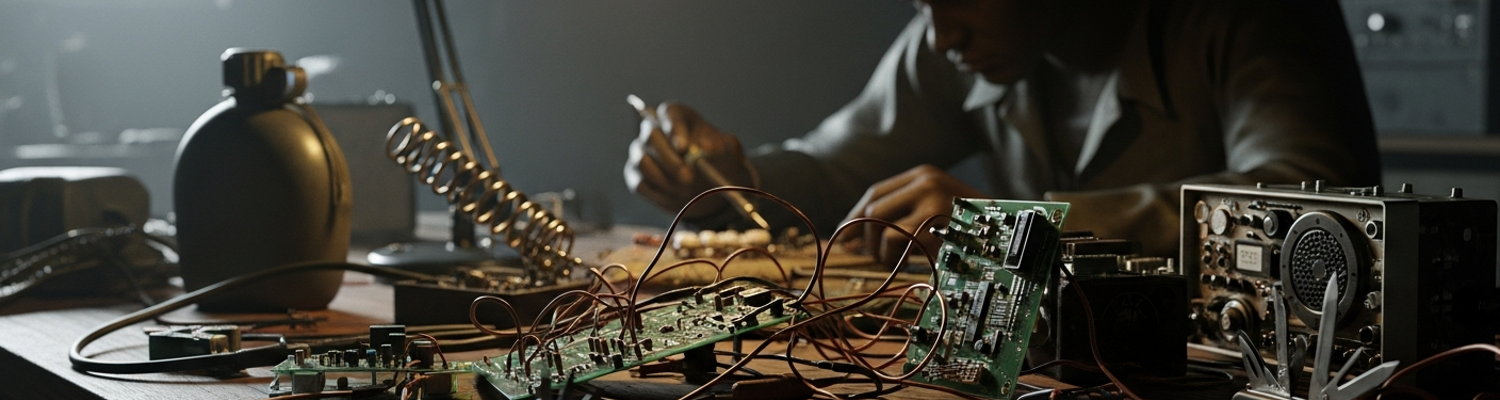
The specialist decided to bypass the BQR-21’s sophisticated digital processor entirely. His plan, outlined in sketches found in the mission logs, was to construct a crude, single-purpose analog filter. He would build a passive band-pass filter designed to aggressively strip out the high-frequency crunching and low-frequency groaning of the ice, leaving only a very narrow window of audio frequencies where the blade-rate and machinery hum of a Soviet submarine were most likely to appear. To do this, he cannibalized components from non-essential equipment. A review of the team’s equipment manifest suggests he likely scavenged capacitors and inductors from a spare AN/PRC-90 survival radio and possibly a secondary navigation beacon. Working inside a cramped, makeshift shelter, he began soldering these components together into a new circuit, a task made immensely difficult by the sub-zero temperatures.
The resulting device was a crude but functional processor. It was a small, shielded box of scavenged parts that fed directly from the raw hydrophone input into a standard pair of audio headphones. It provided no visual display, no target tracking, and no automated alerts. Detection rested entirely on the technician’s ability to discern a faint, repetitive pattern from the filtered, but still present, background noise. It was a severe technological regression, replacing a million-dollar digital system with a hand-built analog filter. Yet, it worked. The jury-rigged processor allowed the team to regain a marginal level of acoustic awareness, transforming the overwhelming chaos of the Arctic environment into a manageable, if primitive, listening problem.
Repurposed Field Technology
The crude analog filter was a temporary fix, a desperate stopgap against total system failure. Archival evidence shows the Electronics Technician recognized its limitations. The filter was unstable, susceptible to temperature drift, and lacked any amplification, forcing the sonar operator to listen for nearly imperceptible sounds. A more robust solution was required, and it was found inside a standard-issue AN/PRC-77 radio receiver. The ‘77 was a ubiquitous man-portable radio, but to the specialist, its key feature was its transistorized audio amplification module. This sub-assembly was designed to drive a handset speaker with a clean, powerful audio signal. He physically removed the module from the radio chassis, a process involving desoldering multiple connections on the main circuit board. Working with numb fingers in the cramped operational shelter, he then integrated this salvaged amplifier between his hand-built filter and the operator’s headphones. Power was drawn directly from the sonar array’s primary battery pack, a risky move that could have shorted the entire system. The modification worked. It provided the gain needed to make the faint, filtered acoustic signals audible, turning a potential submarine contact from a subliminal whisper into a distinct, analyzable tone.
The team could now hear potential targets, but they still had no way to visualize the data. The original AN/BQR-21 processor would have displayed the acoustic environment as a scrolling waterfall spectrogram, allowing an analyst to spot the faint, persistent line of a submarine’s machinery against the background noise. Without it, they were relying solely on the human ear. A close review of the mission’s technical logs reveals the next improvisation, a step that pushed the boundaries of field engineering. The team’s equipment manifest included an AN/PAS-7 thermal imager, a heavy, first-generation unit intended for night observation. These early thermal viewers were complex electro-mechanical devices, using an oscillating mirror to scan a scene across a small array of cooled detectors, with the resulting signal painted onto a miniature cathode ray tube (CRT) display. The technician correctly identified the display’s electronic driver board as a potential signal visualization tool. He cannibalized the thermal imager, discarding the heavy germanium optics and cryo-cooler assembly. He then bypassed the infrared detector input and fed the amplified audio signal from his modified sonar directly into the CRT’s vertical deflection amplifier.
The result was a crude, home-built oscilloscope.
The horizontal sweep of the electron beam remained timed by the imager’s original scanning mirror circuitry, while the vertical movement was now controlled by the acoustic signal’s voltage. This created a real-time waveform display on the AN/PAS-7’s small green phosphor screen. It was not a spectrogram, but it was a visual representation of the sound. A steady, repeating pattern on the screen could indicate a mechanical noise source long before the human ear could confirm it.
A final, and perhaps most unusual, innovation came from the team’s medical kit. A close study of special operations equipment lists from the period indicates that SEAL teams with advanced medical training would carry portable diagnostic equipment. In this case, the team possessed a military-issue field electrocardiograph (EKG), a device designed to monitor a patient’s heart rhythm. Like the thermal imager, the portable EKG of that era contained a small CRT screen and sensitive amplifiers designed to process and display weak electrical signals. When the modified thermal imager began to show signs of failure due to power drain, the technician turned to the medical monitor. He disconnected the patient input leads, which were designed to attach to an individual’s chest, and wired the audio output from his sonar amplifier directly to the EKG’s input stage. The machine, intended to display the P, QRS, and T waves of a human heartbeat, was now displaying the raw audio waveform of the Barents Sea soundscape on its screen. The device’s built-in filters, designed to isolate cardiac signals, had to be physically removed from the circuit board to allow the full spectrum of the acoustic data to pass through. This transformed a life-saving medical instrument into a submarine detection tool.
Intelligence Impact and Legacy
The raw audio captured on magnetic tape by the improvised sonar rig represented the single most important intelligence yield of the entire operation. A close review of the operator’s logs shows that the modified EKG display did not provide a clean, identifiable target. It showed a raw waveform, a frantic green line dancing on a tiny phosphor screen. The operator was looking for one thing: repetition. Amidst the chaos of the ice-filtered noise, a faint, rhythmic pulse emerged. It was not a clear sound, but a recurring visual pattern on the screen. This was the partial acoustic signature of a Project 971 Akula-class submarine. The team had no way to classify it, no library to compare it against. They could only record the raw, amplified audio from their hand-built processor, capturing several minutes of what was likely the blade-rate frequency of the Akula’s seven-bladed propeller and the low-frequency hum from its machinery rafting. This fragmented data, a series of magnetic imprints on a cassette tape, was the first-ever captured acoustic evidence of the West’s newest undersea adversary operating within its own protected bastion.
That single cassette tape forced a fundamental realignment of U.S. Navy anti-submarine warfare (ASW) doctrine. When the tape was delivered to the Office of Naval Intelligence (ONI), analysts at the Farragut Technical Analysis Center faced an unprecedented challenge. The audio was distorted, captured by non-standard equipment, and lacked the contextual data a proper sonar suite would have provided. Yet, it was all they had. New signal processing techniques had to be developed on the fly to clean the audio and extract a usable intelligence product. The effort confirmed the Navy’s worst fears: a new class of Soviet submarine was operating at noise levels comparable to, or even quieter than, their own Los Angeles-class boats. A review of ASW training directives from the late 1980s reveals a distinct shift away from hunting known, loud signatures. The partial Akula data, flawed as it was, became the cornerstone for developing new tactics focused on detecting ultra-quiet targets in high-noise environments. Sonar operator training was completely overhauled, moving from identifying clear signatures on a waterfall display to searching for faint, intermittent clues, much like the SEAL team had been forced to do. This one piece of intelligence invalidated the existing acoustic library and jump-started the development of the doctrine that would define undersea warfare for the remainder of the Cold War.
The mission’s most enduring legacy was its brutal exposure of a deep and unacknowledged intelligence gap in the U.S. Navy’s own technological capabilities. The complete failure of the standard AN/BQR-21 sonar system was a finding as important as the Akula signature itself. It proved that billions of dollars of advanced, temperate-water sensor technology was effectively useless in the Arctic. The ad-hoc system, built from a radio amplifier and a medical monitor, had succeeded where the purpose-built digital processor had failed. This stark lesson rippled through the naval procurement and research communities. An examination of naval technology programs initiated in the wake of this period shows a new emphasis on developing systems for the specific acoustic challenges of the polar regions. Investment surged into low-frequency passive sonar, with systems like the Surveillance Towed Array Sensor System (SURTASS) being adapted with new processing algorithms specifically to listen for the faint sounds of quieted submarines in acoustically cluttered littoral zones. The episode served as a powerful case study, demonstrating that the most sophisticated processor is worthless if its core assumptions about the operational environment are wrong. It highlighted the need for more adaptable, operator-in-the-loop systems that could be tuned and even modified in the field, a principle that would heavily influence the next generation of American sonar design.