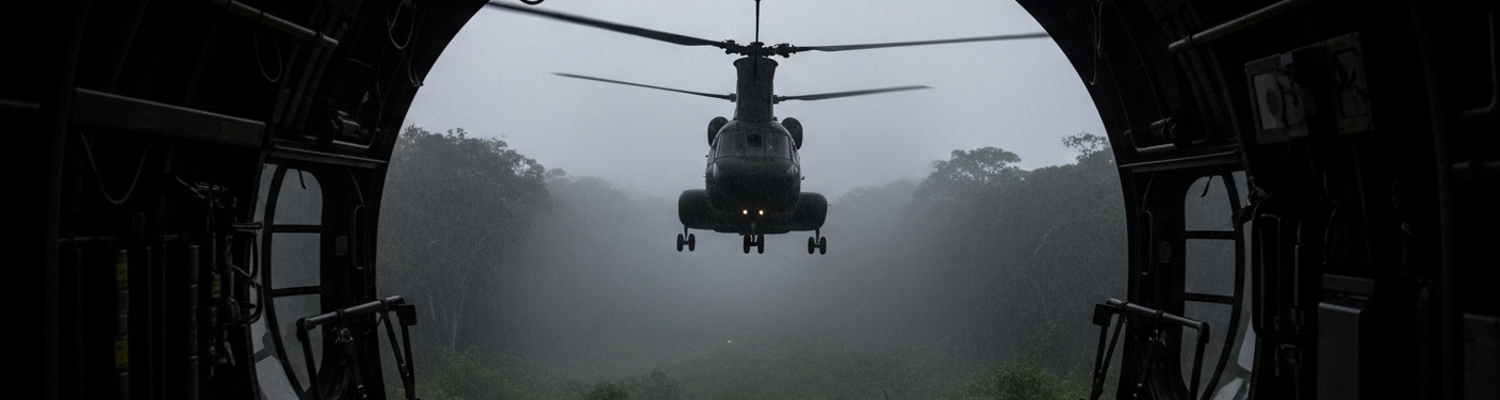

A close review of operational doctrine from the mid-1960s reveals a Marine Corps deeply invested in the helicopter. Scarred by the grinding attrition of Korean War beachheads, the Corps saw its future in vertical envelopment. The concept was a direct evolution of amphibious assault, designed to bypass fortified coastlines and enemy strongpoints by flying over them. Manuals and planning documents from Quantico depicted helicopter-borne forces landing with speed and surprise deep in an enemy’s rear, severing lines of communication and striking headquarters elements before a defense could be mounted. This doctrine was born on the drawing boards, a direct response to the threat of a nuclear battlefield where troop concentrations were a death sentence. The arrival of the Boeing Vertol CH-46 Sea Knight in 1964, intended to replace the older UH-34 Seahorses, was supposed to be the final piece of the puzzle. It could carry more troops, faster and farther, theoretically enabling the massed aerial assaults the doctrine required. The entire concept rested on a foundation of mechanical reliability, air superiority, and the element of surprise.
This theory was set for a major test in an operation codenamed Steel Serpent.
Archival evidence from III Marine Amphibious Force indicates that planners saw the A Shau Valley as an ideal target for a large-scale vertical envelopment. The valley was a known North Vietnamese Army logistical sanctuary and a primary infiltration corridor from the Ho Chi Minh Trail in Laos toward the coastal cities of Huế and Da Nang. Intelligence had pinpointed what was believed to be a regimental headquarters complex, the nerve center for NVA operations in the region. The plan for Steel Serpent was a direct application of doctrine: a swift, multi-battalion helicopter assault carried out by a Special Landing Force. In mid-1967, this meant units like Battalion Landing Team 1/3 or 2/3, supported by the CH-46s of a squadron like HMM-265, would lift off from amphibious assault ships of the Seventh Fleet, fly over the mountains, and descend upon the headquarters in a single, decisive blow. The operation was envisioned as a classic decapitation strike, eliminating enemy command and control in one swift action.
The target, however, was not an abstract pin on a map. Following the fall of the A Shau Special Forces Camp in 1966, the NVA had transformed the valley into a fortress. It was not a simple base area but a hardened, integrated air defense zone. The valley floor and surrounding ridges were riddled with interlocking firing positions for DShK 12.7mm heavy machine guns and even Soviet-supplied 37mm anti-aircraft cannons. These weapons created a lethal envelope that helicopters flying low and slow into a landing zone had to penetrate. The operational environment itself was a weapon. The valley’s unpredictable weather could ground all aircraft for days, and the triple-canopy jungle concealed enemy positions until the helicopters were directly on top of them. Early CH-46A models were also plagued by technical issues. Engine compressors were vulnerable to foreign object debris ingestion, and a series of catastrophic structural failures of the aft pylon had led to the grounding of the entire fleet in September 1967 for modifications (per NAVAIR 01-245FDB-2). The doctrinal manuals that envisioned wide-open landing areas had little to say about inserting a battalion into a 50-meter clearing surrounded by 150-foot trees and pre-ranged machine guns.
The doctrinal purity of Operation Steel Serpent, as conceived by the III Marine Amphibious Force, could not survive contact with the broader strategic map maintained by the Military Assistance Command, Vietnam in Saigon. A review of operational planning from the period reveals that General William Westmoreland’s headquarters viewed the Marine-centric plan for a deep vertical envelopment into the A Shau Valley with skepticism. MACV’s primary concern was not the tactical elegance of the assault but the high-level political risks it created. The A Shau was a logistical artery connected directly to the Ho Chi Minh Trail, and its westernmost reaches pressed against the sovereign, and theoretically neutral, territory of Laos. A large-scale American operation so close to the border threatened to create a major international incident, undermining the carefully constructed political limitations of the conflict. MACV’s solution was blunt. The deep, single-stroke helicopter assault was scrapped. Instead, the Marine assets, including the helicopter squadrons and infantry battalions of the Special Landing Force, were re-tasked to support a radically different strategy. They were fed into a grinding, attritional campaign along the Demilitarized Zone, a series of strongpoints and conventional ground offensives designed to block NVA infiltration at the point of entry into South Vietnam.
This was not just about a single operation. It was a symptom of a much larger inter-service realignment occurring in the I Corps Tactical Zone. I Corps was traditionally a Marine area of operations. By 1967, Westmoreland, an Army general, was consolidating his control over the entire theater. He believed the Marines were too focused on pacification and their own amphibious concepts, neglecting what he saw as the main fight: finding and destroying large NVA main-force units. This philosophical clash led to direct intervention. A close study of command chronologies shows MACV began inserting Army units into I Corps to pursue Westmoreland's attrition strategy. The most significant of these was the creation of Task Force Oregon, a provisional Army division-sized unit established in April 1967 and placed in the southern part of I Corps. Its presence altered the command dynamics. It created a parallel Army command structure within the Marine zone and pulled Marine air and logistical support away from III MAF priorities.
Marine commanders in I Corps now found their forces being dictated by Army operational concepts. The helicopter assets that were supposed to enable deep, maneuver-based warfare were instead relegated to shuttling troops between fixed positions along the DMZ or supporting the newly arrived Army formations. Instead of bypassing enemy strongpoints, the Marines were ordered to garrison and defend them, most notably at isolated outposts like Khe Sanh. This shift is evident in the operational record. Where Marine planners envisioned fluid, air-mobile operations, they were increasingly engaged in static defense and head-on assaults against fortified enemy positions. MACV’s interference, driven by political expediency and a differing strategic vision, effectively chained Marine air mobility to a conventional, ground-based war of attrition, negating the very advantages the Corps had spent a decade developing. The CH-46s, intended for lightning raids deep in the enemy's rear, were now committed to a protracted struggle for which they were not the ideal tool.
The doctrinal shift away from deep vertical envelopment strikes to a war of attrition along the Demilitarized Zone found its expression in Operation Kingfisher. Launched on July 16, 1967, this was not a surgical raid but a massive, sustained blocking action intended to prevent North Vietnamese Army divisions from infiltrating Quang Tri Province. Archival evidence from the 3rd Marine Division shows that the operation committed multiple battalions, including units like the 2nd Battalion, 9th Marines and 3rd Battalion, 4th Marines, to a wide area of operations south of the DMZ, centered around the strongpoints of Con Thien and Gio Linh. The helicopter, once envisioned as the key to unlocking an enemy’s rear, was now employed as a tactical shuttle, moving companies from one contested hill to another in a landscape defined by pre-sighted artillery fire. A review of the operational plan shows its objectives were conventional: sweep designated sectors, find and destroy NVA units, and disrupt enemy logistical preparations. This represented a complete inversion of air mobility doctrine, tying the CH-46 squadrons to fixed ground bases and predictable flight paths in one of the most heavily defended regions in South Vietnam.
A landing zone designated Dove became emblematic of the disconnect between planning and the tactical situation. A close examination of III MAF after-action reports and command chronologies reveals a failure in the intelligence and planning cycle. LZ Dove was one of several pre-designated helicopter landing zones for operations near Gio Linh. It was selected from aerial photographs and maps, appearing as a suitable clearing in the dense jungle terrain. The operational tempo and the extreme danger of the area precluded any form of on-the-ground reconnaissance. Force Recon teams could not remain in the field for more than a few hours, if not minutes, before drawing heavy fire. The entire region was under constant observation by NVA forward observers located in the sanctuary of the DMZ. Despite the known absence of ground-truth intelligence, the landing zone was approved for a major air assault. The doctrinal requirement for detailed, first-hand reconnaissance of a proposed LZ was sacrificed to the expediency of the new attritional strategy. Planners were forced to rely on sterile map analysis, a decision that ignored the NVA’s demonstrated expertise in camouflaging fortifications and pre-sighting landing areas with mortars and machine guns.
The NVA did not need spies.
The selection of LZs was further corrupted by high-level political restrictions. The formal rules of engagement strictly forbade U.S. ground forces from entering the Demilitarized Zone itself. This created an absurd tactical dynamic: the NVA could build, supply, and man extensive artillery and observation posts within the DMZ, firing on American forces with impunity, while III MAF was prohibited from crossing the boundary line to neutralize them. This political reality meant that any air assault had to be staged south of the DMZ's southern border. NVA military intelligence simply had to look at a map and identify the viable clearings just outside their sanctuary. LZ Dove and others like it were not just tactically poor choices; they were geographically predetermined targets. NVA artillerymen, using powerful Soviet-supplied 130mm field guns with ranges exceeding 10 miles, could register these LZs and wait. The political decision to respect the DMZ’s border created predictable killing zones, channeling Marine air assaults into the very muzzles of an enemy that could not be attacked at its source.
The first wave of CH-46 Sea Knights from Marine Medium Helicopter Squadron HMM-164 approached Landing Zone Dove at 1500 feet, the standard altitude prescribed by doctrine. Below them, the clearing appeared exactly as it had on the reconnaissance photos: a 60-meter patch of green surrounded by jungle. The illusion of a cold LZ evaporated with physical violence. As the lead aircraft descended past 1,000 feet, the surrounding tree lines erupted. A review of after-action reports from Operation Kingfisher indicates the North Vietnamese Army had turned the area into a prepared trap. They had withheld their fire, patiently waiting for the helicopters to commit to their landing approach and enter the most vulnerable phase of their flight profile. The designated landing zone, chosen by planners miles away, was now revealed to be a pre-ranged kill box.
The volume of anti-aircraft fire was overwhelming. NVA gunners, concealed in deeply dug-in and camouflaged positions, initiated the ambush with a barrage from DShK 12.7mm heavy machine guns. These weapons, firing at a 600-round-per-minute cyclic rate, sent streams of tracers and armor-piercing incendiary rounds lacing through the formation of descending helicopters. Analysis of airframe damage from this period shows the DShK was capable of penetrating non-critical components of the CH-46, but its true danger was fire and the potential to sever hydraulic or control linkages. Almost simultaneously, 37mm anti-aircraft cannons, likely Soviet M1939 models, joined the attack. These larger caliber weapons fired explosive shells that could destroy a helicopter outright. The aircrew’s nightmare was complete: a multi-layered, interlocking web of machine gun and cannon fire designed to shred the thin-skinned aircraft as they slowed to land. After-action interviews with pilots confirm the enemy gun crews were disciplined; they would not fire on every aircraft, instead concentrating their guns on one or two helicopters at a time to guarantee a kill.
In the face of this onslaught, doctrinal procedure was abandoned for survival. Marine pilots, trained for stable, patterned landings, were forced to improvise. Command chronologies from HMM squadrons operating near the DMZ detail a rapid evolution of tactics driven entirely by pilot experience. Instead of the gentle, multi-angle approach, pilots began executing high-speed, low-level assault approaches. They would fly toward the LZ at maximum speed just above the treetops, then execute a violent flare maneuver at the last possible second, pulling the nose up to bleed off speed and bounce the aircraft onto the ground. This minimized the time spent in the air as a slow-moving target. When LZs were found to be cratered by artillery or too small for a full landing, pilots performed one-wheel or two-wheel landings, balancing the helicopter precariously on the edge of a bomb crater or patch of solid ground while the Marines leaped from the rear ramp. If the fire was too intense, the lead pilot had the authority to declare the LZ Cherry, radioing a wave-off to all subsequent aircraft and aborting the insertion. This immediate, decentralized decision-making, born from the chaos over places like LZ Dove, became an unofficial but life-saving tactical deviation.
The raw after-action reports submitted by the pilots of HMM-164 and the company commanders of the 2nd Battalion, 9th Marines painted a damning picture of the LZ Dove engagement. A review of these initial field summaries (NARA Record Group 127) reveals a catalog of failures dictated from above. Pilots detailed how the pre-selected landing zone was a geographic funnel, perfectly registered by enemy mortars and anti-aircraft guns firing from the sanctuary of the DMZ. Ground commanders reported stepping out of helicopters into a pre-planned ambush, with NVA machine guns firing from camouflaged, interlocking positions that had clearly been prepared for weeks. The language was blunt. It spoke of predictable ambushes, a suicidal lack of ground reconnaissance, and flight paths that led directly into the teeth of an alerted enemy. One pilot’s report, later scrubbed, described the approach to LZ Dove not as a tactical maneuver but as flying into a box of fire. The initial casualty reports were stark, listing not just the numbers killed and wounded but the specific nature of the damage to the CH-46s. Hydraulic lines severed by 12.7mm fire, cockpits shattered, and at least one airframe lost to a catastrophic transmission failure under the stress of evasive maneuvers. These first drafts were a visceral, ground-truth indictment of the entire operational plan.
This unfiltered truth did not survive the journey up the chain of command. A comparative analysis of the initial field reports and the final, consolidated after-action report for Operation Kingfisher reveals a systematic process of revision and sanitization by higher echelons at the 3rd Marine Division and III Marine Amphibious Force headquarters. Specific, damning details were the first to go. Mentions of NVA forces firing from the legally untouchable sanctuary of the DMZ were generalized to heavy enemy resistance. Pilot complaints about the impossible tactical situation created by MACV’s political rules of engagement were removed entirely. The language was softened. Catastrophic intelligence failure became unexpectedly heavy enemy contact. Predictable killing zone was rewritten as heavily contested landing zone. Entire paragraphs from the reports of company commanders detailing how political restrictions on crossing the Ben Hai River allowed the NVA to observe and prepare for the assault with impunity were struck from the record. The final report was no longer a tactical analysis of a failed action but a curated narrative of heroism in the face of a determined foe.
This redaction served a clear purpose. It was to obscure the consequences of high-level strategic and political interference on tactical operations. To admit that LZ Dove was a pre-ordained disaster would be to admit that MACV's shift to a war of attrition along the DMZ, combined with strict political limitations, was getting Marines killed for no achievable gain. An honest after-action report would have been an official indictment of General Westmoreland’s entire strategy in I Corps, highlighting how the re-tasking of Marine air mobility assets to support a static, conventional ground campaign negated their doctrinal purpose and exposed them to unacceptable risks. The sanitized document papered over the disconnect, protecting the careers of senior officers and preserving the illusion of strategic coherence between III MAF and MACV. The final official casualty figures for the broader operation, 340 Marines killed and 1,461 wounded, were presented as the cost of a tactical victory, disconnected from the planning failures that inflated them.