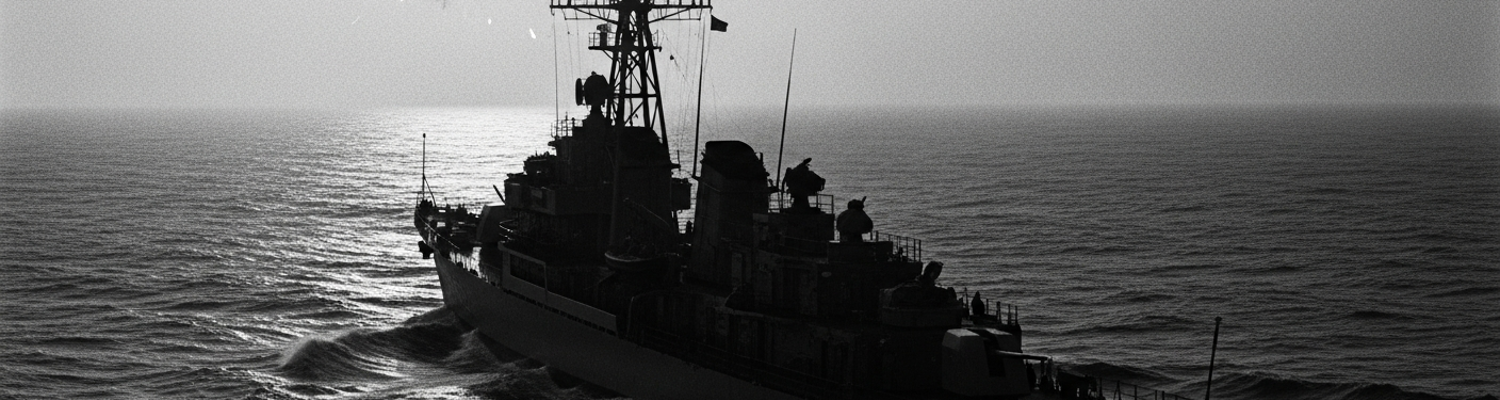

Silence on the bridge of the USS Mahlon S. Tisdale. The only sounds were the low whine of the gyrocompass and the hiss of ventilation. On the radar repeaters, green lines swept in hypnotic circles, painting an empty sea. Every man was at his station. The tension in the humid Caribbean air was a physical weight.
A review of Cold War naval doctrine reveals a framework built for simplicity. The guiding principle was the avoidance of ambiguity in a world governed by thermonuclear weapons. Operational planning from the period focused on open-ocean, blue-water engagements against a known peer adversary. The structure of a carrier battle group, submarine tactics, and a destroyer's mission profile were all optimized for clear-cut, decisive action.
Hesitation was not an option.
Planners in Newport and Norfolk envisioned coordinated strikes. Soviet bombers would be met by waves of F-4 Phantom interceptors hundreds of miles from the fleet. Soviet submarines would be hunted relentlessly by task forces of destroyers and specialized aircraft across the North Atlantic. The expected sequence was detection, classification, and immediate destruction. There was little room for warning shots, for hailing civilian vessels, or for the hesitant dance of escalation. The purpose of conventional force was to win a limited engagement so quickly and overwhelmingly that the opponent never had the time or the incentive to consider reaching for a tactical nuclear weapon.
Archival records confirm the USS Mahlon S. Tisdale (DD-826) was a product of this thinking. A Gearing-class destroyer, it had been surged from the Pacific Fleet to reinforce Atlantic forces. Its recent Fleet Rehabilitation and Modernization (FRAM I) refit had transformed the World War II-era hull into a dedicated submarine hunter. The primary weapon was not the pair of 5-inch gun mounts but the eight-cell RUR-5 ASROC launcher amidships, capable of delivering a homing torpedo or a nuclear depth charge to a submarine contact nearly ten kilometers away. Its senses were the powerful SQS-23 sonar, its bulbous dome projecting from the keel. The combat information center was designed to process data and generate a firing solution in minutes. Crew training was singular: find the submarine, sink it on the first attempt.
The 1962 quarantine of Cuba broke that doctrinal clarity. The term 'quarantine' was a careful legal distinction, not a declaration of war. It placed the Tisdale and its cohort in an impossible position. White House rules of engagement, filtered through a delayed chain of command, were fundamentally at odds with the ship’s design and the crew’s training. Orders specified graduated force: hails, then warning shots, then disabling fire at rudders or propellers. The objective was to stop and board, not to sink. Captains trained for obliteration were now maritime police, operating under the pressure that a single miscalculation could trigger a global nuclear exchange. The enemy was no longer a defined Soviet warship but a collection of ambiguous radar contacts. Freighters, fishing boats, Cuban patrol craft. Any one could be a proxy or a decoy.
A new directive arrived by encrypted teletype from CINCLANTFLT. It fundamentally altered the Tisdale's mission. The destroyer was detached from the main quarantine line and ordered to the southern coast of Cuba. Its new patrol box covered a jagged stretch of Oriente Province. The operational order specified the new assignment: aggressive coastal surveillance and interdiction. Intelligence briefings attached to the order suggested the possibility of Soviet-supplied Komar-class missile boats and P-6 motor torpedo boats being moved to clandestine anchorages, hidden amongst civilian fishing vessels.
The rules of engagement accompanying the assignment were dangerously vague. A review of declassified operational guidance from the period shows a pattern of command authorities attempting to micromanage tactical decisions from afar. The burden of action, however, remained with the commanding officer on scene. The ROE dictated a phased process of escalation. For any vessel deemed suspicious, the Tisdale was first to attempt hails by radio and signal lamp in English, Spanish, and Russian. If these failed, it was to fire warning shots from its 5-inch guns, but only well clear of the vessel. Following this, it could employ disabling fire aimed specifically at rudders and propellers. The order failed to define what constituted a suspicious vessel, leaving it to the bridge watch to distinguish a fast-moving fishing skiff from a torpedo boat in the dark. It offered no guidance on how to handle a vessel that maneuvered erratically. Every decision point was a gray area.
The ship's officers registered deep concern. The ship’s logs and after-action reports (AARs) contain formal questions about the mission’s feasibility from the Operations and Gunnery officers. The Operations Officer noted the severe limitations of the AN/SPS-10 surface-search radar in a cluttered coastal environment. The radar, designed for open-water contacts, was known to be degraded by land-mass interference and sea clutter. This made reliable tracking of small, low-freeboard wooden vessels nearly impossible. The Gunnery Officer’s objections were more pointed. The ship's twin 5-inch/38 caliber gun mounts were designed for anti-aircraft fire or shore bombardment. The fire-control system was not built for precise, non-lethal shots against a small, fast, maneuvering target at close range. The Tisdale, a 3,500-ton deep-water vessel, was also unsuited for the shallow, confined waters close to the Cuban coast. Its primary ASROC weapon was useless for this task.
01:17 local time. An intermittent contact appeared on the AN/SPS-10 surface-search radar in the Combat Information Center. Skunk Alpha. The ship's operational logs show the target moving at an erratic speed over 30 knots, dangerously close to the three-fathom line along the coast of Oriente Province. The behavior was suspicious. The radar return was weak, suggesting a small, low-freeboard vessel, likely of wooden construction. Intelligence briefings had warned of Soviet P-6 torpedo boats in the area. The vessel was running dark. It refused to respond to hails on international maritime frequencies.
The order came to intercept.
The command for flank speed sent a shudder through the 3,500-ton destroyer. Its steam turbines, designed for open-ocean sprints, pushed the vessel forward. The pursuit lasted 73 minutes. Deck logs indicate the destroyer was at a disadvantage. For every turn the small craft made towards the shoreline, the Tisdale, with its larger turning radius, had to execute a wide, time-consuming loop to maintain an angle. At 01:48, after multiple unanswered challenges, the captain ordered warning shots. The forward 5-inch/38 gun mount trained out. Its fire-control system struggled for a stable lock on the low-profile target amidst heavy sea-return. Two star shells were fired, bathing the sea in temporary daylight. The vessel did not stop. Two high-explosive rounds followed, fired into the water ahead of the craft’s path. The geysers of water were visible to lookouts. Skunk Alpha did not slow.
The destroyer was too big.
The task was impossible. The Tisdale was a blue-water warship built to hunt submarines, not to play cat-and-mouse with a speedboat in coastal shallows. Its SQS-23 sonar was useless. Its ASROC system was irrelevant. The ship's draft of over 14 feet made closing with the coastline a navigational hazard, forcing the officer of the deck to divide his attention between the tactical plot and the fathometer. The turbulent waters of the Windward Passage handicapped the larger vessel while favoring the smaller craft. The target boat used wave crests and troughs to its advantage, periodically vanishing from the SPS-10 radar. Archival analysis of the destroyer’s fire-control systems shows they were not designed for the precision required for non-lethal disabling fire under these conditions. Hitting the rudder of a small boat maneuvering erratically in heavy seas at night was a matter of chance, not skill. At 02:30, Skunk Alpha made a final, sharp turn toward an inlet south of Punta de Maisí. Its radar signature merged with the landmass return from the cliffs and vanished.
The chase of Skunk Alpha exposed deficiencies in the Tisdale’s sensor and weapon systems. In the Combat Information Center, the primary AN/SPS-6 radar presented a picture of confusion. The radar was developed for detecting aircraft, with a secondary, limited surface capability. Its large parabolic antenna was optimized for long-range air search, not for discriminating a small boat from wave tops. The ship’s logs from the engagement detail the operator’s struggle. The scope showed a high degree of sea return, the electronic echo of the Caribbean waves. The low-riding target produced a weak pip that would vanish for several sweeps, lost in the background noise. Operators manually adjusted gain and sea-clutter suppression. Reducing the gain to dampen the sea return made the target disappear. Increasing it drowned the scope in noise. The AN/SPS-6, a product of late 1940s technology, lacked the resolution to distinguish the wooden hull from the sea and land it used for cover.
This failure was absolute.
This corrupted track data fed into the Mk 56 Gun Fire Control System (GFCS) guaranteed an inaccurate engagement. The Mk 56 was a post-World War II electromechanical system, fundamentally analog. Its design was a complex network of spinning gyroscopes, servo motors, and machined cams built to solve a ballistic firing problem. The system received target bearing and range from radar, own-ship course and speed from the gyrocompass, and pitch and roll data from its internal gyros. It then mechanically calculated a predicted target position and transmitted gun orders. The system was designed for use against subsonic aircraft or large ships on steady courses. It could not cope with the bad data. The fading and reappearing target meant the analog computer could never establish a stable track or calculate a reliable speed. The destroyer's violent pitching in heavy seas introduced errors the mechanical stabilizers could not correct. The target’s high speed and radical maneuvering defied the computer’s predictive algorithms. The fire control solution was always seconds behind the target’s actual position.
Naval gunnery doctrine was predicated on achieving rapid, destructive fire superiority. Training emphasized hitting and destroying the target on the first salvo. The rules of engagement, however, demanded precision disabling fire. The technical failures made even that impossible. An after-action report notes the forward gun mount fired twelve 5-inch rounds after the initial star shells. None came close to hitting Skunk Alpha. The shells landed erratically. The Mk 56 system failed to provide a coherent solution. The Tisdale, a warship built for decisive combat, was rendered tactically impotent by a vessel a fraction of its size.
The failure to intercept Skunk Alpha heightened the tension. At 03:05, a second contact materialized on the SPS-10 scope. Skunk Bravo. It was slower, on a steadier course, well inside the 12-mile territorial limit. It moved at eight knots and appeared larger than the first contact. The bridge team was on high alert. Hails by radio and signal lamp went unanswered. The captain concluded it was another probe of the quarantine line. He ordered the ship to close with intent to enforce the ROE through disabling fire. At a range of 2,000 yards, the forward 5-inch gun mount fired a single high-capacity explosive round aimed at the water aft of the target’s stern. A technical review of the fire control solution showed the Mk 56 was still struggling, but the target’s slow movement offered a more stable track. The shell did not land in the water. A miscalculation in the analog system, compounded by an unexpected roll of the ship, sent the round directly into the vessel’s aft quarter. The detonation was catastrophic.
The warship had just fired on a Cuban fishing boat.
The mission of interdiction became one of rescue. The Tisdale’s motor whaleboat launched into the choppy water, guided by searchlights toward the debris. They found carnage. The vessel, a 60-foot wooden trawler named Estrella del Mar, was nearly torn in half. The 5-inch shell had detonated in the small engine compartment, turning machinery and hull into shrapnel. A post-action assessment concluded casualties were not from the initial blast but from the secondary effect of the wooden hull’s disintegration. Men sleeping in their bunks were killed instantly. Of the twelve crew members, five were dead. The seven survivors, some grievously wounded, were pulled from the water. They were fishermen in oilskins and work boots, suffering from blast trauma, deep lacerations from wood splinters, and burns. The rescue team loaded the wounded into the whaleboat for the trip back to the destroyer.
On the fantail of the Tisdale, chaos unfolded under the isolated glare of emergency battle lanterns. The ship was still at general quarters, rigged for red lighting to preserve night vision. The ship’s doctor, a young lieutenant, demanded bright light. Main deck lights were out of the question; they would illuminate the destroyer for any spotter on the Cuban coast. Corpsmen brought out portable, battery-powered lanterns. Their white beams cut through the red ambient light, casting long shadows across the steel deck. The ship’s medical bay was too small, forcing triage into the open air. The ship’s medical log records the accounting. Two men required immediate amputation. Another had a sucking chest wound. Multiple patients had compound fractures and penetrating shrapnel wounds. The deck, slick with salt spray, became slick with blood. The handful of hospital corpsmen were overwhelmed. They worked frantically, applying tourniquets, inserting IV lines, and dressing wounds. Sailors who moments before had manned gun mounts were now holding lanterns, restraining injured men, and ferrying supplies from sickbay. The only sounds were the hum of generators, the doctor's commands, and the moans of the wounded.
Amidst the carnage on the fantail was a civilian. Alistair Finch. An accredited correspondent for the European edition of Stars and Stripes, assigned to a routine story on quarantine operations. His press credentials show he was a former wire service reporter who covered the French withdrawal from Indochina. He understood violence. As corpsmen worked on the fishermen, Finch documented. With a Nikon F camera, he captured the scene in unflinching detail. The flash of his camera’s bulb caught the glint of a surgical clamp, the exhaustion on a young sailor’s face, a crude, bloody stump where a leg had been. He took notes in a spiral-bound pad, his pencil moving with practiced speed.
There was the truth, and there was the official report.
The dispatch Finch filed was a model of journalistic precision, stark and devoid of emotion. It chronicled events from the first contact with Skunk Alpha to the shell that struck the Estrella del Mar. His photographs were more damning. One frame, seen in declassified contact sheets, showed the ship’s doctor, his face spattered with blood, looking into the camera with an expression of defeat. Another showed discarded, blood-soaked battle dressings next to a fisherman’s wicker creel. A review of the Tisdale’s outgoing message logs for the same period reveals a different narrative. The captain’s initial after-action report, destined for CINCLANTFLT, was written in the sterile, passive language of naval bureaucracy. The Estrella del Mar was Skunk Bravo. The engagement was a successful neutralization of a non-compliant vessel. The fishermen’s deaths and injuries were cataloged as collateral damage. The failure of the fire control system was omitted, replaced by a note on the unpredictable performance of ordnance in a high sea-state.
This divergence solidified a cynicism among the ship’s junior officers. In the destroyer’s wardroom, which still bore the stains of its use as a surgical theater, the lieutenants and ensigns saw both versions of the night’s events. They had been on the bridge, in the CIC, and on the fantail. They had seen Finch’s photographs. They had also seen the draft of the captain’s report on the ship’s teletype. For the Operations and Gunnery officers, it was a bitter confirmation of their earlier warnings. Their documented concerns about the radar and gunnery systems' unsuitability had been proven correct in a horrific way, yet the official record was written to obscure that failure. The trust that underpins the chain of command began to evaporate. The mission was no longer a matter of national defense; it was an exercise in political messaging, and they were complicit in a lethal fiction.