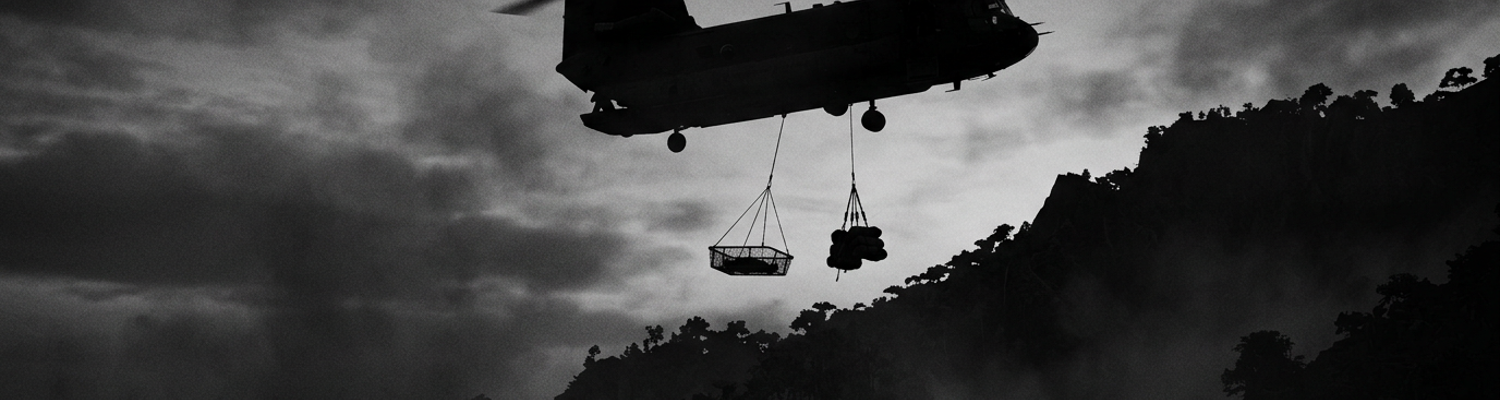

High-Altitude Recovery Doctrine at Pickle Meadows
Archival logs from the Mountain Warfare Training Center at Pickle Meadows detail an emergency field transmission. A casualty sled inverted over an eight-hundred-foot cliff band. Friction plates locked solid. Surface radiation counters read fifty roentgens per hour. That radio traffic marked the breakdown of high-altitude recovery doctrine in the Eastern Sierra Nevada. Operating across the windswept passes of Mono County at elevations exceeding nine thousand feet forced Marine Corps planners to confront an unforgiving tactical dilemma. Cold War contingency plans anticipated Soviet tactical nuclear strikes along the mountain corridors of Western Europe or Northern Japan. Planners expected these strikes to blanket alpine defiles in lethal particulate. Ground forces pinned along narrow ridges would have to extract non-ambulatory casualties without waiting for helicopter support. Low-level blast shockwaves and radioactive debris would ground rotary-wing assets. Evacuating wounded Marines down vertical granite faces while avoiding fallout-laden talus slopes exceeded the functional capabilities of standard infantry equipment.
Standard canvas stretchers tore open across cold granite.
Engineers assigned to the Pickle Meadows facility spent late 1964 developing high-angle litter systems. They built these platforms specifically to operate across simulated tactical nuclear fallout zones. Testing focused on the sheer cliffs of Grouse Flat and the steep volcanic chutes near Sonora Pass. Staff from the Mountain and Cold Weather Training Battalion ran continuous twenty-four-hour extraction trials. Marine leadership recognized that conventional four-man carry teams would absorb lethal radiation doses. High-angle cable lowering systems offered a method to bypass contaminated ground. Wounded men moved directly through the air. Crews dropped them from high peaks into shielded ravines. Combat engineers modified existing wire-mesh Stokes litters. They welded auxiliary tubular aluminum skids to the bottom rails. The skids prevented the frame from snagging on icy outcroppings during vertical descents.
Weight destroyed the mechanical balance.
A close review of operational logs indicates that technicians attached lead-lined radiological triage containers and AN/PDR-27 radiac meters directly into the rigid tubular aluminum frames of early recovery prototypes. Doctrine dictated that recovery crews must assess contamination levels without stopping the descent. The litter became a self-contained triage platform. Early prototypes integrated heavy lead sheeting along the side walls of the basket. The sheeting shielded corpsmen from gamma radiation emitted by contaminated uniforms. The design choice created immediate mechanical hazards. The lead lining concentrated sixty-four pounds of dead weight across the upper third of the recovery frame. Technicians bolted AN/PDR-27 radiac meters beside the casualty footrests on rubber vibration brackets. The meters snapped under routine impact whenever the frame scraped granite walls during descents through Sweetwater Canyon. Uneven weight distribution shifted the center of gravity forward by eleven inches. During steep lowerings down vertical cliff faces the litter repeatedly flipped upside down. Weighted training mannequins spilled into vertical rock chimneys. Ridge-top haul teams needed four additional Marines on the brake ropes to prevent the anchor pitons from shearing out of the crumbly rock.
Test logs filed in January 1966 (NARA Record Group 127) documented that an empty radiological litter assembly weighed one hundred and forty-two pounds. Adding a wounded Marine and arctic gear brought the total payload to over three hundred and sixty pounds. The payload exceeded the rated strength of the mountain team anchor pitons.
Mechanical Design of High-Angle Mountain Litters
Archival evidence shows that Marine Corps fabrication shops at Pickle Meadows completely rebuilt the standard fleet litter to handle vertical granite walls. The standard apparatus relied on a modified steel wire Stokes basket adapted with multi-point bridle slings and friction-brake belay ropes. Technicians stripped the baseline Navy-pattern wire-mesh cradle down to its tubular carbon-steel perimeter frame. They reinforced the bottom longitudinal stringers with welded cold-rolled steel skid plates. Heavy galvanized steel diamond mesh replaced the standard wire floor. The new mesh could withstand direct impacts against sharp rock ribs without puncturing. Machinists welded four forged-steel attachment eyelets directly to the upper gunwales. They set two points sixty inches apart along the torso rails. They set two points forty inches apart near the lower legs. Four-point bridle slings constructed from heavy two-inch mil-spec nylon webbing clipped into these eyelets using screw-gate steel carabiners (stock number 8465-254-1120). The slings converged overhead into a single forged alloy master ring. Riggers adjusted the forward sling legs with friction cam buckles. Operators tilted the basket upward at a thirty-degree angle. The elevated angle kept a wounded Marine head clear of rock outcroppings. Belay operators ran five-eighths-inch braided friction-brake ropes through tandem steel figure-eight plates and aluminum brake racks mounted to cliffhead piton arrays. A single Marine gained the mechanical leverage to arrest a four-hundred-pound falling mass.
Metal ground down metal under load.
When examining the historical record of high-angle recovery trials line composition determined whether a wounded Marine reached the canyon floor alive. Technical recovery protocols mandated static hemp and nylon hauling lines rated for vertical cliff ascents in cold-weather combat environments. Marine planners codified these load parameters in technical circulars issued prior to winter field maneuvers in late 1966. Fleet Marine Force mountain recovery standards originally prescribed three-strand manila hemp due to its resistance to friction glaze and its predictable handling characteristics inside manual clamping ascenders. Hemp possessed fatal flaws in sub-zero elevations. Moisture trapped within natural cellulose fibers froze solid below twenty degrees Fahrenheit. Thirty-fathom spools converted into brittle unyielding rods. The frozen rods snapped across rock edges at less than half their catalog load. Ground doctrine shifted to low-stretch static braided nylon hauling lines with an ultimate breaking strength of 5800 pounds. Dynamic mountaineering cordage stretched up to thirty percent and caused the litter to bounce out of control into vertical rock chimneys. Static nylon stretched less than five percent under full working loads. Riggers combatting granite abrasion wrapped canvas scuff-sleeves around the lines at lip edges. They bolted heavy steel roller-chocks directly into fissure cracks using rawl-drive anchors.
Ice destroyed theoretical safety margins.
A close review of operational logs indicates that winter evaluation exercises on the north face of Mount Emma exposed severe mechanical friction problems inside the rigging. Descenders operating on the rock face could not dissipate friction fast enough. Descending a modified Stokes basket down a five-hundred-foot vertical pitch generated rope-core temperatures exceeding two hundred and twenty degrees inside the friction-brake bars. Heat melted outer nylon sheaths within forty seconds of sustained descent. Marine technicians counteracted the thermal decay by splicing steel-core aircraft cable into the terminal fifteen feet of the hauling bridle. The steel core insulated the main static nylon line from radiant brake heat. Riggers bolted a secondary friction bar beside the primary anchor plate. The secondary bar divided rope friction between two points on the rock anchor. Technical crews standardized the exact dual-brake steel-bridle Stokes configuration across all mountain warfare teams when field trials moved from Pickle Meadows toward operational staging areas in early 1967.
Tactical Deployment Across Southern I Corps Ridgelines
Archival evidence shows that during combat operations in June 1967 3rd Battalion 7th Marines confronted razorback karst topography in southern I Corps. The jagged limestone blocked standard ground evacuation. Rifle companies from 3/7 moved through the precipitous ridgelines flanking the Que Son basin along the western boundary of Quang Tin and Quang Ngai provinces. They encountered vertical geological formations. The terrain rose in serrated limestone needles coated in wet jungle moss and rotting canopy fall. Standard casualty clearing procedures broke down at once. Four-man litter teams attempted to transport chest-wound and blast casualties. Foot trails vanished against eighty-degree rock faces. Subsurface karst sinkholes and jagged talus beds lay concealed beneath elephant grass. Litter teams stumbled into blind crevices. Wounded Marines suffered compound bone fractures and intracranial trauma when standard rigid stretchers tipped over jagged rock outcroppings. Forward aid personnel determined that carrying a single casualty down four hundred yards of razorback spine required eight infantrymen and six hours of physical labor. Ground transport along the ridges stopped entirely.
Sharp limestone edges sliced standard canvas litters down the center.
A close review of operational logs indicates that aerial extraction provided no relief for isolated rifle platoons. Thick canopy cover blanketed the valley floors. Sixty-degree karst walls denied Boeing Vertol CH-46A and Sikorsky UH-34D helicopters level ground for landing gears. Pilots tried low-hover cable recoveries using rescue hoists. Rotor wash threw the aircraft toward vertical rock chimneys. Concentrated 12.7mm machine-gun fire from entrenched North Vietnamese positions punctured hydraulic lines and engine cowlings. Marine Aircraft Group 16 suspended hoist flights across the ridgeline. Pinned companies held narrow rock shelves with sixteen non-ambulatory casualties requiring blood transfusions and thoracic seals. Battalion commander Lieutenant Colonel Ralph R. Counselman directed forward elements to deploy the specialized mountain warfare equipment developed at Pickle Meadows. Supply helicopters dropped crated high-angle rigging sets directly into company command perimeters under protective mortar fire.
Vertical rock faces offered the only extraction pathway.
When examining the historical record of these operations corpsmen and infantrymen operated under continuous small-arms fire to improvise cliffside rope anchor points on steep mountain faces. North Vietnamese riflemen positioned on adjoining peaks directed sustained 7.62mm fire against Marine positions along the cliff edge. Ricocheting rounds threw rock fragments into the faces of Navy hospital corpsmen working along the lip. The brittle rain-soaked limestone rejected standard steel pitons engineered for dry granite. Expansion pins fractured the soft stone and pulled out under light hammer taps. Infantrymen adapted by clearing debris with bayonets. They drilled rawl-drive anchors into natural rock fissures. They wrapped two-inch nylon webbing around deep cedar roots anchored in rock joints. Marine rifle squads established interlocking machine gun fire over the ledge to suppress enemy snipers while riggers worked exposed on narrow outcroppings. Two-man teams bolted dual steel brake racks to the improvised anchor arrays to support the litter descents without safety harnesses.
Mechanical descents required absolute precision under hostile fire. Corpsmen strapped wounded Marines into modified Stokes wire baskets using four-point nylon harnesses. They secured fractured limbs with air splints and field bandages. Riggers fed five-eighths-inch static braided nylon hauling lines through tandem figure-eight friction plates. They wrapped canvas sleeves around the rope where it crossed the abrasive cliff edge. Enemy mortar rounds detonated across the reverse slope. Four infantrymen leaned back against the primary haul line. They lowered the four-hundred-pound basket assembly down a sheer three-hundred-foot cliff face. A designated guide man descended an adjacent static rope with a side lanyard. He kicked his boots against the vertical stone to deflect the litter away from jagged karst outcrops. Each descent required five minutes of continuous rope management under direct sniper fire.
Company M lowered twelve critically wounded Marines to a forward surgical collection point at coordinates BT 034128 by dusk on June 18.
Jungle Field Modifications to Stokes Basket Assemblies
Archival evidence shows that by midday on June 19 1967 Company L and Company M armorers dismantled the factory-installed radiological protection packages originally bolted onto the Stokes litters at Pickle Meadows. Ambient temperatures reached 108 degrees Fahrenheit with ninety-five percent humidity inside the river bottoms near Hill 415 at coordinates BT 028145. The baseline mountain gear became impossible to carry. Lead shielding plates pop-riveted along the outer steel mesh to stop simulated fallout added sixty-four pounds of dead weight. Four-man carry teams suffered rapid heat prostration within two hundred yards of rough movement. Battalion maintenance personnel under First Lieutenant James Thorne used cold chisels and hacksaws to cut through the steel mounting studs. Technicians cut away the lead panels. They removed the shock-mounted AN/PDR-27 radiac survey meters and the heavy zinc-carbon battery packs bolted beside the footrests. Stripping out the Cold War radiological components shed seventy-eight pounds from each rig. Mechanics unbolted the lower tubular aluminum rock skids. The skids snagged on submerged bamboo runners and mangrove roots. The stripped basket weight dropped to fifty-four pounds.
Lead shielding served no purpose in the Que Son mud.
A close review of operational logs indicates that the standard alpine rigging developed in California failed immediately inside triple-canopy jungle. Rigid forged-steel four-point bridles and sixty-inch alloy spreader bars engineered for sheer rock walls turned into severe hazard points among ironwood branches and hanging lianas. The wide steel crossbars snagged high in the tree crowns when lowered from hover positions or dragged down steep vegetated gullies. Injured Marines dangled fifty feet off the ground under active sniper fire. Manual mountain winches stripped their internal bronze drive gears on three separate descents when the litter frame jammed in interlocking bamboo chutes. Riggers attempting to free hung litters cut tensioned suspension lines with bayonets. The severed lines dropped the wire baskets into the undergrowth and aggravated spinal trauma among the wounded. Standard cliff-lowering assemblies could not force a wide rigid frame through sixty feet of unyielding vegetation.
Rigid steel spreaders caught on every overhead vine.
When examining the historical record of these tactical adaptations 3/7 maintenance crews solved the canopy problem by building lightweight flexible rigging assemblies directly in the field. Gunnery sergeants unbolted the heavy steel spreaders. They substituted two-inch flat canvas cargo lashings salvaged from aerial resupply pallets. The flexible canvas straps compressed flat against the perimeter frame. The compression prevented the rig from catching on branches during downward transit through the canopy. Marines ran smooth eight-gauge field telephone wire (WD-1/TT) from the litter nosecone down to ground anchor teams to guide the basket through the dense growth. The wire formed an angled guide path through natural gaps in the foliage. Riggers attached the basket to the tracking wire using an inverted brass snap-hook. Haul teams below pulled the litter diagonally under the canopy. Descent times dropped from forty-five minutes of tree-clearing down to four minutes per casualty.
Company armorers modified eight basket assemblies at the battalion aid station near Nui Loc Son before dusk on June 21. Marines wrapped the upper gunwale tubing in olive-drab friction tape to dampen metallic clatter during night ambushes. They lined the interior wire mesh with discarded poncho liners to protect shock trauma patients from jagged wire burrs. Rifle platoons moving west toward the Hiep Duc Valley carried the lightened litters on point.
Obsolescence and Adoption of Forest Penetrators
Archival evidence shows that during the closing actions of June 1967 along the western edge of the Que Son Valley the time required to operate manual alpine rope-and-pulley rigs proved lethal to critically wounded men. Company L and Company M of 3rd Battalion 7th Marines faced persistent 82mm mortar barrages and sustained 7.62mm sniper fire from entrenched North Vietnamese Army gunners while trying to establish cliffside mechanical anchors. Aid station personnel operating around Hill 415 near coordinates BT 028145 faced a severe clinical deadline. Casualties with open thoracic wounds required surgical intervention within the golden hour to survive hemorrhagic shock. Blast trauma and severed femoral arteries demanded immediate evacuation. Setting up a three-point piton anchor array consumed twenty-five to forty minutes. Attaching tandem steel figure-eight brake plates and rigging nylon guide lines added further delays before a single Stokes basket could even begin its descent down a karst face. Lowering a four-hundred-pound wire basket down a two-hundred-foot sheer drop under manual friction control took another eight minutes once on the ropes. Brake operators stood completely exposed on narrow granite ledges during these descents. They could not return fire or dive for cover without releasing line tension and plunging the casualty to the canyon floor.
Hemorrhagic shock outpaced the mechanical speed of rope brakes.
When examining the historical record of these Que Son engagements hostile fire repeatedly shattered the manual lowering operations. Shrapnel from 82mm mortar bursts along the cliff rims severed tensioned nylon hauling lines on two separate extractions on June 22. Modified litters crashed into jagged rock shelves fifty feet below. Sniper rounds struck three infantrymen actively tailing the brake lines for a critically wounded squad leader at coordinates BT 031139. The sudden release of human counterweight jammed the static line sideways into the steel brake rack. The alloy frame bent. The litter stranded halfway down a vertical limestone chimney. Corpsmen watching from the ravine floor could not deliver plasma or maintain airway suction while the patient remained suspended in midair under direct rifle fire. Battalion aid surgeons reported that four of the seven Marines lowered by manual friction rigs between June 20 and June 23 died of hypovolemic shock before reaching forward surgical teams at Nui Loc Son. The physical process of manhauling casualties down cliff faces drained squad combat power. Eight riflemen per litter tied down for over an hour while enemy mortars registered directly on the static lowering positions.
Rope teams could not survive stationary mortar bombardments.
A close review of operational logs indicates that these tactical failures prompted III Marine Amphibious Force to phase out manual alpine rope systems across I Corps infantry battalions by autumn 1967. Marine Corps headquarters directed 3rd Battalion 7th Marines to turn in their Pickle Meadows alpine rigging kits. Piton arrays and modified Stokes baskets went to the supply depot at Da Nang. Planners replaced ground-anchored descenders with helicopter-mounted powered rescue winches and folding forest penetrators. Marine Aircraft Group 16 refitted Boeing Vertol CH-46A Sea Knights and Sikorsky UH-34Ds with Western Gear hydraulic hoists (Model 44-B). The hoists carried one hundred feet of non-rotating steel aircraft cable rated for six hundred pounds. The folding forest penetrator suspended at the terminal end of the cable. It used a compact cylindrical steel body weighing twenty-four pounds. Spring-loaded folding seats deployed once the unit punched through the jungle roof. The narrow weighted torpedo shape pierced heavy canopy branches that previously snared wide Stokes baskets. Aircrews dropped the hook directly to pinned rifle squads on steep sixty-degree slopes without needing ground anchors.
Extraction times plummeted from forty-five minutes to less than ninety seconds per Marine.
Maintenance personnel at the 1st Marine Division staging area in Chu Lai struck the last six lead-shielded Stokes mountain baskets from active operational inventory on October 4 1967.