
The first American commitment to the Royal Kingdom of Laos was a paper strategy. It arrived in crates filled with World War II surplus. M1 Garand rifles, M1 carbines, Browning Automatic Rifles, and M3 submachine guns were stacked high, intended to standardize the new Royal Lao Army (RLA). The plan, conceived in Washington D.C. and Honolulu, was to build a 25,000-man conventional force from a lightly armed constabulary. This new army would resist Pathet Lao and North Vietnamese influence.
It was an army designed to fight a European war.
A close review of declassified Programs Evaluation Office (PEO) documents reveals an advisory team operating with a fundamental disconnect from the Laotian environment. The PEO, established in December 1955 and staffed by retired or civilian-clad American military personnel to circumvent the 1954 Geneva Accords, was tasked with this military buildup. Their initial assessments of the RLA were blunt. Advisors, many with experience in post-war Germany and Korea, saw an undereducated, poorly trained force. The officer class was stratified, mirroring the social habits of its former French colonial mentors. The PEO’s solution was to impose a Western military structure, drafting tables of organization that called for infantry battalions and integrated logistics. A blueprint for a miniature US Army.
This assessment treated the Laotian soldier as a standardized input and the kingdom as a simple geographical problem. There was little evaluation of how a largely illiterate, subsistence farming population could maintain complex machinery. The plan was to supply the hardware and assume the culture of military discipline and technical skill would follow.
It would not.
The theoretical army collided with the physical world. The arterial road network, specifically the critical Route 13 running parallel to the Mekong River, was a string of loosely connected dirt tracks and crumbling colonial pavement. American planners, accustomed to Europe’s dense network of all-weather roads, presumed a functional system for moving supplies. The two-and-a-half-ton M35 cargo trucks, the designated workhorses, were ill-suited for the conditions. Suspensions shattered on axle-deep potholes. Transmissions failed under the strain of constant, low-gear churning through mud. During the monsoon season, from May to October, entire sections of the road network simply dissolved. Dirt tracks became impassable swamps. A journey that might take a day in the dry season could take weeks during the rains, if it was possible at all. Operational logs (NARA Record Group 472) detail convoys stranded for days, their cargo of ammunition and rice spoiling in the humid air, waiting for a washed-out wooden bridge to be repaired.
American logistical doctrine was predicated on an infrastructure that did not exist. Secure warehouses, paved airfields, and reliable fuel depots were fantasies in 1957 Laos. The PEO’s plan required a massive supply chain, but planners had to build it from scratch in a country lacking reliable electricity. Ammunition and sensitive equipment, which required climate-controlled bunkers, were often left on open-air landing strips under tarps. Rust and corrosion became a potent enemy. The few existing airfields, like the one at Vientiane, were often short, unpaved laterite strips. They could not support the weight of larger transport aircraft like the C-47 Skytrain in wet conditions, limiting the volume of any strategic resupply and forcing a reliance on smaller, less efficient planes. Fuel was laboriously transported in drums, which were prone to leaks and contamination, further straining the fragile supply lines.
The annual monsoon did not complicate logistical operations; it annihilated them. The unpaved laterite and dirt tracks transformed into impassable quagmires. A review of operational logs from the period details how Route 13 became a series of disconnected, mud-choked segments. The M35 trucks were mechanically defeated. Fine, abrasive mud infiltrated wheel hubs, destroyed brake linings, and clogged engine air intakes. The constant, high-rpm effort required to navigate the sludge led to widespread transmission and clutch failures. A journey of 100 kilometers that might take two days in the dry season became a three-week ordeal of winching, digging, and waiting for flash floods to subside.
This was a systemic failure of assumption. The PEO operated as if a basic level of infrastructure existed. This was a catastrophic miscalculation. Staffed by advisors and administrators, the PEO possessed no organic capability to conduct large-scale road maintenance. When a bamboo bridge washed away, a convoy was not just delayed; its mission was often canceled. There were no Bailey bridges in reserve, no stockpiles of steel culverts, and no trained engineering battalions to deploy. The entire logistical projection system was predicated on fair-weather conditions. A 1958 Government Accountability Office report noted that equipment was being delivered without adequate knowledge of the country’s ability to use or even store the materiel. The monsoon magnified this problem exponentially. Ammunition sat corroding on pallets at washed-out river crossings while RLA units dozens of kilometers away rationed bullets.
This environmental collapse led directly to the tactical isolation of RLA garrisons. Outposts in the remote, mountainous provinces of Phongsaly and Sam Neua were entirely dependent on these tenuous road connections. Once the rains began, these positions were cut off. A CIA assessment from the period notes the sporadic nature of Pathet Lao raids on isolated outposts, a task made simpler by the monsoon’s effects. An RLA battalion could find itself with dwindling food stores and no radio contact, unable to be reinforced. Air America provided some emergency transport, but the same weather that closed the roads often made landing on short, unpaved local airstrips impossible. Units were forced to forage locally, creating friction with villagers, or simply wait as their combat effectiveness drained away.
The selection of the Dodge M37 3/4-ton truck for operations on the Bolovens Plateau was a misjudgment of both machine and environment. A close examination of PEO maintenance logs from 1957 reveals a litany of recurring mechanical failures. The M37 was powered by the Dodge T-245, a civilian-derived L-head straight-six engine with origins in 1930s passenger vehicles. It was fundamentally unsuited for the high-rpm, high-stress demands of the terrain. The engine was prone to connecting rod failures when pushed hard. More critically, its 24-volt ignition system, theoretically waterproofed, proved highly susceptible to the extreme humidity. Moisture would penetrate the distributor, causing shorts and misfires that would stall the engine. PEO advisor reports repeatedly cite vapor lock as another persistent issue; the low-speed churning through mud would overheat the engine, boiling the fuel in the lines and starving the carburetor. For a convoy attempting to traverse the rugged plateau, a truck was likely to become mechanically immobilized even if it did not get stuck.
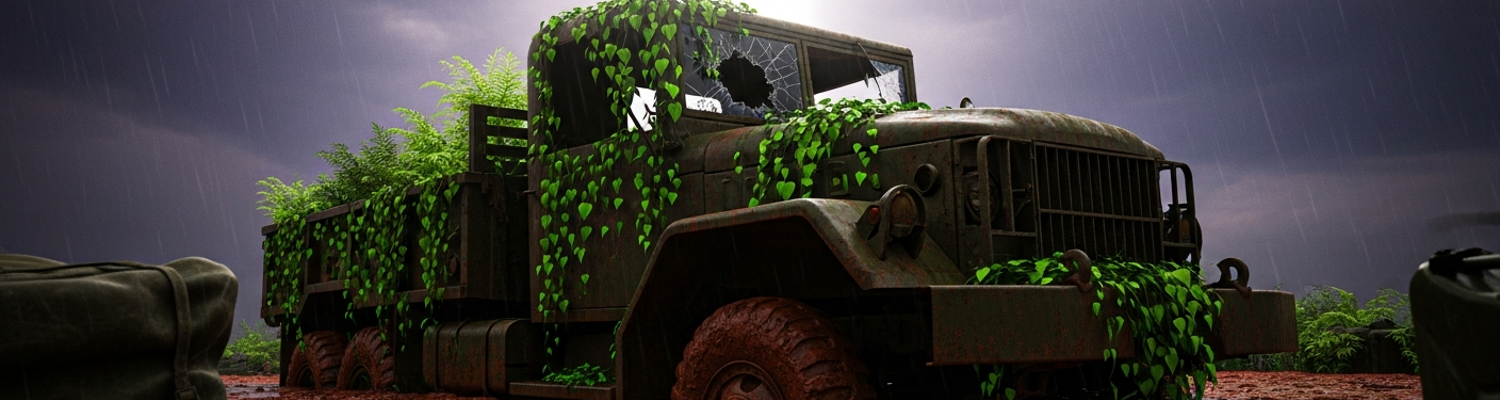
This mechanical attrition is captured in stark visual detail. Analysis of archival footage from Reel 130-57, shot by a U.S. Army Signal Corps team, provides irrefutable evidence of the vehicle’s failure. The film documents a supply convoy’s attempt to move from Pakse toward Saravane across the plateau during the 1957 monsoon. Frame by frame, the reel shows M37 trucks, loaded with ammunition and rice, sunk past their axles in red mud. The basaltic lava rock of the plateau weathers into a deep, lateritic soil, creating a uniquely adhesive and dense muck when saturated by over 160 inches of annual rainfall. The footage depicts American advisors and RLA soldiers using logs in desperate, futile attempts to gain traction. Wheels spin uselessly, coating the entire undercarriage with a thick paste. There are scenes of soldiers using entrenching tools to dig out impacted mud from around the differential and springs, a task made nearly impossible by the mud’s clay-like consistency. The film shows engines smoking from overheating and men abandoning their vehicles, defeated not by an enemy but by geology.
The result was the operational paralysis of American-backed forces. The Bolovens Plateau became a vehicle graveyard that consumed hardware and erased any possibility of projecting ground-based logistical support. Convoys intended to resupply isolated garrisons would bog down and become static targets. A planned two-day journey could stretch into weeks, with the cargo often spoiling or being abandoned. The M37, envisioned as the light tactical workhorse, instead became an anchor. Its failure forced a near-total reliance on inconsistent and expensive air transport, which itself was frequently grounded by the same weather. PEO planners had procured a vehicle based on its performance in Korea, failing to account for the unique environmental hostility of southern Laos.
The breakdown of the road network had immediate consequences for the welfare of RLA units. PEO reports reveal a force plagued by severe ration shortages. For an RLA battalion in a remote outpost, the standard daily issue consisted of rice and salt. This entire supply was dependent on the now-immobilized truck convoys. With no food coming in, garrisons were ordered to subsist on local foraging. This policy was a disaster. It created immediate friction with local villagers, who had little surplus to spare, turning government protectors into a predatory force and driving villagers toward the Pathet Lao.
Morale plummeted. An army that cannot feed its soldiers ceases to function. The officer corps often maintained separate, better-stocked messes, a practice that bred deep resentment. Reports from American advisors describe a force consumed not with tactical readiness, but with daily survival. Soldiers became lethargic, their physical condition deteriorated, and their focus shifted from security patrols to searching for anything edible.
The same environmental conditions that starved the soldiers also destroyed their equipment. A 1958 survey noted that equipment maintenance was already at a low level; the monsoon accelerated this degradation. In isolated positions, there was no escape from the dampness. The M1 Garand rifles were highly susceptible to rust. Without a steady supply of cleaning kits, rifle bolts would seize and barrels would become pitted. Canvas M1936 pistol belts and suspenders rotted directly on the soldiers' bodies. Leather boots, constantly saturated, fell apart. The problem was compounded by a near-total lack of spare parts. An RLA infantryman with a broken firing pin did not receive a replacement; his rifle became a club.
The most critical equipment failure involved communications. The primary field radios, such as the vacuum-tube-based AN/PRC-10, were heavy and ill-suited to the environment. Their batteries died quickly and could not be replaced. The sensitive electronics were vulnerable to moisture. A company or battalion, cut off by washed-out roads, would also find itself unable to report its status or call for an emergency airdrop. The isolation was absolute.
The combination of malnutrition, exposure, and failed sanitation proved medically devastating. Disease became a more effective enemy than the Pathet Lao. The primary killers were malaria and dysentery. The monsoon-flooded landscape created a perfect breeding ground for mosquitoes, and malaria rates skyrocketed. While PEO advisors had access to some malaria prophylactics like chloroquine, these supplies rarely reached the common RLA soldier. The supply chain collapse meant that medical supplies, including basic antibiotics and water purification tablets, were just as unavailable as ammunition.
A review of PEO administrative records from Vientiane in 1957 reveals a quartermaster system defeated before a single truck was dispatched. The popular conception of American military logistics was fiction in Laos. The PEO quartermaster section was a small, overwhelmed office fighting a losing battle against climate and corruption. Materiel arrived from U.S. depots, but without a functioning inventory system, crates were often lost or left to rot on open-air tarmacs. There were no climate-controlled warehouses. Ammunition boxes swelled and split in the humidity. Bags of rice became infested with insects and mold in makeshift storage tents. The quartermaster was not managing a supply chain; he was presiding over a system of institutionalized waste.
This dysfunction created an impossible dilemma for American commanders. Every request for resupply from an advisor in the field initiated a cascade of hopeless decisions. A PEO officer in Vientiane would receive a desperate radio message from a garrison in Phongsaly: food gone, ammunition low, malaria rampant. The officer had to weigh his options. He could authorize a truck convoy, knowing the M37s would likely break down or become permanently mired in mud, sacrificing the vehicles and their cargo. He could petition for an Air America airdrop, but these assets were scarce and often grounded by the same monsoon weather. Or he could do nothing, effectively writing off the garrison to starvation and disease.
There was no good decision. This paralysis was a direct consequence of high-level strategic choices made in Washington, where planners had equipped an army for a conventional war on European plains. Brigadier General John A. Heintges, who took command of the PEO in 1958, found a force he described as a rabble with terrible equipment and no discipline. The command decision to impose a Western-style military structure on the RLA was a foundational error. American commanders were not failing due to a lack of will; they were failing because they were captives of a doctrine and a procurement system utterly blind to the physical and human geography of the battlespace. The quartermaster's empty storerooms and the commander's impossible choices were the final, bitter outcomes of this initial misjudgment.