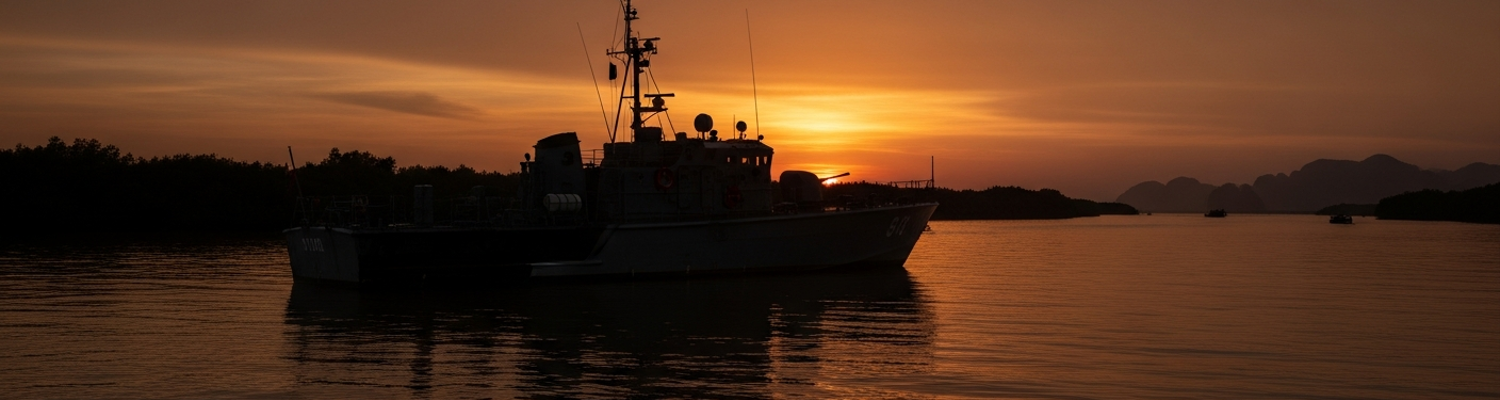

The high-frequency whine inside the AN/WLR-1 receiver abruptly stopped. A technician aboard the USS Maddox, steaming on a DESOTO patrol in the Gulf of Tonkin, would have seen the green sweep of the panoramic display collapse into a dead, flat line. The system of vacuum tubes and precisely tuned circuits, designed to detect the electronic signatures of Soviet or Chinese naval radars, had gone silent. This was the world of 1960s Electronic Intelligence, or ELINT. Its architecture was built upon a specific premise: that the enemy would be a conventional, state-level actor employing a predictable electronic order of battle. ELINT was the art of passively listening to an opponent’s electronic emissions. Not the content of communications, which was SIGINT, but the nature of the signals themselves. Analysts in darkened shipboard compartments were trained to identify the pulse repetition frequency of a Soviet radar or the distinct electronic fingerprint of a People’s Liberation Army Navy fire-control system. The objective was to map these threats, understand their capabilities, and develop electronic countermeasures. This created a strategic database for a potential global conflict between superpowers. The equipment was heavy, power-hungry, and optimized for detecting high-powered signals across vast, open ocean expanses.
A close review of operational logs (NARA Record Group 38) indicates the scale of American naval power arrayed off the Vietnamese coastline. Task Force 77, the Seventh Fleet’s carrier strike force, operated from designated areas like Yankee Station. It launched waves of A-4 Skyhawks and F-4 Phantoms against targets in North Vietnam. Further inshore, cruisers and destroyers of the naval gunfire support line provided direct fire missions for Marines engaged in the I Corps Tactical Zone. Ships like the heavy cruiser USS Saint Paul could direct the fire of its nine 8-inch guns onto targets miles inland, coordinated by spotters on the ground or in the air. This coastal presence was formalized under Operation Market Time, a naval interdiction effort established to halt the seaborne flow of supplies and personnel from North to South Vietnam. This operation utilized a layered defense of everything from large destroyer escorts on the outer screen to agile PCF Swift Boats and Coast Guard cutters patrolling the labyrinthine network of inlets and river mouths that defined the South Vietnamese coast.
The application of Cold War-era ELINT systems to this environment proved to be a significant failure. The primary adversary, the Viet Cong and the North Vietnamese Army, presented an almost nonexistent electronic profile for American systems to detect. Archival evidence shows that enemy command and control relied heavily on low-tech, non-electronic methods that were invisible to the sophisticated receivers aboard U.S. Navy vessels. Communication was often conducted by runners, pre-planned signals using flags or lights, and an extensive network of buried telephone wires that were impossible to intercept from the sea. When radio was used, it involved very-low-power, hand-cranked generators and short, encoded burst transmissions on unpredictable frequencies. These fleeting signals were often swallowed by the dense, triple-canopy jungle, a terrain that created immense signal attenuation and multi-path interference. The powerful AN/SLR-2 and AN/WLR-1 systems on destroyers, designed to detect a Soviet destroyer’s search radar from fifty miles away, were functionally deaf to the whisper of a Viet Cong radio operator transmitting from a spider hole just a few thousand meters from the beach.
The mechanical heart of a 1968-era destroyer’s electronic intelligence suite was the AN/WLR-1 receiver. This was not a system of silent microprocessors. It was a room-sized assembly of vacuum tubes, humming power supplies, and motor-driven components that demanded constant human supervision. An operator sat before a five-gun cathode-ray tube, a circular screen presenting panoramic displays of intercepted signals. His job was to manually tune across frequency bands, watching for the vertical spike of a hostile radar emission. The system’s processing speed was the operator’s own reaction time. His ability to interpret the raw, analog data of pulse duration and bearing on the green-glowing screen. Built to identify the powerful search and fire-control radars of Soviet warships, the AN/WLR-1 was optimized for the open ocean. Its resolution was not granular enough to isolate the faint, fleeting, and low-power transmissions used by adversaries in Vietnam. The entire architecture, from the spinning directional antennas to the thirty-second time delay for filament warmup, was a product of Cold War assumptions about a conventional, electronically active enemy.
The Viet Cong and North Vietnamese Army relied on infiltration methods that produced no electronic signature for the WLR-1 to detect. Their primary logistical craft were wooden-hulled sampans and junks, vessels functionally invisible to the ELINT systems aboard U.S. Navy warships. These boats, often indistinguishable from the tens of thousands of legitimate fishing vessels that crowded the coastal waterways, used sails, oars, or at most a small, shielded engine for propulsion. Intelligence assessments prior to the full implementation of Operation Market Time in 1965 suggested that the majority of arms and supplies for forces in the South arrived by sea. However, the interdiction of these supplies relied on visual confirmation from patrol aircraft, boardings by Swift Boats and Coast Guard cutters, and, for the few steel-hulled trawlers used, radar detection. An examination of operational reports from Task Force 115 shows that engagements were initiated by visual sightings or radar contact. Never by a passive ELINT detection of the target vessel itself. A wooden junk carrying ammunition presented the same electronic profile as one carrying fish: nothing.
This intelligence void was made absolute by the physical environment of I Corps. The northernmost tactical zone in South Vietnam. Its coastline was not a simple, clean line, but a chaotic interface of land and sea. It was a jagged network of river mouths, mangrove swamps, and shifting sandbars, particularly around the tactically important Cua Viet River, which served as a key supply artery for Marine and Army units near the DMZ. This complex geography created immense challenges for any form of electronic surveillance. The high humidity and dense triple-canopy foliage inland caused severe attenuation of radio signals. The rugged coastline created countless radar and electronic shadows where a vessel could hide undetected. An estimated 60,000 junks and sampans operated along the coast. This created a backdrop of visual and acoustic noise that made isolating a single enemy craft nearly impossible.
A review of operational logs shows the III Marine Amphibious Force (III MAF) headquarters at Da Nang as an island of insulated procedure. It was physically and psychologically detached from the war it directed.
First at the air base, later at Camp Horn on the Tiensha Peninsula.
This command center was the nerve center for all Marine operations in the I Corps Tactical Zone. By 1968, Mobile Construction Battalion 12 had erected a hardened combat operations center. It was a concrete bastion against the Vietnamese heat. Inside, senior commanders and their staffs operated within a bubble of processed information. They did not experience the monsoon mud or the metallic taste of fear during a mortar attack. Their war was an array of acetate overlays on large-scale maps. A stream of radio summaries. The clatter of teletype machines spitting out casualty figures and logistics reports from documents like the Daily Staff Journal (DSJ). This was the Headquarters Bubble. For a general officer in Da Nang, the operational picture was an aggregation of data. It was filtered through multiple echelons of command. The raw input from the field was translated into sterile statistics. Decisions to commit battalions or authorize artillery strikes were made based on this time-delayed abstraction of the battlefield. It was a version of the conflict that bore little resemblance to the reality faced by a fire team leader near the Demilitarized Zone.
This disconnect was hardwired into the command and control (C2) system supporting units like the 1st Battalion, 12th Marine Regiment. As an artillery battalion, 1/12 was a combat support asset, its batteries often dispersed across the northern reaches of I Corps, occupying firebases from Khe Sanh to Camp Carroll. A command chronology of the 12th Marines details a rigid, multi-layered hierarchy that information had to navigate. At the lowest level, a forward observer attached to an infantry company would use an AN/PRC-25 man-portable radio. A rugged but low-power VHF unit with a realistic line-of-sight range of only a few miles in the dense jungle. His request for fire would go to his company command post, which then relayed it to the infantry battalion. From there, it entered the artillery C2 network, passed to the 1/12 fire direction center. The battalion itself reported to the 12th Marine Regiment headquarters, which in turn answered to the 3rd Marine Division, headquartered for a time at Phu Bai. The division reported to III MAF in Da Nang. Each step in this chain represented not just a physical distance but a technological one. Messages were passed from short-range tactical FM radios to more powerful vehicle-mounted sets and, at higher levels, to secure teletype systems. Each node was a potential point of failure, delay, and reinterpretation.
Aboard the destroyer USS Turner Joy, on patrol as part of a DESOTO mission, an electronics technician monitored the green glow of his AN/WLR-1 receiver. His job was to manually scan frequency bands, watching for the electronic signature of a hostile radar. A review of operational logs from this period shows a sudden, intermittent signal appeared on his scope. It did not match the known profiles of Soviet or Chinese systems. The parameters were logged: pulse repetition frequency, pulse width, scan rate. Cross-referencing against the limited available data suggested a tentative identification of the Skin Head search radar on a North Vietnamese P-4 torpedo boat. North Vietnam had received a dozen of these fast, Chinese-built vessels between 1961 and 1964. The detection of this signal near the Cua Viet River mouth was a significant event. A rare electronic indicator of a fast-attack craft in a sector dominated by the electronically invisible sampans and junks used for logistical runs.
The journey of this data point from the Turner Joy’s Combat Information Center to a decision-maker on the ground reveals a systemic failure. The raw data on the WLR-1’s cathode-ray tube first had to be interpreted and logged by hand. This handwritten report was then carried to the ship’s radio room. There, a radioman would manually type the message into a Teletype machine for transmission over a secure radioteletype (RATT) circuit. This process was slow by modern standards, with typical transmission speeds of 45 to 75 baud, or about 60 to 100 words per minute. The message would be encrypted by offline crypto hardware and broadcast to a shore station. It was then decrypted and physically delivered by courier to the III Marine Amphibious Force headquarters at Da Nang. Communication logs from the era show this entire ship-to-shore data transfer could take between two and six hours. A P-4 torpedo boat, capable of speeds up to 55 knots, could have relocated over 100 miles in that time.
When the teletype finally clattered out its message at the III MAF intelligence shop, it was a sterile string of alphanumeric characters, stripped of all tactical context. An analyst, likely a Marine officer whose expertise was in ground-based threats, faced the challenge of converting this data into actionable intelligence. The report, “UNID RADAR EMITTER” followed by technical specifications, lacked the corroborating information necessary for a commander to act. The intelligence architecture of the time was fractured. The ELINT from the Turner Joy was not automatically fused with imagery from a reconnaissance flight or a report from a Special Forces team. A 1969 study of intelligence timeliness in the 9th Infantry Division’s area of operations confirmed that the value of such information decayed rapidly. Without a robust, shared database of enemy electronic signatures specific to Vietnam, and without analysts trained to interpret naval ELINT in near-real time, the report was often just a historical footnote. The data pointed to where the enemy had been hours ago, not where a flight of Phantoms or a Marine patrol needed to go now.
After-action reports from Operation Market Time reveal the fundamental nature of the seaborne threat. The adversary was not a conventional navy but a guerrilla force at sea. Viet Cong and NVA logistical efforts relied on a vast, decentralized fleet of wooden-hulled sampans and junks. These vessels, built with traditional methods and materials, were indistinguishable from the tens of thousands of civilian fishing boats that plied the coastal waters and river systems daily. Propulsion was simple: oars, sails, or a small, easily shielded inboard engine whose acoustic signature was lost in the ambient noise of civilian traffic. This provided perfect camouflage. Infiltration units moved primarily at night or during periods of poor visibility, hugging the complex coastline. They used the labyrinthine network of river mouths and mangrove swamps to evade patrols. Their cargo was ammunition, explosives, medical supplies, and personnel, often hidden beneath false decks or caches of fish and produce. For American electronic surveillance platforms, these craft were ghosts.
This nearly invisible fleet posed a direct threat to American ground forces. The artillery units positioned to support operations in I Corps were especially vulnerable. The 1st Battalion, 12th Marine Regiment, an artillery unit tasked with providing fire support for Marine infantry, frequently established firebases in close proximity to the coast and major inland waterways like the Cua Viet River. An examination of firebase locations shows that positions like Camp Carroll and bases near Dong Ha were chosen to command key terrain and support operations along the DMZ. Their proximity to the water, a logistical necessity for resupply, also made them acutely vulnerable. The defensive posture of a typical firebase was oriented toward a ground-based assault. Perimeters were protected by concertina wire, minefields, and listening posts, all designed to detect and break up an infantry attack moving overland. The possibility of a significant threat emerging from the sea or a river, often to the rear of the main defensive sector, was a critical planning gap. A small flotilla of sampans could land a company of NVA sappers on an unguarded stretch of beach or riverbank just a few thousand meters from a 1/12 firebase, allowing them to bypass the prepared defenses entirely.
Archival records of sapper attacks on Marine artillery positions detail the effectiveness of these waterborne infiltrations. A Viet Cong sapper unit, having landed undetected, could move stealthily to the perimeter of a 1/12 firebase. Their objectives were specific: penetrate the wire, destroy the battalion’s 105mm or 155mm howitzers with satchel charges, and detonate the main ammunition supply point. A command chronology from the 12th Marines (dated 14 March 1968) documents an attack where Viet Cong forces, likely landed nearby, breached the wire of a battery position, inflicting heavy damage on two howitzers before being repelled. Communications were cut before the assault began. The fight devolved into close-quarters combat on the gun line itself. Illumination rounds fired from other batteries provided the only light. For the headquarters staff in Da Nang, the first indication of such an attack would be a garbled, frantic radio call from a position they considered secure, reporting that it was being overrun from an unexpected direction.
For the Marine rifleman dug in along the Demilitarized Zone, the war was not a map in an air-conditioned command post in Da Nang. It was the immediate, suffocating press of heat, humidity, and insects. It was the taste of halazone tablets in his water and the constant tension that came from occupying a fixed position, waiting for an attack that headquarters could not predict. A review of personal correspondence and after-action reports reveals a disconnect between the intelligence picture available to III MAF and the lethal, granular reality on the ground. A Marine on a listening post outside the wire of a firebase like Con Thien did not have access to ELINT reports. His situational awareness was built from the snap of a twig in the elephant grass, the silhouette of a ridgeline against a flare-lit sky, or the sudden cough of a distant mortar tube. The systemic failure of high-level intelligence to detect enemy preparations meant that the entire burden of early warning fell upon the senses of individual, exhausted 19-year-olds.
The result was a battlefield where situational awareness was fatally compromised. Without timely intelligence warning of enemy movements, Marine units were repeatedly caught by surprise. Patrols moving through the jungle-choked hills of Quang Tri Province often walked into well-planned ambushes. The first indication of enemy contact was the coordinated eruption of machine-gun fire from concealed bunkers. Firebases, designed as anchors of American firepower, became isolated islands. They were subject to sudden, intense mortar and rocket attacks that were not preceded by any strategic warning. Archival records of sapper attacks on artillery positions, such as those of the 12th Marines, show a consistent pattern. Small, elite enemy units would conduct detailed reconnaissance of a target for days, plotting defensive positions and patrol patterns, completely undetected by American intelligence. Then, often under the cover of monsoon fog or a pre-dawn mortar barrage, they would breach the perimeter wire at a pre-selected weak point. The ensuing fight was not a battle of formations, but a chaotic, close-quarters melee inside the wire. Artillerymen fought for their lives with carbines and pistols against attackers armed with satchel charges and grenades. The command and control failure was absolute. The first report from the attacked position was often a desperate, garbled radio transmission announcing that the base was already being overrun.
Survival became a random lottery. In the absence of prior threat intelligence, an engagement was not a planned action but a sudden, catastrophic event. A Marine’s life or death could depend entirely on which side of a bunker he was standing on when a rocket-propelled grenade hit, or whether his machine gun jammed at the critical moment. Personal accounts from survivors of firebase attacks describe the sheer chaos when sappers, having memorized the layout of the base, moved with lethal purpose to destroy command bunkers and ammunition dumps while defenders struggled to orient themselves in the darkness. The fight devolved into a series of disconnected, individual struggles for survival. A gun crew from the 1st Battalion, 12th Marines might find their howitzer a primary target, forcing them to defend their position as infantry. The randomness was compounded by the fact that the enemy often initiated these attacks by targeting communications antennas, isolating the base from support and turning the battle inward.
The aftermath of a sapper attack was a sensory deprivation nightmare punctuated by screams. A Navy Corpsman, attached to a battery of the 1st Battalion, 12th Marines, would find himself working in absolute blackness. The unit’s generators were likely among the first targets destroyed. His world shrank to the narrow beam of his flashlight, sweeping across shattered sandbags and the mangled steel of a howitzer. The air was thick with the smells of cordite, diesel fuel, and blood. Triage under these conditions was a brutal calculus of survival, performed without any overarching situational awareness. The corpsman had no way of knowing if the perimeter was secure, if a second wave of attackers was massing, or where all the casualties even were. He sorted the living from the dead by the sound of their breathing and the warmth of their skin. He applied battle dressings and tourniquets based on a flowchart drilled into him in training, one that seemed wholly inadequate for the multi-casualty chaos he now faced. Every decision was made in an information vacuum, a direct consequence of the command echelons being blind to the initial infiltration.
This lack of battlefield clarity crippled the next link in the survival chain: medical evacuation. A review of MEDEVAC mission logs from the period highlights a recurring operational friction point. A UH-1 Huey Dustoff helicopter crew, having received a frantic, often garbled radio call for immediate evacuation, would arrive on station only to be waved off. The pilot, orbiting in the darkness miles from the relative safety of Da Nang, could not land in a hot landing zone. The problem was that no one, not the survivors on the ground fighting in isolated pockets nor the command staff in the III MAF bubble, could definitively declare the firebase secure. The same intelligence chasm that allowed the sappers to approach undetected now prevented confirmation of their departure. For the grievously wounded Marine lying on a stretcher, the rhythmic whump-whump of the Huey’s rotors overhead was not a sound of rescue, but of a life-saving capability held hostage by the systemic breakdown in command and control. The critical window for a trauma patient to reach surgical care was evaporating while pilots and commanders argued over an intelligence picture that did not exist.