
Fortification and Environmental Decay
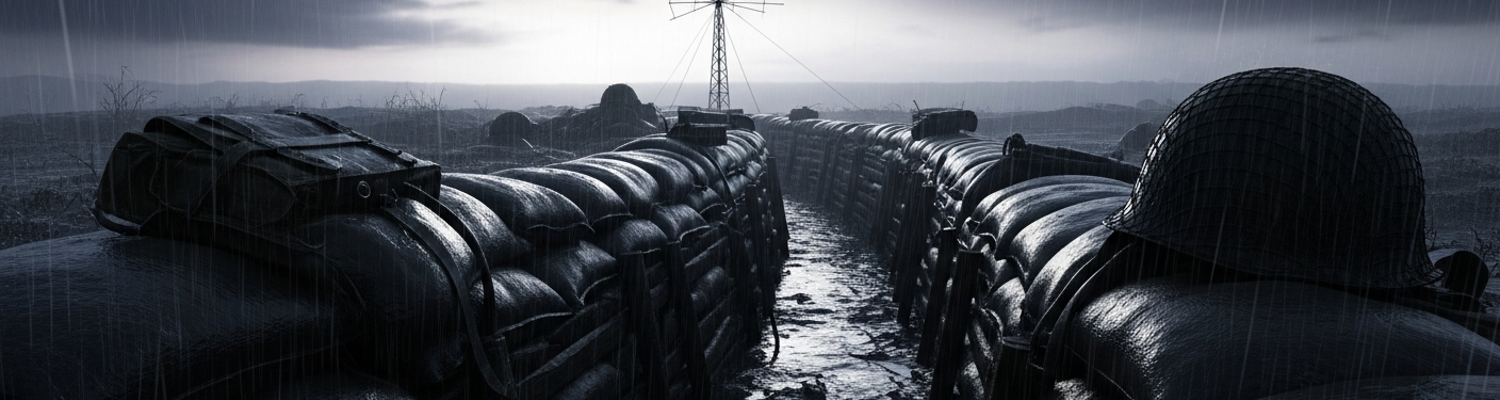
The earth of Quang Tri Province was red, slick, and unstable. For a Marine with the 3rd Marine Division holding the line south of the Vietnamese Demilitarized Zone (DMZ), the world was defined by the trench. A morning was spent not cleaning a rifle but clearing a drainage channel with a dulled entrenching tool. Every scoop of the thick, laterite clay felt impossibly heavy. The monsoon season was not a backdrop; it was a tactical obstacle that transformed fortifications into liquid traps. A review of operational logs from firebases like Khe Sanh and Con Thien (archived under NARA Record Group 127) shows a constant, losing battle against gravity and water. The very ground the Marines relied on for cover was dissolving.
Standard military engineering, designed for temperate European climates, failed in Southeast Asia. The torrential downpours, at times intensified by classified weather modification efforts under Operation Popeye, turned defensive positions into slurry pits. Trench walls, dug to shoulder height for protection, would liquefy and collapse, burying equipment and sometimes the men themselves. Sandbags, the fundamental building block of every forward base, became waterlogged and burst under their own weight. The constant dampness bred immersion foot, a skin infection that could remove a Marine from the line as effectively as a bullet. Archival evidence from 1967 and 1968 details how units expended a substantial portion of their daily energy not on patrols, but on the simple act of trying to keep their holes from filling with water. The structures built to provide shelter from enemy fire were themselves a relentless, exhausting threat.
Survival was measured in sandbags.
Then came the shelling.
People's Army of Vietnam (PAVN) artillery units, often dug into camouflaged positions north of the Ben Hai River, maintained a steady, demoralizing drumbeat of high-explosive ordnance. The siege of Khe Sanh in early 1968 provides a grim case study. On a peak day, over 1,300 mortar and artillery rounds impacted the base. A direct hit from a Soviet-supplied 122mm rocket on a bunker constructed of timber, corrugated steel, and sandbags was devastating. The concussion alone could collapse lungs. The steel roofing would tear into jagged shrapnel. A direct strike on the primary ammunition supply point on January 21, 1968, destroyed 98% of the base’s munitions in a chain reaction of explosions that lasted for two days. Marines learned to live underground, scurrying between positions in a half-crouch known as the “Khe Sanh shuffle” to avoid snipers and shrapnel. Every lull in the bombardment was immediately followed by damage assessment, the prelude to the next phase of labor.
What the rain weakened, the shelling obliterated.
The daily existence for an enlisted Marine became one of ceaseless manual labor. There was no heavy machinery. There were only shovels, entrenching tools, and bare hands. Men would fill sandbags with the heavy, wet earth, their hands raw, only to see their work undone by the next artillery barrage. They scavenged debris, splintered wooden pallets, pieces of wrecked helicopters, fragments of pierced steel planking, to reinforce collapsing bunkers. This was not a secondary duty; it was the primary function. Combat readiness was directly tied to structural integrity. A unit whose trenches were flooded and bunkers compromised could not effectively repel a ground assault. The physical toll pulled men from guard duty, patrols, and what little sleep they could get in the rat-infested pits they called home.
Disconnected Artillery Fire Support
The connection between a forward observer and the artillery battery was a lifeline woven from radio waves. For a Marine dug in along the DMZ, that lifeline was frayed and stretched to its breaking point. The forward observer, or FO, was the eyes of the guns. He was often a lone Marine lieutenant or sergeant attached to a rifle company, separated by miles of hostile territory from the M101 and M102 howitzers of the 12th Marine Regiment. His job was to exist on a forward slope or a concealed hilltop that offered a sliver of visibility into enemy territory. His primary tool was the 25-pound AN/PRC-25 radio, a device dependent on line-of-sight transmission. This forced FOs into exposed, isolated positions, making them priority targets for enemy snipers and mortar teams. The very geography that gave him a view of the enemy also cut him off from the infantrymen he was tasked to protect, men hunkered down in trenches a thousand meters away.
That connection was tenuous.
Operational logs from Con Thien and Khe Sanh during the fighting of 1967 and 1968 reveal a struggle against the environment. Visibility was a fantasy. The monsoon season shrouded the landscape in a thick, sightless fog and rain that could reduce visibility to mere feet. An FO attempting to spot a PAVN mortar pit was often staring into a wall of gray mist. He relied on sound, the dull thump of a tube firing, or the momentary flash of a muzzle blast half-obscured by triple-canopy jungle. PAVN units were masters of camouflage, their positions dug in and concealed with a discipline that made visual confirmation nearly impossible. The FO would be forced to make an educated guess, translating a sound or a flicker of light into a six-digit grid coordinate. The handset of the PRC-25, notoriously vulnerable to moisture, would be wrapped in a plastic bag from a battery pack. Every transmission was a battle against the elements.
The call for fire went out over a crackle of static. The request would travel from the FO's PRC-25 to the Fire Direction Center (FDC), the nerve center of the artillery battery. Here, another team of Marines would plot the coordinates on a paper map, calculate the firing data, azimuth, elevation, and powder charge, and relay the commands to the gun crews. Each step introduced a potential for delay and error. A weak signal from the distant FO might require multiple repeats of the grid coordinates. A single digit misunderstood in the static could send thousands of dollars of high explosives into an empty patch of jungle. Archival accounts detail the frustrating loop: a fire mission is called, calculations are made, and the guns fire. The rounds would take minutes to travel the miles to the target area. By the time they impacted, the enemy mortar team had often fired several more rounds and displaced to a new, prepared position. The FO would then have to adjust fire, beginning the slow process all over again. The delay between the initial request and the first rounds hitting the ground was often long enough for enemy units to break contact. This gap in communication and response rendered the power of American artillery imprecise.
Systemic Radio Communication Failures
The AN/PRC-25 radio was a 25-pound burden and a lifeline. For a Marine radio telephone operator, or RTO, moving through the hills of Quang Tri Province, the world was a constant hiss of static punctuated by bursts of garbled voice. This solid-state radio, introduced in 1965, was a leap forward from older tube-based models, but it had a dependency on line-of-sight. The steep, jungle-choked ravines and hills systematically broke these lines of sight. A rifle company in a valley could be electronically deaf to its battalion headquarters on the other side of a ridge. The radio’s frequency modulation (FM) signal was easily absorbed by the dense foliage, and its low power output struggled to push through. The monsoonal humidity was a relentless adversary, seeping into connections and shorting out the delicate H-189/GR handsets. RTOs learned to encase their handsets in the plastic bags that spare BA-386/PRC-25 batteries came in, a field improvisation against the weather. A close review of operational logs reveals a constant struggle. Units were forced to use intermediary radio relay teams on exposed hilltops just to speak to adjacent units, creating more targets for an observant enemy.
Fear of enemy eavesdropping forced Marines to speak softly into the handset, a practice that further degraded the already weak signal. North Vietnamese Army units, using captured American PRC-25s, were known to monitor Marine frequencies. This lax radio discipline, born of the belief that the enemy lacked the technical sophistication to exploit it, had lethal consequences. The combination of a whispered voice, environmental interference, and line-of-sight issues meant that transmissions, like calls for artillery fire, became a dangerous game of telephone. A single distorted number in a six-digit grid coordinate could mean the difference between salvation and disaster.
The rounds were coming in short.
It was a phrase that struck cold fear into any Marine. A detailed analysis of the fighting during Operation Kingfisher in 1967 reveals multiple instances where communication breakdowns led directly to friendly fire. On September 21, elements of the 3rd Battalion, 4th Marines were engaged in a close-quarters fight. A forward observer, pinned down and struggling to be heard over the din of battle and a crackling radio, called for an artillery strike on a PAVN position. The coordinates were misheard. The shells from their own supporting batteries slammed into the Marine lines instead of the enemy’s. The result was catastrophic, compounding the chaos and inflicting casualties at the moment they were most vulnerable. These were not isolated incidents. The very structure of fire support coordination was fragile. A request traveled from a forward observer’s PRC-25, was hopefully heard clearly at a Fire Direction Center, plotted, calculated, and then relayed to the gun crews. Any break in that chain, a battery failure, a damaged antenna, a misunderstood word, could be fatal. For the men in the trenches, the sound of incoming American artillery was a terrifyingly common occurrence.
This communication gap also rendered American firepower ineffective in the task of counter-battery engagement. PAVN artillery units were masters of their craft. From concealed positions in and north of the DMZ, they could rain shells from Soviet 130mm M-46 field guns on Marine firebases like Con Thien and Khe Sanh with relative impunity. The process for retaliating was agonizingly slow. A Marine position would take fire. They had to first spot the enemy gun flashes or estimate a location based on the sound of the outgoing rounds. Then, the RTO would get on the radio, fighting through the static to relay a fire mission to the Fire Direction Center. Archival records from the siege of Khe Sanh show that the time between the initial enemy barrage and the first American counter-battery rounds landing was often far too long. The disciplined PAVN gun crews would fire a set number of rounds and immediately displace to a new, prepared position. The American shells would frequently impact an empty patch of earth, the enemy having already moved on. This inability to effectively strike back created a deep sense of helplessness and allowed the NVA to dictate the terms of the artillery duel.
The Physical Toll of the Terrain
The ground in Quang Tri Province was an antagonist. A close examination of soil composition in the region reveals a prevalence of fine-grained clay and silt, materials that become exceptionally viscous when saturated. During the monsoon season, this earth transformed into a thick, flowing slurry. It was not merely mud; it was a liquid trap. For Marines of the 3rd Marine Division dug in at outposts like Con Thien, the world dissolved into this reddish-brown paste. It filled trenches, undermined bunkers, and created an environment where solid ground was a memory.
Movement was a form of combat.
Every step was a battle against suction. A Marine’s jungle boot, plunged into the muck, would be seized by the thick, heavy slurry. Pulling it free required a conscious, strength-sapping effort, only for the other foot to sink and become trapped in turn. Progress through the trenches or across the fire-swept open ground between positions was agonizingly slow. The mud could pull boots clean off a man’s feet. A close review of operational logs from actions like Operation Kingfisher in 1967 shows that the simple act of maneuvering a rifle company a few hundred meters could take hours and leave the unit physically spent before the first shot was fired. This constant immersion in cold, unsanitary water led to widespread cases of immersion foot. The condition caused tingling and numbness, which progressed to swelling, blisters, and decaying flesh. It could take a Marine out of the fight as effectively as a bullet, and the threat of court-martial for neglect did little to stop its spread in an environment where keeping feet dry was an impossibility.
The physical tax was unrelenting. The struggle to navigate the waterlogged trenches created a state of profound exhaustion throughout the ranks. A Marine’s daily energy was consumed not just by patrols and firefights, but by the simple act of existing in an environment that actively fought against him. Moving from a sleeping bunker to a guard post, hauling ammunition, or evacuating a wounded comrade became a Herculean task. After-action reports from the siege of Con Thien repeatedly detail the miserable conditions, noting the depressing effect of the inescapable mud and drizzle. This pervasive exhaustion was a tactical liability. Fatigued troops were less alert, slower to react to enemy probes, and more susceptible to the psychological strain of constant artillery bombardment. The fight against the ground itself drained the strength of units, degrading their combat effectiveness before they ever made contact with the NVA.
Weapon Handling Under Duress
The taste of fear was metallic. A Marine crouched in the red mud of a trench line south of the DMZ knew it intimately. It was a physiological reality. Archival analysis of combat stress responses shows that the fight-or-flight mechanism, triggered by the brain in moments of extreme threat, floods the body with hormones like norepinephrine. These chemicals can directly affect taste receptors, while also causing severe dry mouth, which alters taste perception. For a Marine at a firebase like Khe Sanh, hearing the distant thump of outgoing enemy artillery, the body’s reaction was immediate and uncontrollable. The adrenal glands would dump their contents into his bloodstream, increasing his heart rate and preparing muscles for action. This ancient survival response also produced the distinct, coppery tang on the tongue, a biological announcement that death was a close possibility. This physiological marker was a constant companion during the 77-day siege of Khe Sanh, where an average of 150 shells, rockets, and mortars fell on the base every single day.
Recoil from the M16 rifle was a jarring punctuation to the chaos. While the 5.56mm cartridge produced a recoil energy far less than older battle rifles, its effect was magnified by the context of combat. An infantryman was not firing from a stable bench on a calm range. He was often firing from a contorted position in a collapsed trench, his body already buzzing with adrenaline. The rifle weighed 7.9 pounds fully loaded. The act of firing sent a sharp impulse back into the shoulder, a force that traveled up through the clavicle and jaw. With each shot, the stock slammed into the pocket of the shoulder, and the vibration rattled teeth in their sockets. During a sustained firefight, a Marine might fire hundreds of rounds. This produced a cumulative physical effect, a deep bruising in the shoulder and a specific type of fatigue born from repeatedly absorbing these small shocks. This was compounded by the M16A1's known reliability issues in the wet, dirty conditions of Vietnam. The direct impingement gas system was prone to fouling, leading to frequent failures to extract spent casings. This forced Marines to handle their weapons under extreme duress, trying to clear a stuck casing while the rifle was hot and the enemy was closing.
Combat stress triggers profound perceptual distortions. Under extreme duress, the brain prioritizes visual information, leading to a condition known as tunnel vision. A Marine’s field of view would constrict, focusing entirely on the immediate threat, a bunker opening, a muzzle flash. Everything on the periphery would blur and disappear. This hyper-focus was often paired with auditory exclusion, a phenomenon where the brain simply stops processing certain sounds. The cacophony of a PAVN assault, the roar of AK-47s, the screams of wounded men, the blast of RPGs and grenades, would merge into a single, roaring wall of noise. A Marine might not hear the shouted orders of his squad leader standing five feet away, or the tell-tale whistle of an incoming mortar round. Studies of high-stress encounters show that heart rates exceeding 175 beats per minute can trigger these sensory shutdowns. For the defenders of Hill 881 South or Con Thien, living under the constant threat of being overrun, their bodies were perpetually caught in this state of overload, a condition known as combat stress reaction. Their senses, overwhelmed and distorted, offered a fractured and incomplete picture of the battlefield.
The Enlisted Fight for Survival
The daily existence for an enlisted Marine along the DMZ was a contest against dissolution. Survival was not measured by enemy contact but by enduring the environment itself. A Marine at Khe Sanh or Con Thien woke up to find rats sharing his bunker, a consequence of the uneaten, grease-congealed C-rations that littered the base as men lost the willpower to consume two meals a day. His first task was often a desperate attempt to reclaim his position from the landscape. He would spend hours digging out trenches that had liquefied overnight, his entrenching tool making a sucking sound with every scoop of red slurry. The constant dampness was corrosive, forcing directives to regularly turn in small arms ammunition for fresh stock before the humidity rendered it useless. Water was severely rationed. During the worst periods of the 77-day siege of Khe Sanh, men spread ponchos down hillsides to capture condensation from the thick fog, hoping to collect a canteen of water to last until the next morning. This was the physical reality: dehydrated, unwashed, and exhausted, their world reduced to the few feet of trench they occupied.
From the perspective of a private or lance corporal, the war lacked tangible ends. The strategic purpose was an abstraction. His reality was the cyclical labor of rebuilding fortifications that would inevitably be destroyed again. A close review of operational logs from the 26th Marine Regiment at Khe Sanh shows a unit under constant bombardment. Marines would spend hours filling sandbags with heavy, wet clay, their hands raw, only to see their work obliterated in an instant. This created a pervasive sense of futility. The war’s ambiguous objectives, coupled with an individual rotation system (DEROS) that guaranteed each man an exit date, eroded the connection to any larger strategic victory. For the 6,000 Marines at Khe Sanh, surrounded by an estimated 20,000 to 40,000 PAVN soldiers, the mission was simply to endure a siege where they were the bait. The feeling was of being trapped, unable to evacuate, and wholly dependent on air resupply that was itself a high-risk gamble.
In this void of strategic purpose and institutional function, the only system that held was the immediate squad. Trust was a survival mechanism forged in shared misery. This intense bonding in small combat units was a decisive factor in maintaining morale. With command and control frequently severed by radio failures and the chaos of battle, lieutenants and sergeants, often barely out of their teens, ran the fight. Cohesion was built patrol by patrol, firefight by firefight. It was the man next to you pulling you out of a collapsing trench. It was the shared knowledge that reinforcements were often far away and unavailable. This dynamic was especially pronounced in units like the Combined Action Platoons, where small teams of Marines were isolated in villages, entirely dependent on one another. A close examination of Marine Corps operations shows that this reliance on small-unit leadership was a core institutional strength. When a man’s world was reduced to mud, incoming shells, and the hiss of a faulty radio, the only intelligible order came from the squad leader, and the only reliable asset was the Marine to his left and right.