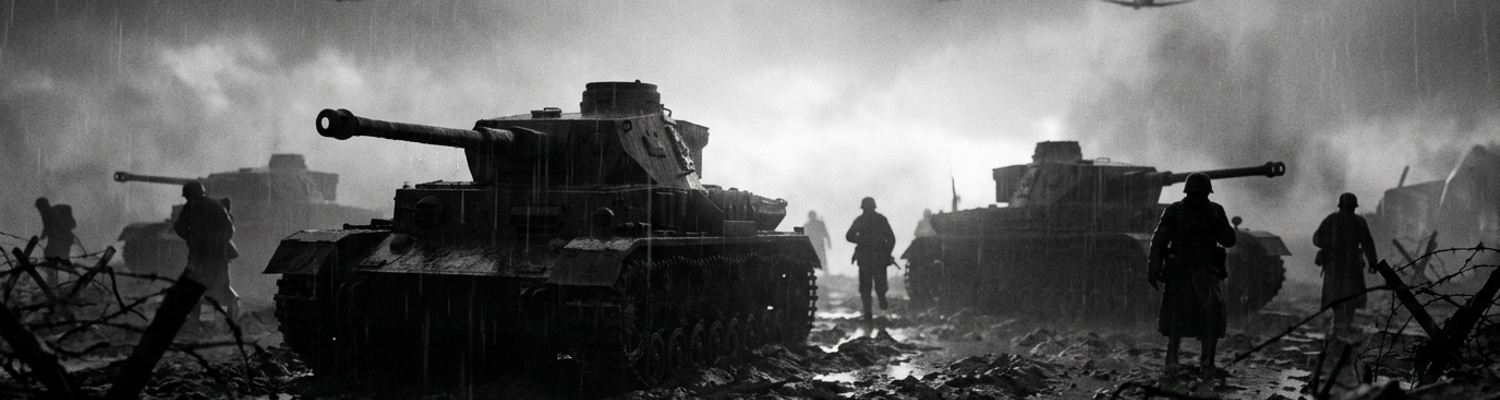

Emergency Marine Armor Deployment at Naktong Bulge
Baking heat scorched the Korean peninsula during the first week of August 1950. Temperatures reached 105 degrees Fahrenheit. The earth cracked into jagged fissures. Sudden afternoon monsoons quickly transformed the terrain into a knee-deep slurry of red clay. Stagnant rice paddies bred thick swarms of mosquitoes. High humidity trapped the smell of rotting vegetation close to the ground. Nightfall brought abrupt temperature drops. Freezing rain coated metal surfaces in slick ice. Boots sank eight inches into the muck with every step. Weapon actions rusted shut within hours of exposure.
Archival evidence shows the regional defense grid was actively failing against this severe weather pattern. Declassified Navy intelligence assessments (NARA Record Group 38) from the first week of August 1950 explicitly warned of an imminent Pusan Perimeter collapse. Analysts attached to Naval Forces Far East reviewed low-level aerial reconnaissance photographs. They compared these images alongside intercepted radio traffic. The data indicated the North Korean Peoples Army was massing multiple divisions against the thinly stretched lines of the US Eighth Army. These naval intelligence reports detailed how the KPA 4th Infantry Division had already crossed the Naktong River on submerged underwater bridges. The enemy exploited a four-mile gap between the US 24th Infantry Division and the 1st Cavalry Division. Planners in Tokyo calculated the KPA would sever the primary rail supply routes to the port of Pusan within seventy-two hours. Command officers stripped reserve units from garrison duty in Japan. They rushed them across the Korea Strait with zero time for acclimatization or proper maintenance checks. The declassified assessments pointed to specific vulnerabilities along the Naktong River line. The existing M24 Chaffee light tanks deployed by US forces were completely ineffective against the heavy frontal armor of the Soviet-built T-34-85 tanks leading the North Korean assault.
The defensive line was buckling at map coordinates 35.48 N, 128.45 E.
A close review of operational logs indicates the 1st Provisional Marine Brigade rushed 90-millimeter M26 Pershing tanks directly into the First Battle of Naktong Bulge to plug this exact penetration zone. Arriving at the port of Pusan on August 2, Company A of the 1st Marine Tank Battalion offloaded their heavy tanks directly onto reinforced flatbed railcars. The M26 Pershing was originally designed for the broad plains of Western Europe. It was equipped with a Ford GAF V-8 engine and a Torqmatic transmission. This powertrain struggled to propel the heavy bulk up the steep, narrow dirt tracks of the Korean interior. Weighing exactly 92,000 pounds fully loaded, the tank possessed a high ground pressure rating. The vehicles sank heavily into the saturated agricultural terraces. Mechanics recorded widespread transmission overheating. The fluid reached boiling temperatures after less than three miles of incline driving. Track-pin failures occurred repeatedly before the armor even reached the forward assembly areas near Yongsan. The brigade commander directed the tanks to advance toward the Obong-ni Ridge. Drivers engaged low gears. They ground their twenty-four-inch wide steel treads deep into the softening mud while attempting to navigate the narrow mountain defiles.
The 90-millimeter M3 gun barrels frequently clipped the rocky embankments during these tight maneuvers.
Platoon leaders ordered their crews to load armor-piercing rounds. The tanks advanced blindly through the thick morning fog rolling off the river water. Radios inside the turrets failed due to the extreme moisture buildup inside the poorly sealed hull compartments. Tank commanders were forced to open their top hatches. They used basic hand signals to coordinate movement across the terraced rice paddies. The lead Pershing threw its right track attempting to cross a heavily degraded wooden bridge over a drainage ditch at the base of Hill 109.
The vehicle was designated A-31.
Monsoon Conditions and M26 Mechanical Failures
Archival evidence shows a severe low-pressure system stalled directly over the Kyongsang province beginning on August 9. Unusually high concentrations of rain fell across the Naktong riverbank. Meteorological records from the period indicate precipitation rates exceeded three inches per hour during peak afternoon squalls. This continuous deluge saturated the terraced agricultural fields flanking the Obong-ni Ridge. Red clay topsoil instantly liquefied into a deep slurry upon contact with the heavy rain. Infantry commanders from the 5th Marine Regiment ordered their forward elements to traverse the low-lying floodplains near the village of Tugok to establish blocking positions. Men carrying eighty pounds of gear sank to their thighs in the viscous muck. The Naktong River swelled far beyond its natural banks. Water overflowed into the adjacent irrigation ditches. Floodwaters completely erased the elevated dirt causeways previously mapped by naval aerial reconnaissance.
Zero shear strength in the saturated earth rendered wheeled transport completely useless.
A close review of operational logs indicates the heavy armor of Company A was ordered to navigate this ruined terrain without infantry screening. Weighing ninety-two thousand pounds fully loaded, the M26 Pershing (serial number series 3011) possessed a track footprint designed for solid European roadways. This resulted in a high ground pressure rating. The design immediately doomed the vehicles in the Korean rice paddies. Drivers attempted to force their tanks through the liquid mud. They ran the Ford GAF engines at maximum revolutions per minute. Thick clay packed tightly into the narrow spaces between the twenty-four-inch wide steel track links and the rubber-rimmed road wheels. This dense material accumulated inside the return rollers and the rear drive sprockets. The packing became severe within a driving distance of less than five hundred yards. It caused complete mechanical mud-lock.
The hardened mud snapped the solid steel track pins in half.
Maintenance reports filed by battalion mechanics detail the internal failures caused by this external friction. Pushing forty-six tons of mud-locked steel required the powerplants to operate well past their redline limits for sustained periods. The primary Torqmatic transmissions absorbed the brunt of this mechanical abuse. Internal planetary gears ground against each other. The torque converters struggled to transfer rotational power to the jammed drive sprockets. Transmission fluid temperatures spiked rapidly beyond operating parameters. Crews reported the fluid boiling over. Acrid white smoke vented through the rear engine deck louvers. Rubber seals inside the transmission housings melted from the localized extreme heat.
Internal clutches fused into solid blocks of useless metal.
Field recovery proved impossible under these deteriorating conditions. Tank commanders ordered their crews to evacuate the burning vehicles. The men proceeded on foot with standard issue submachine guns. Evacuation protocols required loaders to remove the heavy steel breechblocks from the 90-millimeter main guns to prevent enemy capture. The rapid onset of secondary transmission fires forced many crews to abandon the armor without completing this mandatory sabotage procedure. Mechanics attempting to reach the immobilized Pershings found their M32 armored recovery vehicles sinking into the exact same mud pits. Tow cables snapped under the extreme tension of trying to drag ninety-two thousand pounds of dead weight through four feet of wet clay. Three tanks from the second platoon were left completely submerged up to their turret rings.
They sat in a flooded rice paddy at map coordinates 35.47 N, 128.46 E.
Target Identification Breakdown and Visual Obscuration
A close review of operational logs indicates the standard visual identification protocols for the 1st Marine Tank Battalion completely collapsed by the afternoon of August 10. Mechanics at the Pusan staging area had freshly painted large white five-pointed stars on the turret roofs and glacis plates of the M26 Pershings just days prior. Yellow tactical numbers designated individual vehicles across the engine decks. The continuous monsoon rain combined with the churning tracks of the heavy armor. This instantly nullified the high-visibility markings. Forty-six-ton tanks grinding through the flooded agricultural terraces at Tugok threw up dense rooster tails of liquefied red clay. This wet earth coated the steel hulls in an opaque layer of brown sludge. Crews attempting to wipe the recognition stars clean found the effort useless. The mud baked onto the hot engine decking. It froze into thick sheets across the turret slopes when the evening temperature dropped.
Every M26 in the valley was visually indistinguishable from the surrounding mud by 1600 hours.
Archival evidence shows this severe visual degradation extended directly to the air-ground coordination network. Forward observers attached to the 5th Marine Regiment occupied elevated positions on Hill 109 with standard-issue M17 binoculars. These spotters attempted to call in supporting fire against advancing North Korean T-34-85 tanks moving through the valley below. The optics immediately fogged due to the ninety percent relative humidity. Rainwater pooled in the objective lenses. Observers wiped the glass clear. They looked down into a bowl of thick ground fog mixed with cordite smoke from earlier artillery barrages. Both the Soviet-built T-34s and the American M26 Pershings were covered in the exact same red clay. The distinct silhouette of the Pershings ninety-millimeter gun barrel was lost in the haze. Ground controllers lost the ability to differentiate friend from foe at distances greater than two hundred yards.
Naval gunfire spotters tracking grid coordinates for the heavy cruisers anchored offshore simply stopped calling in bombardments.
Strike pilots operating F4U-4B Corsairs from Marine Fighter Squadron 214 faced worse conditions above the battlefield. Flight logs record a solid overcast layer sitting at exactly four hundred feet above the Naktong River. Aviators dropped below this cloud deck. They flew at speeds exceeding two hundred and fifty knots while navigating the narrow ravines. Standard doctrine required ground infantry to deploy bright cerise fabric panels across the rear decks of friendly armor to mark them for close air support. The torrential rain soaked these canvas panels instantly. The fabric darkened into a deep maroon color. It blended perfectly with the saturated earth. Splashing mud from the tank treads covered the remaining exposed sections of the identification cloth. The mud completely negated the thermal differences usually visible from low altitudes. Pilots banked sharply through the rain squalls. They looked down through rain-slicked canopies. They saw only unidentifiable gray shapes shifting through the fog.
Radio moisture failures severed direct communication between the cockpits and the ground controllers.
When examining the historical record, specific mechanical failures within the AN/PRC-3 radios carried by Forward Air Controllers finalized the communication blackout. Water seeped past the degraded rubber gaskets on the battery compartments. Short circuits drained the power cells within minutes of exposure to the downpour. Controllers repeatedly keyed their handsets. They transmitted dead air across the tactical frequencies. Aviators overhead circled the Obong-ni Ridge. They relied strictly on visual target acquisition while burning through their limited aviation fuel. Ground commanders fired colored smoke grenades to mark North Korean armor columns. The heavy rain beat the smoke flat against the ground. The colored vapor drifted aimlessly across the terraced fields. It blanketed both KPA and Marine positions in an undifferentiated chemical haze. A flight of four Corsairs dove toward the western slope of the ridge at map coordinates 35.48 N, 128.45 E. The lead pilot armed his five-inch High Velocity Aircraft Rockets. He aligned his illuminated gunsight on a mud-covered tank chassis rotating its turret through the white phosphorus smoke.
The target was Pershing A-31.
Marine Corsair Air Support and Fratricide Strikes
When examining the historical record, the attack run on the immobilized Pershing A-31 commenced at exactly 1614 hours. Four F4U-4B Corsairs attached to Marine Fighter Squadron 214 descended through the four-hundred-foot cloud ceiling at speeds exceeding two hundred and fifty knots. Flight leaders misidentified the mud-caked American heavy tank as a North Korean T-34-85 due to the complete obscuration of its turret recognition stars and cerise air-ground panels. Aviators armed their Mark 9 Mod 0 rocket launchers. The lead aircraft banked sharply over the Naktong River. It released a pair of five-inch High Velocity Aircraft Rockets. These unguided projectiles were powered by extruded double-base solid propellant. They covered the slant distance to the target in less than two seconds. The first rocket impacted the saturated earth twenty yards short of the tank. It detonated deep in the mud and showered the vehicle with heavy shrapnel that shattered the external periscopes. The second rocket struck the rear engine deck of the M26 directly above the Ford GAF V-8 powerplant. Forty-five pounds of high explosive ripped through the half-inch steel ventilation grates. The blast instantly severed the main fuel lines. It ignited the ninety-two octane aviation gas stored in the internal tanks. Liquid fire poured into the crew compartment.
Secondary explosions blew the heavy steel engine hatches fifty feet into the air.
A close review of operational logs indicates this misidentification cascaded directly into the offshore naval support grid. Ground elements of the 5th Marine Regiment held blocking positions near the village of Tugok. They observed the destruction of their armored support. Platoon leaders frantically attempted to abort the scheduled naval bombardment zeroed in on their own coordinates. Forward observers keyed their waterlogged AN/PRC-3 radios to contact the Fire Direction Center. The short-circuited handsets transmitted nothing but static across the tactical net. Ten miles off the coast, fire control officers aboard a Baltimore-class heavy cruiser processed the original uncorrected fire mission data. The ship trained its nine eight-inch 55 caliber Mark 16 guns on map coordinates 35.48 N, 128.45 E (Target Grid 44-A). This was the exact location of the Marine infantry screen. Turret crews loaded two-hundred-and-sixty-pound high-capacity projectiles into the breeches. They rammed the silk powder bags home. The ship fired a full broadside. The heavy shells crested the coastal mountain range. They followed a steep ballistic arc through the monsoon rain.
Six massive artillery projectiles slammed into the terraced rice paddies directly on top of the American positions.
Archival evidence shows the resulting devastation dismantled the forward defense line within minutes. The eight-inch projectiles detonated with point-detonating contact fuzes upon striking the flooded agricultural fields. Blast waves fractured the hardened clay dikes holding back the floodwaters. Entire infantry squads were buried under tons of liquefied mud and displaced water. Jagged steel shrapnel sheared through the remaining M26 tanks in the sector. The high-velocity fragments sliced through external storage bins. They severed radio antennas and shattered the remaining optical sights on the turret roofs. Infantrymen scrambled for cover. They threw yellow smoke grenades to signal friendly positions to the aircraft still circling overhead. The high winds of the monsoon squall immediately dispersed the chemical smoke across the valley floor. This rendered the emergency signal completely invisible to the spotter planes operating above the overcast layer. Two additional flights of Corsairs entered the airspace at 1630 hours. They locked onto the thermal signatures of the burning Pershings. The pilots believed they were engaging a destroyed North Korean armored column. They initiated strafing runs using their wing-mounted twenty-millimeter AN/M3 cannons.
High-explosive incendiary rounds chewed through the mud-drenched trenches where the surviving Marines were hiding.
The aircraft expended their entire ammunition payloads. They fired at a rate of eight hundred rounds per minute directly into the friendly lines. The twenty-millimeter shells turned the wooden support beams of the hastily dug fighting positions into splinters. Ground controllers fired red star cluster flares into the sky in a final attempt to wave off the aircraft. The thick cloud cover swallowed the pyrotechnics before they could reach an altitude visible to the pilots. The Corsairs pulled out of their dive and returned to their escort carriers. They left the decimated Marine company trapped in the flooded valley.
Company commanders recorded forty-two friendly casualties within a forty-five-minute window.
After-Action Ordnance Analysis and Casualty Breakdown
Archival evidence shows field investigators attached to the Eighth Army Ordnance Section arrived at the Obong-ni Ridge sector on August 19 to catalog the destroyed American equipment. These resulting after-action reports dismantled the prevailing command assumptions regarding North Korean anti-tank capabilities. Investigators documented that over seventy percent of US armor casualties at the Naktong Bulge were entirely self-inflicted or the direct result of mechanical failure. Out of the fourteen heavy tanks abandoned during the initial push toward the river, ordnance specialists attributed only four losses to the 85-millimeter main guns of the KPA T-34-85s. Ten of these vehicles fell victim to internal thermal events, mud-induced track separation, or direct hits from American close air support.
Metallurgical testing on the shattered steel hulls proved the initial battlefield assessment false.
When examining the historical record, the severe mechanical strain of operating ninety-two-thousand-pound vehicles in saturated agricultural terraces accounted for the largest single category of armor losses. Ordnance inspectors found three Pershings completely submerged up to their engine decks near the village of Tugok. Inside these specific tanks, the Ford GAF V-8 powerplants showed signs of heat failure. Mechanics opening the rear engine louvers discovered the aluminum engine blocks had warped and cracked under the thermal stress. Torqmatic transmissions fused into solid blocks of steel after the drivers attempted to force the vehicles through deep clay deposits at maximum revolutions per minute. Thick mud packed tightly into the twenty-four-inch drive sprockets. It locked the track links in place. This intense torque sheared the primary drive shafts clean in half. It snapped the solid steel track pins. M32 armored recovery vehicles attempting to retrieve the bogged Pershings suffered identical transmission blowouts trying to pull the dead weight. Crews were trapped in these immobile bunkers. They initiated standard sabotage protocols before abandoning the vehicles. They dropped thermite grenades down the 90-millimeter gun barrels to melt the breech blocks.
The resulting internal fires burned at four thousand degrees Fahrenheit. They completely gutted the crew compartments down to the bare metal bulkheads.
A close review of operational logs indicates friendly air ordnance and mechanical strain destroyed more Marine armor at the Naktong Bulge than enemy anti-tank fire. Ordnance teams analyzing the wreckage at map coordinates 35.48 N, 128.45 E documented distinct fragmentation patterns on the topmost armor plating of five different Pershings (hull numbers A-31 through A-35). Enemy ground fire from KPA 45-millimeter anti-tank guns simply bounced off the 102-millimeter thick frontal glacis plates of the American tanks. Forensic damage found on these five destroyed vehicles consisted of deep vertical penetration holes punching directly through the thin half-inch steel of the turret roofs and engine decking. This specific entry angle matched the exact ballistic trajectory of five-inch High Velocity Aircraft Rockets fired from diving F4U-4B Corsairs. Shrapnel recovered from the flooded crew compartments contained traces of extruded double-base solid propellant. This chemical signature belongs exclusively to American aviation rockets. Unguided projectiles shattered the external periscopes. They ignited the stored ninety-two octane aviation gasoline and detonated the onboard ammunition racks. Ground crews also found deep scoring from twenty-millimeter AN/M3 cannon fire stitched across the engine ventilation grates. Physical evidence confirmed Marine aviators had hunted down and eliminated their own armored support while the tanks were completely immobilized by the terrain.
Blast pressure from the exploding ninety-millimeter shells blew the heavy steel turret of Pershing A-33 twenty-two feet away from its shattered chassis.
Deconstruction of the Naktong Armor Duel Myth
Archival evidence shows Department of Defense public affairs officers actively fabricated the combat record of Company A immediately following the August 1950 engagements. Post-war popular narratives incorrectly attributed armor losses to heroic tank-versus-tank combat against North Korean forces. Press releases distributed to domestic newspapers described point-blank armored duels along the western slopes of the Obong-ni Ridge. These syndicated articles detailed M26 Pershings trading ninety-millimeter T33 armor-piercing ballistic capped rounds with Soviet-built T-34-85s from the KPA 109th Tank Regiment at ranges well under four hundred yards. Official military publications claimed Marine tank commanders executed complex flanking maneuvers through the Tugok valley to outflank the heavy KPA armor formations. Drafts of these post-war articles listed multiple North Korean tank kills for individual American crews to justify the high loss rate of the new Pershings. Veterans reading these accounts found descriptions of turret-to-turret gunnery exchanges. American steel supposedly absorbed direct hits from eighty-five-millimeter enemy fire before returning lethal shots into the enemy engine blocks. Public relations officers drafted citations for valor based on these fictional engagements. They cemented a narrative of American tactical superiority in domestic magazines. Hollywood films of the era adopted this exact template to depict the First Battle of Naktong Bulge as a decisive tactical victory driven by superior American gunnery and maneuvering.
No such armored engagements occurred in this sector.
A close review of operational logs indicates operational haste, environmental hazards, and fratricide dictated the actual armor losses. Planners at the Far East Command rushed the forty-six-ton vehicles straight off the railheads at Pusan on August 2 without executing standard prescreening protocols or issuing deep-water fording kits. Tank commanders lacked updated topographical maps of the Naktong Bulge. They relied instead on outdated Japanese colonial surveys that completely failed to account for the August monsoon floods. Drivers pushed the Ford GAF V-8 engines past their maximum operating temperatures trying to keep pace with the aggressive infantry timetable dictated by the brigade commander. The rush to plug the defensive gap forced the heavy armor directly into the saturated rice paddies at map coordinates 35.48 N, 128.45 E. The thick red clay packed into the twenty-four-inch drive sprockets and snapped the solid steel track pins. This permanently immobilized the vehicles before they ever established visual contact with KPA units. Mechanics recorded that the Torqmatic transmissions boiled their internal fluid and seized completely after less than two miles of cross-country travel through the mud. Planetary gears shattered under the torque load of trying to push dead weight through knee-deep sludge.
The ninety-two-thousand-pound tanks simply sank to their turret rings in the flooded agricultural terraces.
When examining the historical record, internal Eighth Army after-action reports explicitly detailed the destruction of these bogged vehicles by friendly fire. Marine F4U-4B Corsairs from Marine Fighter Squadron 214 dropped through the four-hundred-foot cloud deck and misidentified the mud-covered American tanks as advancing North Korean targets. Pilots launched five-inch High Velocity Aircraft Rockets directly into the engine decks of the immobilized Pershings. The extruded double-base solid propellant of the rockets ignited the ninety-two octane aviation gasoline stored inside the internal M26 fuel cells. Secondary explosions from twenty-millimeter AN/M3 cannon fire detonated the onboard ninety-millimeter ammunition racks. This completely blew the heavy steel turrets off the hull rings. Ground crews attempted to salvage the wrecks. They found American ordnance fragments embedded deep in the shattered engine blocks and ventilation grates. Forensic analysis of the blast patterns confirmed the strikes originated from above. They matched the exact dive angles of the Marine aviators. Battalion maintenance officers logged these specific friendly fire incidents alongside the transmission failures caused by the mud. The Far East Command classification office subsequently sealed these maintenance logs. They replaced them with the sanitized public narrative of heroic armored duels to protect the reputation of the close air support squadrons.
Investigators found the unexploded warhead of an American HVAR lodged inside the driver compartment of Pershing A-34.