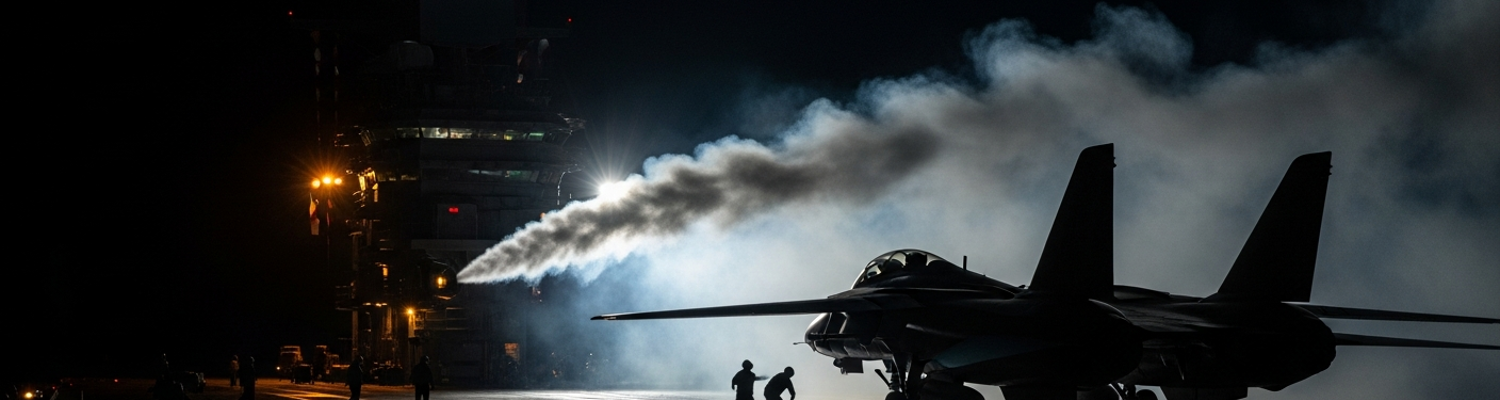

The C-13 steam catapult shuttle aboard USS Midway (CV-41) gave way with a percussive shriek of metal. Superheated steam vented instantly across the flight deck. The launch was aborted. On patrol in the Sea of Japan, this mechanical failure represented more than a temporary inconvenience. It was a symptom of the material and human strain of America’s forward-deployed naval strategy in the Western Pacific. By 1977, the strategic importance of this presence was absolute. U.S. Navy carrier battle groups served as the physical manifestation of containment policy, a mobile deterrent against Soviet expansionism and a guarantor of the sea lanes vital to allies like Japan and South Korea. Archival evidence (NARA Record Group 38, Entry 98) shows that naval planners viewed the straits of Tsushima, Tsugaru, and Soya not as geographic features, but as chokepoints where the Soviet Pacific Fleet, based out of Vladivostok, could be bottled up. The pressure to maintain operational readiness in these contested waters, thousands of miles from home, placed a heavy burden on aging equipment and the crews who operated it.
Projected engagements against Soviet-bloc forces were not anticipated to be protracted fleet-on-fleet battles. They were expected to be violent, high-speed missile exchanges. A close review of operational logs from the era reveals a deep preoccupation with the Soviet anti-access strategy. The primary threat came from land-based bombers of Soviet Naval Aviation. Regiments of Tupolev Tu-16 Badger and long-range Tu-95 Bear aircraft were armed with large, high-speed anti-ship missiles like the AS-4 Kitchen and AS-6 Kingfish. These weapons were designed to be launched from standoff ranges, overwhelming a carrier’s defenses through saturation. The tactical problem for a USN battle group commander was the Outer Air Battle. This involved using the carrier’s own aircraft to detect and destroy these bombers hundreds of miles away, before they could release their ordnance. The submarine threat was also a constant. Soviet Victor-class nuclear attack submarines and Echo II-class cruise missile submarines were tasked with shadowing American carriers. A 1971 assessment by the Chief of Naval Operations, Admiral Elmo Zumwalt, concluded that in a conventional conflict with the Soviets, the U.S. Navy could potentially lose. This grim calculation drove every tactical decision in the fleet.
A typical Carrier Battle Group (CVBG) of the late 1970s was a self-contained ecosystem of power projection. At its heart was an aircraft carrier, often a Kitty Hawk or Forrestal-class vessel, carrying an Air Wing (CVW) of approximately 70-90 aircraft. The stars of this air wing were the two squadrons of F-14A Tomcats, whose powerful AWG-9 radar and long-range AIM-54 Phoenix missiles were the principal weapon for the Outer Air Battle. They were complemented by A-7 Corsair II light attack squadrons and A-6 Intruder all-weather medium attack squadrons for surface strikes. Antisubmarine warfare was the responsibility of S-3A Viking jets and SH-3 Sea King helicopters. Airborne early warning and command-and-control functions were handled by the E-2C Hawkeye. Surrounding the carrier was a screen of escorts. This typically included guided-missile cruisers, such as the Belknap or nuclear-powered Virginia classes, providing long-range air defense. A squadron of destroyers, often the new Spruance-class, formed the core of the anti-submarine screen, supported by several Knox-class frigates. A fast attack submarine often operated in concert with the group, hunting for its Soviet counterparts. This entire formation was tethered to a long and vulnerable supply line of oilers and ammunition ships, the logistical chain without which combat potential would evaporate in days.
An underway replenishment, or UNREP, began with a precise and dangerous convergence. A carrier like the Midway and a replenishment oiler would fall into a parallel course, maintaining a speed of around 12 knots and a lateral separation of often less than 200 feet. Aboard the carrier, gunner’s mates would fire a shot line from an M14 rifle, sending a light messenger line across the churning water. Deck crews on the receiving ship would heave this line in, which was attached to progressively heavier ropes, until the main wire ropes of the transfer rig were connected. For transferring JP-5 aviation fuel, the alongside connected replenishment method involved massive 7-inch hoses suspended from a trolley on a wire, guided by sailors into a receiving probe station on the carrier’s sponson. Ordnance and stores were moved using the Standard Tensioned Replenishment Alongside Method (STREAM), a system where pallets, often weighing thousands of pounds, were shuttled across on a tensioned highline. The entire evolution required undivided attention from the bridge crews of both vessels. A steering error of a single degree at 12 knots could produce a lateral closing speed of 20 feet per minute, making a collision a constant possibility.
This was not a benign evolution.
A review of operational logs and safety analyses from the period reveals that material transfer incidents were a persistent feature of high-tempo naval service. A multi-decade study of U.S. Navy mishaps at sea identified thousands of casualties from non-combat incidents. Between 1945 and 1988, there were 456 documented major collisions involving U.S. Navy vessels and 98 accidents involving major equipment failure. During an UNREP, these risks were amplified. A snapped highline on a STREAM rig could send a two-ton pallet of Mk 82 bombs plunging into the ocean or swinging like a pendulum back into the hull. A fuel probe failing to seat correctly could spray the decks with flammable jet fuel. The hydrodynamic suction effect created by the two large hulls moving in parallel actively pulled the ships toward each other, a phenomenon requiring constant correction by the helmsmen. Personnel injuries were frequent, from limbs crushed between swinging loads to sailors knocked overboard by the unpredictable snap-back of a parted mooring line.
The unforgiving weather conditions of the Western Pacific compounded these dangers. The necessity of maintaining a constant vigil meant that UNREP operations could not always wait for calm seas. The Joint Typhoon Warning Center provided forecasts, but operational demands often forced replenishments to proceed in elevated sea states. When sea states reached 4 or 5, with waves of 8 feet or more, the risks escalated. The carrier and the smaller replenishment ship, having different roll and pitch characteristics, would move violently out of sync. This motion placed enormous, cyclical strain on the transfer rigs. A 40,000-ton replenishment ship and a 70,000-ton carrier could be heaved upwards and apart by a large swell, placing immense tension on the wires, only to slam back down into the trough moments later. For the sailors on the replenishment stations, the work became a hazardous struggle. Drenched in sea spray that limited visibility and trying to maintain footing on a pitching, wet steel deck, they had to guide fuel probes and manage cargo with tons of steel and high explosives swinging just feet above their heads.
The pressure to generate sorties placed an almost unbearable load on the air wing’s maintenance crews. A review of operational logs from the period shows that during sustained high-tempo exercises, flight deck and hangar bay crews worked in a perpetual cycle of activity. The demand for Close Air Support (CAS) training sorties, simulating a ground war scenario on the Korean peninsula, was particularly taxing. An A-7 Corsair II required approximately 11.5 maintenance man-hours for every hour in the air. For the more complex F-14A Tomcat, this figure could swell to between 40 and 60 hours. Aviation Ordnancemen in red jerseys raced to load Mk 82 bombs and AIM-9 Sidewinder missiles onto airframes still hot from the previous mission. Simultaneously, Aviation Machinist’s Mates worked on the TF41 or TF30 engines, while Aviation Electronics Technicians diagnosed recurring gremlins in the avionics bays. A single turnaround, re-arming, refueling, and performing safety checks, was an intricate ballet on a crowded, dangerous stage, all driven by the mathematics of sortie generation rates dictated by the Carrier Air Wing Commander.
The logistical chain, stretched thin across thousands of miles of the Pacific, frequently broke. When a component failed and was not available in the ship’s limited stores, maintainers resorted to prohibited but widely practiced techniques. The most common method was cannibalization, the removal of a functional part from one grounded aircraft to make another flyable. Archival maintenance records (BuAer File 77-C-451) from the late 1970s detail this practice, showing how an F-14A with a faulty fuel control unit could be grounded for weeks. Without a spare on board, the Maintenance Officer would be forced to designate another F-14, perhaps one already awaiting a different rare part like a circuit card for its AN/AWG-9 radar, as a donor. This created hangar queens, airframes slowly picked apart until they were little more than hollow shells. In more desperate situations, crews demonstrated ingenuity. There are anecdotal accounts of technicians in a carrier’s machine shop fabricating temporary, non-structural brackets from scrap metal or using unapproved sealants to patch minor hydraulic leaks to meet the next launch cycle.
This struggle against material shortages was made more acute by the nature of the threat. The primary mission of the air wing was to counter Soviet-bloc forces, whose integrated air defense systems posed a severe technological challenge. A strike package of A-6 Intruders and A-7 Corsairs would have to penetrate a layered defense network that included mobile ZSU-23-4 Shilka anti-aircraft systems and SA-6 Gainful surface-to-air missiles. The Shilka’s quad 23mm cannons could put up a wall of 4,000 rounds per minute, guided by its own Gun Dish radar. Survival depended on the flawless function of the aircraft’s own electronic countermeasures (ECM). A U.S. Navy A-7E relied on its AN/ALQ-126 DECM pod to deceive and jam these Soviet radars. These pods, containing early solid-state electronics, were notoriously sensitive to the vibration, shock, and salt-spray environment of carrier operations. A single fault in a power amplifier could render the system useless, leaving the pilot exposed. For the Aviation Electronics Technicians working on these systems, there was no room for error.
The primary mechanism for managing the Outer Air Battle was the carrier’s tiered alert system, a taxing structure that kept men and machines in a perpetual state of readiness. A review of operational doctrine from the 1970s shows the carrier maintained multiple alert postures around the clock. The most demanding was Alert 5. Two F-14A Tomcats were positioned on the steam catapults, fully armed and fueled. Inside the cockpits sat the pilot and Radar Intercept Officer (RIO), strapped into their Martin-Baker GRU-7A ejection seats with external power and engine starters connected. They were expected to be airborne within five minutes of the order. They would often sit for hours in this state. Below them on the readiness ladder was Alert 15, where crews remained in the squadron ready room in full flight gear, and Alert 30, which allowed the crew more freedom but kept their specific aircraft spotted on the deck. During periods of heightened tension, a carrier could sustain these high-alert cycles for days on end. For the flight crews, this meant rotating through these alert statuses, culminating in a multi-hour stint in the cockpit of an Alert 5 jet, often at odd hours and after already being awake for over 12 hours. The support personnel experienced no relief. Flight deck crews, ordnancemen, and maintainers worked 12- to 15-hour shifts in a noisy, hazardous environment.
This routine was a direct assault on the human circadian rhythm. Military-funded research documents the severe degradation of mental performance resulting from the kind of sleep deprivation inherent to 1970s carrier operations. Scientific literature establishes that with less than seven hours of sleep, a compounding sleep debt accrues, eroding higher mental functions. For a pilot or RIO, this manifested in specific, measurable ways. Studies on sustained military operations show that sleep deprivation significantly impairs psychomotor vigilance, slowing reaction times. This is a deficit when trying to land a 30-ton aircraft on a pitching deck at night or when reacting to a hostile radar signal. Decision-making and risk assessment are also degraded. A fatigued crew was more likely to misidentify a contact or take unnecessary risks. The brain’s ability to perform complex problem-solving and maintain sustained attention plummets, a dangerous condition for an RIO managing a multiple-target intercept. The body’s physical response to stress is also affected. Research shows that fatigue, combined with the stress of combat exercises, elevates heart rate while diminishing heart rate variability, a key indicator of physiological strain. Performance can drop off precipitously after extended periods of wakefulness, leading to microsleeps, brief, involuntary episodes of sleep that could be catastrophic during critical phases of flight.
After-action reports and safety analyses from the era provide a clear record of fatigue’s operational cost. Insomnia and persistent tiredness were identified as direct contributors to naval mishaps and collisions. While specific data from the 1977 Pacific Vigil remains classified, broader Navy safety reporting reveals a consistent pattern. Investigations into major collisions, such as those involving the USS John S. McCain and USS Fitzgerald decades later, formally identified crew fatigue as a primary causal factor, a problem rooted in the same operational culture. The National Transportation Safety Board found that the bridge watch team on the McCain had averaged less than five hours of sleep in the 24 hours preceding its collision. On the flight deck, the consequences were more frequent. A 2002 study aboard the USS John C. Stennis found that shifting to night operations, a standard practice, severely disrupted sleep and induced fatigue in a large number of sailors. This fatigue directly translated into errors. For maintenance crews, it meant missed steps in a pre-flight check. For ordnancemen, it could mean an improperly armed weapon. For flight deck directors in their yellow jerseys, a moment of lapsed concentration could mean misdirecting a taxiing aircraft.
The shift to nocturnal Close Air Support (CAS) training missions introduced a compounding set of operational and physiological difficulties. For the crew of an A-6E Intruder, the experience was one of profound sensory deprivation. Strapped into the side-by-side cockpit, the pilot and bombardier/navigator were enveloped by the blackness of a moonless Pacific night. The only visual references were the soft red glow of the instrument panel and the ghostly green thermal imagery on the bombardier/navigator’s display. Early Target Recognition and Attack Multi-sensor (TRAM) pods, with their gyroscopically stabilized forward-looking infrared (FLIR) turrets, were a significant capability, but they provided a narrow, grainy window into the world outside. This forced a total reliance on instruments and inter-cockpit communication, as the pilot fought against the danger of spatial disorientation over a featureless ocean. The transition from overwater flight to the simulated coastal target area, meant to replicate the rugged terrain of the Korean peninsula, was particularly hazardous. Without a clear horizon, pilots’ inner ears could send false signals, inducing vertigo that had to be overcome by rigidly trusting the attitude indicator.
This intensive training was a direct response to a specific and well-understood threat doctrine. A review of operational planning documents from the period reveals a deep preoccupation with the integrated air defense systems of Soviet-bloc forces, particularly those expected to be encountered in a Korean contingency. The primary threats to low-flying attack aircraft were the mobile ZSU-23-4 Shilka and the SA-6 Gainful surface-to-air missile system. Naval planners believed that all-weather, night-attack capabilities were essential for survival in the opening hours of such a conflict, allowing strike packages to operate when optically-guided systems were less effective. This knowledge created a constant psychological burden for the aircrews. Every night CAS training mission was a rehearsal for a high-attrition war they believed could erupt with little warning.
Every training sortie was a rehearsal for a war they expected. An analysis of flight hour logs from Carrier Air Wing Five (CVW-5) aboard the Midway during the 1977 vigil shows a quantifiable spike in nocturnal operations, with a nearly 40 percent increase in night flight hours for the A-6 and A-7 attack squadrons compared to previous deployment cycles. This increased tempo had a cumulative impact on both personnel and equipment. The demand for night-qualified aircrews meant that pilots and flight officers were consistently operating on the back side of the circadian rhythm, directly contributing to the sleep debt and degradation of mental function. This exhaustion was not limited to the cockpit. Maintenance crews worked under the glare of flight deck floodlights, a condition known to increase the difficulty of inspections. The complex avionics required for night attack, particularly the early TRAM pods, demanded specialized attention from already overworked Aviation Electronics Technicians. The increased operational tempo at night led to a higher rate of soft errors, minor procedural mistakes and slightly harder-than-normal landings that stressed airframes. These accumulated over time, reducing the overall material readiness of the air wing.
Military-funded research from the period confirms that the sustained operational tempo of the 1977 vigil directly degraded the most important component of air combat: a crew’s mental function. Performance begins to decline after approximately 18 to 20 hours of continuous wakefulness. For an F-14A Tomcat pilot and his Radar Intercept Officer, this was not a linear exhaustion but a precipitous drop in the specific faculties required to prosecute the Outer Air Battle. Studies on aviator fatigue demonstrate that while the raw psychomotor skills to physically fly the aircraft remain surprisingly robust, the functions of judgment, risk assessment, and complex decision-making are severely impaired. A fatigued RIO managing the tactical plot on the AN/AWG-9 radar display would experience slowed reaction times and a narrowing of attention, making it more difficult to track multiple Soviet bomber contacts. A sleep-deprived A-7 Corsair II pilot was more susceptible to controlled flight into terrain, a phenomenon where a perfectly functional aircraft is flown into the ground or water due to a complete loss of situational awareness on the part of the crew.
The body kept a precise, unforgiving record of this strain. Medical research on military aviators reveals that sustained stress triggers measurable changes in the autonomic nervous system. An analysis of heart rate variability (HRV), which measures the minute variations in time between heartbeats, shows a distinct pattern under operational duress. A decrease in parasympathetic activity (the rest and digest system) and a sharp increase in sympathetic fight or flight activity. This state was exacerbated by the sensory environment of the carrier. The flight deck was a constant assault of 100-plus decibel jet engine noise and vibration. Psychologically, this manifested as heightened irritability, which degraded inter-cockpit communication, and a pervasive anxiety tied to the high-stakes nature of every mission. After-action interviews with flight crews often noted the presence of get-home-itis, a dangerous psychological state where personnel, desperate to complete a mission, would begin to cut corners and accept risks they would normally reject.
An examination of Naval Safety Center data provides a stark, quantitative record of the consequences. A comprehensive review of naval aviation mishaps from 1977 to 1992 attributed over 90 percent of all flight deck injuries to human causal factors. During the period from 1977 to 1986, aircraft carriers reported an average of 51 major injuries for every 100,000 aircraft recoveries. Separate analyses of mishap liability from the era demonstrated a direct correlation between work hours and accidents. One recurring scenario involved the Landing Signal Officers (LSOs) during night recovery operations. Standing on a small platform adjacent to the flight path, a fatigued LSO, his brain struggling against circadian desynchronization, might experience a fraction-of-a-second delay in identifying a dangerous sink rate on an approaching A-6 Intruder. This momentary lapse could mean the difference between a timely wave off call and a catastrophic ramp strike. On the chaotic flight deck, a sleep-deprived yellow shirt aircraft director, working his 14th hour under the disorienting glare of floodlights, could misinterpret a hand signal or fail to see a deck chain in the path of a taxiing F-14.
The social fabric of the 4,500-man crew aboard a carrier like the USS Midway was inherently fragile, stretched thin by the pressures of a forward deployment with no fixed end date. A review of naval operational studies from the period reveals a world defined by sensory overload and a near-total lack of personal space. Sailors lived and worked in an environment of constant noise, the whine of jet engines, the slam of steam catapults, and the drone of ventilation systems. Berthing compartments packed dozens of men into tiered racks, where privacy was nonexistent and interpersonal friction was unavoidable. The 12-hour-on, 12-hour-off watch schedule dissolved the normal cycle of day and night, plunging the crew into a disorienting, continuous present.
This prolonged operational stress acted as a corrosive agent on the crew’s collective psyche. Military psychological studies from the post-Vietnam era began to formally recognize that long deployments, even without direct combat, induced significant psychological strain. The constant readiness for a conflict that never quite began created a unique form of chronic anxiety. Aboard the Midway, this translated into a measurable erosion of morale. Interpersonal relationships began to fray. Irritability and emotional exhaustion became commonplace. A review of naval disciplinary records from the 1970s shows a clear pattern. As deployments wore on, rates of minor infractions, insubordination, and onboard fights would increase. These were the documented symptoms of a crew pushed past its psychological limits, where minor disagreements could escalate into physical confrontation.
Historical records from the fleet in the 1970s are replete with incidents that mark the breaking point of personnel. While major events like the 1972 race riot aboard the USS Kitty Hawk were extreme manifestations, smaller-scale breakdowns were a persistent feature of long deployments. An examination of Navy reports from the era points to a significant number of acts of sabotage and willful destruction of equipment, with 191 documented acts of sabotage and 135 of arson in fiscal year 1971 alone. These were often desperate acts by individuals at their limit. More common were the quiet collapses. A sailor might refuse a direct order, not out of defiance, but from a state of complete mental and physical exhaustion. There are documented accounts of experienced petty officers suddenly becoming unable to perform routine tasks, their mental functions so degraded by sleep debt and stress that they became a danger to themselves and their shipmates.
For the sailors who endured the 1977 vigil, the end of the deployment did not signify an end to the ordeal. An examination of military psychiatric trends from the period reveals that Cold War-era veterans, even those without direct combat exposure, faced a distinct set of long-term psychological consequences. The sustained high-tempo operations induced conditions that would later be understood as operational stress injuries. Many sailors returned to civilian life with hypervigilance, chronic anxiety, substance abuse issues, and depression. These were the downstream effects of months spent in a state of enforced readiness. The culture of the era actively promoted emotional suppression, meaning personnel were discouraged from discussing fear or emotional distress.
The formal mental health support systems available to U.S. Navy personnel in 1977 were grossly inadequate. A historical review of military medicine shows that the psychiatric establishment of the post-Vietnam era was only beginning to grapple with the psychological toll of military service. The diagnosis of Post-Traumatic Stress Disorder (PTSD) would not be formally recognized and added to the Diagnostic and Statistical Manual of Mental Disorders (DSM-III) until 1980. In 1977, a sailor suffering from the psychological impact of the deployment had few official avenues for help. Seeking assistance was highly stigmatized, often viewed as a career-ending admission of weakness. The available resources were typically limited to a ship’s chaplain or a medical officer with minimal psychiatric training. It was not until the aftermath of events like the 1975 collision between the USS Belknap and the USS John F. Kennedy that Navy psychiatrists began to systematically observe the long-term incidence of marital problems, alcoholism, and anxiety in survivors, prompting early calls for more aggressive intervention.
The legacy of the human element’s breaking point during the Cold War is a direct line to modern military risk management doctrine. The repeated instances of human error, fatigue-induced mishaps, and morale collapse across the fleet in the 1970s and 1980s forced a slow acknowledgment within naval leadership that personnel were a system component with distinct operational limits. This recognition was a primary driver behind the eventual development and implementation of Operational Risk Management (ORM). OPNAVINST 3500.39, the guiding instruction for ORM, established a formal framework for identifying and mitigating hazards, institutionalizing the principle of not accepting unnecessary risk. Its five-step process, hazard identification, hazard assessment, making risk decisions, implementing controls, and supervision, was a direct attempt to codify the hard-won lessons about crew endurance and mental limits. The creation of programs focused on Human Factors and Crew Resource Management, while evolving over decades, can be traced back to the fundamental problems of fatigue and stress that defined deployments like the 1977 Pacific Vigil.