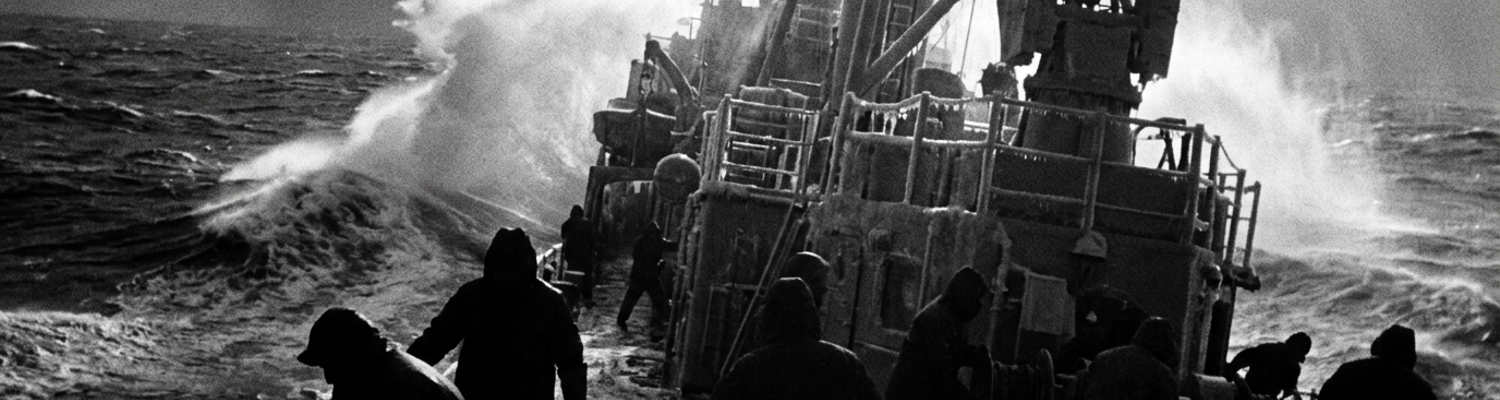

Guardian-Class Pickets on the Pacific Barrier
Orders dispatched from the Commander in Chief, Pacific Fleet, gave the vessel precisely thirty-six hours to clear its moorings. Maintenance crews at the naval shipyard had already opened the low-pressure cylinder casing on the primary reciprocating engine. The emergency deployment directive arrived on October 11. Instead of the scheduled fourteen-day refit window, the engineering department had to bolt the machinery back together within a single overnight watch. Fleet command granted zero latitude for post-repair sea trials. Every lost hour docked in port eroded the margin required to reach Station Victor off the Aleutian chain.
The naval timetable permitted zero mechanical margin.
When examining the historical record, the vessel itself represents an expedient Cold War adaptation of disposable wartime mass production. USS Interceptor (AGR-8) began service in 1943 as the EC2-S-C1 Liberty ship SS Edwin Markham. Shipyard personnel in the mid-1950s stripped the cargo booms and rebuilt the superstructure. They erected heavy tubular lattice masts directly over cargo hatches to support electronic detection suites. To counteract the dangerous topside weight of the AN/SPS-17 long-range air surveillance antenna, workers poured three thousand tons of solid pig iron and concrete ballast into the lower cargo holds. Propulsion relied on an obsolete, direct-drive triple-expansion reciprocating steam engine. The Joshua Hendy Iron Works manufactured this plant. It generated just 2,500 indicated horsepower from two Babcock and Wilcox oil-fired boilers. Archival evidence shows that this aging machinery had to move a top-heavy, 10,000-ton hull through subarctic swells at an operational speed of barely ten knots. This placed continuous mechanical strain on propeller shaft bearings and crankpins.
Internal engineering spaces routinely filled with superheated steam leaks.
A close review of operational logs indicates that the mission profile on the contiguous Pacific Barrier (BARPAC) radar line demanded sustained station-keeping. Operating on Station Victor in deep subarctic waters south of Adak Island near latitude 51 degrees north, the converted freighter held station in an area known for severe low-pressure systems. Station orders required continuous radar picket coverage within an exact fifty-mile geographic box for thirty to forty-five consecutive days without port relief. Inside the darkened Combat Information Center, radar operators watched high-persistence cathode-ray screens for Soviet Tu-95 Bear bombers. They relayed real-time plot vectors across high-frequency teletype links directly to the North American Air Defense Command (NORAD) headquarters at Ent Air Force Base in Colorado. Freezing ocean spray accumulated across the AN/SPS-17 antenna reflector at rates reaching four inches per hour. This locked the drive gears and raised the ship's center of gravity until deck details cleared the ice with axes.
Salt encrustation inside the forward waveguide feed severed all microwave transmission.
Subarctic Gale Damage and Medical Emergency
A close review of operational logs indicates that on January 18, 1962, an intense low-pressure system off the Kamchatka Peninsula collided with an Arctic front. This trapped USS Interceptor in continuous hurricane-force winds south of the Aleutian Trench. Ambient air temperatures dropped to fourteen degrees below zero Fahrenheit. This cooled the welded low-carbon steel plates of the converted World War II Liberty hull well below their ductile-to-brittle transition point. Severe hogging and sagging stresses generated by fifty-five-foot cross-seas focused dynamic load spikes across the cargo deck. At 0415 hours, a sudden structural failure shook the hull. A four-foot vertical tear opened along the starboard sheer strake at frame seventy-four. This breach sat immediately adjacent to the reinforced base of the forward radar tower. Heavy vibrations from the Joshua Hendy steam engine worsened the metal fatigue. Within ninety minutes, secondary fractures propagated across the deck stringer plates toward the centerline cargo hatch coaming.
The ship was breaking apart under its own ballast.
Archival evidence shows that structural destruction above deck matched the hull failures below. Sustained wind gusts exceeding eighty-five knots placed intolerable aerodynamic drag against the massive parabolic reflector of the AN/SPS-17 air search radar. The tubular lattice mast twisted six degrees out of true alignment. Forward guy wires snapped under extreme tension. They whipped across the forward deckhouse and severed pressurized fire mains. Deprived of structural support, the upper platform buckled under the weight of the eight-thousand-pound antenna assembly. The motor drive gears stripped clean. This froze the scanner array permanently facing thirty degrees off the port bow. All radar coverage over the assigned Pacific Barrier sector terminated instantly. Salt water poured directly into exposed electrical junction boxes. This grounded out primary power buses and filled the forward equipment spaces with thick electrical smoke.
Radar picket coverage across the northern perimeter went completely dark.
When examining the historical record, physical casualties among the crew escalated from contusions to life-threatening trauma. Violent forty-six-degree rolls flung watchstanders across interior steel bulkheads. In the auxiliary machinery space, an unbolted three-hundred-pound spare centrifugal pump broke its deck lashings. It pinned an engineman against the reduction gear housing and fractured both of his femurs. Two deckhands inspecting the forward hatch shoring sustained compound fractures and severe internal hemorrhaging. An exceptional sea breached the bulwarks and slammed them into the deck winch drums. Down in sickbay, the lone Chief Hospital Corpsman faced three severely injured men slipping into hemorrhagic shock. He lacked whole blood reserves, mechanical respirators, or sterile surgical facilities. Stabilizing intracranial injuries required neurosurgical intervention available only at a land-based hospital.
Staying on station meant three sailors would die before sunrise.
Weighing the total loss of primary sensor capability against the certainty of crew fatalities and catastrophic hull separation, the commanding officer made the unauthorized decision to abandon Station Victor at 0730 hours. He swung the helm hard to three-hundred-forty degrees. The cracked bow pointed directly toward the jagged southern approaches of Adak Island ninety miles away. Plotting transit through the blind whiteout of the Amchitka Pass with an inoperative surface-search radar forced bridge officers to calculate course changes using dead reckoning and raw fathometer soundings. Hull plates groaned under reverse torque. The vessel took on three hundred gallons of freezing sea water per minute through the compromised sheer strake. Damage control teams drove wooden wedges and lead caulking into the widening steel fissure to limit flooding. Course corrections brought the vessel into the dangerous littoral shoals off Cape Moffett. The ship advanced directly toward the fleet anchorage at Kuluk Bay.
Seventeenth Naval District Communications Breakdown
Archival evidence shows that at 0812 hours, severe atmospheric interference and storm damage severed primary radio relay channels between the 17th Naval District coastal defense stations and offshore craft. At Naval Station Adak's communications outpost on Mount Moffett, continuous eighty-eight-knot sustained winds ripped two sixty-foot wire rhombic antennas directly from their reinforced anchor posts. Sea spray driven inland across the tundra coated porcelain insulators on the transmitter towers at Sweeper Cove. This triggered continuous electrical arcing across the three-thousand-watt AN/FRT-39 transmitters. Watchstanders attempted to shift high-frequency circuits to secondary ultra-high-frequency transceivers. Localized auroral ionospheric absorption from the deep Bering Sea low-pressure front scattered the direct signals before they could clear the volcanic ridges enclosing Kuluk Bay. Down at the district operations center twelve hundred miles away in Kodiak, high-frequency teletype channels fell silent. All shore-based tracking of vessels off the central Aleutians ceased.
Every operational radio circuit went cold within six minutes.
A close review of operational logs indicates that this total transmitter loss stripped offshore picket craft of all technical guidance from coastal defense stations along the island perimeter. USS Interceptor rolled past forty degrees in shallow littoral waters off Cape Moffett. Its AN/SPS-17 radar dish sat buckled and frame seventy-four tore open. The ship sent continuous distress traffic across the 2716-kilohertz emergency channel. Down in the radio room, freezing sea water poured through ruptured overhead seam caulking directly onto the AN/URC-9 high-frequency radio cabinets. This short-circuited the main power transformers and filled the compartment with dense insulation smoke. Radio technicians switched to battery-powered emergency transmitters to tap out manual Morse code distress messages. The charged auroral layer absorbed the low-wattage transmissions completely. Coastal defense observation posts situated at Cape Adagdak and Sitkin Sound logged only static on tactical frequencies. Offshore craft remained separated from the regional radar network while moving through zero-visibility fog banks.
Command headquarters at Kodiak had lost the ship entirely.
When examining the historical record, rescue vessels attempting surf-zone navigation near Adak operated without real-time coordination from mainland naval controllers. Shore commanders at the Sweeper Cove boat basin dispatched two sixty-three-foot aircraft rescue boats and an auxiliary harbor tug into Kuluk Bay. They received no track plots, weather updates, or approach vectors from Alaskan Sea Frontier controllers at Kodiak or mainland controllers at Elmendorf Air Force Base. Violent twenty-five-foot swells broke across the shallow shoals of Andrew Bay and the entrance to Clam Lagoon. The small wooden hulls pitched into six-knot cross-currents. Coxswains operated blind inside driving sleet. They relied entirely on visual wave timing and hand-held lead lines dropped from the open bow to detect submerged basalt pinnacles. Mainland naval controllers in Anchorage possessed no active radar telemetry for the coastal breakers. This prevented them from warning the rescue craft about sudden depth drops or the drift rate of Interceptor as the disabled ship drifted toward the rocky shoals off Cape Moffett.
At 0940 hours, a breaking wave sheared the port rudder assembly off the lead rescue boat eighty yards south of the reef line.
Hostile Target Alerts and Evacuation Delays
Archival evidence shows that at 1008 hours, coastal tracking operators at the Battery 234 harbor defense station on Zeto Point registered two radar contacts entering the southern arc of Kuluk Bay. Operating an AN/TPS-31 surface surveillance radar through sleet-saturated sea returns, radar plotters tracked the blips advancing at nine knots along the Cape Adagdak shoreline. The returning sixty-three-foot aircraft rescue boat lacked steering and its high-frequency transmitter sat disabled by salt spray. The crew was unable to transmit the assigned Identification Friend or Foe (IFF) Mode 2 challenge codes for the day. Naval intelligence bulletins dispatched seventy-two hours earlier had warned the Seventeenth Naval District of possible Soviet Project 123 torpedo boat harassment and submarine periscope reconnaissance near the Aleutian passes. Evaluating the low-profile radar cross-section as an unidentified surface combatant penetrating the inner harbor defenses, the harbor defense duty officer categorized the radar return as a hostile surface incursion. He activated the base-wide general alarm. Coastal artillery crews manned the dual twin 40-millimeter gun mounts at Sweeper Cove. Harbor control stations flashed warning red beacons across the snowy roadstead.
Harbor defense tracking batteries had locked their fire-control directors onto friendly craft.
A close review of operational logs indicates that the hostile alert triggered rigid defensive protocols that froze all small-craft operations along the shoreline. Base defense plans designated the Aleutian littoral as a primary interception corridor. This required automatic harbor closure the instant an unverified track crossed the outer acoustic array. At 1014 hours, the harbor defense coordinator at Naval Base Adak headquarters transmitted the executive order over 3005-kilohertz tactical radio. He ordered all military watercraft to hold position under threat of coastal battery engagement. Coxswains aboard two 40-foot personnel lighters heading toward the surf zone received instructions to shut down their Detroit 6-71 diesel engines and drop anchor immediately. Down at the Sweeper Cove boat basin, marine gate guards dropped anti-torpedo netting across the channel entrance. This blocked auxiliary tugs from exiting into open water. Two hundred yards outside the breaker line, the incoming rescue craft cut its single operational propeller shaft. The crew sought to avoid drawing direct 40-millimeter fire from the gun crews on Zeto Point.
Base defense regulations severed the casualty evacuation route.
When examining the historical record, this operational lockdown halted the transfer of USS Interceptor's injured sailors across the subarctic surf zone off the Andrew Bay gravel spit. Down in the unheated open well deck of the lead rescue launch, three casualties from the radar picket ship lay strapped inside wire Stokes litters. Their body temperatures dropped below ninety-one degrees Fahrenheit in twelve-degree ambient air. The engineman with bilateral femur fractures had entered decompensated hemorrhagic shock. Saline infusion bottles suspended from deck cleats froze solid in the biting wind. Intravenous needles sheared free from collapsed veins as six-foot breakers repeatedly tossed the flat-bottomed craft against the sandbar. Navy medical corpsmen from Naval Dispensary Adak had positioned four-wheel-drive field ambulances on the frozen gravel bank. Armed sentries at the beachhead ordered the teams to seek cover behind sandbag revetments pending target identification. Emergency litter teams were forbidden from launching inflatable rubber landing boats across the surf line to recover the casualties. For forty-eight minutes, the rescue craft pitched in freezing wash ninety yards off the rocky shoreline. Casualty transfer remained completely suspended while artillery controllers verified radar tracks against manual optical sightings.
Freezing spray coated the open wounds before corpsmen received clearance to advance.
NORAD Early Warning Picket Gap
A three-hundred-mile hole opened across the Pacific defense perimeter.
A close review of operational logs indicates that USS Interceptor departing from Station Victor at 0730 hours on January 18 stripped the Pacific Barrier of its primary electronic sentinel south of the Aleutian chain. Station Victor, fixed at latitude 51 degrees north, longitude 177 degrees west, functioned as the central linchpin connecting the seaward Distant Early Warning line to naval pickets patrolling Hawaiian approaches. When the converted Liberty ship swung toward Adak to prevent its cracked hull from splitting open, the AN/SPS-17 radar footprint vanished from regional sector displays. Air surveillance operators lost active microwave scanning over two hundred and fifty nautical miles of subarctic ocean. Backfill arrangements did not exist on short notice. Fleet oilers and escort destroyers based out of Kodiak lacked long-range volumetric search electronics capable of detecting high-altitude bombers at two hundred miles. The assigned relief vessel, USS Guardian, lay tied to a refit pier at Pearl Harbor with disassembled reduction gears. Unmonitored airspace across the northern Pacific flight corridor expanded across thousands of square miles as hours accumulated. Soviet Tu-95 Long Range Aviation regiments staging out of operational airfields near Petropavlovsk and Provideniya gained an unobserved ingress route straight through the Great Circle approach toward the Pacific Northwest. This complete surveillance vacuum persisted for ninety-six consecutive hours.
The outer defense line had ceased to exist.
Archival evidence shows that inside the Combat Operations Center at North American Air Defense Command headquarters at Ent Air Force Base in Colorado Springs, the disruption registered as an unexplained hardware failure before escalating into an operational crisis. Air Force tracking personnel monitoring the 425L command-and-control display boards noted the sudden, unannounced cessation of raw plot data feeds originating from Station Victor. High-frequency datalinks had gone dead without an accompanying operational notification message or standard transfer-of-watch authorization from the vessel. Automatic target-tracking computers dumped active tracks. This cleared the northern air defense quadrant of all correlated radar targets. Duty controllers initially suspected ionospheric disturbances caused by the Aleutian storm system. Forty minutes of silence confirmed that the physical transmitter was no longer broadcasting. Watch officers dispatched flash-priority teletype inquiries directly to the Seventeenth Naval District operations room in Kodiak. They requested immediate status confirmation of the radar picket. Kodiak could provide no coordinates. Atmospheric auroral blackout and storm-damaged antennae at Sweeper Cove prevented coastal naval staff from verifying whether Interceptor remained afloat or had gone down with all hands.
Colorado Springs had no tactical picture of the northern ocean.
When examining the historical record, NORAD commanders viewed the unnotified degradation of contiguous early warning coverage as a breakdown in national air defense readiness. General John K. Gerhart's staff drafted an urgent priority dispatch to the Commander in Chief, Pacific Fleet. They demanded to know why a front-line picket ship had vacated the primary interception corridor without activating standard contingency relocations. NORAD protocols required seventy-two hours of advance notice prior to any planned degradation of the contiguous radar barrier. This allowed the Air Force to scramble EC-121 Warning Star aircraft from the 552nd Airborne Early Warning and Control Wing at McClellan Air Force Base to fill maritime coverage gaps. Because the ship had withdrawn under total radio blackout to save injured personnel, no such alert reached Joint Chiefs of Staff liaison officers. Defense planners in Colorado Springs found themselves running strategic warning boards blind along the Alaska-Aleutian corridor. Four whole days elapsed before an emergency airborne radar orbit established partial coverage over the 51st parallel. Naval authorities in Kodiak only managed to deliver a handwritten situation report to regional Air Force liaisons at Elmendorf Air Force Base eighty-two hours after the initial hull breach occurred.
Inter-Service Recriminations in Washington
The ninety-six-hour electronic blackout across the Aleutians triggered an immediate budget confrontation inside the Pentagon.
Archival evidence shows that Air Force Chief of Staff General Curtis LeMay seized upon the Adak coverage collapse to mount an aggressive assault against the Navy's seaward early warning program. During emergency briefings convened in the National Military Command Center, Air Staff officers presented radar coverage overlays. These contrasted the rapid response times of airborne platforms against the slow movements of surface ships. Air Force leadership argued before Secretary of Defense Robert McNamara that anchoring ten-knot converted freighters in subarctic sea lanes represented an obsolete concept of operations. These civilian-pattern hulls lacked organic air defense weapons. They carried zero antisubmarine sensors. They were incapable of evading Soviet Project 659 nuclear cruise missile submarines operating off the Kuril Islands. Picket vessels trapped in fifty-foot seas had to spend their mechanical power battling storm swells rather than maintaining radar orientation. Air Force briefers showed that three Lockheed EC-121K Warning Star aircraft from the 552nd Airborne Early Warning and Control Wing could deploy from McClellan Air Force Base to Alaska within twelve hours. This would establish flexible search orbits unaffected by surface ice accumulations or hull fractures.
Navy planners found themselves stripped of technical justifications.
When examining the historical record, closed-door Joint Chiefs of Staff hearings throughout late January 1962 focused relentlessly on the structural failures and spiraling repair accounts of the Guardian-class program. Joint Staff analysts cross-examined Bureau of Ships engineers regarding the wisdom of deploying emergency wartime hulls built from low-grade carbon steel into the continuous thermal shock of northern waters. Records tabled before the committee revealed that the sixteen converted EC2-S-C1 Liberty ships required extensive shipyard interventions every six months. Crews had to patch cracked deck stringers, re-weld torn sheer strakes, and replace fatigued rivets. Emergency drydocking at Puget Sound Naval Shipyard for Interceptor alone was projected to cost 1.4 million dollars. This pulled emergency naval repair funds away from fleet destroyer overhauls. Technicians testified that Joshua Hendy triple-expansion steam engines, originally designed for throwaway transatlantic convoys in 1943, were suffering chronic main bearing wipeouts and cracked cylinder heads. This damage occurred under the torque generated by three thousand tons of solid concrete and pig iron ballast. Maintenance logs entered into evidence (NARA Record Group 338) documented thirty-four separate steam-line blowouts across the Pacific Barrier fleet during the preceding winter season. Severe boiler tube scaling accompanied these failures and reduced operational range by forty percent.
A close review of operational logs indicates that Chief of Naval Operations Admiral George W. Anderson Jr. attempted to shield the picket force. He argued that land-based air wings could not maintain continuous 360-degree radar dwell time in subarctic blizzard conditions. Systems analysis staff working under Assistant Secretary of Defense Charles Hitch dismantled the Navy's position with hull-loss projections. Hitch presented structural inspection sheets showing that sister pickets USS Guardian and USS Lookout had developed identical metal fatigue fissures near frame seventy-four following sustained patrols in five-degree water. Bureau of Ships inspectors admitted that brittle fracture thresholds in wartime welded plate made hull failure an engineering certainty whenever subarctic seas exceeded thirty feet. Naval representatives left the January 28 hearing with orders to prepare a phased decommission schedule for all sixteen Guardian-class hulls.
Accelerated Phaseout of Ocean Radar Pickets
Archival evidence shows that the command breakdown off Adak triggered an immediate acceleration of the Department of Defense's retirement schedule for the entire Guardian-class radar picket inventory. Secretary of Defense Robert McNamara's Office of Systems Analysis seized upon the structural crisis of USS Interceptor to dismantle the Navy's ocean picket program years ahead of its original timeline. Budget directives drafted in February 1962 canceled scheduled five-year overhaul cycles for all sixteen converted Liberty hulls. This truncated an operational posture that fleet planners had scheduled to extend past 1968. Analysis teams directed by Comptroller Charles Hitch compiled data demonstrating that maintaining an AGR hull on station cost over twice as much per radar track hour as maintaining equivalent land-based or airborne sectors. The Bureau of Ships faced immediate cancellations of structural remediation programs intended to reinforce hull strakes and main decks against subarctic wave loading. Fleet commanders received instructions to draft decommissioning itineraries for both Atlantic and Pacific picket squadrons. They targeted the complete elimination of the vessels from frontline continental air defense rosters.
The converted Liberty hulls had become an unsustainable fiscal and structural liability.
A close review of operational logs indicates that the mechanical autopsy of USS Interceptor at Puget Sound Naval Shipyard sealed the fate of its sister ships. Shipyard inspectors surveying the fractured starboard sheer strake at frame seventy-four calculated that rebuilding the torn low-carbon steel plate and bracing the sagging radar mast platform would cost 1.4 million dollars. Identical embrittlement fractures discovered along deck stringers on USS Guardian (AGR-1) and USS Lookout (AGR-2) convinced Department of Defense engineers that wartime welded plates could never withstand continuous subarctic hogging and sagging cycles without complete structural rebuilds. Navy leadership attempted to salvage the program by proposing structural retrofits and propulsion overhauls. McNamara's deputies canceled planned installations of modernized AN/SPS-30 height-finder radars across the class. Bureau of Ships planners halted all machinery procurement for Joshua Hendy reciprocating steam engines. This denied spare crankpins, boiler tubes, and cylinder heads to forward supply depots at Kodiak and Pearl Harbor. Pacific Fleet commands marked USS Interceptor (AGR-8), USS Skywatcher (AGR-3), and USS Searcher (AGR-4) for immediate operational stand-down. They scheduled their transfer to the Maritime Administration's reserve fleet berths in Suisun Bay and the James River.
Early warning responsibility shifted from storm-battered deckhouses to high-altitude flight decks.
When examining the historical record, continental surveillance duties transferred rapidly to airborne early warning wings and fixed Arctic radar installations. Fleet airborne squadrons operating Lockheed EC-121 Warning Stars assumed the seaward picket routes. Deployments originated out of Naval Air Station Barbers Point, Midway Island, and Naval Station Argentia. Outfitted with ventral AN/APS-20 air search dishes and dorsal AN/APS-45 height-finder radomes, these multi-engine aircraft flew continuous barrier sweeps at twelve thousand feet. The airframes operated entirely clear of surface wave action and ice accumulation. Flight crews from Airborne Early Warning Barrier Pacific (AEWBARRONPAC) established round-the-clock patrol orbits covering the Great Circle route. Operators linked tactical air plots directly to North American Air Defense Command consoles within fractions of a second. Defense planners simultaneously directed capital funds toward land-based detection lines spanning the northern perimeter. Upgrades expanded the Distant Early Warning (DEW) line across the northern rim from Point Lay to Greenland. Engineers integrated high-frequency tropospheric scatter communications arrays that eliminated ionospheric storm blackouts. Clear Air Force Station in central Alaska reached operational status with its Ballistic Missile Early Warning System (BMEWS) Site II. It projected AN/FPS-50 radar fans across the polar approaches to track supersonic targets far beyond the physical range of shipboard antennas. Naval authorities struck the last Guardian-class picket from the register on July 28, 1965.