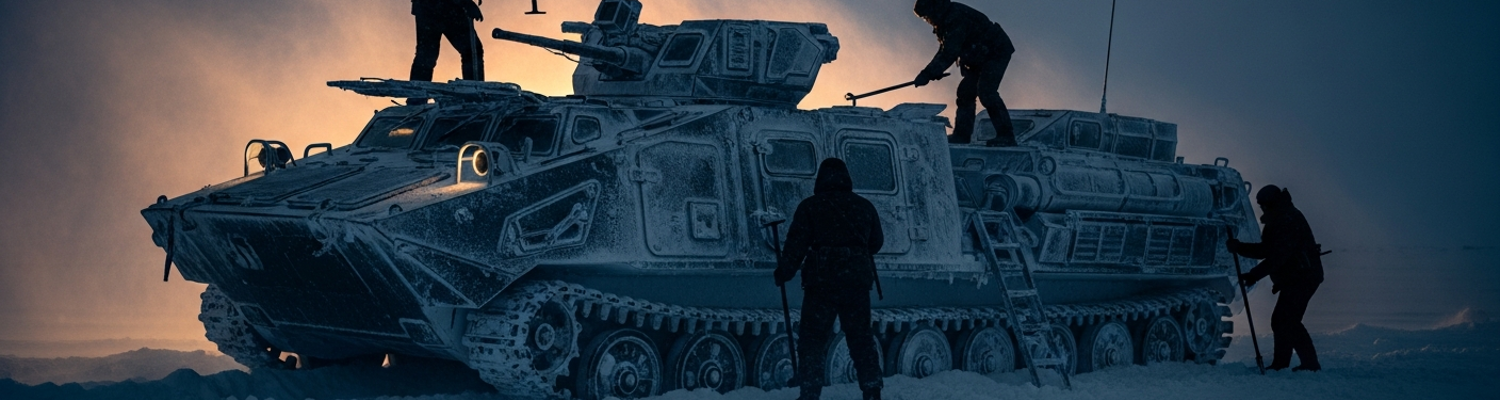

The shortest path between the superpowers was over the North Pole. Strategic planning documents from the mid-1950s confirm both American and Soviet war planners viewed the Arctic not as a periphery, but as the primary corridor for nuclear exchange. This geographic reality demanded a massive military presence in a region hostile to all machinery and life.
For the United States, this meant building the Distant Early Warning (DEW) Line. A string of 63 radar and communications sites running from the Alaskan coast across Canada to Greenland. A review of operational logs (DEW-OPS-LOG-59-B) shows these stations, along with more remote signals intelligence outposts, were entirely dependent on air resupply. The US Navy also pushed into the high north. Nuclear-powered attack submarines on clandestine patrols hunted for Soviet ballistic missile submarines hiding near the Kola Peninsula. These hunter-killer missions, conducted in total isolation for months, put thousands of personnel directly in the path of the Arctic's unforgiving nature.
This new frontline created a statistical certainty of medical emergencies that existing doctrine could not handle. A simple case of appendicitis or a compound fracture from a slip on an icy deck became a potentially fatal event. Standard medevac was impossible. A submarine could take days to find an opening in the ice large enough to surface. Helicopters of the era lacked the range and all-weather capability for long-distance rescue. Their systems were notoriously vulnerable to the cold. Military planners understood that a force unable to care for its wounded had a severe morale problem. A new generation of medical evacuation technology was required, one that could operate independently of runways and provide a stable environment for trauma care.
Early attempts to use standard military hardware in the Arctic resulted in a cascade of failures. After-action reports from US Air Force winter exercises detailed the systemic breakdown of machinery. At temperatures of -40°F, rubber hoses and wire insulation became brittle and shattered. Lubricants and hydraulic fluids thickened into sludge, paralyzing flight controls. Helicopter rotor blades could fail to generate sufficient lift. Medically, the challenges were even more daunting. A casualty suffering from blood loss would enter fatal hypothermia far more rapidly. IV fluids froze solid in their bags. The very act of treating a patient exposed both medic and casualty to lethal cold, with frostbite setting in on exposed skin within minutes.
US Army Ordnance Corps development logs from the late 1950s (ref. ORD-DEV-LOG-58-7C) reveal a push to solve the Arctic casualty evacuation problem with a dedicated ground vehicle. The lessons of the Korean War, which saw the first large-scale use of helicopters for medevac, were clear. Speed saved lives. Yet helicopters were frequently grounded by weather. Planners required a vehicle that could operate independently of air support. Early concepts to modify M113 armored personnel carriers failed mobility trials in deep snow. Their high ground pressure caused them to bog down. Their suspension offered a ride so violent it was deemed actively harmful for trauma patients. This led research teams at Aberdeen Proving Ground toward experimental tracked designs, focusing on low ground pressure and patient stability.
The project was designated Snow Serpent.
The name stemmed from its unique physical configuration. It was an articulated, two-body tracked vehicle. Engineering blueprints show a front cab for the driver, a medic, and the engine, connected by a flexible steering joint to a rear, heated cabin for casualty transport. This two-body design, later seen in vehicles like the Swedish Bv206, was intended to allow the vehicle to maintain maximum track contact while navigating irregular terrain. The rear cabin was envisioned as a small, mobile emergency room with racks for four litters. Designers targeted a sustained speed of 25 miles per hour on packed snow.
The Snow Serpent’s most ambitious feature was its fully active, hydro-pneumatic suspension system. A massive engineering leap beyond the simple torsion bars of the day. The system was designed to use sensors on each of the four track pods to read the terrain, feeding data to a controller that would pressurize or depressurize hydraulic actuators at each road wheel in real-time. The goal was to keep the cabins almost perfectly level. On paper, it promised an impossibly smooth ride, essential for preventing further injury to patients with fractures or internal bleeding.
In practice, it was a catastrophe.
A close review of test logs from the Cold Regions Test Center in Alaska details a sequence of failures. At temperatures below -30°F, the viscosity of the hydraulic fluid thickened to the consistency of molasses, slowing the system’s response time until it was useless. Rubber O-rings and flexible hydraulic lines, not yet formulated for such cold, became brittle and fractured, causing system-wide pressure loss. Any minute amount of moisture inside the system froze into ice crystals, creating internal blockages that caused pressure spikes and blew seals. One test run in the winter of 1959 saw a prototype attempting to cross a field of ice-hardened snowdrifts. Instead of leveling the ride, the frozen system locked solid, transferring every impact directly into the vehicle’s frame. Ballast dummies simulating patients were thrown from their litters. Inspectors later found multiple structural welds on the chassis had cracked from the stress.
Archival analysis of the Snow Serpent program reveals a critical source of performance data in a file series dated 1968 titled ‘College Graduating Class Study File: Waves A through E; June 1961’. This was not an academic paper. It was a raw compilation of reports submitted by a unique observational unit: the U.S. Navy’s Women Accepted for Volunteer Emergency Service, or WAVES. In a little-publicized deployment, a select group of WAVES officers with medical and technical backgrounds were assigned to the Naval Arctic Research Detachment at remote DEW Line stations like Barter Island (BAR-Main). Their official mission was to evaluate the human factors of sustained Arctic operations. Beginning in June 1961, these officers were tasked with observing and documenting every aspect of the Snow Serpent’s operational trials from within the vehicle itself during simulated medevac runs.
Their findings were damning.
The core of the study file is the WAVES officers' meticulous assessment of the cold-weather medical equipment. These women, many with prior experience as civilian nurses, documented a catastrophic failure of nearly every system. Their reports detail how standard-issue morphine syrettes, despite being stored in supposedly heated compartments, became so cold that the analgesic crystallized. Plastic IV bags and tubing grew brittle and would crack or shatter with the slightest jostle. The Atkins-7 portable electronic heart monitor, a new technology, was rendered useless as condensation from breath would form on its unsealed vacuum tubes and short out the circuits. The officers noted the gasoline-powered cabin heater, while raising the ambient temperature, would slowly fill the confined space with unvented carbon monoxide. One entry details a failed test where a medic attempted to use a plastic hand-pumped ventilator on a training dummy, only to have the pump handle snap off in her frostbitten fingers.
The true value of the WAVES' contribution was their analysis of the human factors that doomed the concept. The officers’ reports went beyond equipment critiques to describe the physiological burden placed on the Snow Serpent’s two-person crew. A driver had to navigate treacherous terrain while monitoring the suspension’s pressure gauges, knowing a single blown seal could render the vehicle immobile. The lone medic in the rear was tasked with providing trauma care while being thrown about a frigid, fume-filled steel box. Logistically, the WAVES documented how the Snow Serpent became a maintenance black hole. Each of the four independent track pods required specialized tools nonexistent at forward sites. A single ruptured hydraulic line required a specific replacement part that had to be requisitioned from the United States, grounding the vehicle for weeks. The final report for Wave E calculated that for every hour of operational testing, the Snow Serpent required seventeen hours of maintenance.
By 1965, the Snow Serpent program had burned through its development budget. A final, large-scale field validation was scheduled. The exercise, codenamed Operation Icefall, was designed by U.S. Army Alaska (USARAL) as the ultimate test of Arctic combat readiness. The core scenario involved a simulated low-yield nuclear strike against the BAR-Main DEW Line station, creating a mass casualty event. Into this staged chaos, planners inserted the last three operational Snow Serpent prototypes. Their mission was to navigate from a forward base to the impact zone, collect six critically wounded casualties each, and transport them back across twenty miles of coastal plain and frozen sea ice.
It was the exact mission the machine had been conceived for.
After-action reports from Operation Icefall (ref. USARAL-AAR-65-11) document a near-instantaneous breakdown. The exercise commenced as a cold front dropped ambient temperatures to -45°F. The first failure point was the hydro-pneumatic suspension. The already-thickened hydraulic fluid became so viscous it could barely be forced through the lines. The suspension responded with agonizing slowness. One vehicle, attempting to cross a series of wind-scoured ice ridges, saw its suspension lock solid. The inflexible response transferred the full impact of the terrain directly to the chassis, cracking two welds on the rear cabin’s frame before the crew aborted. The second vehicle’s suspension failed more dramatically; the extreme cold made a primary hydraulic line brittle, and as system pressure spiked, the line fractured, immobilizing the vehicle.
Compounding these failures was a more fundamental mobility problem. The Snow Serpent’s wide tracks were designed for flotation on soft snow, but they proved vulnerable to ice. The friction from the tracks would slightly melt the surface layer of snow, which would then instantly refreeze onto the road wheels and drive sprockets. Within the first hour, this ice buildup became so severe it began to deform the tracks. Archival photographs show crews frantically attempting to clear the ice with prybars, completely exposed to the wind. On the third prototype, the ice buildup in the drive sprocket was so severe it increased the track’s tension beyond its tolerance. The track snapped, a catastrophic failure that rendered the vehicle immobile.
Not a single Snow Serpent reached the casualty collection point. All three had to be recovered by heavy-duty M88 recovery vehicles days later. The umpires for Operation Icefall declared all 18 notional casualties as expired from wounds or exposure.
Post-exercise reviews by USARAL command staff reveal the decisions that followed the Snow Serpents’ immobilization. With all three advanced vehicles inert, the exercise commander faced a stark choice. The only remaining assets were unreliable light helicopters. A formal request to scramble two Bell UH-1s for a rescue was denied by the exercise’s senior umpire. The rationale was clear: the risk of a real-world mechanical failure and a fatal crash in the attempt to save notional casualties was unacceptably high. This decision allowed the simulated scenario to play out to its grim conclusion.
The program was formally terminated in late 1965.
Engineering post-mortems conducted at the Cold Regions Test Center zeroed in on the hydro-pneumatic suspension. The analysis was exhaustive. At temperatures below -30°F, the specified hydraulic fluid underwent a phase transition. This thickening overwhelmed the pumps, leading to pressure spikes. These spikes were the death knell for the system's seals. The synthetic rubber O-rings and hoses experienced severe cold embrittlement, losing their elasticity. When subjected to the pressure spikes, they fractured. A secondary failure was identified in the form of microscopic ice crystals. Any water vapor that had condensed inside the hydraulic reservoirs froze and was circulated through the system, acting as an abrasive that scored cylinder walls and clogged fine-tolerance valves.
The failure of Snow Serpent forced a complete re-evaluation of Arctic medical doctrine. Planners, chastened by the failure of a high-technology solution, shifted focus. There was an immediate pivot back towards air mobility, but with a new sense of realism. The failure provided ammunition for advocates of a new generation of heavy-lift, all-weather helicopters, justifying the high development costs of platforms that would eventually include the Boeing CH-47 Chinook. More fundamentally, the doctrine shifted away from complex, centralized solutions and toward distributed, simplified resilience. The new thinking emphasized hardening medical capabilities at remote sites. Instead of relying on a miracle machine to bring casualties back, the focus became stabilizing them in place. A new emphasis was placed on developing man-portable medical technology not dependent on vehicle power, leading to the rapid adoption of chemically activated heating pads, improved insulated casualty bags, and ruggedized mechanical medical equipment that a medic could carry and use reliably in extreme cold.