
Soviet Naval Expansion 1971
The South China Sea offered no relief. A metallic sun beat down on steel decks, turning compartments into ovens and flight decks into griddles. Humidity, a constant and oppressive blanket, worked its way into every mechanism, accelerating corrosion on airframes and shorting delicate electronics. Salt spray coated everything, a gritty film that etched steel and irritated skin. In the Indian Ocean, the conditions were even more pronounced. The heat was a physical presence, a suffocating force that seemed to suck the energy from men working for hours in the open. They wrestled with fuel lines and ordnance carts under a relentless sky. This was the unforgiving operational environment for the U.S. Seventh Fleet, a battle against physics and climate that stretched its material and human resources to their limits.
A new threat was solidifying on the horizon.
Archival evidence shows that by late 1971, a definitive picture of a transformed Soviet naval capability was coming into sharp focus for U.S. planners. The document crystallizing this new strategic problem was National Intelligence Estimate 11-10-71, issued on December 15, 1971. Its title was direct: The Uses of Soviet Military Power in Distant Areas. This assessment was not a speculative forecast. It was a technical analysis of a demonstrated and expanding reality. A close review of the estimate indicates it detailed a fundamental shift in Soviet naval doctrine, moving far beyond the traditional role of a coastal defense force. The Soviet Navy, under the ambitious direction of Admiral Sergey Gorskov, was now an instrument of global power projection. The NIE documented how the Soviets were using naval deployments as a primary tool of statecraft, supporting client states and challenging Western actions. The estimate concluded that Soviet out-of-area operations, which had grown fivefold between 1965 and 1970, had stabilized at a new, high tempo. This was not just about numbers. It was about a new confidence and a new mission, one aimed directly at contesting the sea control long taken for granted by the U.S. Navy.
The hardware underpinning this strategic shift was formidable and purpose-built. The global OKEAN-70 naval exercise had provided a stunning preview, involving over 200 warships, submarines, and support vessels in a coordinated display of blue-water capability. Intelligence streams were tracking the deployment of new classes of warships specifically designed for anti-carrier warfare. Kresta and Kynda-class guided-missile cruisers, along with a growing fleet of nuclear-powered submarines armed with long-range anti-ship cruise missiles, were no longer confined to home waters. These platforms were engineered to hunt and kill the centerpieces of American naval power, the aircraft carriers of fleets like the Seventh. This created a direct threat that demanded constant, heightened vigilance. The operational logs of U.S. destroyers and patrol aircraft from this period show a marked increase in cat-and-mouse interactions. Soviet tattletale ships shadowed carrier strike groups, gathering electronic intelligence and practicing mock attacks. This constant harassment imposed a significant psychological and operational strain on U.S. crews, forcing them to maintain a draining combat-ready posture at all times.
Nowhere was this new reality more apparent than in the Indian Ocean and Western Pacific. CIA reports from the period show that Soviet naval ship-days in the Indian Ocean had surged from approximately 1,000 in 1968 to over 8,000 by 1971. This presence was formalized by the increasing operations of what would soon be designated the 8th Operational Squadron, drawing its assets primarily from the Soviet Pacific Fleet. The Soviets were also securing logistical footholds, gaining access to port facilities in places like Berbera, Somalia, which allowed their ships to refit and replenish far from their homeport in Vladivostok. The political-military implications became clear during the Indo-Pakistani War in December 1971. As the American Task Force 74, centered on the carrier USS Enterprise, entered the Bay of Bengal, the Soviets responded by dispatching their own naval force. A group of cruisers and destroyers, augmented by submarines, shadowed the American task force, creating a tense standoff. No shots were fired, but the message was unambiguous. The Indian Ocean was no longer a Western lake. Soviet naval power was now a fixture in the Seventh Fleet’s primary area of responsibility, capable of directly intervening in regional crises and challenging U.S. strategic moves.
CTF 77 Forward Deployment
The necessity for forward deployment came without warning, a strategic shockwave triggered by events in the Gulf of Tonkin in August 1964. Reports from the destroyers USS Maddox and Turner Joy alleging attacks by North Vietnamese torpedo boats compelled a rapid escalation. A close review of operational directives from this period shows that pre-deployment work-up cycles, essential for integrating a carrier and its air wing and for conducting maintenance, were summarily cancelled. There was no time. Carriers on the West Coast of the United States or on station elsewhere in the Pacific were ordered to proceed with all available speed to the waters off Vietnam. For example, the USS Ticonderoga was on station and launched retaliatory aircraft in response to the initial incident. This directive meant that ships like the Constellation, Hancock, and Ranger were thrown into a full combat posture directly from a peacetime rotation. Their crews and equipment were unprepared for the intensity and duration of the operations that would follow. This abrupt transition bypassed the periods normally allocated for engineering assessments, parts replenishment, and crew training, seeding the fleet with latent mechanical and human failures that would manifest under the pressure of continuous combat.
The operating area was designated Yankee Station.
From this fixed point in the South China Sea, roughly 90 miles offshore, the carriers of Task Force 77 (CTF 77) began a relentless air war. The operational tempo was punishing from the outset. Carriers worked in 12-hour shifts, one conducting flight operations while another stood by, rearming and refueling. This cycle ensured a constant stream of airpower directed at targets in North Vietnam and Laos under campaigns codenamed ROLLING THUNDER, STEEL TIGER, and later LINEBACKER I and II. A single carrier air wing was expected to generate thousands of sorties a month. With three carriers on station, the monthly average could exceed 4,000 launches and recoveries. The mission set was diverse and dangerous, ranging from massive Alpha strikes involving dozens of aircraft against heavily defended strategic targets like bridges and supply depots, to armed reconnaissance flights searching for targets of opportunity, and close air support for ground forces in South Vietnam. The sheer scale of these operations is visible in archival records. Carriers such as the USS Kitty Hawk, USS Coral Sea, and the nuclear-powered USS Enterprise became fixtures at Yankee station, their flight decks a chaotic, 24-hour cycle of launching and recovering aircraft laden with ordnance. This constant activity placed an incredible burden not just on the aircrews, but on the flight deck personnel, ordnance handlers, and maintenance teams who had to sustain the pace in the unforgiving heat and humidity.
This sustained operational posture was mandated, with no end in sight. The standard deployment tour of six to seven months, once a predictable rhythm of naval life, became an elastic and often extended period of intense combat. Line periods, the number of consecutive days a carrier was required to conduct combat flight operations, stretched from a planned 30 days to over 40. The longest line period recorded was 42 days leading up to the Linebacker II campaign. These extensions had severe consequences for both machinery and personnel. Maintenance on steam catapults, arresting gear, and aircraft elevators was deferred. The constant high-power cycling of the ship’s four catapults led to an increase in component failures, from launching valves to hydraulic seals, creating a backlog of repairs that could only be addressed during brief respites in ports like Subic Bay in the Philippines. The human cost was equally high. The 12 on, 12 off schedule for flight deck crews was often a fiction, with maintenance and ordnance loading requirements bleeding deep into supposed rest periods. The psychological erosion caused by sleep deprivation, the perpetual danger of flight deck accidents, and the knowledge that the line period could be extended at any moment created a state of cumulative fatigue that degraded performance and morale across the task force. Over nine years, twenty-one different U.S. carriers would serve on the line, accumulating over 9,100 days of combat operations in a war that consumed men and material at a rate few had foreseen.
Unprecedented Replenishment Tempo
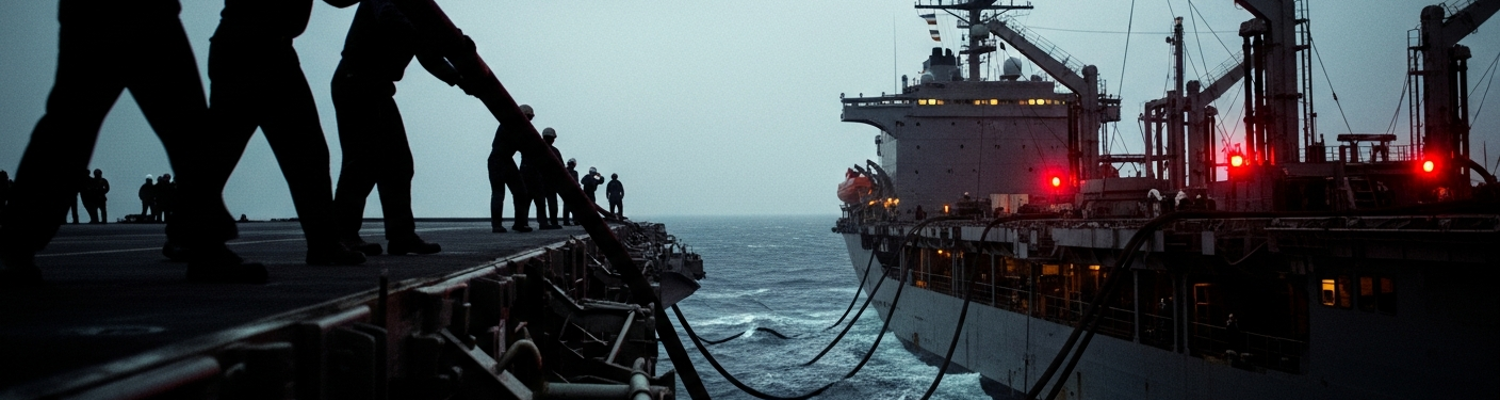
The logistics train that sustained Task Force 77 was unceasing. Its operational heartbeat was the Underway Replenishment, or UNREP, a constant, high-stakes transfer of fuel, ordnance, and stores in the open sea. The pace was dictated by the insatiable demands of carrier aviation at Yankee Station. A single carrier strike group burned through fuel and expended ordnance at a rate that required replenishment every two to three days. With multiple carriers on the line, this created a continuous five-day cycle for the fleet oilers (AOs) and ammunition ships (AEs) steaming out of Subic Bay. A close review of operational logs shows ships like the oiler USS Ponchatoula conducting as many as twenty UNREPs in a single day, transferring millions of gallons of JP-5 jet fuel and fuel oil in a 24-hour period. This tempo was a grinding reality, turning the waters of the South China Sea into a perpetually active logistics field where the fleet's combat power was constantly being refilled.
This crushing demand forced ad-hoc modifications to established transfer protocols. The standard method was Connected Replenishment (CONREP), where ships would steam in parallel, 80 to 200 feet apart, connected by heavy wires and hoses. The preferred system, the Standard Tensioned Replenishment Alongside Method (STREAM), used ram tensioners to keep the highline taut, but the system was being pushed beyond its designed limits. To shorten time alongside, a period of extreme vulnerability, crews were pushed to accelerate transfer rates. This placed enormous strain on mechanical components. Reports from the period detail incidents of parting wires, fuel hose clamps unseating and spraying volatile JP-5 across the deck, and padeyes ripping from their welds under excessive load. To supplement the slow and hazardous CONREP process, particularly for ordnance, the fleet rapidly expanded its use of Vertical Replenishment (VERTREP). First pioneered in the early 1960s, VERTREP used CH-46 Sea Knight helicopters to sling-load pallets of bombs and rockets from supply ships to the carrier’s flight deck. While faster and allowing the ships greater maneuverability, it was a technique refined under combat pressure, with crews developing procedures on the fly to handle the rapid succession of heavy, swinging loads. One wrong move could send a two-ton pallet of bombs crashing into the deck.
Every one of these evolutions was performed under the watchful eyes of the enemy. Soviet intelligence-gathering ships, designated AGIs, were a permanent fixture, shadowing the carrier groups. These vessels, often camouflaged as civilian fishing trawlers but bristling with antennas, would trail the task force, meticulously recording every detail. UNREP operations were their primary intelligence focus. During replenishment, the American warships were at their most vulnerable: locked on a straight course and steady speed, physically connected, and unable to maneuver freely. The AGIs would close in, sometimes attempting to cut through the formation, to gather electronic intelligence, document replenishment times, and photograph the procedures. This continuous surveillance imposed a severe psychological burden on the crews, who were forced to perform a dangerous, high-pressure ballet of machinery and seamanship with the full knowledge that they were being targeted. The response was to station destroyers as shoulders to keep the AGIs at a distance and maintain a combat air patrol overhead, but the threat was omnipresent. It turned the already hazardous act of refueling and rearming into a tense, nonstop confrontation in the Cold War.
Personnel and Equipment Criticality
The human element aboard the carriers and their escorts was the first to show signs of failure under the operational tempo. A close review of operational logs and later analyses indicates that sailors were consistently working far beyond sustainable limits, with some reporting 100-hour work weeks. The mandated 12 on, 12 off work cycle was a fiction for most. For the sailors on the flight deck and in the maintenance bays, the 12 hours off were consumed by pre-launch preparations, ordnance loading, and repair work that could not be deferred. Sleep deprivation became systemic. This exhaustion was compounded by the intense, ever-present danger of the work itself, from the controlled violence of flight operations to the inherent risks of handling live ordnance. The psychological erosion was significant. Personnel records from the period show a marked increase in fatigue-related incidents and a degradation of performance, a direct consequence of extended line periods that stretched men past their breaking point. The constant pressure, combined with the knowledge that deployment dates were elastic and subject to extension with little notice, created a climate of sustained stress that wore down even the most seasoned crews.
The mechanical backbone of carrier operations began to fracture under the same relentless strain.
Archival maintenance records from Task Force 77 ships paint a stark picture of equipment being pushed far beyond its designed service life. The four massive steam catapults on each carrier, essential for launching heavy attack aircraft, were cycled thousands of times per month, leading to premature failure of critical components like launching valves, hydraulic seals, and bridle catchers. The arresting gear, responsible for catching returning aircraft, suffered from frayed cables and worn-out hydraulic dampers. These were not isolated incidents but a fleet-wide cascade of mechanical failures driven by the deferral of essential maintenance. The brief periods in Subic Bay were insufficient to address the growing backlog of repairs, forcing maintenance crews to prioritize only the most critical downing discrepancies. Ships often returned to the line at Yankee Station with a host of known, but unfixed, mechanical problems. This created a vicious cycle where failing equipment placed even greater demands on the already exhausted personnel trying to keep it running.
The act of underway replenishment itself, the very process that kept the carriers in the fight, became a high-risk evolution where both men and machines were at their limits. The standard method of Connected Replenishment required ships to steam in parallel formation, a mere 80 to 200 feet apart, while heavy fuel hoses and wire highlines for cargo were passed between them. To shorten this vulnerable period, crews were pushed to accelerate transfer rates, putting immense stress on the STREAM gear. Mishaps became more frequent. Safety reports from the period document incidents of parting wires, fuel hose clamps unseating and spraying volatile JP-5 jet fuel across hot decks, and deck padeyes, the metal attachment points welded to the ship, ripping away under excessive loads. To augment this, the fleet increasingly relied on Vertical Replenishment, using CH-46 Sea Knight helicopters to rapidly sling-load pallets of bombs and provisions. While faster, this method introduced its own dangers, with two-ton loads of ordnance swinging over a crowded flight deck, demanding absolute precision from pilots and deck crews who were often operating on minimal rest.
Radio Operators Communication Burden
A close review of operational logs from Seventh Fleet carriers at Yankee Station reveals the central nervous system of the entire air war was the ship’s radio room. The burden placed on the radiomen, specialists who translated the chaos of combat into manageable information, was extraordinary. Inside the cramped, climate-controlled spaces, the air was thick with the constant clatter of teletype machines, specifically the AN/UGC-6 model, which punched out tactical data and logistical requests onto paper tape at a rate of up to 100 words per minute. Operators managed a relentless flow of traffic across multiple high-frequency (HF) voice and data circuits simultaneously. They handled everything from task force command and control directives and intelligence summaries to routine administrative messages and, most critically, the minute-by-minute coordination of air operations. Every piece of information, from a change in a target’s coordinates to a pilot’s fuel state, had to be received, logged, authenticated, and relayed with absolute precision. An error in a single character of a coded message could mean the difference between a successful strike and a catastrophic failure.
This communications load was a physical and psychological grind that defined the operator’s existence.
The most demanding and highest-stakes function for the carrier’s radio operators was the coordination of aerial refueling assets. Strike packages launching from Yankee Station, particularly aircraft like the A-4 Skyhawk or F-4 Phantom II laden with heavy ordnance for missions deep into North Vietnam, had limited fuel reserves. This made carrier-based tankers, such as the KA-3B Skywarrior and later the KA-6D Intruder, a lifeline. Analysis of communication procedures shows that when a strike aircraft reached a low fuel state, the pilot would transmit a bingo call. This signal initiated a frantic but precise sequence orchestrated by the radiomen. They had to receive the distressed aircraft’s position and fuel status, often from a pilot whose voice was strained by the stress of combat, and immediately identify the nearest available tanker, designated by the callsign Texaco. The operator then had to vector the tanker to the rendezvous point in the Gulf of Tonkin, managing multiple aircraft on different frequencies to ensure a safe and rapid link-up. The process was fraught with peril, as a miscalculation or delay could result in the loss of the aircraft and its crew. The entire evolution was a race against time, managed by an operator juggling dozens of other transmissions in the background.
Compounding this intense workload was a constant battle against signal degradation. The radio-frequency spectrum over the Gulf of Tonkin was a hostile environment, polluted from three distinct sources. Natural interference from tropical thunderstorms and atmospheric conditions frequently garbled HF transmissions, forcing operators to constantly hunt for clear channels. The carrier strike group itself was a massive source of electromagnetic interference, with its powerful search radars and other transmitters flooding the airwaves and bleeding into sensitive receiver channels. The most direct threat came from deliberate enemy action. Soviet intelligence-gathering trawlers (AGIs) were a permanent fixture, shadowing the American fleet to do more than just observe. These vessels were equipped for electronic warfare, capable of pinpointing the fleet’s primary communication frequencies and directing targeted jamming against them. North Vietnamese and Chinese operators also engaged in jamming efforts. For the Seventh Fleet radioman, this meant that a critical transmission from a pilot in distress could be suddenly overwhelmed by a piercing tone or unintelligible noise. Maintaining a stable communications link required immense technical skill, forcing operators to rapidly shift frequencies, re-route signals through different antenna arrays, and apply counter-jamming filters, all under the extreme pressure of ongoing combat operations.
Fatigue and Psychological Erosion
The underway replenishment cycle became a focal point for extreme fatigue, particularly during night and low-visibility operations. Steaming side-by-side, often only dozens of feet apart, the massive hulls of a carrier and a replenishment oiler created a hydrodynamic phenomenon known as the Venturi effect, where the accelerated water flow between the ships generated a powerful suction. It demanded intense concentration from experienced helmsmen just to keep the ships from being pulled into a collision. In the blackness of a Gulf of Tonkin night, with ships darkened to avoid enemy detection, this task was perilous. Deck crews worked under faint red or blue battle lanterns, struggling to handle heavy fuel lines and cargo nets that could snap with lethal force. A misstep could send a sailor into the churning water between the vessels, where the suction would pull them under the hull. A 2002 study on the USS John C. Stennis confirmed that shifting to an inverted night-work schedule to support combat operations caused significant sleep disruption and fatigue, with nearly half of the participants reporting they never fully adjusted. The constant, high-risk nature of these evolutions, performed by crews that were already sleep-deprived, led to a documented increase in mishaps, from parted lines to fuel spills.
This was the operational environment.
An examination of personnel records and later medical studies shows the profound psychological impact of this tempo. The official 12 on, 12 off schedule was an illusion for most sailors, with workdays stretching to 18 hours or more. Studies have shown that losing even two hours of sleep can degrade performance and increase the risk of errors. Chronic sleep restriction leads to documented burnout and anxiety. For sailors on Yankee Station, this was not a temporary condition but a months-long reality. Cognitive function, decision-making abilities, and reaction times are all degraded by lack of sleep. On a carrier flight deck, where a 30-ton jet could land just feet away, slowed reflexes were fatal. The term combat fatigue, a precursor to the modern diagnosis of PTSD, was widely observed. Symptoms included anxiety, depression, hypervigilance, and emotional numbness. Research on military personnel has shown a direct link between high-frequency nightmares and poor physical and mental health, including physical exhaustion and difficulty communicating with peers. The unrelenting pressure and the knowledge that deployments could be extended without notice created a corrosive environment of sustained stress.
The breaking point of the human element manifested across the fleet in the early 1970s. A 1971 report in the Armed Forces Journal stated that the morale, discipline, and battle-worthiness of U.S. forces were lower than at any other time in the century. This was not confined to ground troops. Onboard Seventh Fleet carriers, the strain erupted into violence and disobedience. In October 1972, a major race riot involving over 100 sailors broke out aboard the USS Kitty Hawk, resulting in 46 injuries. Days later, a large group of sailors on the USS Constellation conducted a sit-in and refused to return to the ship to protest grievances. These events were symptoms of a system under severe duress. The Navy also saw a rise in sabotage. The aggregate effect was a military force whose institutional integrity was eroding. Army studies from the period revealed that over half of all soldiers in Vietnam engaged in antiwar dissent or used drugs as a form of resistance, a clear detriment to combat readiness. The constant fatigue and psychological stress degraded the very discipline required to operate complex warships in a combat zone.