
During the Vietnam War, the standard equipment replacement cycle for the U.S. Army was eight years. In Vietnam, that timetable was reduced to two. This acceleration was not primarily due to combat losses, but to an unyielding, corrosive enemy that attacked every piece of equipment: the environment itself. In the Mekong Delta, this war against nature centered on three relentless elements: water, mud, and rust.
The atmosphere in the Mekong Delta was a tangible, oppressive force. With humidity perpetually hovering near saturation, the air itself degraded men and materiel with frightening efficiency. A close review of operational logs from units like the 9th Infantry Division, which pioneered riverine tactics in the Delta, shows a persistent struggle against the effects of water. For individual soldiers, it meant canvas gear that soaked up rain and sweat, turning a standard 60-pound load into an 80-pound burden of wet fabric. For their weapons, the consequences were more direct. The early M16 rifles, issued without chrome-lined chambers and barrels, were disastrously susceptible to the wet conditions. Ammunition would corrode, the powder inside compromised by moisture, leading to misfires. More critically, the rifles themselves would jam frequently. Reports from the 1st Infantry Division in 1966 detailed a loss of confidence in the XM16E1 rifle due to constant malfunctions. The water caused microscopic pitting inside chambers, leading to failure-to-extract malfunctions where spent casings would get stuck, requiring a cleaning rod to be hammered down the barrel. A fatal delay in a firefight. Sensitive electronics in radios and sensor equipment suffered from short circuits and fungal growth on their components, severing communication links in a battlespace that was already fragmented and isolated.
When the pervasive water mixed with the Delta’s soil, it created another enemy: a thick, abrasive, and corrosive mud. This was not merely dirt. It was a dense slurry of clay, silt, and decaying organic matter that clogged everything it touched. M113 armored personnel carriers and even tanks would become mired, slipping off slick, rudimentary roads or sinking into the soft earth of rice paddies, rendering them immobile and vulnerable. For the infantrymen of the Mobile Riverine Force, a joint Army-Navy unit designed for Delta operations, the mud was a constant companion. Disembarking from river assault craft, they would plunge into chest-deep water and thigh-deep mud that sucked at their boots and loaded their equipment with kilograms of clinging grime. This muck worked its way into the actions of M16s and the complex feeding mechanisms of M60 machine guns, causing jams that required immediate, and often exposed, field stripping. Archival evidence from the 9th Infantry Division’s 2nd Brigade shows that weapon cleaning was a permanent, exhausting ritual. It was not a task performed at the end of the day, but a continuous action required to keep firearms functional.
The combination of heat, water, and, in coastal areas, salt, created a perfect storm for accelerated corrosion. Metal components that would last for years in other climates were consumed by rust in a matter of months. The decision by the U.S. Army to procure early M16s without chrome-plated barrels and bolt carriers, a lesson learned in the jungles of World War II, proved calamitous. The humid air alone was enough to create microscopic rust inside rifle barrels overnight, degrading accuracy and leading to stoppages. Ammunition magazines, made of steel, would rust through, their springs weakening and causing feeding issues. Vehicle frames, radio battery contacts, and even the steel plates on armored riverine craft showed signs of severe degradation. The USS Askari, a converted landing ship, was assigned to the Mobile Riverine Force specifically to provide repair facilities, including cranes that could lift patrol boats from the water for hull work, a constant necessity due to corrosion and damage. This accelerated decay created a voracious demand for spare parts, placing an enormous strain on the supply chain. Every nut, bolt, and barrel that rusted away in the Delta had to be manufactured in the United States, shipped across the Pacific, and delivered to a forward base, a logistical marathon dictated by atmospheric chemistry.
The M21 Sniper Weapon System was born from the National Match M14 rifle, a firearm purpose-built for competition and prized for its mechanical precision. Army armorers at Rock Island Arsenal selected the most accurate M14s, glass-bedding their actions and fitting them with match-grade barrels to create a sniper’s tool. Yet, this finely-tuned instrument, designed for the clean, predictable world of stateside marksmanship competitions, was deployed into the one environment guaranteed to dismantle it. Its semi-automatic action, the very feature intended to provide a rapid follow-up shot, became a primary vector for failure. A close review of operational logs and after-action reports reveals a persistent battle not against the enemy, but against the weapon itself. The complex M14 action, with its tight tolerances, operating rod, and reciprocating bolt, offered multiple points of entry for debris. In the field, this led to frequent and unpredictable stoppages, often from failure-to-eject or failure-to-feed malfunctions that were disastrous for a sniper team operating deep within enemy territory.
The core of the problem was a paradox of maintenance. To protect the rifle’s steel components from the ever-present, rust-inducing humidity, soldiers had to apply a constant, thin coat of lubricant. This oil, however, acted as a perfect adhesive for the fine, abrasive dust and grit that permeated the air, particularly in the dry season. This mixture created a grinding paste that worked its way into the rifle’s bolt raceways and gas system. For snipers attached to Long Range Reconnaissance Patrols (LRRPs), who spent days moving stealthily through the jungle, this degradation was a constant threat. The smooth travel of the operating rod would grow sluggish, the trigger pull gritty and inconsistent. Clearing such a stoppage was not a simple matter of cycling the action; it often required a partial disassembly that was perilous in a forward position and exposed the weapon’s sensitive internals to even more contamination. The M21’s reliance on specialized armorer-level servicing meant that once it began to fail in the field, the operator had few options for a reliable fix.
The most direct attack on the M21’s effectiveness, however, came from within. The rifle’s classic black walnut stock, a hallmark of traditional American service rifles, became a tactical liability in the perpetual dampness of Southeast Asia. The wood absorbed ambient moisture like a sponge, causing it to swell, twist, and warp. This subtle, internal change had a devastating effect on accuracy. As the stock warped, it applied inconsistent pressure against the receiver and barrel, altering the weapon’s harmonics and completely shifting the point of impact. A sniper from the 9th Infantry Division could spend hours carefully zeroing his rifle at a fire support base, only to find that after a day on patrol in the Mekong Delta, his point of impact had wandered by several inches. This environmental instability made a mockery of a sniper’s core skill. The issue was so pronounced that field reports noted soldiers being physically unable to reassemble their rifles after cleaning because the swollen wood stock would no longer fit the steel action. While fiberglass stocks that solved this problem were eventually developed, they were not fielded in significant numbers until after the M14 was already being phased out of general service.
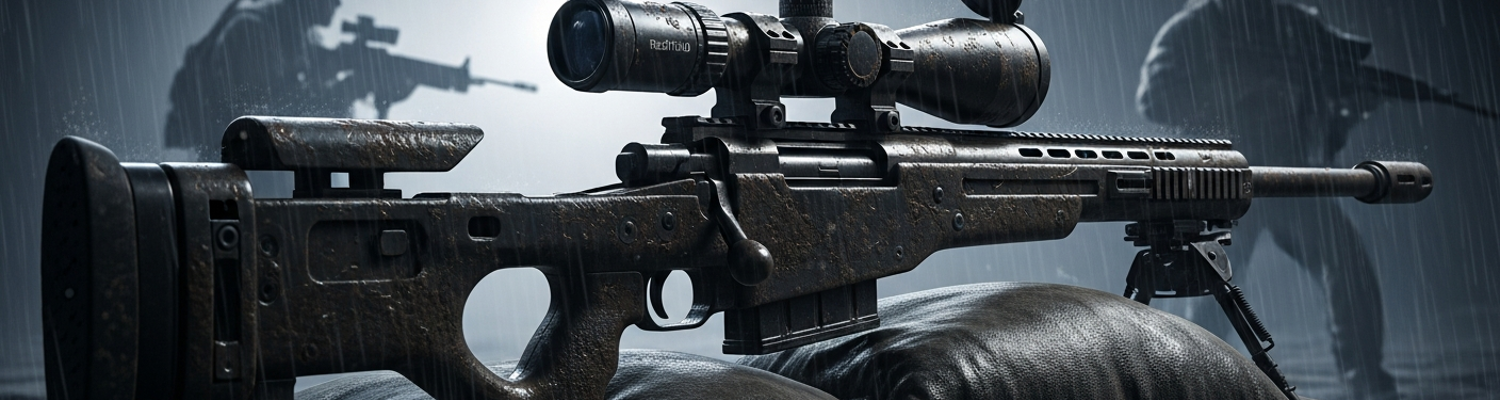
Compounding the rifle’s mechanical instability was the fragility of its sighting system. The M21 was typically paired with a Redfield 3-9x variable power scope, a commercial hunting optic that was, for its time, technologically advanced. It was not, however, designed to survive a monsoon. The seals on these commercial scopes frequently failed in the extreme humidity, allowing moisture to penetrate the housing and cause the lenses to fog internally, rendering the scope useless. Other accounts from the period mention reticles drooping or breaking inside the scope body under the dual stress of recoil and intense tropical heat. The scope’s innovative Accu-Range feature, which used stadia lines to estimate distance, relied on internal components that, in early models, were made of thin plastic, a known point of failure in the harsh conditions. For the sniper, this meant that even if his rifle’s action was clean and his stock had not warped, his ability to place an accurate shot was still hostage to an optic that could fail without warning.
A sniper’s effectiveness was contingent on two things: seeing the target and communicating with his support. In the jungles and rice paddies of Vietnam, both were under constant assault. The Redfield 3-9x variable power scope, standard issue on the M21 and M40 sniper rifles, was a commercial hunting optic pushed into a warzone it was never designed to survive. A 1968 Army evaluation of sniper equipment found that over half of all telescopic sights in use suffered from catastrophic internal moisture accumulation. The relentless humidity, coupled with drastic temperature swings between monsoonal downpours and oppressive heat, attacked the scope’s seals. Once these seals failed, moisture wicked its way inside the scope body. This resulted in a debilitating internal fogging of the lenses that could render the optic completely useless in seconds. A sniper team from a Long Range Reconnaissance Patrol could lie in a concealed position for hours, only to have their one opportunity at a high-value target vanish behind a milky white lens when the moment of action arrived.
The breakdown was not limited to just fogging. Archival reviews of ordnance reports show a pattern of deeper mechanical failures within the optics. The Accu-Range reticle system on the Redfield, which used a set of stadia lines to estimate range, relied on an internal yardage scale that in early models was made of plastic. Under the intense solar heating common in the region, these plastic components could warp or even melt, destroying the scope’s ability to range targets. For a sniper, whose entire purpose was precision, this loss of capability was mission-ending. The constant shock of recoil combined with the harsh environmental exposure could cause the fine wire reticles to droop or break entirely. Even a minor shift in the reticle would throw off the rifle’s zero, a subtle and dangerous failure that might not be discovered until a shot was missed. This created a deep-seated lack of confidence in the equipment. A sniper could never be entirely certain if his meticulously established zero from the fire support base would hold after a day navigating the jungle.
Beyond the failure of vision was the failure of voice. For small, isolated teams like the six-man LRRP units of the 101st Airborne or the 9th Infantry Division, the AN/PRC-25 radio was their only connection to extraction, artillery support, or emergency medical evacuation. While the PRC-25 was considered rugged for its time, it had vulnerabilities to the pervasive moisture. The handset, in particular, was not waterproof, and operators resorted to wrapping it in the plastic bags from battery packages for protection. More insidious was the corrosion that attacked the battery contacts in the lower compartment. A thin film of oxidation, invisible to the naked eye, could prevent a solid electrical connection, rendering the 23-pound radio inert. Water intrusion could also short-circuit the transceiver’s internal solid-state components. For a LRRP team that discovered an enemy concentration and needed to call in fire, or a sniper team that was compromised and required immediate extraction, a dead radio meant they were utterly alone. Some teams took the precaution of carrying two radios, but this added significant weight and was no guarantee against an environment that attacked all equipment indiscriminately.
The entire enterprise of counter-sniper action in Vietnam began with a fundamental, often fatal, lack of information. A single shot would echo through the triple-canopy jungle, its origin immediately obscured by dense foliage and baffling terrain, leaving American units with almost no actionable intelligence. A review of after-action reports from units like the 1st Cavalry Division and various Marine Corps Surveillance and Target Acquisition (STA) platoons reveals a recurring pattern of reactive chaos. The sound of the shot itself was a deeply unreliable indicator, bouncing off hillsides and muffled by vegetation, making auditory triangulation a matter of pure guesswork. Viet Cong and NVA snipers were masters of concealment, often firing from positions that were nearly impossible to spot from the ground or the air, before melting back into extensive tunnel networks or the surrounding jungle. This left platoon leaders and company commanders with a terrible choice: absorb the casualty and do nothing, or react with force based on fragmented, uncertain data. The pressure to respond was immediate. The intelligence picture was almost always a void. The resulting operations were less a precise hunt and more a desperate, violent sweep in a vaguely suspected direction.
This pressure cooker of uncertainty gave rise to the widespread use of rapid-deployment hunter-killer teams. The term often referred to aerial teams of OH-6 scout helicopters paired with AH-1 Cobra gunships, but the philosophy extended to ground units as well. Upon taking sniper fire, a platoon-sized element would be tasked with an immediate counter-sniper sweep. These were not cautious, deliberate patrols. They were high-pressure deployments, with troops ordered to rush the sniper’s position to close the distance and overwhelm the enemy. The tactical theory was to saturate a suspected area with manpower, hoping to either fix the sniper or flush them from cover. For units operating in the rugged terrain of the Central Highlands or the dense vegetation of the Mekong Delta, this meant moving as fast as possible through an environment perfectly suited for ambushes. Command elements, desperate to neutralize the psychological and physical threat posed by snipers, demanded aggressive action, but the sweeps often devolved into frustrating and dangerous searches in a 360-degree threat environment.
Executing these already fraught counter-sniper sweeps in near-zero visibility conditions represented a descent into pure tactical misery. During the monsoon season, torrential downpours could reduce visibility to mere yards and turn the jungle floor into a river of knee-deep mud. A CIA report on weather effects noted that the prolonged 'crachin' season, from December to April, brought persistent drizzles, fog, and low clouds that severely hampered air and ground operations. A patrol from the 9th Infantry Division, sweeping for a sniper in these conditions, moved through a world of gray mist and dripping vegetation. The constant drumming of rain on helmets and leaves made it impossible to hear approaching enemy soldiers, while the fog blinded them to booby traps and ambush positions just feet away. Movement slowed to a crawl. Soldiers struggled through mud that could suck boots off their feet. Radio communication became unreliable under the thick, wet canopy, isolating squads from one another and from fire support. Even if a soldier managed to spot an enemy position, the internal fogging that plagued the Redfield scopes on M21 rifles meant that a precision shot was often impossible. For the men on the ground, a counter-sniper sweep in the fog and rain was a disorienting, terrifying ordeal where they were left to fight an enemy they could not see.
The technical foundation for a friendly fire incident was often laid long before the first shot was fired. It began with the slow breakdown of a sniper’s most critical tool: his optic. A close review of Army ordnance evaluations from 1968 shows that over half of all telescopic sights in Vietnam were compromised by internal moisture. For a Marine Corps STA team operating near the Demilitarized Zone, this was not an abstract statistic. The Redfield 3-9x variable power scope, a commercial hunting optic, was simply not built for the theater. Its seals would fail under the oppressive humidity, allowing a film of condensation to coat the interior lens surfaces. From a concealed position, a sniper might observe a trail for hours, only to have his sight picture turn to a useless, milky blur at the critical moment. This degradation was a direct contributor to misidentification. Through a fogged lens, the distinct shape of an NVA pith helmet could easily be mistaken for the rounded profile of a U.S. M1 helmet. The green of a Marine’s uniform and the khaki of an enemy’s became indistinguishable shades of gray. The visual data was corrupted, turning positive identification into a dangerous guess.
Compounding the failure of vision was the failure of voice. For a small, six-man LRRP deep in enemy territory, the AN/PRC-25 radio was the sole link to support. While considered rugged for its era, the PRC-25 had key vulnerabilities. Its handset was not waterproof. The battery contacts in its lower compartment were notoriously susceptible to corrosion. For a sniper team that believed it had identified an enemy element, the inability to communicate with their command post to verify the location of other friendly patrols was catastrophic. A team leader, seeing what he believed to be enemy soldiers through his compromised scope, would order his radio operator to make contact. The RTO, finding only static, would furiously check the handset connection and then the battery compartment, perhaps scraping at the contacts with a knife in a desperate attempt to get a signal. Each second of radio silence amplified the pressure on the team leader to make a decision based on incomplete and corrupted visual information. The lack of a response from headquarters was not just a communications problem; it was a tactical event that isolated the team and forced its hand.
Then there was the weapon itself. The M21 rifle, built on the M14 action, was a precision instrument with tight tolerances that made it highly susceptible to the grime of field conditions. An attempt to engage a misidentified friendly patrol could be fatally delayed by a mechanical malfunction. After the decision to fire was made, the sniper would acquire his target through the hazy scope, exhale, and squeeze the trigger, only to be met with a dull click. A failure-to-feed, caused by a magazine spring weakened by rust or by an accumulation of oily grit in the action, would require the sniper to break his position to manually cycle the bolt. This sudden, frantic movement could alert the friendly patrol, who, seeing a weapon being manipulated in their direction, would react as they were trained: with immediate return fire. The sniper’s delayed, inaccurate response, caused by a malfunctioning rifle, would transform a moment of misidentification into a chaotic, two-way engagement between friendly forces.
The pressure on field commanders to act decisively in the chaotic environment south of the Demilitarized Zone was immense. On September 4, 1967, during Operation Kingfisher, this pressure culminated in a series of decisions. The command post of the 3rd Battalion, 4th Marines, under Lieutenant Colonel Bendell, was responsible for coordinating action in a sector thick with enemy presence. That morning, his India Company engaged a North Vietnamese unit 1,500 meters south of the vital Con Thien combat base. In the ensuing fight, the flow of information back to battalion headquarters was a frantic and confusing mixture of radio traffic detailing enemy movements, friendly positions, and urgent calls for fire support. The tactical situation was fluid, with units maneuvering through rice paddies and hedgerows that made positive identification from the air or from distant observation posts nearly impossible.
A review of after-action reports shows that the targeting error which unfolded was rooted in this confusion. Another unit, Company M of the 3rd Battalion, 4th Marines, was ordered to move up from Con Thien to support the engaged India Company. As Company M advanced, commanders at the battalion Fire Support Coordination Center (FSCC) were attempting to plot enemy positions based on fragmented reports. In the heat of the moment, a request for artillery and air strikes was processed against a suspected enemy force. The coordinates provided, however, corresponded not to the NVA unit, but to the position of the advancing friendly company. The error was a direct result of the high-stress environment, the speed at which events unfolded, and the pressure to provide immediate fire support to troops in contact. There was no single point of mechanical failure; instead, it was a systemic breakdown in situational awareness under the extreme duress of combat.
The immediate result of the friendly fire was devastating. Artillery shells and bombs slammed into Company M’s position, inflicting casualties and throwing the unit into disarray. The emotional impact on the survivors was profound, creating a deep sense of betrayal and shattering confidence in the very support systems they relied on for survival. For the commanders who authorized the strike, the realization of their error was a crushing psychological blow. The incident forced an immediate halt to local operations as the chain of command scrambled to understand what had happened. In the long term, the event sent shockwaves through the 3rd Marine Division, leading to a stringent review of fire support coordination procedures. The agonizing decision, made under the intense pressure to save one group of Marines, had led directly to the decimation of another. It created a climate of extreme caution, where some field leaders became hesitant to call for fire support, fearing a repeat of the disaster. This operational paralysis, born from a single tragic choice, arguably cost more lives in subsequent engagements than were lost in the initial incident.
A sniper’s weapon system is an equation of three parts: the rifle, the optic, and the ammunition. The failure of any single part renders the entire system useless. For many U.S. Army and Marine snipers in Vietnam, the weakest link was the one they had the least control over. The designated ammunition for the M21 and M40 sniper rifles was the M118 Match cartridge. Produced initially at the Frankford Arsenal and later at the Lake City Army Ammunition Plant, the M118 was specifically engineered for precision. It featured a 173-grain full metal jacket boat-tail bullet, designed for superior ballistic performance at long range, loaded into cases with carefully measured powder charges and consistent primer seating. This was not standard infantry ammunition. It was a specialist tool, and the journey from the factory floor in the United States to a rucksack in the A Shau Valley was fraught with logistical friction. The American military supply chain was a colossal enterprise built to move millions of tons of common items: artillery shells, M80 ball ammunition for machine guns, and C-rations. A small, low-demand, high-specialty item like M118 Match was easily lost in the shuffle.
A case of M118 Match ammo, often packed in simple white or brown paper boxes, began its journey on a ship crossing the Pacific. Upon arrival at a massive depot like the one at Da Nang or Long Binh, it entered a chaotic ecosystem. Pallets were broken down, and supplies were sorted for forwarding to corps-level logistical hubs, then to division, and finally to the fire support bases from which sniper teams operated. At every step, the low-volume, non-standard boxes of M118 were at risk of being misplaced, damaged, or simply deprioritized in favor of the thousands of belts of 7.62mm M80 ammunition needed to feed the M60 machine guns that were the anchor of platoon firepower. Archival evidence shows that ammunition requests from line units were often filled with what was available, not what was requested. A sniper from a Surveillance and Target Acquisition platoon might request M118 Match and instead receive linked M80 ball ammo, de-linked by hand at the forward base. This forced snipers to rely on ammunition that was fundamentally unsuited for their mission.
The physical differences between the M118 Match round and the standard M80 ball cartridge were profound. The M80 was loaded with a lighter, 147-grain flat-based bullet with a much lower ballistic coefficient. It was mass-produced for volume of fire, not for shot-to-shot consistency. Powder charges could vary, and the bullet’s shape made it more susceptible to wind drift and less stable in transonic flight. For a sniper whose rifle was zeroed for the 173-grain M118, chambering a 147-grain M80 round meant his entire ballistic calculation was wrong. The lighter bullet would have a different trajectory, causing the shot to strike high at intermediate ranges and drop off unpredictably at longer distances. The inconsistency from round to round meant that even if a sniper attempted to re-zero his rifle with M80 ball, he could never establish a reliable point of impact. One round might strike true, while the next could be off by several inches.
This ammunition inconsistency completely undermined a sniper’s confidence. A marksman’s skill is built on a foundation of predictable repetition. By being forced to use standard infantry ammunition, that foundation was shattered. A review of firsthand accounts indicates that experienced snipers became intensely frustrated, knowing their weapon was mechanically capable of accuracy that the ammunition would not permit. The performance of M118 itself declined over the course of the war as manufacturing standards were altered, with match-grade brass being replaced with standard combat-grade cases and primers used for machine gun ammunition. This degradation, combined with the frequent need to use M80 ball, meant that a sniper could never be certain of his first-round hit probability. Every engagement became a gamble.
A weapon’s mechanical integrity was only as good as the tools and lubricants available to preserve it, and for snipers in Vietnam, these were chronically absent. The standard-issue cleaning kits were sparse, often containing little more than a few patches and a sectional cleaning rod that was known to break inside a barrel. This was a significant problem, as the M14 action on which the M21 was based required grease on its main contact surfaces, not oil. The standard lubricant, LSA (Lubricant, Small Arms), was a lightweight grease that came in several weights, but its supply was inconsistent. Archival evidence shows that when proper kits and specified greases like Lubriplate 130-A were unavailable, troops resorted to whatever they could find. Toothbrushes replaced proper bore brushes. C-ration toilet paper served as cleaning patches. This lack of high-quality cleaning supplies had direct consequences, especially for a precision rifle. Using incorrect or contaminated lubricants created a gritty paste that accelerated wear on the M21’s bolt and operating rod, leading to sluggish action and failures to cycle.
A close examination of ordnance logs reveals a shortage of essential replacement parts for the M21 rifle. The U.S. military supply chain was a massive apparatus designed to move common items by the ton. Small, specialized components for a non-standard weapon like the M21 were a low priority and frequently lost in the system. This meant that when a high-wear part failed deep in the field, a replacement was often impossible to acquire. Firing pins, subject to immense stress, could fracture. The small but critical extractor spring, responsible for pulling a spent casing from the chamber, would weaken with heat and use, leading to extraction failures that could jam the rifle solid. A sniper team from the 101st Airborne operating in the A Shau Valley might find their mission-critical rifle rendered inert by a single broken spring worth only a few cents. Armorers at fire support bases were often forced to cannibalize parts from damaged rifles just to keep a handful of M21s operational, a desperate measure that pointed to a systemic failure in the logistical pipeline.
Without a steady supply of proper parts, soldiers in the field were left to their own devices, performing repairs that often compromised the weapon’s safety and destroyed its accuracy. A bent operating rod might be hammered straight on a rock. A weakened extractor spring might be stretched out by hand in a futile attempt to restore its tension. To tighten a loose-fitting wooden stock that had swollen and warped in the humidity, soldiers would jam shims made from C-ration cans between the stock and the receiver. While these fixes might get the rifle to cycle, they had ruinous effects on performance. A shimmed stock applied uneven pressure to the action, completely altering the rifle’s zero and making a precise shot impossible. Taping magazines together for a faster reload was a common modification for the M16, and some snipers adopted the practice, but the added weight and awkwardness could unbalance the finely-tuned M21. These improvised repairs turned a weapon designed for surgical precision into an unpredictable tool.