
Submarine Deep-Dive Trials Off Cape Cod
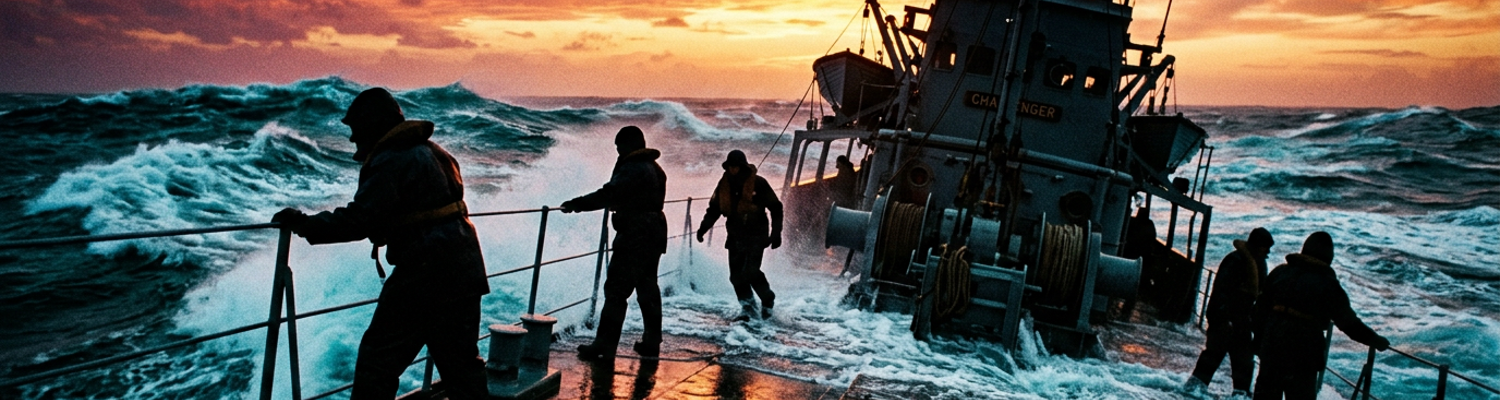
USS Skylark lost direct radio contact with fleet headquarters ashore when atmospheric noise blanked out long-range frequencies. The Penguin-class submarine rescue vessel, designated ASR-20, escorted the nuclear attack submarine USS Thresher 220 miles east of Cape Cod on April 9 and 10 in 1963 for post-overhaul deep-dive trials. Enlisted sailors aboard the rescue ship manned cold watch stations on open bridge wings while diesel exhaust blew across wet steel decks in the heavy Atlantic swell. Technicians inside the cramped sonar space clamped heavy headsets over their ears to maintain contact through the underwater telephone rather than relying on unreachable shore commanders. Sonar operators listened to the steady hum of Thresher as the nuclear submarine secured its topside hatches and aligned its ballast valves to begin submerging.
Ballast tanks flooded along the submarine hull to break surface buoyancy, dragging the massive steel boat beneath the waves while Skylark rolled through ten-foot swells above. Thresher commenced a stepped descent toward a design test depth of 1,300 feet over an ocean abyss exceeding 8,400 feet. Navigators on the rescue ship tracked the bottom soundings with echo sounders, watching the paper chart register deep water far beyond the operating limits of any submarine rescue chamber. Standard naval test doctrine demanded that Thresher pause at predetermined stops during its dive, halting at 400 feet and again at deeper stages to inspect sea valves, pipes, and internal hull fittings under mounting hydraulic pressure. Watchstanders on Skylark tracked these deliberate stops by jotting down depth checkpoints transmitted through the underwater telephone speaker in the operations room.
Speakers mounted against the bulkhead crackled with underwater voice transmissions from below as Thresher confirmed that its hull remained tight during the intermediate inspections. Radioman First Class David H. Royce and his fellow operators adjusted the receiver volume knobs on the underwater telephone to filter out the background noise of water crashing against the steel hull of Skylark. Every voice transmission from the depths took seconds to travel through the water column, vibrating through the transducer elements bolted underneath the rescue ship keel. Cold sea spray drenched the deckhands handling the diesel throttles and steering gear, who worked in continuous shifts to keep Skylark hovering near the designated dive coordinates. Officers on the bridge reviewed the agreed emergency protocols on clipboards, preparing for the reality that a major hull breach at those depths would crush piping and compartments faster than any crew could react.
Bridge officers watched the chronometer tick past nine in the morning while waiting for the next mandatory underwater transmission from the deep-diving submarine. Skylark swung hard against the ocean current, churning white water with its propellers to counter the drift while sonar men pressed their earphones tight against their temples. Static hissed through the underwater telephone speaker as the submarine signaled that it was approaching its maximum test depth and conducting minor checks. Enlisted lookouts scanned the surface swells for green dye markers or emergency smoke flares, holding onto wet safety rails as the rescue vessel rolled through the cold sea. The underwater speaker hissed again with garbled, distorted syllables from the deep, breaking the routine dialogue and signaling that an unexpected mechanical crisis was unfolding beneath the waves.
Gertrude Acoustic Traffic and Hull Collapse
Sonar operators on USS Skylark leaned over the AN/UQC-1 underwater telephone, widely known as Gertrude, straining to isolate the mangled syllables coming through the receiver speaker. Static and ocean noise filled the audio circuit as the operators adjusted their gain controls and rotated the receiver dials to clean up the sound. Fragmented transmissions from Thresher reported that the submarine was experiencing minor difficulties, had taken a positive up-angle, and was attempting to blow ballast to push the vessel toward the surface. The distinct, hollow roar of high-pressure air rushing into ballast tanks buzzed through the acoustic headset elements before the sound abruptly stuttered. Operators scribbled every broken phrase onto their communications pads while listening to air valves hissing in the deep. Enlisted men shouted the garbled message through the communication tube to the bridge officers waiting above.
Officers on the open bridge of Skylark grabbed the communications microphone and ordered the sound room to broadcast an immediate query back down through the keel transducer. The rescue ship transmitted repeated voice calls into the ocean, asking Thresher for its current depth, its heading, and whether its watchstanders had control over the flooding casualty. Transmissions from the submarine grew increasingly distorted as water temperature layers deflected the acoustic carrier waves away from the surface ship. A final, broken transmission murmured from the speaker cone with scattered references to test depth and blowing air, accompanied by a brief metallic rattle that faded into background static. Sound technicians pressed their fingers against their earphones to hear any further speech, but only the steady hum of empty ocean water returned. Watchstanders stared at the mechanical dials as the underwater telephone channel went completely quiet.
Hydrophones deployed across the seabed and surface watchstanders aboard Skylark monitored the expanding silence as the ship chronometer reached 0918 EST. Surface watchstanders and underwater hydrophones recorded a distinct low-frequency acoustic disturbance signifying high-pressure hull implosion as Thresher sank past crush depth. The massive steel pressure hull gave way under thousands of pounds of hydraulic pressure per square inch, shattering the vessel into pieces thousands of feet down. Enlisted sailors standing near the engine hatches of Skylark felt a dull, heavy vibration shake the steel deck plates through the surrounding seawater. Naval underwater listening arrays along the Atlantic coastline registered the sharp acoustic shockwave as it traveled outward through the deep ocean sound channel. Technicians in the sonar shack pulled off their headphones and reported the abrupt acoustic shudder to the deck officers.
Sailors rushed out onto the open bridge wings and catwalks with binoculars to scan the rolling ocean swells for any trace of the submarine. Deckhands dropped explosive underwater signal charges over the side, detonating small blasts every few minutes according to navy rescue instructions to guide the submarine toward the ship if it remained steerable. Lookouts searched the wave troughs for air boils, yellow life jackets, oil slicks, or rising debris, while cold rain and sea spray whipped across their canvas jackets. The helmsman maintained a slow circular patrol around the last known dive position while bridge personnel called out over Gertrude without hearing any human response. The navigation officer marked the dead reckoning point on the chart table and wrote down the coordinates where the last acoustic signals had vanished.
Explosives and Surface Search Operations
Seamen sprinted across the slick fantail with wooden crates of explosive sound signaling charges to begin the mandatory recall doctrine over the marked coordinates. The deck force dropped explosive hand-grenade sound signals into the water at predetermined intervals to command the submerged submarine to blow all tanks and surface immediately. Deckhands pulled safety pins from the weighted canisters, held the ordnance over the stern railing, and cast each charge into the foamy wake where underwater fuses triggered sharp detonations beneath the hull. Standard emergency doctrine dictated that the underwater concussions would travel through the deep sound channel, hammering against the pressure hull of Thresher with acoustic pressure waves strong enough to alert the diving officer even if all electrical circuits had burned out. Sailors stood gripping the icy lifelines between drops, counting the seconds on handheld stopwatches and bracing against the pitching deck as each muffled shockwave thumped upward through the steel deck plates.
Lookouts and deck personnel scanned heavy ocean swells for emergency visual signals, including white smoke flares, green dye markers, oil slicks, and debris. Enlisted men on the open bridge wings pressed heavy seven-by-fifty binoculars against their eyes, fighting stinging saltwater spray and bitter north Atlantic wind as the ship climbed ten-foot swells and crashed into deep wave troughs. Naval training taught every watchstander that a stricken submarine attempting to break free from the bottom would release pyrotechnic smoke canisters and dye bags from its salvage ejector tubes to pinpoint its location for surface rescue ships. Spotters searched for the bright yellow-green stain that fluorescein dye would spread across the gray chop, or the rising pillar of chemical white smoke signaling that the boat was fighting its way toward the air. Officers rotated the bridge searchlights toward the breaking foam while the helmsman steadied the ship on a creeping search line across the coordinates.
Technicians inside the sound room rotated the underwater telephone controls between the grenade blasts to listen for emergency hull tapping from below. Operators pushed their audio headsets hard against their ears, trying to catch the sound of steel wrenches striking pipe bulkheads or any faint hiss from an emergency air bank discharging into flooded tanks. Nothing broke through the receiver except the steady rumble of the propulsion screws of Skylark and the hiss of cold water swirling around the hull transducer. Radioman First Class David Royce repeatedly depressed the transmitter switch, speaking the code name of the submarine into the microphone and instructing the crew to report their status and release their emergency beacons. Silence remained absolute across the acoustic spectrum, leaving the surface rescue ship rolling alone above miles of empty ocean.
Lieutenant Commander Stanley Hecker ordered the engine room to increase diesel revolutions and widened the surface search circle around the position where the last garbled underwater messages had ended. Deckhands rigged heavy cargo nets and wire-mesh dipping baskets along the bulwarks, preparing to haul survivors or floating wreckage out of the freezing sea the moment anything broke the surface. Sailors along the port and starboard rails leaned out over the safety netting with boat hooks, watching every patch of foam and wave shadow that drifted past the hull. Skylark maintained its relentless sweep across the crests while the deck force broke open another crate of hand-grenade charges to repeat the surface-command cycle into the deep.
McCann Chamber Limits in Deep Water
Concussion waves from the exploding hand-grenade charges shuddered through the hull plating of Skylark, but every sailor handling the ordnance knew their primary rescue equipment remained strapped tight to the midships deck. Skylark carried the McCann Submarine Rescue Chamber, a tethered diving bell designed to mate with the escape hatches of disabled submarines resting on the continental shelf. Deckhands and riggers walked past the ten-ton steel apparatus sitting in its cradles near the main deck boom, their eyes drifting over the locked hatch, the heavy winches, and the coils of thick steel operating wire. Navy procedure manuals prescribed that in a bottomed-submarine emergency, the rescue vessel would plant four massive moorings directly over the target, lower a diver to secure a downhaul cable to the submarine hatch, and winch the pear-shaped diving bell down to seal against the hull and extract survivors in small groups. This entire mechanical system relied on daylight conditions, manageable currents, and relatively shallow depths where human divers could breathe compressed gas mixtures and guide the tether.
Steel pressure walls and circular viewing ports on the diving bell could not withstand the immense hydraulic crushing force of the deep Atlantic basin. The McCann chamber had an absolute operating depth rating of 850 feet, leaving the rescue apparatus functionally useless over an 8,400-foot seabed. Depth sounders on the bridge confirmed that the muddy seafloor lay nearly ten times farther down than the mechanical limits of the chamber hull and its winch cables. Sending the chamber down into that depth would have caused its steel plates to buckle and cave in under thousands of pounds of water pressure per square inch before it even approached the submarine. Rigging crews on deck confronted the doctrine gap where surface rescue vessels could only watch rather than assist deep-diving nuclear submarines in distress.
Sailors on the rolling fantail stared at the idle rescue chamber while cold seawater washed through the scuppers around their boots. Navy brass had designed and tested the McCann bell in 1939 to pull thirty-three survivors from USS Squalus, a diesel-electric submarine that had sunk in two hundred and forty feet of water off the New Hampshire coast. Submarine design had surged forward during the following two decades, replacing slow coastal hulls with high-speed nuclear power plants capable of diving deep into international ocean trenches. Surface rescue capabilities had remained frozen in the pre-war era, leaving rescue ships with gear engineered exclusively for shallow continental shelves. Deckhands checked the steel lashing chains holding the chamber to the deck, recognizing that their ship carried thousands of pounds of specialized salvage gear that could not save a single life beneath them.
Boatswain mates ordered the deck force to tighten the gripes and securing cables around the inactive diving bell so the rising Atlantic chop would not break the heavy steel bell loose from its cradle. Sailors tightened the heavy turnbuckles with steel wrenches, securing the umbilical hoses and electric lines against the superstructure to keep the decks clear for whatever debris might float up from below. Lieutenant Commander Stanley Hecker maintained the surface search patterns from the bridge wings, directing lookouts to scan the rolling wave crests for dye markers, oil slicks, or floating cork insulation. Lookouts braced themselves against the bridge railings and swept their binoculars across the gray chop, searching for any sign of human survivors while the submarine rescue ship circled alone above the drop point.
Fleet Task Group 89.7 and Deep-Ocean Search Operations
Spotters on Skylark watched additional gray hulls arrive on the horizon as the operation transformed from a frantic surface rescue into a systematic search for sunken steel. The United States Navy organized Task Group 89.7 under surface and research commands to map the sea floor and locate the wreckage of Thresher. Oceanographic research vessels, salvage ships, and fleet destroyers gathered in a loose formation across the search sector, pitching violently in the freezing North Atlantic swell. Enlisted technicians and civilian hydrographers worked side by side on slippery quarterdecks, securing heavy electric cables to deep-towed sonar arrays and experimental underwater television sleds. Winch operators gripped greasy hydraulic levers to spool miles of braided steel wire over the stern rollers, lowering instrument frames into the black water while bridge officers fought wind and crosscurrents to hold exact grid lines. Echo sounders and hydrophone pingers pulsed through thousands of feet of ocean, registering broken acoustic returns that indicated thousands of shattered metal fragments scattered across the bottom.
Transducers mapped those acoustic echoes into a wide pattern of debris targets spread across the muddy seabed. The Office of Naval Research deployed the deep-diving bathyscaphe Trieste to conduct visual surveys and photograph the 8,400-foot debris field. Navy transport teams moved the fifty-foot craft across the continent from San Diego by rail and cargo vessel, staging the bathyscaphe alongside specialized salvage ships in the rolling sea. Deckhands and civilian mechanics crawled over the rounded float hull in cold ocean spray, checking electrical lines and pumping forty-four thousand gallons of lightweight aviation gasoline into the buoyancy cells. Riggers hauled canvas bags of iron shot to fill the magnetic ballast hoppers, securing emergency dump valves with safety pins while waves repeatedly washed over their sea boots. Handling crews guided the dive crew through the narrow upper trunk into the spherical steel gondola, dogging the heavy entry hatch shut with brass wrenches to seal the occupants against the immense pressure waiting below.
Seawater flooded the forward maneuvering tanks, pulling the bathyscaphe beneath the surface swells on a slow descent into complete blackness. Pilot Donald Keach and his crewmate wedged themselves inside the forged steel cabin, watching condensation run down the curved metal walls as the surrounding seawater dropped to near-freezing temperatures. Heavy hull rings groaned under external pressures exceeding thirty-five hundred pounds per square inch, compressing the steel sphere slightly as the craft passed seven thousand feet. External mercury-vapor floodlights ignited near the ocean bottom, cutting through drifting sediment to expose a massive field of mangled steel plates, ruptured pipe clusters, and torn machinery. Crewmen rotated internal camera controls to photograph structural bulkhead sections, recording visible weld failures and twisted frames embedded deep in the Atlantic mud.
Thrusters turned the heavy bathyscaphe across the mud bottom, kicking up clouds of gray silt with every steering burst. Pilots pressed their faces against the conical acrylic viewing port, maneuvering close to tangled pipes and broken bulkheads to verify paint markings and stamped serial numbers. Mechanical arms extended from the lower equipment rack, grappling for identifiable debris and clutching sections of brass piping marked with the hull number of Thresher. Enlisted recovery teams on the surface tracked the underwater acoustic pings of Trieste on their hydrophones, calculating dive times and standing by with recovery slings on the rolling fantail. Pilots dropped hundreds of pounds of iron shot from the release hoppers to regain positive buoyancy, initiating their long vertical climb back toward the surface search fleet with photographic evidence of the submarine destruction.
Submarine Rescue Doctrine and SUBSAFE Creation
Deckhands hooked steel recovery cables to the lifting eyes of Trieste as the bathyscaphe breached the gray swells, hauling the dripping gondola onto the support ship to unload rolls of exposed 35-millimeter film. Photographic technicians rushed the canisters into shipboard darkrooms, developing negative strips that revealed sheared pipe clusters, ripped bulkhead plates, and crushed reactor compartments embedded in deep ocean mud. Surface crews gathered around the light tables in silence as the images confirmed that the pressure hull had shattered into thousands of fragments under millions of pounds of hydraulic force. The loss of all 129 crew members and shipyard personnel marked the worst submarine disaster in United States Navy history and demonstrated the total inadequacy of old rescue doctrine for the nuclear fleet. Surface rescue ships carrying outdated gear could operate down only several hundred feet, leaving crews completely helpless when a nuclear submarine suffered a casualty over an ocean abyss. Sailors aboard Skylark watched the recovery fleet pack away its useless diving bells, recognizing that the fleet had built submarines capable of reaching depths where no existing surface apparatus could ever save a trapped crew.
Investigators convened formal courts of inquiry at Portsmouth Naval Shipyard to determine why Thresher had been unable to arrest its plunge toward the abyss. Technical experts analyzed acoustic tapes, construction blueprints, and recovered wreckage, pinpointing a catastrophic chain reaction that began with a ruptured silver-brazed joint in an engine room seawater line. High-pressure sea spray had blasted across electrical switchboards in seconds, shorting out vital controls, shutting down the nuclear reactor, and leaving the propulsion shaft motionless. Enlisted watchstanders had scrambled through deafening mist to reach emergency valves, desperately attempting to blow high-pressure air into the ballast tanks to push the dead submarine upward. Moisture trapped in the high-pressure air flasks rushed through the narrow piping, expanding and dropping in temperature until solid ice packed the strainers and choked off airflow to the tanks. Seawater pressure swiftly exceeded the yield strength of the steel hull frames, crushing the compartments before the crew could blow ballast or restart the reactor.
Engineers overhauled the entire submarine building program to prevent another fatal hull collapse across the fleet. The disaster directly led to the implementation of the SUBSAFE quality assurance program in June 1963, establishing strict engineering standards for hull integrity, seawater piping joints, and emergency deballasting. Quality control inspectors fanned out across military and commercial shipyards to inspect every submarine under construction, halting assembly lines whenever paper documentation failed to verify physical parts. Technicians conducted ultrasonic tests on thousands of silver-brazed joints across every operational boat, condemning any seam that showed voids, slag pockets, or improper bonding. Welders cut out vulnerable brazed joints and replaced them with heavy, full-penetration welded steel connections designed to withstand full sea pressure. Shipyard workers also rerouted high-pressure air lines, installing dehumidifiers, heaters, and expanded pipe diameters to guarantee that ice crystals could never plug the deballasting lines during an emergency ascent.
Mechanics dismantled seawater systems aboard operational submarines across the Atlantic and Pacific, stripping away questionable fittings and rebuilding entire piping runs to meet SUBSAFE certifications. Submarine commanders accepted severe operating depth limits on their vessels, keeping their hulls far above design depths until every valve, hull penetration, and emergency blow line received stamped metallurgical approval. Navy planners abandoned the obsolete rescue doctrine, phasing out the shallow-water McCann chambers in favor of air-transportable deep submergence rescue vehicles capable of operating thousands of feet down. Shipyard inspectors verified the chemical composition and strength testing of every single replacement bolt, valve body, and structural ring. Riggers stamped serialized tracking numbers into every newly welded hull penetration, locking the inspection records into permanent engineering archives before clearing each submarine for deep-water trials.