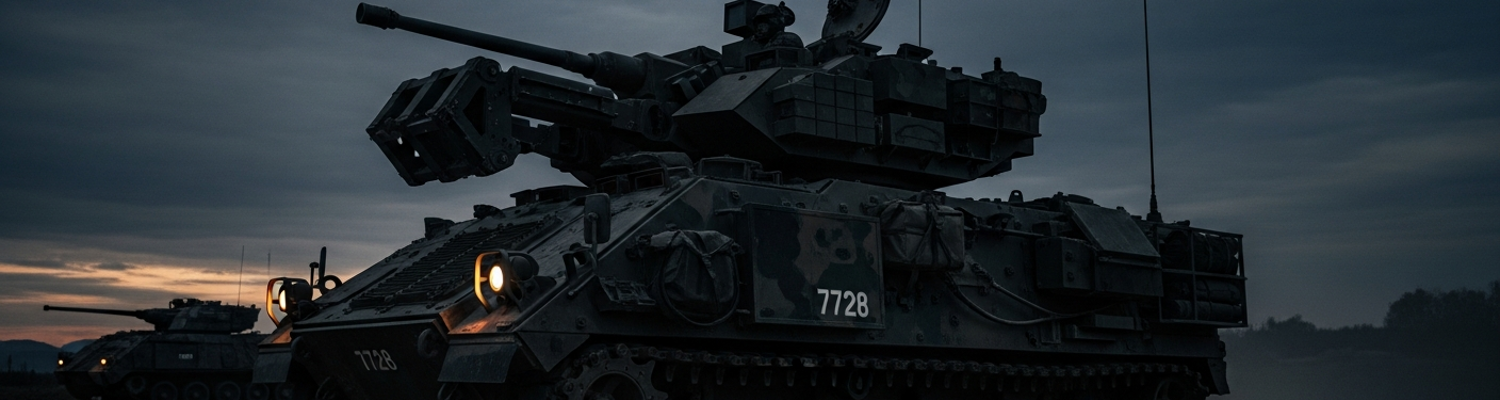

The catastrophic failure of Operation Eagle Claw in April 1980 was not an anomaly. It was a symptom. The mission to rescue 52 American hostages from Tehran involved elements from the Army, Marine Corps, Navy, and Air Force. A post-mission analysis, the Holloway Report, detailed a joint operation where the component services had barely trained together, used incompatible equipment, and possessed fractured communication lines. The plan required Navy RH-53D Sea Stallion helicopters, flown by Marine pilots, to meet Air Force C-130s at a remote Iranian landing zone named Desert One.
It fell apart immediately. Mechanical failures grounded three of the eight helicopters, forcing a mission abort. During the disorganized evacuation, a helicopter collided with a C-130, and the resulting explosion killed eight servicemen. The surviving American forces abandoned the site, leaving behind aircraft, classified documents, and the bodies of their comrades. This lethal outcome of inter-service dysfunction was a public manifestation of a private war fought for decades inside the Pentagon. It was a conflict waged not with bullets, but with budgets, doctrine, and institutional ego, a struggle that played out in the simulated battlefields of West Germany.
REFORGER's Logistical Impossibility
The annual Return of Forces to Germany (REFORGER) exercise was designed to prove a logistical concept. Its objective was to demonstrate America's ability to rapidly reinforce NATO against a Warsaw Pact invasion by airlifting entire divisions to West Germany. These formations would draw pre-positioned heavy equipment from massive depots, known as POMCUS sites, and move directly to their defensive positions. A single REFORGER could involve over 90,000 troops and a complex choreography of airlift and ground movement across multiple countries.
A deep analysis of after-action reports from the late 1970s and early 1980s exposes a profound disconnect between planning and execution. The movement of a heavy division, like the 1st Infantry Division from Fort Riley, Kansas, was the first point of failure. Military Airlift Command C-141s and C-5s ran a continuous air bridge into hubs like Rhein-Main Air Base. The soldiers arrived. Their equipment was another story.
The POMCUS sites were a known problem. A review of unit logs from REFORGER 82 (NARA Record Group 338) shows that M60A1 Patton tanks drawn by one armored battalion had engine seals that had dried and cracked in storage, causing massive oil leaks once started. Entire platoons of M113 armored personnel carriers were found to have had their radios or fire control components cannibalized for use by other units during the year. No replacements were available. The arriving unit, doctrinally responsible for the equipment, had no control over its maintenance status until the moment they signed for it, thousands of miles from their own motor pools. An immediate, acrimonious battle began between combat units and logistics personnel on the ground before a single shot was fired in the exercise.
The Nuclear Umpire
The war game itself was a descent into further inter-service antagonism, primarily through the routine simulation of tactical nuclear weapons. This was not a fringe scenario; it was a central pillar of NATO’s Flexible Response doctrine, which relied on the threat of battlefield atomic weapons to offset the Warsaw Pact’s numerical superiority.
Exercise umpires, known as the Control group, would arbitrarily declare the use of nuclear ordnance. A controller would hand a commander a card indicating that a 20-kiloton airburst from an Air Force F-4 Phantom II had just occurred at a specific grid coordinate. The unit commander was then informed that his lead battalion had ceased to exist.
This created an operational and administrative problem that no manual could solve. Archival evidence from REFORGER 79 details a running argument between an Army armored cavalry regiment commander and the Air Force umpire who had just notionally vaporized his screening force. The Army commander argued his units were dispersed in accordance with doctrine for a high-threat environment and that the umpire’s casualty assessments were excessive. The Air Force controller, following his own service’s damage-assessment tables, refused to modify the ruling. The regiment was declared combat-ineffective. This forced the entire corps’ defensive plan to be redrawn mid-battle, all based on a procedural dispute between two officers from different branches. Communications were just as fraught. The simulated electromagnetic pulse (EMP) from a nuclear detonation meant controllers would declare all radio traffic down for hours, forcing units to rely on landline or messengers, a practice almost entirely alien to formations built around instantaneous radio contact.
A Paper War of Incompatible Truths
The end of a REFORGER exercise triggered an administrative avalanche. For every notional round fired in the field, a literal ton of paper was generated. The deluge of after-action reports (AARs) from the participating services created a secondary battle. The problem was one of fundamental incompatibility. The systems, formats, and even the core philosophies of data collection were service-specific, designed in institutional vacuums.
The result was a mountain of data that offered no coherent, unified picture.
An Air Force AAR on a close air support mission was a document of cold metrics. It was composed of computer printouts detailing sortie generation rates, time-on-station, and precise ordnance delivery data based on pilot reports. To Tactical Air Command, an A-10 Thunderbolt II mission that expended 500 rounds of 30mm PGU-14/B armor-piercing incendiary ammunition into a designated kill box was a successful engagement. The report was concise and focused entirely on the performance of the airframe.
The corresponding Army AAR from the 11th Armored Cavalry Regiment, the unit theoretically saved by this airpower, told a completely different story. It was a thick, narrative-based document. In this report, the umpire’s ruling was paramount. If the controller, using his own service's damage assessment tables, declared that only three T-72 tanks were destroyed despite the A-10’s strafing run, then that was the reality the Army recorded. The Army commander’s report would focus on the gap between requested support and time of arrival, the confusion in communications, and the umpire's casualty assessments. Trying to merge these two documents was impossible; they did not speak the same language or measure success by the same criteria.
Joint commands established analysis centers to synthesize these disparate reports. These centers produced finding aids and glossaries intended to translate the services’ unique dialects. A close review of operational logs indicates these tools consistently obscured rather than clarified. An Army officer trying to understand an air support failure might consult a joint lexicon, only to find a technical definition that offered no operational context. The aids created a false sense of interoperability. A database might successfully link an Air Force sortie number to an Army ground unit’s designation, but it could not capture the running argument between a battalion commander and an air liaison officer over the correct radio frequency. The data remained fundamentally un-fused.
Engineer Operations in Radioactive Zones
In any theoretical conflict against the Warsaw Pact, the role of the US Army combat engineer battalion was to force mobility. They were the mechanical enablers of the armored spearhead. This meant laying 19-meter scissor bridges from the chassis of M60 tanks to span rivers. It involved clearing minefields with the 165mm demolition gun of the M728 Combat Engineer Vehicle, a derivative of the M60 tank. Units like the 79th Combat Engineer Battalion in Germany were expected to repair cratered roads with their M9 Armored Combat Earthmovers, specialized bulldozers designed to keep pace with M1 Abrams tanks. The entire AirLand Battle doctrine rested on the assumption that these engineer units could execute these physically demanding tasks under fire.
The introduction of simulated tactical nuclear weapons into exercises obliterated this assumption.
The battlefield was not just muddy or mined; it was saturated with an invisible, persistent threat. The primary mission of the combat engineer did not change, but the conditions became functionally impossible. Exercise reports and scientific studies from the era show that performing even basic military tasks while wearing the full Mission Oriented Protective Posture (MOPP) 4 suit was a study in inefficiency. A soldier’s performance degradation was estimated to be between 20 and 50 percent. Tasks requiring any manual dexterity, such as connecting hydraulic lines on an Armored Vehicle Launched Bridge (AVLB) or rigging the crane on an M728, could take up to three times longer. The thick rubber gloves made delicate work impossible. The limited field of view from the M17 protective mask turned operating heavy machinery into a lethal guessing game.
Heat was a constant enemy. Inside the vapor-impervious suits, a soldier’s body temperature could soar, leading to a required work-rest cycle of just 16 minutes of work for every 44 minutes of rest. A bridge that should have been laid in minutes now took hours. All while an armored brigade sat stationary, a perfect target for Warsaw Pact artillery.
Decontamination Doctrine Collapse
The machinery itself was just as vulnerable. The M9 ACE, notorious for its unreliable hydraulics in ideal conditions, became a maintenance problem in a radiological environment. Radioactive fallout, composed of fine dust and debris, would be sucked into engine air intakes, contaminating internal components and turning the vehicle itself into a radiological hazard.
The doctrine for sustained operations in a contaminated zone simply did not exist. The equipment and procedures were functionally impossible.
Decontamination of a 52-ton M728 CEV was a monumental task. It required vast amounts of water and exposed decontamination crews to the very radiation they were trying to wash away. The very doctrine of engineer support began to break down. The command dilemma became absolute. An engineer commander, tracking the radiation exposure of his soldiers with simple, often inaccurate chemical dosimeters that changed color to indicate dose, had to weigh mission accomplishment against the literal survival of his men. Archival analyses of these exercises detail bitter arguments between engineer commanders and the armor commanders they supported. The armor officer, focused only on his objective, would demand a breached minefield. The engineer officer, watching his soldiers’ potential radiation exposure climb toward established safety limits, knew that ordering them to do the job would render them combat ineffective for the rest of the war.
The Disconnected Tactical Air Controller
The American ground-warfare doctrine in Europe rested on a single connection: the link between an Army commander under fire and an Air Force pilot overhead. This connection was the Tactical Air Control Party, or TACP. A TACP was a small team, often just two or three airmen, whose entire existence was dedicated to living and fighting alongside soldiers. Their function was to serve as expert advisors on the use of airpower and to provide terminal attack control for close air support (CAS) missions. These airmen were meant to translate the urgent needs of a ground fight into the precise, formulaic language an attack pilot could understand. Operational logs show these teams were laden with specialized equipment, including bulky PRC-series radios, laser designators, and detailed maps.
This system was a functional disaster waiting to happen.
The primary point of failure was communications. Archival evidence from joint exercises in the 1980s consistently highlights the incompatibility between Army and Air Force radio systems. Army ground units were equipped with VHF-FM radios like the AN/PRC-77 and the new SINCGARS, designed for ground-to-ground communication. Air Force TACPs and the aircraft they spoke to used UHF-AM radios, such as the Have Quick system, which operated in an entirely different radio band. The two systems could not speak to each other directly. This forced the TACP to become a walking communications hub, carrying multiple, heavy, and incompatible radio sets. To speak with the Army battalion commander he was assigned to, he used one radio; to speak to the A-10 Thunderbolt II pilot overhead, he had to use a completely different one. This created a dangerous delay, forcing the TACP to manually relay information from one net to another while under fire.
This technical divide was magnified by a chasm in doctrine. During REFORGER exercises, the process of getting bombs on a target became a case study in paralysis. An Army company commander being engaged by enemy armor would send an urgent request for air support up his chain of command. This request would travel through battalion fire support channels before eventually reaching the corps level, where it was handed off to the Air Support Operations Center (ASOC). The ASOC, staffed by the Air Force, was responsible for directing air support for the land forces. Only then would the ASOC task an available aircraft. This process could take anywhere from 30 minutes to over an hour. A lifetime in a fluid battle. To the Army commander on the ground, the Air Force appeared unresponsive. To the Air Force planners in the ASOC, the Army’s requests were often viewed as frantic and lacking the detail needed to execute a safe strike. The TACP was caught in the middle.
Electronic Annihilation and Targeting Delays
The entire architecture of command and control rested on the assumption of clear communication. This assumption was systematically dismantled during REFORGER exercises through the simulated effects of tactical nuclear weapons. The most disruptive element was not the notional blast, but the electromagnetic pulse (EMP). Exercise controllers would hand a unit commander a card declaring that a high-altitude nuclear detonation had occurred. His electronic world would cease to exist.
For a period of hours, all solid-state electronics were considered fried. The silicon-based transistors and integrated circuits at the heart of the Army’s new SINCGARS radios were declared inert. Command posts, which relied on a web of radio nets to coordinate artillery, maneuver, and logistics, went silent. A battalion commander, moments before in contact with his platoons and his brigade headquarters, was suddenly isolated. The degradation was absolute. Units were forced to revert to World War II-era communication methods, a practice for which they were neither equipped nor mentally prepared.
This theoretical electronic apocalypse was layered on top of the daily reality of inter-service electronic incompatibility. The problem existed at the most fundamental level of hardware. Army ground units operated almost exclusively on VHF-FM radio sets (30-88 MHz band). The Air Force lived in the UHF-AM world (225-400 MHz). The two systems were physically incapable of communicating. It was the electronic equivalent of trying to fit a square peg into a round hole.
This technical chasm had lethal tactical implications. The TACP was the designated human bridge, an Air Force airman embedded with an Army unit to coordinate close air support. He was an overburdened communication hub, forced to carry multiple, heavy, and mutually incompatible radio sets. To speak to the Army battalion commander, he used a PRC-series SINCGARS radio. To request and direct the A-10, he had to switch to his UHF set. Every piece of information, from the frantic calls for support to the precise 9-Line attack brief for the pilot, had to be manually received on one radio and re-transmitted on another. This process introduced delays and points of failure into a situation where seconds mattered. A jammed frequency or a dead battery could mean the difference between a successful air strike and a friendly fire incident.
The structural inability of the services to communicate created a targeting cycle defined by dangerous delays. The process could consume the better part of an hour. By the time a pilot arrived on station, the tactical situation on the ground had completely changed. Archival analyses of exercise AARs consistently reveal a recurring and potentially lethal disconnect. The pilot would arrive with targeting data that was now an hour old, looking for enemy tanks at a location friendly forces may have since occupied. The risk of fratricide was enormous. These friendly fire incidents were not hypothetical. During Operation Desert Storm, a significant percentage of U.S. casualties were the result of friendly fire, a rate far higher than in previous conflicts. The fear of fratricide became a primary constraint on tactics, forcing ground commanders to build in massive safety buffers and cease movement, slowing the operational tempo to a crawl. The warnings documented for years in the paper-logged war games of West Germany had become a lethal reality in the deserts of the Middle East.